








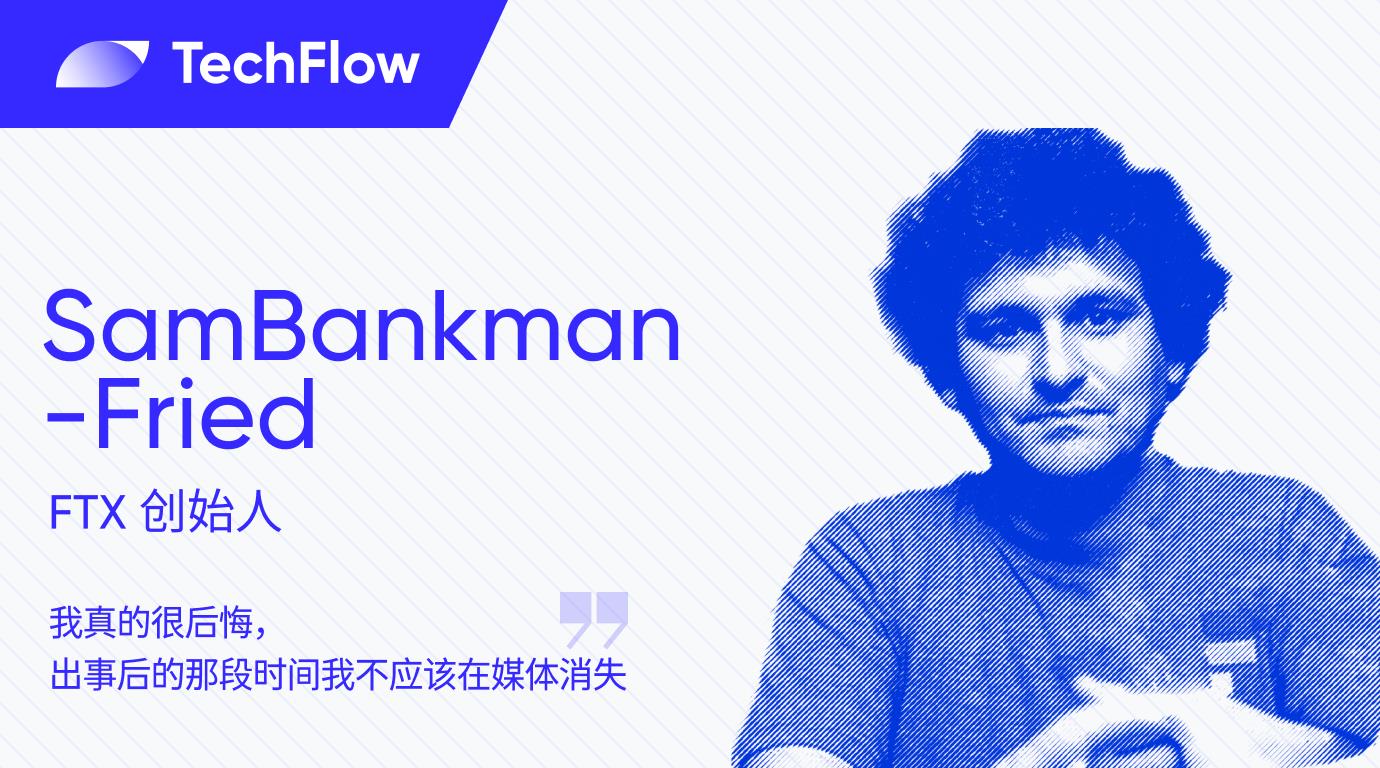
Before SBF's arrest, we had a chat with him
TechFlow Selected TechFlow Selected
Before SBF's arrest, we had a chat with him
"I'm sorry, I messed up."
 Navigating Web3 tides with focused insights
Interview & Writing: Claudia
On December 13, FTX founder Sam Bankman-Fried was formally arrested by Bahamian authorities.
According to an official statement from the Bahamas, the U.S. Department of Justice has formally filed criminal charges against SBF. After receiving formal notice from the United States, Bahamian police arrested SBF and will proceed with extradition as requested. The U.S. Attorney’s Office for the Southern District of New York also confirmed this on Twitter, stating that the indictment would soon be made public. According to sources cited by The New York Times, SBF is accused of wire fraud, conspiracy to commit wire fraud, securities fraud, conspiracy to commit securities fraud, and money laundering.
Previously, SBF frequently gave interviews to major media outlets and participated in numerous Twitter Spaces, leading many to wonder: why did SBF appear unscathed after FTX collapsed?
The dust is beginning to settle.
Just days before his arrest, TechFlow conducted a video interview with SBF. That day, he seemed in good spirits, even smiling several times—a rare sight. Throughout the interview, he repeatedly expressed regret, saying things like "I messed up," and emphasized his desire to actively resolve customer issues. Yet at the same time, he pointed fingers at CZ and FTX’s current CEO and team overseeing bankruptcy proceedings. In his view, CZ was the one who pulled the trigger, ultimately causing FTX to explode.
Notably, during the interview, SBF admitted that in the past, he wasted much of his energy on media appearances and FTX brand-building rather than focusing on product optimization and risk management—shortcomings that have now led to serious consequences.
At the end of the interview, we asked him: What is your biggest regret?
He replied: I regret disappearing from the media after the incident—I could have done more.
Truth or Rumor?
TechFlow: Since FTX's collapse, Three Arrows Capital has repeatedly accused Alameda, claiming it was hunted down by Alameda during the LUNA crash, resulting in the total loss of funds from its LPs and creditors. Additionally, The New York Times reported that federal prosecutors in Manhattan have begun investigating whether Alameda played a role behind the LUNA collapse. How do you respond to these allegations? Did Alameda hunt down LUNA and Three Arrows Capital?
SBF: Absolutely not. While I deeply regret many things that went wrong this year—things that directly led to FTX’s collapse, which I’m incredibly sad about—not everything can be attributed to me.
Three Arrows’ collapse had nothing to do with us. Terra had nothing to do with us either. In some ways, Three Arrows and Alameda shared similar experiences: highly leveraged long positions, falling market caps, and eventual liquidation. I feel sympathy and sorrow for what they’ve been through, and for everyone harmed by the market downturn this year. But I cannot accept their spreading rumors and trying to blame others for their own problems.
They’re smart people—I find it hard to believe they actually think Alameda had any connection to their positions. The market crashed—that’s straightforward enough. But none of it was related to my actions or Alameda’s. From my perspective, they’re just looking for a scapegoat, trying to shift responsibility onto someone else.
TechFlow: After the FTX incident, you've consistently claimed you didn’t fully understand Alameda’s financial situation, unaware of the commingling of funds. However, Forbes reported that over two years, you compiled five asset lists with precise figures down to the last digit regarding Alameda’s finances. What do you say about that report?
SBF: The document I sent to Forbes was in response to inquiries about my holdings. I provided them with a summary covering both my personal holdings and Alameda’s. This gave me partial insight into Alameda’s token holdings, but I wasn’t fully involved.
I only reviewed Alameda’s outstanding margin positions, not all details. As a result, I didn’t have a comprehensive understanding—including full net asset value. I knew roughly what assets they held, but only recently, after everything blew up, did I learn the full picture.
TechFlow: So you knew specific numbers, but not the reasons behind them?
SBF: I only knew parts of it. For example, I knew where Alameda’s largest assets were, but not their liabilities. I knew about certain loans or borrowings, or their positions on FTX—the main tokens they held. I wish I’d known more, but clearly, I didn’t.
TechFlow: Recently, the Financial Times (FT) revealed nearly 500 investment items made by Alameda and FTX Ventures, totaling over $5 billion. Where did the capital for these investments come from? Looking back, were some of these investments too hasty?
SBF: Making such large-scale investments was definitely a mistake. While I believe many individual investments were reasonable, Alameda’s overall investment scale was far too big—eventually reaching billions of dollars. This contributed significantly to its prolonged long exposure and lack of liquidity. I truly wish Alameda hadn’t made such massive investments.
Media and Self
TechFlow: On Twitter, many people express frustration, believing you bribed media outlets like The Wall Street Journal and Bloomberg, which seemingly downplayed the severity of FTX’s collapse. What was FTX’s media strategy?
SBF: Media strategy depends on whether you mean before or after the collapse. If we go back a month before the crash, it’s clear I had extensive media engagement. I was very proactive in speaking with journalists. My goal was to help people understand what was happening in the crypto ecosystem and assist in educating lawmakers and others.
But many of my statements later became ammunition used against me. When FTX collapsed last month, I continued talking to reporters, sharing my thoughts and trying to help—but they saw the collapse as tied to me. After that, I entered a period of near-silence with the press. I regret that now, because reporting during that time drifted from reality. Clearly, I messed up—there’s no denying that—and the media certainly has the right to report on it. But many conspiracy theories began circulating, none of which were true. And those narratives gained traction—like claims linking me to Luna and Three Arrows’ collapses… which had nothing to do with me, yet kept appearing in media reports.
*Background: Recently, the Financial Times disclosed Alameda’s portfolio of nearly 500 investments, including stakes in multiple media companies. Also, prominent crypto outlet The Block revealed its former CEO secretly received cumulative loans of $43 million from SBF.
SBF: During the collapse, I did disappear for a while. At the time, I thought that was appropriate. But in hindsight, there was a lot of misinformation emerging. I believed the truth would eventually surface, but I should have actively pushed back against falsehoods earlier.
TechFlow: Previously, you were portrayed in the media as an effective altruist. Now, most people see that as mere image crafting—a facade for deception. Who is the real Sam? What beliefs remain unchanged for you?
SBF: I genuinely tried to do things beneficial for the future of the world—that’s true. But I failed. I know I haven’t achieved the impact I hoped for. I deeply regret that, and it will haunt me forever. But this remains what I’ve always aimed for, and what I’ll continue striving toward. It’s exciting, yet undeniably saddening. I want to do what I believe benefits the world—that part hasn’t changed. Despite making many mistakes, it’s still the direction I’ve worked toward.
TechFlow: Are you a believer in cryptocurrency and blockchain, or do you see crypto merely as a tool for making money?
SBF: Yes, I am a true believer. When I first encountered crypto, it was just a way to make money. In 2017, when I started trading, I didn’t even know what crypto was—I didn’t care much. It was simply something I could trade to earn profits. But within my first year of trading, I learned a great deal about what crypto really is. I had to use it, transfer between exchanges. Through that process, I came to understand why crypto originally existed.
The Future of Exchanges
TechFlow: After FTX’s collapse, Binance’s position has strengthened. How do you see the future of centralized exchanges? Will Binance dominate indefinitely?
SBF: Good question. I’m not sure what will happen, but clearly Binance has become stronger. Right now, they hold most of the trading volume. I disagree with them—I’m very frustrated by many of their actions during FTX’s meltdown. Still, they built a solid product. Their users love using Binance, and credit should be given where due.
Competition in this market is important. Monopolies don’t foster real competition or growth. Preventing monopoly is crucial. Having multiple truly liquid exchanges matters—including Binance. I hope other institutions can survive and grow, but I worry we might end up with excessive centralization in exchange markets. I don’t think that’s healthy for anyone.
TechFlow: What about the future of centralized exchanges (CEX) versus decentralized exchanges (DEX)?
SBF: Some things can only be done efficiently on centralized exchanges. Consider computationally intensive tasks—they’re extremely difficult on DEXs due to throughput and latency constraints. Even on today’s fastest decentralized networks, transaction speeds and delays—tens of thousands of transactions, hundreds of millions of seconds—are far worse than what’s achievable on centralized servers. So when it comes to high-volume or high-frequency trading, centralized exchanges have a clear advantage.
On the other hand, decentralized exchanges are verifiable. They offer proof of reserves. Their code is deployed on-chain, transparent to all. Anyone can build on top of them and compose new applications—this is powerful. So DEXs have many advantages too.
My guess is we’ll see a hybrid model—centralized exchanges incorporating decentralized elements. Computationally intensive products will tend to trade more on CEXs and less on DEXs. You can trade faster on centralized platforms with greater computational resources available. Obviously, there’s a trade-off.
TechFlow: What’s your view on CZ’s role throughout this event, and how did his actions influence the outcome?
SBF: He played a major role. I believe that in the months leading up to the collapse, he ran a series of PR campaigns designed to erode market confidence in FTX. Ultimately, he triggered the bankruptcy. It wasn’t just his initial announcement to sell FTT—over that weekend, a wave of others echoed him. He amplified market sentiment instead of quietly pursuing an OTC deal. If selling FTT was truly his main goal, he chose an unnecessarily long and drawn-out process—one that allowed him to keep talking about it. I think this may have been intentional. Perhaps he deliberately wanted FTX to suffer greater losses during this process. Near the collapse, he said he wanted to acquire us. I don’t believe he ever seriously intended to follow through. I don’t think he genuinely considered acquiring FTX. He just wanted to pressure us into negotiations, knowing he’d back out at the end. I’m dissatisfied with CZ’s role—he acted with targeted intent. This wasn’t about helping the industry improve; it was about harming a competitor.
TechFlow: Do you believe he triggered this crisis?
SBF: Yes, he was the one who took the final action that caused the explosion. Of course, I bear responsibility too—FTX failed at risk management, which was my fault, creating the opening for him. But yes, he pulled the trigger.
TechFlow: Assuming there had been no CoinDesk report and no CZ FTT sell-off, what do you think FTX’s outcome would have been?
SBF: That’s a great question. I don’t know exactly what would’ve happened, but I think we’d have had more breathing room. Early in the event, various forces converged from different sides, accelerating the collapse. Over the past few months, I had started re-engaging more deeply in operations, believing FTX would emerge stronger, with a healthier balance sheet.
TechFlow: Why did you start re-engaging with operations? Was there a turning point?
SBF: Nothing specific. Just that the previous year, I wasted too much time—focused too much on media and brand-building around my vision for FTX’s future. Those things matter—they’re not unrelated to business—but there were far more critical priorities.
First, I should have focused on risk management, fixing our matching engine, and other core systems. Beyond that, there’s no excuse. Over the past few months, I accepted that I’d become detached. I needed to get more involved in building the business, work harder, and refocus on key operational issues like repairing the matching engine. I had plans in place. Unfortunately, the collapse came before I could implement them.
TechFlow: SkyBridge founder Anthony Scaramucci said that during a fundraising trip to the Middle East, you harshly criticized CZ in front of investors, and those words eventually reached CZ. Is that true? If so, do you regret it?
SBF: I don’t know. Scaramucci clearly heard something—I don’t know what he thought or felt. During fundraising calls, everyone talks about their product. I discussed our exchange’s strengths, areas where we excelled, and how we differentiated from competitors. The most common question during fundraising was: What makes you different from your rivals?
That’s what I talked about. Sometimes I spoke broadly about our differentiation; sometimes I compared us directly to specific exchanges. I tried to honestly share my views—what I thought others did well, and where I believed we outperformed them. Clearly, Binance does many things exceptionally well, which explains why it became the world’s largest exchange—an incredible achievement. But I also highlighted areas where I believed FTX surpassed Binance. For anyone listening, positive and negative comments both resonate—but often, it’s the negative ones that stick.
TechFlow: FTX attracted investments from star VCs like Sequoia, Paradigm, and Temasek. What do you think made you so appealing to institutional investors at the time? Any secrets?
SBF: At the time, we were seeking corporate partners, and they were building a network of white-label partners. Their investment helped establish these relationships and secure acquisition capital. I don’t know exactly why they invested in FTX or me—they probably understand their reasons better than I do. But I do believe we were, in many ways, a compelling product and company—though obviously, we had significant room for improvement.
TechFlow: Starting in 2019, you’ve donated extensively to support Democrats, becoming one of the party’s largest donors. What motivated you? Were these funds derived from user assets? Did FTX gain any benefits from political involvement?
SBF: These donations weren’t made through FTX—it was my personal contribution to Kennedy. They supported causes I cared deeply about, especially pandemic prevention and other critical initiatives. I spent considerable time in Washington, D.C., engaging with regulators and policymakers to help shape a regulatory framework for the crypto ecosystem, and to discuss FTX’s licensing. The primary motivation behind the donations, however, was preventing large-scale pandemics.
Where to Go From Here
TechFlow: Currently, multiple parties are vying for control over FTX’s asset disposition. When do you expect users unable to withdraw funds to recover some of their assets?
SBF: It’s chaotic. Many governments have stepped in—Bahamas, Chapter 11 Team, European regulators, Australian regulators, Japanese regulators… It’s extremely messy. I hope whoever ends up with authority prioritizes customers and does everything possible to assist them. Some are doing this—many international regulators and administrators have been helping users. Unfortunately, it looks like there will indeed be a jurisdictional battle.
TechFlow: We understand many FTX employees trusted you and kept most of their assets on FTX without withdrawing. Will you compensate them? What would you say to them?
SBF: I’m deeply sorry. I’d do anything I could to compensate them—if I had the means. I don’t currently have funds to give them, but I haven’t forgotten. I hope I can prove worthy of their trust. I hope one day I can ensure every FTX customer gets compensated. That’s where I’m dedicating all my effort. I can’t guarantee success, but it’s where I’m spending all my time now.
Frankly, I believe progress is already underway. I’m surprised, frustrated, and angry that it hasn’t started sooner. I expected U.S. and Japanese customers to already be compensated—this should’ve happened by now. I’m confused and shocked that the Chapter 11 team hasn’t taken action. Also, I’ve had proposals for potential financing worth several billion dollars, none of which have been accepted. Both situations are deeply frustrating. I believe if the Chapter 11 team wanted to, they could already begin returning assets to customers—but it hasn’t happened yet. I’ll do everything I can to ensure customers are compensated as much as possible. There will be progress on this front within the next month or two.
TechFlow: Have you received any criminal charges? Are you worried about going to prison?
SBF: Not yet. I don’t know what will happen. Clearly, regulators are investigating. But that’s not my current focus. Right now, I’m solely focused on resolving customer issues. At some point, somewhere, I may need to consider myself—but definitely not now.
*Note: This interview was conducted before SBF was charged by U.S. authorities and arrested by Bahamian police.
TechFlow: Given the massive impact on the industry, do you feel guilty? What is your biggest regret?
SBF: I feel unbelievably guilty and terrible about what happened. I never wanted this. But if I had acted more decisively, I could have prevented it. I should have spoken up more, but I didn’t. I deeply regret disappearing from the media after the incident—I could have done more.
Join TechFlow official community to stay tuned
Telegram:https://t.me/TechFlowDaily
X (Twitter):https://x.com/TechFlowPost
X (Twitter) EN:https://x.com/BlockFlow_News






