Conversing with Cancer: The Ethereum Namer, the Glory and Dreams of a Crypto OG
TechFlow Selected TechFlow Selected
Conversing with Cancer: The Ethereum Namer, the Glory and Dreams of a Crypto OG
The industry is evolving too fast—only through continuous learning and iteration can one produce something valuable.
 Navigating Web3 tides with focused insights
Interview & Writing: Claudia
"Crypto OG," "The Namer of Ethereum," "Elder Brother of BTS," "Co-founder of Waterdrip Capital"... Along Cancer’s journey, there are many shining labels.
These labels are like medals earned by a knight—so prominent that you can sense his glory and dreams without even getting close. From founding BitPie Camp and supporting BTS to co-founding Waterdrip Capital today, it's no exaggeration to say that Cancer has witnessed the entire history of public blockchain development...
TechFlow interviews crypto OG and Waterdrip Capital founder Cancer, aiming to present some of his accumulated insights and reflections after weathering multiple market cycles.
Turning a Few People's Celebration into a Future for Many
TechFlow: Could you introduce yourself? As an early figure in the crypto space, what made you decide to enter the world of crypto?
Cancer: My background is actually quite simple. I graduated in 1997 and moved to Shanghai. I started working at the aerospace bureau, then switched jobs several times—worked at Siemens, later at Infosys. In 2013, I was working as an SAP consultant when I first learned about Bitcoin in my spare time. I found it fascinating and naturally began following it closely, participating in many community discussions. After doing SAP work for so long, I found it increasingly boring, while my involvement in Bitcoin-related activities kept growing. One day, I thought, why not just quit and focus on this full-time?
At that time, the Chinese crypto community was still very small. There was a group gathering at Garage Café in Beijing, and another group in Shanghai. I teamed up with some friends to launch the Bit Entrepreneurship Camp, including Da Hongfei, Lanling (Sun Ming), Xu Yiji, Chuxiahu (Gu Ying), Datou (Zhang Yinhai), and Wang Guan (101 Spaceship). We regularly held events and invited guest speakers to help more people understand these ideas, marking the beginning of our journey. Since then, I’ve continued investing, launching startups, experiencing many things, always striving to attract more people into this space.
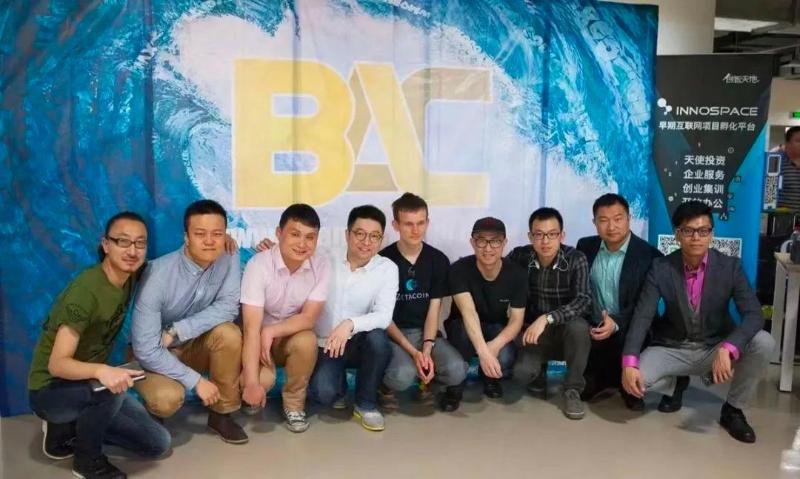
In May 2014, Vitalik met the Chinese community for the first time upon invitation from Bit Entrepreneurship Camp, at Chuangzhi Tiandi in Yangpu, Shanghai. This photo shows the organizers with Vitalik. From left to right: Wang Guan, kaku, Datou, Da Hongfei, Vitalik, Cancer, Xu Yiji, Chuxiahu, Lanling
TechFlow: Was there any particular moment or event that deeply moved you when you decided to go all-in?
Cancer: Going all-in felt like a natural progression for me. But if I had to pick a turning point, it would probably be because of BTS. At the time, the community mainly revolved around Bitcoin and Litecoin, along with a few other minor coins—all essentially Bitcoin clones that also used mining and followed similar structures, only changing minor details like block intervals.
When BTS first launched, it was truly impressive—being able to issue assets on-chain and featuring designs that, viewed through today’s DeFi lens, were remarkably forward-thinking.
I remember the first version of the whitepaper discussed concepts like collateralization and stablecoins (though they weren’t called that yet)—financial mechanisms that required some effort to fully grasp. The official translation came out slowly, so eventually I couldn't wait anymore and translated it myself, adding my own commentary, which I published on 8btc. It seemed to get a lot of readers, and that’s how many in the crypto community first got to know me.
Later came the launch of ETH. Professor Shen Bo knew Vitalik well and was also close to the BTS team—they often met up in North America to discuss technical issues.
At ETH’s inception, Shen Bo invited me to help translate the whitepaper. That’s when I coined the Chinese name “Yi Tai Fang” (Ethereum). Many in the crypto community came to know me through that.
From The Merge to New Narratives
TechFlow: Recently, due to the Ethereum Merge, people have been nostalgically revisiting Ethereum’s development history. You mentioned being the namer of Ethereum in Chinese—why did you choose the name “Ethereum”?
Cancer: I once discussed the name with Charles Hoskinson. "Ether" is easy to understand. As for the character “坊” (fang), there was some thought behind it—but nothing too complicated. “Fang” means workshop or studio, aligning well with the -eum suffix, symbolizing Ethereum as a factory for creating smart contracts.
TechFlow: Since translating the whitepaper years ago, how have your views on Ethereum evolved?
Cancer: After translating the whitepaper, Chuxiahu, representing our Bit Entrepreneurship Camp, invited Vitalik to visit China. He toured Shanghai, Beijing, Hangzhou, and Shenzhen, but the response wasn’t enthusiastic—many didn’t understand what he was talking about. After participating in the ICO, I didn’t follow ETH closely for a long time because its wallet was extremely hard to use and the overall user experience was poor. I only started paying real attention again when EVM was introduced.
A major milestone later was Wanxiang’s involvement—Wanxiang joining the space was a game-changing moment for China’s blockchain community.
At that time, the Ethereum team was facing serious funding difficulties. Mr. Xiao learned about this through Shen Bo and, seeing great potential in smart contracts, invested $500,000.
Later, Mr. Xiao, Shen Bo, and Vitalik jointly established the Wanxiang Blockchain Laboratory and began hosting annual summits, marking a key milestone in the rise of China’s blockchain industry.
Vitalik is an exceptionally intelligent and idealistic person who has deeply reflected on nearly every concept in the industry. He spends significant time writing and speaking. I have a book he gifted me titled *Ideals*, compiling many of his important yet complex essays. It shows how he frequently consults experts across disciplines, striving to understand each critical concept and explain it in ways accessible to ordinary readers.
During Ethereum’s development, he gradually attracted key team members—like Gavin Wood, who possessed strong software engineering skills, proposed the EVM concept, and ultimately implemented it, turning smart contracts from theory into reality. This sparked a massive wave of innovation, shaping the direction of blockchain technology—a truly magical startup story.
TechFlow: Currently, do you support PoW or PoS? After The Merge, Ethereum has transitioned to PoS—what are your thoughts on these two mechanisms?
Cancer: There's been much debate recently between PoW and PoS supporters. Influential figures like Jan, founder of Nervos, and A Jian, former editor-in-chief of EthFans, argue that PoS somewhat undermines decentralization and security. I acknowledge their concerns, but I still support ETH’s transition to PoS.
Such a weakening could be fatal for a startup project—which is exactly why Ethereum chose PoW at mainnet launch. But after eight years of growth, with massive market cap and widely distributed tokens, this weakening becomes negligible. We shouldn’t overstate it. Meanwhile, the gains in efficiency and drastic reduction in energy consumption are real and substantial. We should support this evolutionary direction.
TechFlow: Indeed. You've witnessed the entire evolution of public blockchains. What’s your take on the latest Layer1 narratives—such as Aptos and Sui, the two Move-language-driven blockchains?
Cancer: Diem is dead, but it left behind Move. Looking back at IT history, programming languages have continuously evolved—from FORTRAN to C, to Python, to Java. The languages used in blockchain and smart contracts will undergo similar iterations. Early languages may not have matured enough in power, usability, or security, but newer languages will emerge to meet those needs.
Public blockchains are the same. After BTC, new chains keep emerging. So far, ETH has been the most successful. Projects like Cosmos show promise but haven’t fully delivered yet. Others like ICP remain largely futuristic. All I can say is, Aptos and Sui have the potential to lead a new wave.
A Project’s Rise and Fall Hinges on Vision—and Timing
TechFlow: Many refer to you as the “Elder Brother of BitShares.” Looking back now, BTS had visionary elements—decentralized exchange, synthetic assets, stablecoins, community governance... Similarly, EOS’s high-performance chain narrative became central during the last bull run. Yet both BTS and EOS have relatively “declined.” What do you think caused this, and what lessons can we learn?
Cancer: BTS and EOS share similarities, since both were founded by BM (his community handle was bytemaster, hence BM).
BTS’s core problem was its imperfect foundation—particularly weak in security and decentralization. The DPoS consensus mechanism inherently lacks robustness in security.
BM is an outstanding technical architect, but he wasn’t strongly committed to principles of decentralization and security. He often compromised on these aspects for better UX or higher TPS—an early flaw that planted seeds for future decline.
BTS was ahead of its time in application design—on-chain order books, collateralized lending, stablecoins. But after BM left due to the inflation incident, BTS lost its ability for continuous foundational evolution. Most of its efforts afterward were minor feature tweaks. With the emergence of EVM, cross-chain solutions, and AMMs, BTS gradually faded.
I often wonder—if I could go back in time, what should BTS have done differently? EOS’s launch offered a chance to test that hypothesis. EOS debuted spectacularly—ICO superstar, smart contract support, blazing speed and TPS—but ultimately declined as well.
I believe BTS and EOS share common reasons for decline:
-
First, prioritizing user experience over decentralization and security;
-
Second, failing to properly respect the community and investors.
During the BTS era, BM simply walked away after the inflation controversy. What does that say? He didn’t take decentralized governance seriously. Perhaps he just wanted to build something flashy, thinking his relationship with the community didn’t matter—that’s fatal for a public chain leader.
What did the EOS team do? They raised a huge sum, converted it into BTC, and didn’t spend much on actual project development.
Why do we need public blockchains? They provide trustless, secure systems where everyone is treated fairly—enabling global participation. Whether it’s lacking foundational security or making users feel deeply unfair during development, both are fatal flaws that severely limit scalability.
So I believe the root issues of BTS and EOS lie at the cultural and values level.
Every Step Counts
TechFlow: You wear many hats—the most prominent today being Co-founder of Waterdrip Capital. Could you tell us more about Waterdrip Capital? Which projects have you invested in?
Cancer: Waterdrip Capital was founded by a group of friends from the crypto space—it’s been seven or eight years now. In recent years, we’ve focused heavily on blockchain infrastructure, Polkadot ecosystem, DeFi, NFTs, and Metaverse. Our Link3 page—https://link3.to/waterdrip—lists detailed information. Those interested can check it out.
TechFlow: VC firms in this industry seem quite homogeneous. What makes Waterdrip different? What’s your investment methodology and criteria?
Cancer: I’d say our biggest advantage is that all partners are early participants in the blockchain industry, deeply familiar with its entire development history. We’ve engaged with numerous startups and lived through multiple market cycles, giving us strong judgment on project trajectories. We now have our own investment framework, focusing on early-stage projects, particularly valuing teams’ understanding of blockchain and Web3 concepts, as well as execution capability.
We aim to connect early with exceptional teams and, based on mutual recognition, offer comprehensive support—not just capital, but resources across the board.
TechFlow: Having lived through so many bull and bear markets, what are your reflections?
Cancer: This market cycle correlates strongly with the U.S. interest rate hike cycle. Truly outstanding projects possess the vitality to survive across cycles.
There’s a common saying: Bull markets earn money and build capital; bear markets are for learning, researching, and picking up bargains. But in practice, everyone knows this, yet few can apply it effectively. Markets constantly throw black swan events—like this time, although the Fed’s rate hikes were expected, no one foresaw LUNA and Three Arrows collapsing and dragging down an entire chain of institutions.
I’ve recently been reading Nassim Taleb’s works—*The Black Swan*, *Antifragile*, *Skin in the Game*—and his core idea resonates: Markets are unpredictable. Instead of trying to predict them, participants should manage portfolios according to antifragility principles—limiting downside risk in bear markets while maximizing upside in bull runs.
I find this philosophy realistic and profound. As an institution, we must embrace long-termism.
TechFlow: Looking ahead, which areas will Waterdrip Capital focus on, and how do you plan to move forward?
Cancer: We’re currently most focused on Web3 infrastructure and applications—and that will remain our priority. First, after two years of market validation, Web3 has been widely recognized as the direction of next-generation internet.
Meanwhile, Web3 infrastructure has reached a certain maturity. As it continues improving, we expect explosive growth in applications. This aligns perfectly with our investment focus.
TechFlow: Personally, which investment are you most proud of, and why did you make that decision?
Cancer: Personally, I can’t recall the single most satisfying one, but several stand out—BTS, ETH, and Loopring.
-
Back then, there were few projects—investing in BTS was simply because I found it interesting, nothing complicated;
-
For ETH, I had translated the whitepaper and understood it well, and later they conducted an ICO;
-
Loopring’s founder Dong Wang was a friend in our community. When he started the project, we believed in his capabilities and vision, so we invested.
When we invested in Loopring, Layer2 wasn’t even a concept yet. They went through many transformations before finally settling on Layer2—that happened years after our initial investment.
TechFlow: In a previous interview, you said, “A fierce life requires not just endless money, but also the realization of ideals.” What is your ideal today?
Cancer: Honestly, I don’t have endless money—I’m still quite short on cash and need to keep earning. But that doesn’t mean my current ideal is just making money. I hope, under relatively healthy financial conditions, to pursue meaningful endeavors beyond monetary value. For example, can I create something entirely new? Can I regularly share valuable insights with the community? I want to strive to generate value that transcends money.
Nowadays, the industry evolves so fast. Even for someone who entered early, it’s hard to keep cognitive pace with the rapid changes. So the most important thing remains learning and understanding—constantly iterating oneself, striving to produce something valuable.
Join TechFlow official community to stay tuned
Telegram:https://t.me/TechFlowDaily
X (Twitter):https://x.com/TechFlowPost
X (Twitter) EN:https://x.com/BlockFlow_News