








Analysis: From Web3 Infrastructure to Web3 Framework Architecture
TechFlow Selected TechFlow Selected
Analysis: From Web3 Infrastructure to Web3 Framework Architecture
The internet has fundamentally transformed society, individuals, and the economy.
 Navigating Web3 tides with focused insights
Author: Eric Hu
Translation: TechFlow intern
Disclaimer: All personal opinions, not financial advice
The internet has fundamentally transformed society, individuals, and the economy. As a tool that unlocked knowledge transfer, it ushered in the information age and became the foundational platform for applications, networks, and services.
Evolving over time, today we are transitioning from "Web2" to "Web3"—the next evolution of the internet. If you ask 10 people to define Web3, you’ll get 10 different answers, but one thing is clear: the internet is changing, driven by the convergence and maturation of multiple technologies alongside global and societal shifts.
Web3 embodies numerous principles and holds the promise of becoming a more decentralized and collaborative internet of data and value. Blockchain and cryptocurrency are at its core, but they are just one part of a broader set of technologies enabling this new network.
The explosive experimentation with blockchain and cryptocurrency has proven new structures and business models: powerful network effects, more trustless coordination of stakeholders toward shared goals, aligned incentives, transformed governance models, defined agreed-upon ownership, and perhaps most importantly—linking data with value—all done natively in digital form.
While blockchain and crypto help create new applications and businesses, it's important to emphasize that Web3 represents the evolution of both front-end applications/user experiences and back-end technologies. Web3 highlights greater composability within the tech stack and smarter networks. Whether through smart contracts or machine learning-driven decisions, upgraded computing networks are better suited for automation and managing high-throughput analytics or monitoring technologies (NLP, computer vision, IoT) along with data-intensive use cases (AR/VR, autonomous driving, smart cities). Just as bandwidth exploded in 2000 to support the growing internet, the rollout of 5G and edge computing in hardware will form a mesh, as processing power—via expanded blockchain-driven computation and/or next-generation cloud—opens new possibilities for applications and services.
Another critical point is that cultural and social shifts are indispensable to the success (and timing) of new technologies. In recent years, accelerated by the COVID-19 pandemic, many trends have emerged. We’ve seen significant progress in digital transformation, cashless payments, and migration to cloud computing. As a society, we’ve grown increasingly comfortable transacting and experiencing life digitally. Cryptocurrency has entered mainstream culture and is gradually accepted as a legitimate (albeit still nascent) asset class. After years of asking “when institutions will come,” institutions are now here.
Today’s “Web3” is clunky and full of friction. The next steps are onboarding, better UX/UI, proper regulation, and superior or novel use cases. However, betting against a technology based on its current state is foolish; massive foundational work is underway, and everything starts with building properly.
Over the past two years, Web3 has experienced a Cambrian explosion of innovation—from teams building Layer 1s or scaling protocols, to new applications and projects, and new governance or token models. Where talent and innovation go, capital follows. In 2021 alone, $25 billion flowed into blockchain-based projects. Among these, those categorized as “infrastructure” are among the most critical.
So why is infrastructure more important than apps?
As Moxie, founder of Signal, pointed out—nobody wants to run their own server. As Web3 matures, like previous iterations of the web, abstraction of complexity will be a key driver of growth. Managed services and tools allow teams to focus on innovation without investing heavily in backend concerns like security, reliability, and scalability. When bringing the next billion users into Web3, most shouldn’t need to care which blockchain or token standard a protocol uses, or how to overcome hurdles (and fears!) when interacting with apps. That’s why proper infrastructure, architecture, and tooling are crucial. The potential in Web3 infrastructure is vast, so zooming out, we can use a Web3 infrastructure framework as a mental model for what’s happening.
Evolution of Web and Web3 Principles
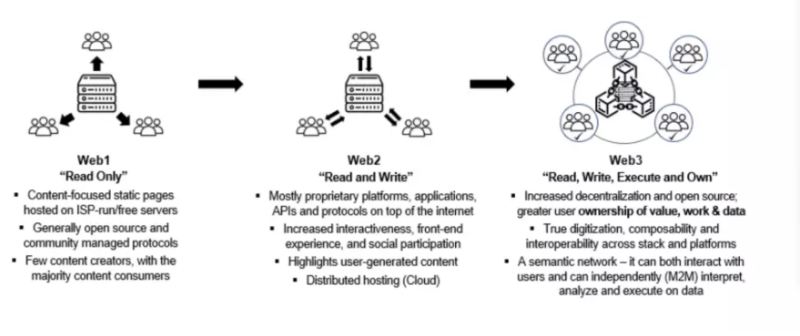
Before diving deeper into infrastructure, it may be useful to discuss Web3 principles further—after all, these are what all projects aim to build toward.
Digitalization: Today, we’re in transition from physical information and assets to digital. Web3 exists in an era of fluid data. Physical data can be measured, combined with digital information, and executed. Backend computing will process information from diverse sources—AR/VR, IoT sensors, autonomous devices, and more.
Convergence and maturity of emerging technologies: Technology doesn’t exist in isolation. Cryptocurrency and blockchain are key parts of the architecture and values. But other technologies are also maturing—5G, AI, edge computing, IoT. Combined with more efficient and intelligent processing of larger datasets, flexible infrastructure, and new business models (e.g., tokens), they lay the foundation for next-generation applications.
-
Ownership of data and assets: Web3 will enable true ownership of data, assets, and work. Blockchain is revolutionary because it can track and verify digital ownership. Digital assets—whether fiat, cryptocurrency, or NFTs—can be controlled by users via wallets. Traceability enables measurement and control of contributions to assets or individuals, which becomes powerful when combined with digital identity.
-
Increased decentralization of control and governance: Cryptocurrency and blockchain are fundamentally about decentralization, trust, and coordination. A token represents not just an asset, but often voting rights or membership. Centralization has benefits, but with DAOs evolving, new models of corporate governance, network control, and distributed decision-making are emerging. Greater decentralization allows builders, operators, and users to own and influence platform development.
-
Composability: Before the internet, there were walled local networks. Many blockchains seem similar today, making interoperability a key focus. With open-source code, Web3 is built with composability in mind. Teams can take existing projects or programs and build on top of them, enabling faster development and cross-application communication (interoperability).
A more mature Web3 will lay the foundation for transforming relationships around data, value, and ownership on the web. Enterprises, users, and networks can share or interact with data and transfer value more freely. Thus, Web3 has much to offer, and we’re currently observing a space in development—that’s why people care about Web3 infrastructure.
So what makes infrastructure important?
Infrastructure is the cornerstone of development. Over the past few years, digital infrastructure has evolved from physical assets like cell towers or fiber networks to “upper-layer” technologies such as cloud, data centers, and managed networking software.
For Web3, we now define infrastructure as the tools, services, and architectures that enable Web3 applications to be deployed, built, and used at scale. After all, both institutions and retail users must access Web3 in a more frictionless and scalable way. Web3 infrastructure comes in many forms—especially across the spectrum of decentralization. A large portion of Web3 projects are naturally decentralized, using tokens or community-based governance. Yet decentralization is a spectrum—with tradeoffs in funding, user experience, and operational efficiency. Across Web3 infrastructure, many adopt centralized approaches, raising funds through traditional equity.
Web3 infrastructure has several attractive characteristics for builders and investors: predictable revenue, similarities with existing platforms/software, more experienced management teams, and mission-critical roles within ecosystems. This has attracted funding from both Web3-native/crypto capital and participation from traditional financial players. As a result, starting in 2021, Web3 infrastructure sectors have begun to take shape.
Guiding Questions for the Framework
When studying Web3 infrastructure, several guiding questions underpin this framework as a way to think about the evolving landscape:
-
What Web3 services and tools (“architecture”) do project teams typically use, and what data, storage, or computing (“core infrastructure”) systems support them?
-
What operational challenges do builders or institutions face in Web3? What “mission-critical” solutions have been developed?
-
What foundational services have been—and need to be—built for certain use cases (e.g., DeFi, NFTs) to succeed at scale?
-
Where are existing companies and projects investing resources—through M&A or organic development?
-
How do components of Web3 “infrastructure” interact? How established is each component (i.e., number of projects in the field, common standards, maturity of solutions)?
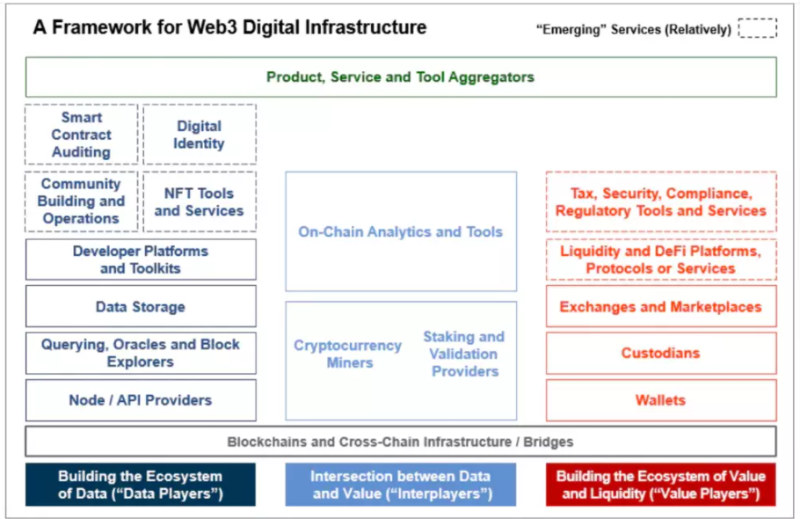
In Web3, digital infrastructure can be considered across three categories of services and products built atop the base computing (blockchain) layer—data, value/liquidity, and participant/blockchain-supporting services.
Computing Layer (Blockchain and Blockchain-Inspired Technologies): The foundation of Web3 is the computing layer. This includes blockchains and blockchain-inspired networks (Layer 1s, subnets/sidechains, and scaling solutions), upon which everything else is built. Cross-chain/full-chain protocols and on-chain messaging projects have emerged to enable exchange of value and information across chains. This is important—blockchain networks interweave transfers of data and value among different stakeholders in a more trustless manner. There’s vast information about this evolving computing/blockchain layer, but suffice to say, it’s where immense effort has been spent and will continue to be invested.
Above the base blockchain layer, services, tools, architecture, and infrastructure can be divided into three parts:
-
Data Participants: Provide core infrastructure, architecture, and tools for teams building and operating Web3 projects;
-
Value and Liquidity Participants: Build blocks to reduce friction for capital flowing between Web3 applications and participants;
-
"Interactors" or Blockchain-Supporting Infrastructure: Support and maintain stakeholders of blockchain/computing networks.
Data Infrastructure: Web3 is an evolution in semantics. It means machines and computers will need to analyze, transmit, and compute vast amounts of data.
For data infrastructure, there are more “core” or established data infrastructures and “emerging” services and tools forming the architecture for development teams. Here, data infrastructure includes various tools, services, and components that make blockchain data usable or buildable upon.
A brief overview of these data-centric building blocks:
-
Core Data Infrastructure: Node and API providers managing blockchain interactions, decentralized data storage, block explorers tracking transactions, and indexing/query services for efficient data access;
-
Emerging/Adjacent Data Infrastructure: Tools and managed services for app development, including developer environments assisting code deployment, code auditors, SDKs (e.g., privacy/zero-knowledge toolkits), and digital identity services;
-
Tools and managed services supporting Web3 use cases: NFT-related services and DAO/community operations tools. For example, NFT analytics or creation, organizational financial management, voting platforms, and community onboarding tools.
Value and Liquidity Infrastructure: A key innovation of Web3 is linking information with fundamental value.
In Web3, value is intertwined with core network functions—whether through governance, security, or utility token incentives—but value without liquidity is meaningless. For all types of capital entering Web3, value must be secured, bridged on/off, allocated, converted, accessed, and allowed to flow across the ecosystem with minimal friction.
Therefore, “value or liquidity” is built by several participants.
Today’s “core” value infrastructure includes:
-
Wallets. Wallets are the gateway to Web3 and the primary interface for users to interact with blockchains, tokens, and applications. Recently, wallets have evolved to become more like “browsers,” which is a positive step.
-
Custodians for institutional or whale capital, exchanges converting value across ecosystems and tokens, and fiat on/off ramps integrated with existing payment infrastructure.
Emerging value and liquidity infrastructure includes:
-
Dashboards and analytics for portfolio management; DeFi or exchange aggregators enhancing liquidity; and institutional trading infrastructure for efficient markets.
-
Adjacent services assisting capital operations—primarily tax, compliance, regulatory, and cybersecurity services.
Interactors and Blockchain-Supporting Infrastructure: We’ve emphasized that at Web3’s core is the fusion of value and data enabled by blockchain technology. Therefore, infrastructure supporting the blockchain computing layer enables the success of value and data services. Interactors and blockchain-supporting infrastructure include:
-
Network Maintenance: Cryptocurrency miners (for PoW networks), staking services, and validator services that simplify network support or maintenance; these aid transaction processing, voting (via delegation), and sharing network incentives (e.g., block rewards).
-
On-chain Analytics: These services, now common in compliance or trading use cases, provide dashboards and tracking for activity on the computing layer. They are highly valuable given the numerous hacks or security breaches in today’s crypto applications.
-
Emerging Infrastructure: As highlighted at EthCC 5 this summer, there’s growing attention on on-chain communication and messaging protocols—we can cite examples like full-chain protocols or cross-chain bridges.
Concluding Thoughts
In recent years, we’ve welcomed a whole new asset class, with some of the brightest minds, largest companies, and massive capital joining the innovation wave. But mass adoption requires improvements in regulation, onboarding, new applications (with real revenue), business models, social structures, and technological infrastructure.
We are witnessing the real-time growth of a new industry and, as a society, learning how to interact in the digital age. Criticism is certainly needed, but as builders solve each iterative challenge—from privacy to scalability—we’ve already seen experimental results in new governance models, hybrid digital-physical businesses, and the power of incentive-driven networks. Now is the best time to build.
Join TechFlow official community to stay tuned
Telegram:https://t.me/TechFlowDaily
X (Twitter):https://x.com/TechFlowPost
X (Twitter) EN:https://x.com/BlockFlow_News


![Axe Compute [NASDAQ: AGPU] completes corporate restructuring (formerly POAI), enterprise-grade decentralized GPU computing power Aethir officially enters the mainstream market](https://upload.techflowpost.com/upload/images/20251212/2025121221124297058230.png?x-oss-process=image/resize,p_50/quality,q_80)






