








Quick Overview of OKX and LinkedIn's "2022 Global Talent Report in Blockchain—Web 3.0 Direction"
TechFlow Selected TechFlow Selected
Quick Overview of OKX and LinkedIn's "2022 Global Talent Report in Blockchain—Web 3.0 Direction"
Given that Web3.0 is still in its early stages, innovation and talent are primarily concentrated in infrastructure.
 Navigating Web3 tides with focused insights
As the digital economy continues to evolve, Web 3.0 innovation built on blockchain as foundational infrastructure is rapidly advancing. Blockchain technology and the crypto ecosystem are experiencing sustained growth, positioning blockchain as a revolutionary force in the digital economy and a next-generation information infrastructure. It is integrating deeply across industries worldwide, accelerating global economic restructuring and reshaping competitive landscapes. In this context, transformative changes, opportunities, and challenges will emerge across industry disruption, organizational transformation, market environments, corporate ecosystems, and talent mobility.
Given that Web3.0 remains in its early stages—with innovation and talent primarily concentrated within the blockchain infrastructure sector—OKX partnered with LinkedIn to co-author the "2022 Global Blockchain Talent Report – Web 3.0 Focus". This report offers forward-looking insights and practical recommendations to help enterprises better understand the blockchain industry, seize opportunities brought by Web3.0 for organizational development, and navigate the dynamics of organizations and talent within it.
Global blockchain talent growth remains strong, but China’s growth rate lags behind
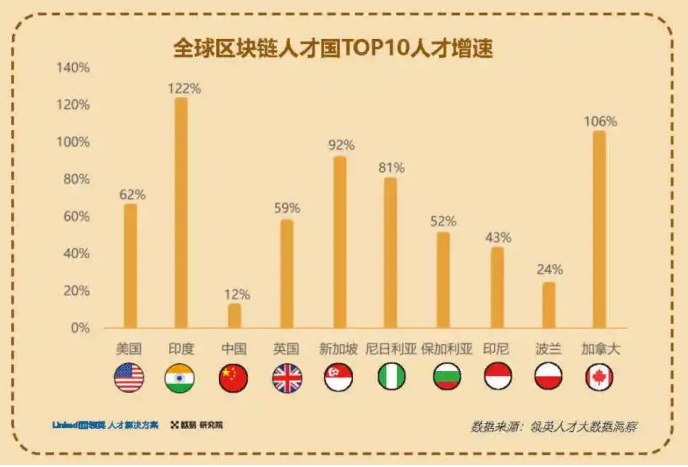
As of June 2022, the total number of blockchain professionals among LinkedIn's global membership grew 76% year-on-year. The United States, India, China, the UK, and Singapore rank as the top five countries for blockchain talent. India and Singapore saw particularly high growth rates at 122% and 92% respectively, while the U.S. grew by 62%. China recorded the lowest growth, with blockchain talent increasing only 12% year-on-year.
Top 10 Countries by Growth Rate of Blockchain Talent
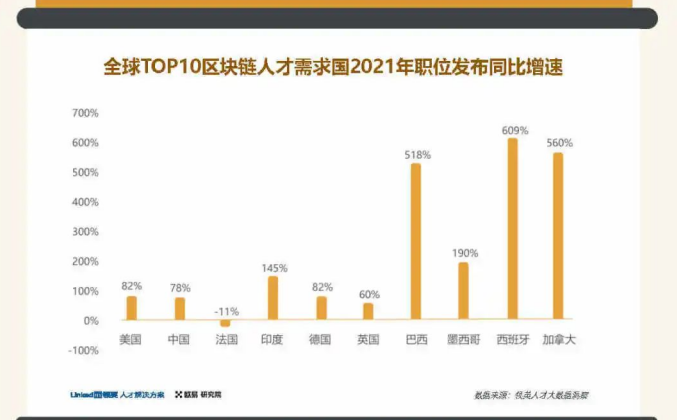
In terms of job postings, demand is concentrated in the U.S., China, France, India, and Germany. Notably, among the top ten countries for blockchain talent, the U.S., China, India, the UK, Singapore, and Canada all experienced exponential growth in blockchain-related job listings in 2021, indicating extremely strong talent demand.
Year-on-Year Growth of Job Postings in Top 10 Blockchain Talent Countries (2021)
Core talent demand shifts from finance-oriented to technology-focused roles
Analyzing global blockchain talent composition, finance professionals represent the largest segment (19%), followed by R&D talent (16%). Meanwhile, test engineers show the highest growth rate, and technical talent faces the largest talent gap.
Finance, R&D, business development, IT, and sales professionals constitute the top five talent categories globally in blockchain. The most in-demand specific roles include cryptocurrency traders, software engineers, analysts, support analysts, and account managers. In terms of growth rate, the fastest-growing positions in blockchain are test engineers, cryptography experts, compliance analysts, designers, and support analysts. These trends reflect how, as blockchain technology advances and integrates into various sectors, the industry is transitioning from a finance-dominant to a technology-driven field—leveraging both its technological and financial attributes to become a key component of the digital economy.
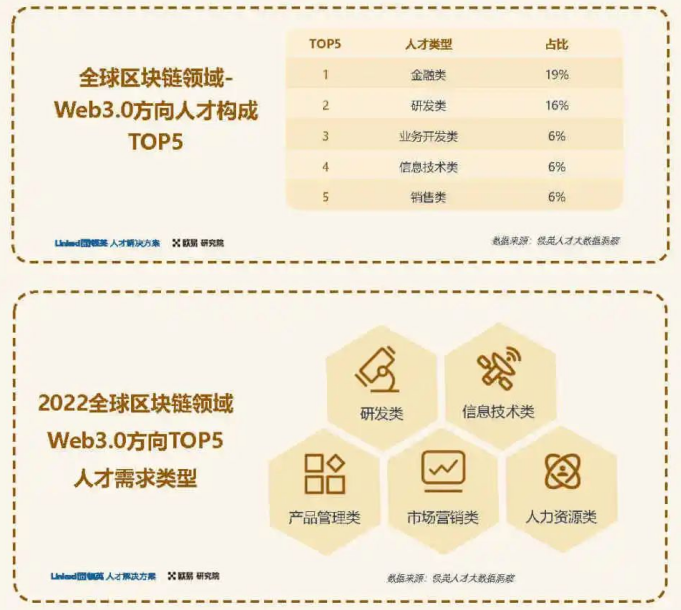
Data also shows that demand for technical talent is currently high and the talent gap significant. As of June 2022, R&D roles lead in global blockchain job postings, followed by IT professionals. Product management, marketing, and HR roles follow closely. In contrast, despite finance professionals being the largest talent group, they rank only sixth in hiring demand.
Notably, HR professionals ranking as the fifth most in-demand role highlights the vibrancy and urgency of talent needs in the blockchain sector.
An HR director at OKX stated:
"Globally, Web3.0 job applicants numbered 18.8k in April 2022 and rose slightly to 18.9k in May. While there is a wide pool of general talent in the market, few specialize in blockchain or Web3.0. There remains a shortage of skilled developers and a scarcity of designers who possess both strong aesthetics and product thinking aligned with crypto."
Blockchain talent has short tenures and high turnover, primarily moving within the industry
The average tenure for blockchain professionals globally is just 1.2 years, reflecting short employment durations and high mobility.
Average tenure varies across top talent categories: finance professionals stay 1.3 years, R&D and business development talent 1.1 years, sales professionals 1.9 years. Additionally, product and marketing professionals—both among the top five in demand—have an average tenure of 1.1 years.
In terms of movement patterns: While talent flows into blockchain from traditional financial and tech firms, internal industry mobility—between blockchain companies—is the dominant trend. Examples of external inflows include professionals joining from traditional financial institutions like Goldman Sachs, JPMorgan, and HSBC, as well as from tech giants such as Google, Microsoft, and Facebook. Within the blockchain sector, LinkedIn’s talent data reveals that since 2021, talent has been circulating primarily among major blockchain firms such as Coinbase, Crypto.com, Gemini, and Ripple.
Gender ratio in blockchain talent is approximately 8:2, highlighting female underrepresentation
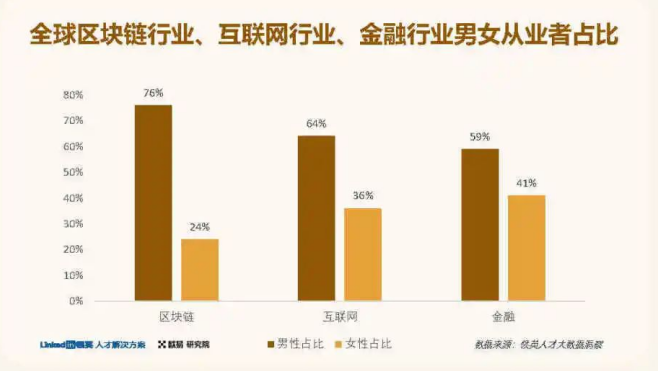
LinkedIn’s talent data shows that as of June 2022, women make up only 24% of the global blockchain workforce, compared to 76% male. This gender imbalance is more pronounced than in internet and finance industries. Despite active efforts by blockchain companies to recruit more female talent, women remain scarce in the field.
Gender Distribution in Blockchain, Internet, and Financial Industries
Blockchain firms are raising educational requirements, intensifying talent competition
Bachelor’s degree holders form the largest group in blockchain (59%), but master’s degree holders account for 40%, indicating a relatively high overall education level. Roles with higher specialization demand even higher qualifications. As innovation progresses and more universities introduce blockchain-related programs, educational expectations will rise further, making talent competition increasingly fierce.
Smart Organizations, Empowered Talent: Accelerating Blockchain in the Digital Economy Era
Global blockchain development is now on a fast track, offering vast potential and opportunities. Yet, the sector also faces multifaceted challenges in organizational growth and talent management. Enterprises must proactively adjust their talent strategies:
With growing mismatch between talent supply and demand, surging demand is inevitable. Companies should actively build global talent databases and strengthen talent reserves.
As blockchain technology advances and the metaverse wave accelerates adoption, blockchain applications will deepen across industries. Governments and regulators are increasingly supportive of blockchain research and deployment, prompting more enterprises to experiment and invest. Consequently, talent demand will continue to soar, intensifying competition in an already constrained talent market. To prevent talent shortages from hindering business growth, organizations must broaden their horizons, monitor market shifts, and establish global talent pools for strategic reserve building.
Technical talent is the core focus of industry demand. Strengthening global talent acquisition and cultivating core skills and potential are critical priorities.
Blockchain has proven to be a key technology for solving complex problems, with broad prospects. Corporate investment in blockchain directly translates into demand for specialized talent and skills. Growing research and data confirm rising demand for blockchain professionals—especially technical talent. Given slowing global talent growth and limited supply, organizations should strategically build hybrid teams to boost vitality. They should also focus on upskilling existing core talent and unlocking potential to bridge skill gaps and shortages.
High talent turnover requires organizations to refresh mission and values to inspire employee purpose.
As a dynamic frontier industry, blockchain exhibits short tenures and frequent mobility due to its inherent characteristics, rapid technological innovation, and policy influences. With blurred industry boundaries and hybrid work becoming the norm, competition for top talent will intensify, making high turnover unavoidable. Organizations must actively renew their vision and values, foster positive work environments, and strengthen both emotional and rational employee engagement. By inspiring a sense of mission and enhancing employee well-being, companies can improve talent attraction and retention, supporting sustainable growth. For example, OKX’s core hiring principle centers on individuals who are visionary, execution-oriented, and mission-driven. On one hand, given the industry’s early stage, only those genuinely curious, optimistic, and committed to deeply understanding the space can sustain long-term growth. On the other hand, as the blockchain industry is close to money and full of temptations and challenges, individuals with integrity and genuine Web3 ideals are highly valued.
Blockchain firms are raising educational standards—organizations must redefine talent and update criteria to keep pace with the times.
As blockchain and its emerging fintech ecosystem gain recognition and acceptance, more universities worldwide are launching blockchain-related courses and degree programs. The more specialized the role, the higher the educational requirement. With more professionals entering the field and blockchain technology advancing, market competition will grow fiercer. Educational qualifications will become an increasingly important screening criterion. Considering the current reality of short tenures and high turnover, organizations must stay ahead of trends, redefine talent teams, and continuously update talent standards—from hard skills and degrees to soft qualities like character and mindset—to build a solid foundation for future readiness and strengthen core competitiveness amid uncertainty.
Join TechFlow official community to stay tuned
Telegram:https://t.me/TechFlowDaily
X (Twitter):https://x.com/TechFlowPost
X (Twitter) EN:https://x.com/BlockFlow_News
 OKX
OKX






