Web3 Tianyancha Watchers: Seeking the Truth from the Entity Level
TechFlow Selected TechFlow Selected
Web3 Tianyancha Watchers: Seeking the Truth from the Entity Level
Watchers is the first application powered by the 0xScope Knowledge Graph Protocol: a Web3 Tianyancha.
 Navigating Web3 tides with focused insights
By 0xScope
Watchers is the first application powered by the 0xScope Knowledge Graph Protocol: a Web3 Tianyancha (corporate intelligence platform).
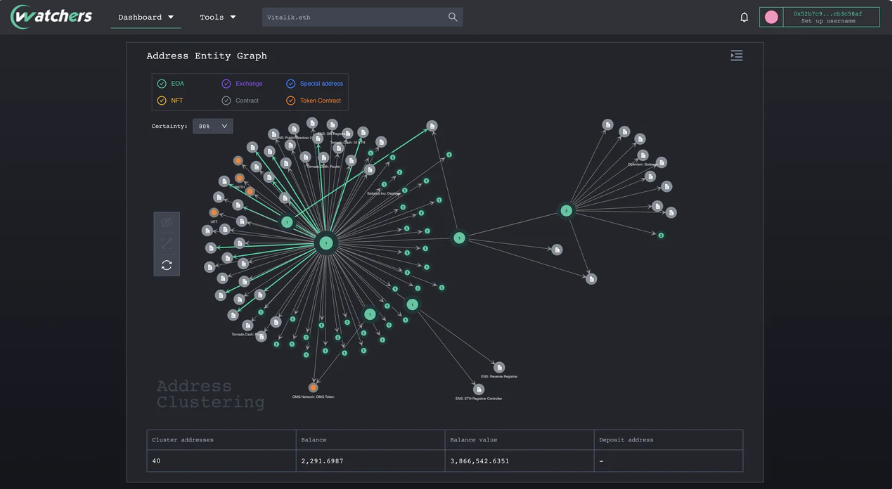
Unlike other data analytics platforms, we extract real-world entities behind blockchain addresses and conduct analysis on this entirely new data layer. As a result, Watchers offers: comprehensive insights and powerful address clustering capabilities, enabling clear visualization of deeper structures, behaviors, and relationships within the crypto network.
Over the past six months, we've collaborated with over 1,000 outstanding fund managers and more than 40 investment institutions to continuously refine our product, launching exciting features such as address clustering, token/project entity analysis, and thematic data dashboards.
Today, we are thrilled to announce—Watchers is officially live! We’re also launching three major new features: Create Entity, Custom Entity, and Alerts for personalized entity behavior monitoring.
From August 22, 2022, to September 7, 2022, all features will be completely free. Click the link below to quickly onboard and join our product and community: https://linktr.ee/scopeprotocol
Connect your wallet and start exploring Watchers!
This article will introduce Watchers from the following aspects:
- Technical Logic & Functional Architecture—A brief review of 0xScope’s technical roadmap to help you better understand the functional architecture and implementation logic of Watchers.
- Features and User Guide—We’ve prepared a series of tutorials to help you quickly learn how to use each feature and understand what sets Watchers apart from other analytics platforms. This section will be continuously updated—we also welcome your contributions!
- Use Cases and Scenarios—We’ll explore three scenarios demonstrating how to uncover deeper truths using Watchers from an entity-centric perspective, including enhanced due diligence, industry analysis, market and user insights, transaction monitoring, hacker tracking, and risk control…
I. Technical Logic & Functional Architecture
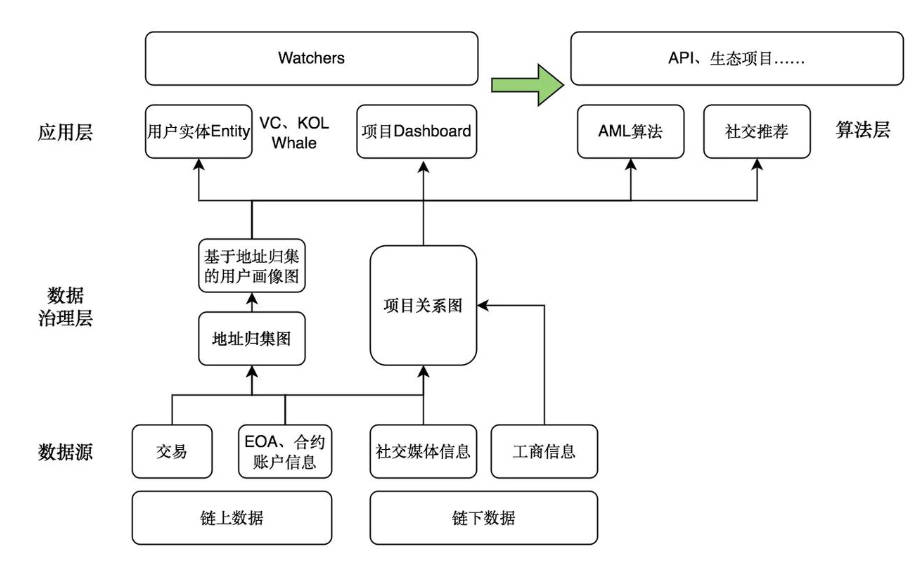
The 0xScope Protocol consists of the following components:
-
Data Sources: 0xScope Protocol is the first Web3 knowledge graph protocol that integrates Web3/Web2 data into a new data layer based on semantic structure, providing robust data sources for Web3 applications through distributed nodes and databases.
-
Data Governance Layer: Using a set of weight-based clustering algorithms powered by graph computing and deep learning, we aggregate groups of addresses highly correlated with a specific address (EOA) into a single entity, forming an address clustering graph. Around these entities, we build user profile graphs and project relationship graphs. Together, these three graphs form our unique, novel data layer.
-
Application Layer: Watchers is our first product built on top of 0xScope. Starting with the new analytical dimension—entity—we offer tools such as address clustering, project/entity data analysis, and personalized entity behavior monitoring. Based on the user profile graph, we curate various tags and scenarios to deliver powerful on-chain data dashboards (including VC/whale/risk entity tracking).
-
Algorithm Layer: Leveraging semantic datasets like the user profile graph, we can efficiently develop various algorithms for use cases such as address monitoring, anti-money laundering, and precision user recommendations.
With this brief overview of the technical roadmap, you now have a high-level understanding of Watchers—the foundation for deeper exploration. Next, we'll walk you through its core functionalities and demonstrate how Watchers helps you better "search for the truth."
II. Core Features & User Guide
Why Address Clustering?
Address clustering is the starting point for all Watchers features: Using weight-based clustering algorithms powered by graph computing and deep learning, 0xScope aggregates groups of addresses highly associated with a given EOA into a single entity. Rich identity and behavioral data enable us to build multiple user profile graphs atop the address clustering graph.
All product features stem from and expand upon this foundational capability. Watchers offers two main types of functionality: Tools and Data Dashboards.
1. Entity-Based Tools
Address Clustering: Watchers enables grouping different addresses into the same entity by setting confidence thresholds, supporting entity-level data analysis.
Token/Project Analysis: Watchers’ token and project dashboards offer two powerful tools: entity-based user data analysis and in-depth token distribution breakdowns via address penetration graphs.
Flash Research: Enables one-stop search across addresses/entities/tokens/projects and automatically completes related entity information using clustering algorithms.
2. Entity Data Dashboards
VC Watch: A dashboard dedicated to analyzing entity data related to venture capital firms, investment funds, and other institutional investors.
Token Whale Watch: A dashboard focused on analyzing top holders of specific tokens. It monitors individual addresses/entities holding more than 0.1% of circulating supply for any given token (currently supports top 100 Ethereum tokens).
Notable Entity Tracker: Aggregates and displays entity information of prominent industry figures—including institutions, developers, and investors—with full visibility into their controlled addresses and latest transactions.
High-Risk Entities Watch: Centralizes and aggregates addresses involved in historical hacks, stolen funds, rug pulls, etc., allowing users to directly access relevant data.
3. Custom Entity Monitoring Suite
We recently launched three new features enabling maximum customization for entity monitoring: Create Entity Groups, Entity Dashboards, and Entity Custom Alerts (supporting scenario-specific alerts for Transactions, Positions, etc.). Learn how to use them here: Watchers User Guide | Entity Dashboards & Alerts
III. Practical Use Cases & Scenarios
With the toolkits and dashboards enabled by 0xScope's entity-level analysis, what previously impossible tasks can industry practitioners and analysts now achieve?
Below, we demonstrate how to seek deeper truths using Watchers from an entity-centric perspective, covering:
1. User Insights: What does a complete user profile look like behind multiple addresses?
As shown, User A controls three addresses: Address 1 is linked to social accounts on a Web3 platform, Address 2 is a multi-sig admin of an NFT DAO treasury, and Address 3 is tagged as a Mask whale. The 0xScope protocol links these addresses together and clearly presents them in Watchers. With such data, analysts can build a comprehensive user profile for A, enabling applications like social recommendation algorithms—unlocking the true potential of Web3's open-source paradigm.
2. Enhanced Due Diligence: What other projects has a founder launched? Which contracts did they deploy? Who are their closely linked entities?
Using Watchers, you can investigate a project founder or contract deployer to uncover their connections to other projects. Take the famous Andre Cronje (AC) as an example:
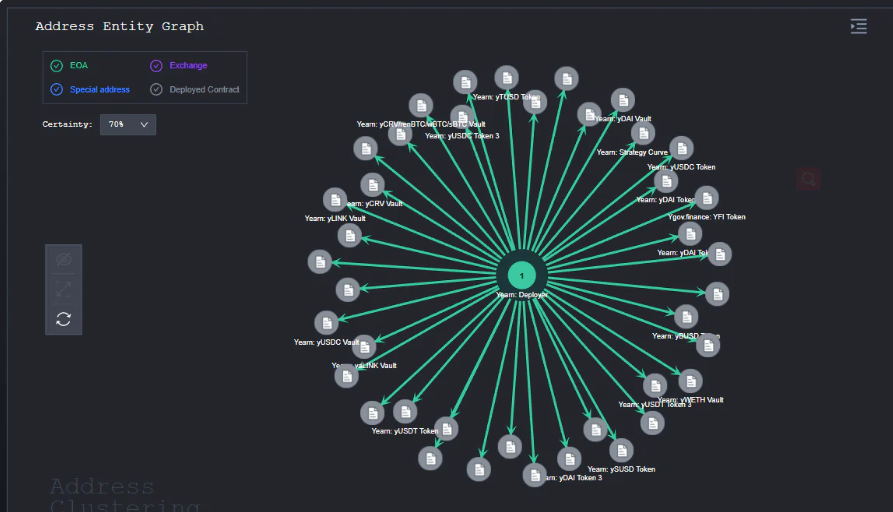
Here, we clearly see AC, founder and deployer of Yearn, has also deployed numerous Yearn Vaults. Notably, AC’s address cluster contains no other EOA addresses, indicating highly transparent operations on the Ethereum mainnet. Now let’s examine another well-known project—UNI. On the UNI token page, we can easily find its deployer address: 0x41653c7d61609d856f29355e404f310ec4142cfb. Clicking the Deployer link in the upper right corner takes us directly to the deployer’s detailed page.
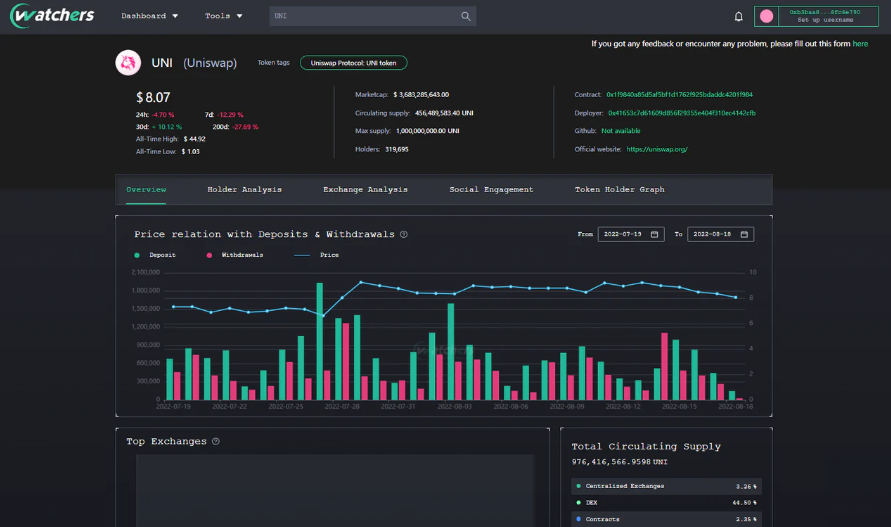
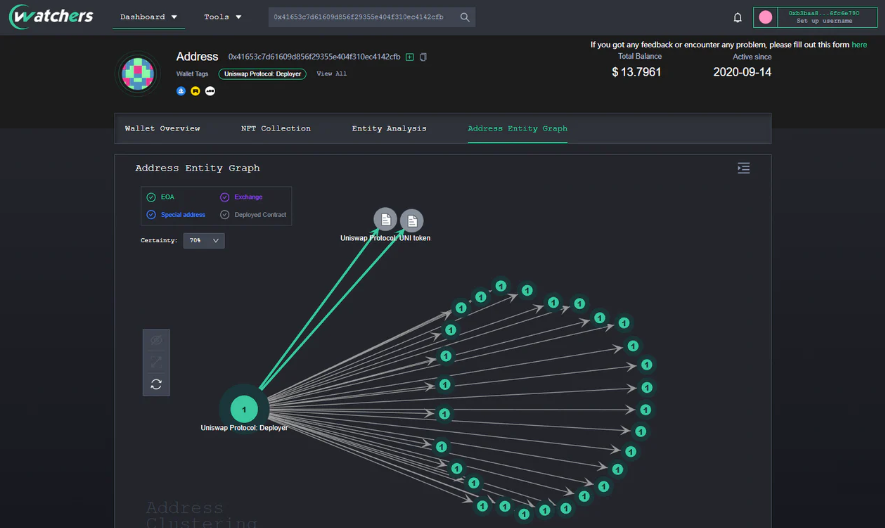
On the Address Entity Graph tab of the deployer’s detail page, we see the UNI Token Deployer is linked to many other addresses. By clicking, you can further explore the activities of these first-degree connected addresses… Go ahead and try it yourself! Share your discoveries with us!
3. Market Insights: How do we calculate a project’s real number of users? How to detect wash trading in NFT projects?
We all know blockchain addresses can be created freely and anonymously, so the number of addresses interacting with a contract doesn’t reflect actual “user count.” Scope’s entity-based analysis solves this problem. For every project, we first calculate the number of interacting addresses, then cluster them into entities to determine how many real users control them. Let’s compare Uniswap and Sushiswap:
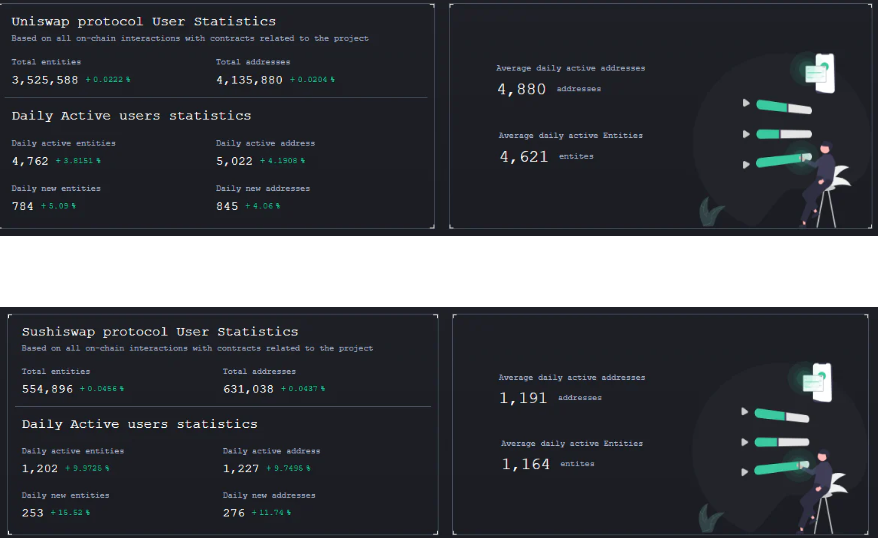
In our project dashboard, you can clearly view both the number of addresses and the number of entities. Overall, the gap between interacting addresses and actual users for Uniswap and Sushiswap is small—about 85% of addresses represent real users.
However, this isn’t always the case. As NFTs grow increasingly popular, how do we extract meaningful signals from the noise? A key application of Watchers is detecting wash trading in NFT projects. Our NFT monitoring tools are still under development, but soon users will be able to see: how much of an NFT project’s volume comes from genuine buyers versus self-dealing by the team. Reliable transaction data will allow us to assess a project’s true potential and make smarter investment decisions.
4. Whales’ Alternate Identities: Are large transactions really as isolated as they appear? What’s their full operational strategy when viewed holistically?
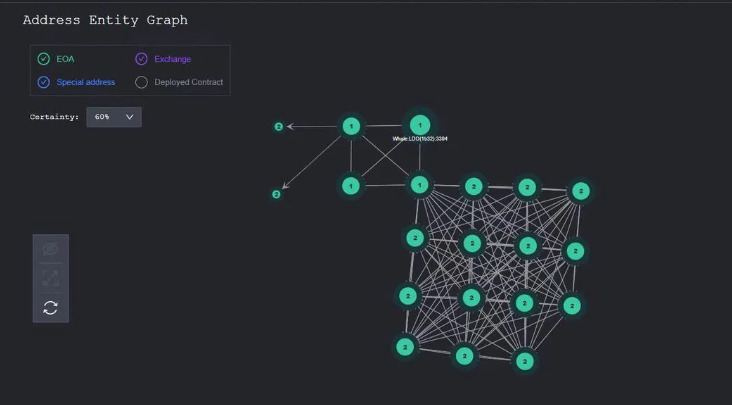
In trading markets, institutional on-chain behavior is true gold. But institutions often operate as coordinated groups, while nearly all blockchain explorers only analyze data per single address—requiring manual tracing of connections across multiple addresses on Etherscan. Watchers delivers a surprise: it effortlessly identifies and filters out whales’ alternate identities. Below is the address relationship graph of an LDO whale—a dense web of interactions, clearly resembling alt-account operations. Combined with other tools like anomaly detection, we can easily track big players’ moves: Is a whale truly buying or selling? When one address loudly buys and tweets “I’m in,” another of their alts might quietly dump.
IV. Join the Watchers Explorer Community!
From the examples above, you’ve likely realized that mastering this new dimension of data analysis can profoundly transform future research. We warmly invite you to join us in exploration!
What else can we explore…?
- Hacker Tracking & Risk Forensics: Can we trace hidden clues to uncover a hacker’s real identity? When a risky address is identified, can we instantly find other strongly correlated addresses with similar risks?
- Industry Analysis: How to calculate real user counts within an ecosystem? How much user overlap exists between similar ecosystems? Can we predict future cross-ecosystem migrations?
- Market Insights: How to measure a project’s real user base? How much of a DEX’s volume is fabricated?
- User Insights: What does a complete user profile look like behind multiple addresses? How to perform cross-project analysis based on full user profiles?
- Social Network Analysis: Hidden collusion among interest groups in an anonymous world? Nepotism among rising project founders?
- Quick Onboarding: Linktree
- Follow us on Twitter: @0xScope ; @Watchers
- Join our community: Discord; Telegram
- Product feedback: Submit Suggestions
In the coming months, we’ll host multiple AMAs with the community to demonstrate Watchers’ usage, showcase more use cases, and highlight incredible community creativity. Learn more: AMA Schedule
Moreover, 0xScope & Watchers are assembling a cutting-edge team to uncover deeper crypto truths and navigate the dark forest together! If you're passionate about exploring products and discovering new use cases, please join us!
Join TechFlow official community to stay tuned
Telegram:https://t.me/TechFlowDaily
X (Twitter):https://x.com/TechFlowPost
X (Twitter) EN:https://x.com/BlockFlow_News
 @ScopeProtocol