0xScope—Revolutionizing Web3 Data Analytics with Knowledge Graphs
TechFlow Selected TechFlow Selected
0xScope—Revolutionizing Web3 Data Analytics with Knowledge Graphs
0xScope Protocol is the first Web3 knowledge graph protocol.
 Navigating Web3 tides with focused insights
0xScope Protocol is the first Web3 knowledge graph protocol. It introduces a new data analysis foundation—Entities. Through a set of graph-computing-based weight aggregation algorithms, 0xScope can associate fragmented and low-information-density Web2 & Web3 data into meaningful entities (i.e., structured semantic data units: including objects, events, situations, or concepts), thereby enhancing data quality and utility. This provides a practical foundation for organic large-scale adoption, addressing the fundamental bottlenecks in Web3 application development and enabling Web3 to truly enter the mainstream.
The Origin of the Problem: Web3 Applications Are Emerging, But Data Infrastructure Needs Optimization
Web3 Open Data Has Tremendous Potential, But Is Highly Fragmented
From the moment Ethereum smart contracts emerged, crypto entrepreneurs began building a new "value internet"—Web3. However, despite on-chain data being public and verifiable, the decentralized mode of production simultaneously brings data fragmentation and lack of unified standards. Combined with inefficient processing and poor scalability at the protocol layer, it becomes difficult to process and consume data effectively.
Web3 open data has tremendous potential, but suffers from severe fragmentation, which manifests in two aspects:
1. The composability of Web3 data struggles to realize its paradigmatic advantages: available Web3 data mainly consists of scattered data points. Without standardized methods for data extraction and processing, these data points are hard to interconnect, making data analysis extremely costly and time-consuming.
2. Web2 and Web3 data have not yet been efficiently interconnected: currently, Web3 lacks an identity layer and still fundamentally relies on centralized Web2 structures, thus unable to escape Web2's limitations. Moreover, there is no standardized solution to simultaneously connect and utilize both Web2 and Web3 data, severely limiting Web3’s ability to unlock its full potential in real-world society.
Data is growing, but usable information and knowledge are diminishing
First, we need to distinguish between data, information, and knowledge. Theirauf defines knowledge management systems as having three levels:
● Data: Data is the lowest level—an unstructured collection of facts and figures. It is not organized in any way and provides no further insights into patterns or context.
● Information: Information is the next level—it is structured data. Information paints a broader picture: data with relevance and purpose that answers questions like who, what, where, when, and how much.
● Knowledge: Knowledge is "information about information," intelligently structured information. It combines experience, values, and insights to provide a framework for evaluating and integrating new information.
In the context of Web3, data corresponds to transaction records of individual on-chain addresses; information corresponds to the definition of Entities: in Web2, an entity refers to an individual or organization with independent and clear legal rights, such as individuals, partnerships, or corporations. In Web3, an entity can be an individual or a group (e.g., organizations or companies) whose behaviors in the Web3 space are reflected through their addresses/operations. Knowledge, then, is the knowledge graph built upon these Entities—transforming human-unreadable data step by step into reusable experience and value.
With the development of multi-chain ecosystems and the continuous emergence of Web3 applications, accompanied by user growth, behavioral complexity, and increasing data demands (for development, analytics, trading, etc.), the expansion of Web3 data scale is an inevitable trend.
It should be noted that although data volume continues to grow, due to extreme fragmentation, it is difficult to establish meaningful connections or deliver structured information. As a result, data usability remains very poor, directly affecting Web3 networks’ attractiveness to developers and their long-term sustainability.
What Problems Does 0xScope Aim to Solve, and How?
In summary, although the Web3 ecosystem is becoming increasingly vibrant, in terms of user scale, user experience, and application diversity, it remains in early stages. Three main factors contribute to this situation:
1. Low processing efficiency at the blockchain infrastructure layer.
2. Lack of entity-level analysis in blockchain infrastructure. From an application perspective, existing technical infrastructure cannot accurately depict comprehensive user profiles, making it difficult to introduce deep learning and related algorithms to improve user experience or expand product types.
3. Single-dimensional and low-quality data. The data provided by current infrastructure is too simplistic, lacking multidimensional data with deeper penetration and stronger association capabilities. This results in low industry-wide data utilization—we are essentially advancing the industry based purely on experience.
For the first issue, many teams in the market have already proposed numerous solutions. However, for the latter two issues, good solutions are rare—and even awareness is limited.
To address this, 0xScope has identified actual challenges hindering Web3 application development and proposed its own unique solution based on current protocol-layer foundations and long-term evolution expectations.
Linking Multiple “Individual Addresses” into One “Entity”
Current data analysis paradigms remain limited to single addresses, which is insufficient to build authentic user profiles.
The 0xScope team believes that to expand Web3 application types and enhance product experiences, the core challenge lies in solving user profiling and data association.
However, when the entire Web3 ecosystem allows zero-cost account creation without direct limits—or indirect KYC restrictions—on the number of user accounts, any user profile based solely on a "single address" fails to reflect reality.
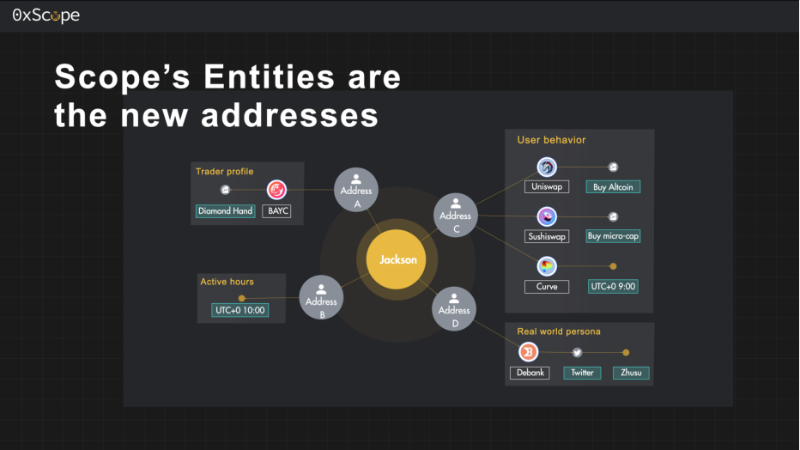
As shown in the figure, analyzing only Address A reveals only that it is a diamond-handed holder of BAYC over a long period. However, we miss the fact that the user behind Address A also owns other addresses indicating they are not only a diamond hand but also an experienced DeFi user who becomes highly active after 10 AM UTC+0.
Therefore, the 0xScope team proposes a new data analysis foundation—Scope's Entities.
0xScope has developed a graph-computing-based weight aggregation algorithm that assigns different weights to dozens of rule-based edges to identify a user’s other addresses. These rules are continuously tested and refined via deep learning to improve address clustering accuracy, reconstructing information units from an Entity-centric perspective.
Still referring to the figure above, when analyzing Address A using Scope's Entities, the system first identifies Addresses B, C, and D. These four addresses are linked into one entity and analyzed collectively from an entity-level view.
The resulting insights are significantly more accurate, specific, and comprehensive than before. Furthermore, since the aggregation algorithm focuses on identifying behavioral commonalities, higher-value behaviors are more likely to be associated. Thus, even if not all of a user’s addresses are discovered, the analysis approaches the truth asymptotically. And importantly, we do not need to know who this user really is or their Web2 identity—unless they voluntarily disclose it for some reason.
This protects user privacy while enabling more complete user profiling. With such profile data, builders can deliver more precise services to every crypto user.
Recognizing Events, Not Just Strings
Almost all current data protocols offer simplistic point-by-point analysis, providing one-dimensional raw data directly to institutions or individuals. Yet analysts must still invest significant effort rewriting query logic and recognition rules to understand relationships between projects or users.
Moreover, all data protocols provide data as Strings—textual representations. When attempting to use this data, users must determine what each string represents, whether it belongs to a broader category, and how it connects to other strings to derive meaningful conclusions.
This is overly complex. If a data protocol could transform these complex strings into Things—real-world entities—and organize all rule-compliant events (things) into a networked graph like the one shown on the right side of the image below, it would dramatically reduce data querying and usage costs, greatly deepening data utilization across the Web3 world.
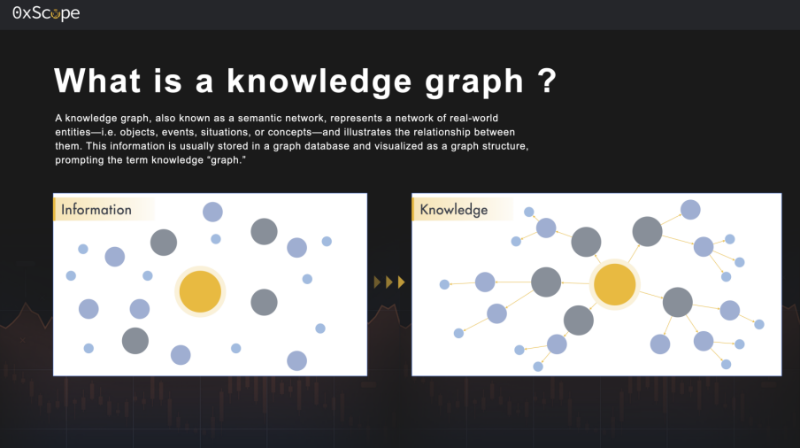
The figure above illustrates an example of a knowledge graph. In addition to providing a graph-computing-based weight aggregation algorithm, 0xScope constructs multiple knowledge graphs from both on-chain and off-chain data for enterprise customers to use.
Based on the knowledge graph data we provide, any enterprise customer can leverage required data quickly, efficiently, and at very low cost.
Summary
First, 0xScope uses a weight aggregation algorithm to link multiple “single-point addresses” into one entity, improving the quality of on-chain identity data.
Second, based on this new “atomic identity,” multiple types of Web3 data knowledge graphs are constructed:
(1) Knowledge graph data will drastically reduce project teams’ costs in data identification, cleaning, and usage.
(2) Knowledge graph data will greatly deepen project teams’ ability to utilize data.
(3) Knowledge graph data will advance the entire Web3 industry. While protecting user privacy, it elevates Web3 product experiences to match those of Web2. And because Web3 products share the same protocol layer, even on your first use of an application, it can leverage the Entity-based (virtual) profile provided by 0xScope to deliver high-quality service tailored to you.
What Value Will 0xScope Bring to the Entire Web3 Ecosystem?
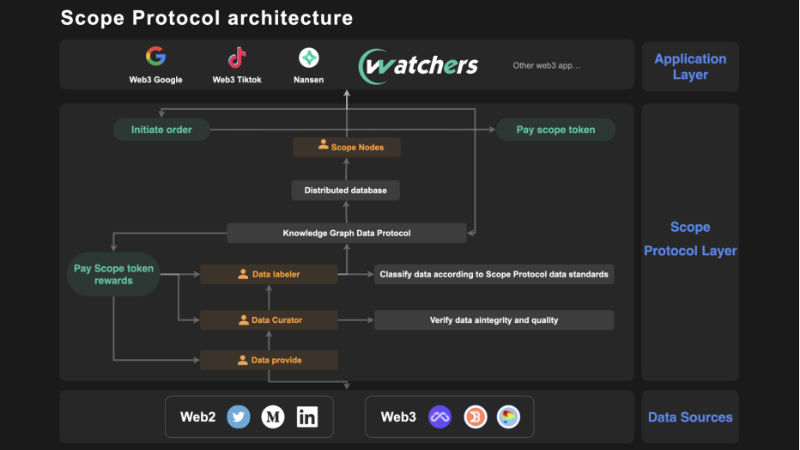
The 0xScope team defines 0xScope as a completely new data layer.
Most of 0xScope’s data originates from protocol layers like Ethereum. After acquiring the data, we uniformly clean and govern it into semantic data and store it in 0xScope’s database. This enables platforms like Curve, Aave, Web3 TikTok, and even centralized data products like Nansen to directly access higher-quality, multidimensional knowledge graph data from our database.
What Are Specific Use Cases of 0xScope’s Data?
As the Scope Protocol database continues to grow, usable knowledge increases, enabling a wide range of rich application scenarios:
1: Web3 Tianyancha (Chinese corporate info platform)—Watchers
Watchers is a Web3 version of Tianyancha built on the Scope Protocol. It offers three core features.
(1) Identifying the entity behind multiple addresses through behavioral relationships between addresses and tag relationships within a label library
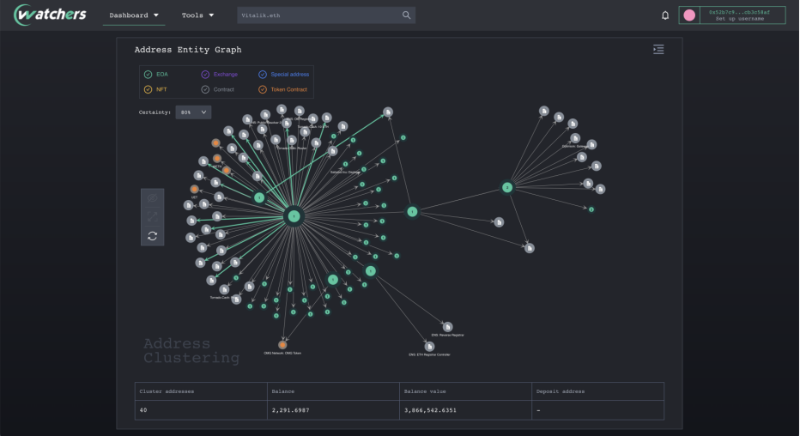
As shown in the figure, User A has three addresses: Address 1 linked to social accounts on a Web3 product, Address 2 serving as a multi-sig admin of a well-known DAO treasury, and Address 3 flagged as involved in a hacking incident.
The 0xScope Protocol can link these three addresses and clearly display their relationships in Watchers. Users querying this data can immediately detect risks.
(2) Project analysis and interest penetration maps centered on Tokens/projects
Clearly display the types, proportions, correlations, and even suspected Web2 identities of holding entities within a project. Gain comprehensive understanding of the user profiles holding a particular token.
(3) Data analytics powered by entity query technology, interest penetration, and relational capabilities
Including but not limited to:
● Providing VC watch or other sentiment monitoring capabilities based on “entities”;
● Delivering fundamental analysis dashboards for user groups, such as price trends between projects with overlapping user bases;
● Tracking fund flows of “risky” addresses or entities.
We will launch more customizable data analytics features in the future.
2: More Accurate Web3 User Profiling Based on “Entities” to Help Projects Achieve Targeted Marketing and Reduce Marketing Costs
3: Rich Structured Semantic Databases Enable the Emergence of On-Chain Recommendation Algorithm Protocols, Helping Web3 Compete with Web2 Applications
Including but not limited to:
● Web3 search engines training recommendation models using semantic data from Scope Protocol—for example, searching Aave automatically recommends similar apps;
● Web3 social apps leveraging Scope Protocol’s semantic data to significantly improve accuracy in social connection recommendations.
4: Rich structured semantic databases support establishing standardized, unified on-chain data risk control protocols, helping high-risk products like DeFi identify risks early.
Current Status and Future of 0xScope
Currently, Watchers has been in trial operation for nearly half a month under a whitelist application model, receiving abundant and sincere feedback. We welcome more users to join testing. For the coming period, we will rapidly iterate based on user feedback, with the official release scheduled for late August.
Additionally, we have already built multiple knowledge graphs based on on-chain user entities and applied them to the Watchers product. This is our first use case, and we can replicate this model to serve various types of projects.
It is foreseeable that with the rollout of 0xScope Protocol, blockchain data analysis will undergo a milestone revolution. Web3 data will follow the Gartner Hype Cycle and enter its first phase of consolidation—evolving from redundant, address-centric data into valuable, entity-centric data sets with real application significance.
Furthermore, this “entity” serves as a standardized solution connecting and utilizing both Web2 and Web3 data. It enables two ideologically opposing worlds to merge organically through shared human knowledge graphs and semantic units, more accurately reflecting the true Web3 landscape. This empowers developers to efficiently and affordably read and analyze data, derive actionable insights, and unlock the latent value of Web3’s open data and composability.
We hope that in the next cycle, the most exciting projects will be built on 0xScope.
What Is 0xScope Labs? How to Join?
We believe encryption technology will democratize information access, break down data silos, and ultimately empower everyone with substantive freedom to pursue growth.
We firmly believe 0xScope is one of the pioneers in the great paradigm shift of Web3. To build something extraordinary, collective intelligence and a culture of continuous innovation are essential. Therefore, we aim to build an open innovation network around this vision.
0xScope Labs is a Web3 innovation lab initiated by 0xScope. Our mission is “Driving Great Innovation Through Technical Insight.”
Leveraging our unique data analysis capabilities, we provide hardcore technical sharing and deep industry insights, creating a hub where cutting-edge technological innovations and visionary business thinking converge. By building a matrix of technical and industry research, we aim to frame efficient innovation pathways for the industry; cultivating a top-tier network of creativity, technology, and capital to ignite waves of transformative innovation.
We host weekly webinars on frontier technologies, industry debates, and innovative case studies.
The inaugural 0xScope Labs Tech Sharing is launching soon! At 8 PM on August 3, 2022, 0xScope Engineer and cryptographer Pan will unpack the history, current state, and future of zk.
Follow @ScopeProtocol on Twitter and join us promptly at 8 PM tonight!
If you're interested in our products and vision:
Apply for whitelist to join Beta testing
Fill out this form if you wish to deeply contribute

Join TechFlow official community to stay tuned
Telegram:https://t.me/TechFlowDaily
X (Twitter):https://x.com/TechFlowPost
X (Twitter) EN:https://x.com/BlockFlow_News
 @ScopeProtocol