Roundtable Forum: The Web3 Revolution and China's Opportunity
TechFlow Selected TechFlow Selected
Roundtable Forum: The Web3 Revolution and China's Opportunity
Web3 Revolution and China's Opportunity
 Navigating Web3 tides with focused insights
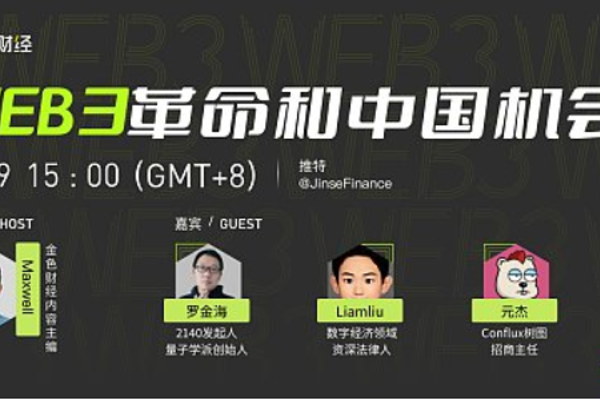
The Golden Finance-hosted event "Calling Web3 from the Center of the World" held its first AMA, themed "The Web3 Revolution and China's Opportunity," featuring Luo Jinhai, founder of Quantum School and initiator of 2140; Iris, a senior legal expert in the digital economy; and Yuanjie, steward of Conflux Tree Graph.

Host: Today’s topic is “The Web3 Revolution and China’s Opportunity.” Since last year—2021—when U.S. lawmakers publicly stated they want to ensure the Web3 revolution happens in America, people have been closely watching whether China will miss this technological wave. Our guests today hold differing views. We have KOL Teacher Luo, Developer-in-the-trenches Teacher Yuanjie, and Lawyer Liu’s team member Iris, who frequently interacts with regulators. Let’s start with brief self-introductions.
Luo Jinhai: I am the CEO of Quantum School and the initiator of the 2140 project—those are my two main roles.
Yuanjie: Hello everyone, I’m Yuanjie. I currently work at Conflux public blockchain. You could say my role is like a business development director—I bring entrepreneurs into the ecosystem and actively communicate with investors and regulators, hoping to create space for innovators. That’s essentially what I do.
Iris: I’m Iris, a lawyer from Lawyer Liu’s team based in Shanghai. Our team specializes in civil and criminal cases in the crypto space, as well as compliance analysis for projects. We’re one of the earliest legal teams deeply focused on this field, having handled around 200 cases, authored two related legal books, and continuously tracked industry practices, laws, and regulatory developments. I’m glad to be here exchanging ideas with all of you today.
Host: Great, let’s begin the AMA. First, each of you please state your position: Will the Web3 revolution be irrelevant to China? And explain why you think so.
Luo Jinhai: It’s not really about Web3 per se—if we trace back to blockchain and early cryptocurrencies, I was already involved in cryptocurrency-related e-commerce platforms and third-party payments as early as 2013. Looking at historical context, China’s early financial policies were relatively mild compared to those in the U.S.
Financial officials represented by Zhou Xiaochuan took a relatively moderate stance toward Bitcoin and the emerging blockchain industry. But after 2017, especially in recent years, the approach has become increasingly rigid—a blanket ban.
If I must state a position, it depends on how we define Web3. In my view, Web3 is still foundational technology—merely an extension of cryptographic techniques. If Web3 is defined strictly as an extension of encryption tech, its development may lean more toward overseas markets. However, if Web3 is defined in connection with visible applications like the metaverse, then there remains significant room for growth within China—it all hinges on definition.
Iris: Personally, I believe Web3 is definitely relevant to China, for several reasons. First, the common argument that it’s unrelated usually stems from concerns over regulation. As lawyers, we deeply understand regulatory logic. I believe future regulation may eventually open up.
Second, there’s talent paying attention to Web3 applications, and there’s consumer demand. Recently, major capital firms like CICC Guosheng and many traditional Web2 players have started entering the space. This indicates substantial latent value in the Web3 ecosystem waiting to be unlocked. Once regulations loosen, building the ecosystem could happen quickly.
Third, current policy issues arise because there’s no better short-term solution than a blanket ban to maintain stability. But once countries like the U.S. and UK pioneer viable paths, China can consider joining later with appropriate liberalization. We wouldn’t be too late—our infrastructure, talent, and technical capabilities already exist.
Yuanjie: Given the current national context, Web3 is a broad field. Within Web3 digital assets, anything directly tied to cryptocurrencies is clearly discouraged by Chinese policy in the short term, so progress there will likely be limited. But digital assets go far beyond just cryptocurrencies.
New categories under digital assets—for example, NFTs—can represent crypto art, PFP avatars, virtual land, wearable items for virtual characters, or membership cards. These forms of digital assets and collectibles are actually encouraged. Although clear guidance on secondary markets is lacking, major internet companies are actively launching primary offerings—even state media and official outlets are issuing them.
I see much of Web3 digital asset development as content-driven—for instance, platforms like Mirror or Poap, or Yuga Labs’ marketing model around Bored Ape IPs. These represent new entrepreneurial directions and experiments in Web3.
Some people challenge me: “Without token economics, how can you call it Web3?” To this, I offer two points:
-
First, while currency issuance isn’t allowed in China, tokens or digital assets aren’t outright banned. For example, ERC-1155 has become a popular standard in China for issuing digital collectibles. While it represents something tangible like an image or membership card, it can still carry price fluctuations and reflect economic logic—thus supporting a token-based economic model without violating regulations. To claim such models are impossible is overly simplistic and dogmatic.
-
Second, many aspects of token economics contain obvious Ponzi-like dynamics. If poorly managed, these can lead to massive collapses and harm users. While early adopters may benefit greatly, newcomers often get hurt. Token economics isn't a panacea—it has flexible room in China but shouldn’t be overused.
I believe Web3 has significant potential in China—you just need to clearly understand our red lines and avoid crossing them. If your project touches sensitive areas, focus on international markets instead of targeting Chinese users.
Host: People care about Web3 and China because they still hold great hope for this land. Today, Web3 is called a revolution—some even compare it to the Age of Exploration. So I’d ask our guests: What fundamentally distinguishes Web3 from earlier eras like Web1 dot-com and Web2 mobile internet?
Luo Jinhai: Let me first respond to the previous topic. Regulatory issues aren’t unique to Web3—we face excessive oversight across too many industries, often without legal basis. This is something we must reflect on. When even legitimate sectors face such heavy-handed control, what does that imply for Web3?
For example, a friend mentioned digital products—we had a project collaborating directly with Tencent, similar to幻核 (Huanhe). Its underlying code was open and technically enabled secondary trading. Yet no one dared implement secondary development or trading. There’s no explicit regulatory issue with digital collectibles, yet no one dares innovate. What kind of signal does that send?
If we define Web3 as evolving from Web1.0 and Web2.0—an era where individuals own databases that are readable and writable—then Web3 means blockchain. And behind blockchain comes token or tokenization: a bearer of value, not necessarily currency. The core of Web3 lies in digital ownership and economic systems; VR, virtual spaces, AR—they’re just surface phenomena.
Web3 gains widespread recognition because tech and finance elites recognize blockchain as the technical backbone, supported by a wealth system that fuels belief. Without financial incentives, would anyone care about the metaverse? Back in 2015, VR alone was enough to amaze us. So inevitably, some form of value representation must exist—not necessarily called a “token,” but something that carries value.
People often rush to label promising innovations as scams, but that’s mostly grassroots noise. From a legal and regulatory perspective, we need clear boundaries. Blanket bans only scare honest builders, not fraudsters. I launched a project called 2140, which we’ve worked on for four to five years. But due to caution around token economics, we’ve had to treat it merely as a regular game.
Even with such a conservative approach, when we partnered with China Post to launch a digital product, they panicked and backed out. Don’t assume authorities fully understand—they’re often confused themselves.
Regarding the host’s second question—why Web3.0 is considered revolutionary—it’s because we’ve seen the transformative impact of Web2.0.
Technologically speaking, Web2.0 wasn’t groundbreaking—it simply made immobile services portable via smartphones. The real revolution was integrating mobile devices into daily lifestyles.
Similarly, I see Web3.0 as a technological extension. If Web3 is truly revolutionary, it’s because every online data interaction can now be converted into personal wealth—that’s the most direct and profound change. Like Web2, it must integrate with lifestyle to matter.
Yuanjie: To me, digital assets mean first owning data, then being able to trade or sell it.
Today, creators can mint an image or video as an NFT and sell ownership directly. Previously, artists could only go B2B—uploading videos to platforms, dependent on intermediaries. Now they can go B2C. This might be the first viable business model emerging from Web3.
Host: Yuanjie, please respond to Luo’s point about China’s regulatory environment.
Yuanjie: China isn’t a financial powerhouse—it remains a manufacturing giant. Adopting a full financialization framework could bring major shocks. I’m not in power, so I can’t predict long-term impacts.
But perhaps opening up to Web3 through regions like Hong Kong or Macau could be a good trial approach.
Host: Regulatory uncertainty is indeed an issue. If Web2 faces such strict oversight, imagine Web3. Iris, what’s your take on the Web3 revolution?
Iris: From a legal perspective, moving from read-write access to ownership—and entering the token economy era—poses major challenges to our current legal system.
Take NFTs: Owning an image should resolve intellectual property rights, yet it spawns new infringement risks. And what exactly do you obtain when buying an NFT? A digital file? Do you gain copyright or IP rights over the physical artwork? Probably not.
Civil law, commercial law, financial law—all may need evolution. Existing concepts like property rights, creditor rights, and asset rights don’t cleanly apply to tokens or NFTs. These are hybrid entities combining elements of property, debt, and intellectual property.
Host: Earlier we discussed regulation—the old saying goes, “Tighten control and it dies; loosen and it becomes chaotic.” So how should regulators, industry practitioners, and ordinary users balance control versus chaos, and innovation versus oversight, under China’s complex regulatory and public opinion landscape?
Luo Jinhai: I think this dilemma can never be fully resolved—it’s rooted in human nature and culture. We promote money-centric values, yet expect people to calmly pursue creation? That’s inherently contradictory.
This is systemic and structural, linked to our social safety nets and cultural values. Without basic security, expecting people to engage in deep technological research or long-term planning is unrealistic. It’s not an individual failure—it’s societal.
Moreover, human biological evolution lags far behind technological advancement. We humans aren’t ready for Web3.0-level tech, so chasing it may be unnecessary.
Web1 brought overall progress, gathered global elites, and advanced globalization. But Web2 showed that technological progress doesn’t guarantee societal advancement—in fact, it fueled populism and anti-globalization trends, which are hard to reverse.
Web3 could be even scarier—if everything becomes financialized, can we handle it?
“Control kills, freedom breeds chaos”—this reflects both structural and human flaws, exacerbated by inadequate social safety nets preventing long-term vision.
Iris: Luo offers a macro view. Drawing from my financial law background, let me discuss balancing regulation and innovation.
First, regulation is essential for innovation. Law is the foundational infrastructure for healthy industry development—it defines innovation boundaries. Laws must keep pace with change and constantly iterate. Effective regulation guides innovation, prevents bad actors from driving out good ones, and although causing short-term pain, ultimately encourages practitioners to seek real value.
Second, finding balance in Web3 regulation remains elusive so far. In China, there are three approaches to regulating financial innovation: First, sandbox regulation—pilot programs—but results have been poor. Second, selective regulation: allow free rein early on, intervene only after problems emerge. This is unfair to genuine innovators. Third, expansive interpretation—applying existing rules broadly through judicial rulings. For example, in securities markets, high-frequency trading tools may be deemed unlicensed securities operations via expanded legal interpretation.
In crypto, China applies a blanket ban—mainly because it’s unclear who should regulate and how. Our financial system and legal frameworks largely follow Western models.
In the U.S., most tokens fall under SEC jurisdiction using the Howey Test’s four criteria—deeming utility tokens as securities, making unregistered token sales punishable. But the SEC can’t possibly monitor everything. The U.S. may pass new legislation next year relaxing the Howey Test, softening past strictness.
Third, despite strong domestic oversight of Web3, numerous investment banks, consulting firms, and VCs continue researching this space. Top university scholars study NFT legal issues, cross-border crypto disputes, and how national financial courts should respond. The Beijing Financial Court was established to expand international financial judicial reach—using judicial interpretation to address innovative financial activities lacking clear legal basis. This is a viable path for civil-law jurisdictions like ours.
Host: To summarize: Regulation needs professionalism to minimize loopholes, and must interact well with society and the public. Next question: With large capital flowing into Web3, where do Chinese internet users stand to gain opportunities?
Luo Jinhai: After publishing my article “Web3 Is Irrelevant to China,” many messaged me privately discussing this.
The most fundamental technologies behind Web3—or blockchain—are not yet mature domestically. Public chains, wallets, high-quality smart contracts—China struggles here. For entrepreneurship, I see potential mainly in blockchain gaming, though it requires persistence, given how many games are just “harvesting韭菜” (scamming users).
Integrating games with Web3 tech—including identity systems and economic models—is promising. Many interactive elements remain Web2-based, but gaming is our strength—especially at the application layer.
Iris: I see promise in two areas. One is GameFi, though still very early—most current projects are ponzi schemes with terrible gameplay. Unless users can earn, they’ll quickly abandon it. Stephen pushed forward by blending virtual and real life, making gaming part of daily living.
Second is crypto art. Currently dominated by generative art, it moves traditional gallery models onto blockchains, offering artists new marketing channels to showcase China’s excellent traditional culture globally.
Third is content creation platforms. Mirror’s user experience isn’t great, but future unicorns could emerge by dramatically improving UX—such applications have real potential.
Yuanjie: We’re building infrastructure—there’s still room for us. Ethereum has limitations—high costs are real issues. We’re also infrastructure builders. It’s not that our technical ability is lacking—it’s constrained by ecosystem maturity. I believe we still have opportunities at the infrastructure level.
At the application layer? That’s where we Chinese excel.
One wallet app in our ecosystem only displays digital collectibles—compliant within China—and already has 500,000 mobile users. It fits domestic regulations, and internationally, we can scale freely.
Xiao Gao: Hello everyone, I’m Xiao Gao, focusing on NFTs—digital asset rights confirmation—and Web3 education. Luo mentioned defining Web3—I’d like to share my thoughts.
Gavin Wood defines Web3 as owning an asset—online or offline—via blockchain integration. If I can use blockchain to verify ownership, independently create and manage it transparently, that’s Web3.
This morning, a friend told me Chinese public chains can’t succeed due to regulatory restrictions. But I see Conflux like Shenzhen during reform and opening-up—Shenzhen was the pilot zone. Experimentation and learning from mistakes there were invaluable. I cherish that spirit and am working hard to promote Conflux and its ecosystem.
These next two years will likely be bear markets. Precisely because of that, it’s the perfect time to strengthen fundamentals, build capabilities, and nurture ecosystems.
Host: I feel these views aren’t contradictory. Despite regulatory uncertainty, innovation and reform attempts continue domestically. Yesterday, Zhou Hang from EasyGo published an article saying Chinese entrepreneurs must enter a new Age of Exploration—top entrepreneurs should go global. These paths can coexist.
Now, for ordinary users—how can average people navigate risks and capture opportunities in Web3?
Iris: Web3 currently attracts mainly programmers and technical folks. I believe bringing in people from diverse backgrounds will make the ecosystem richer and more vibrant.
Capturing upside? Across different sectors, unicorns will emerge. Most individuals can’t deeply analyze every project. If you believe in the overall industry, invest broadly—buy the market.
Yuanjie says: Opportunity depends on depth of participation—the deeper you engage, the greater the reward, and there are countless ways to participate.
Whether joining China’s digital collectible ecosystem, buying fun PFP avatar projects, purchasing crypto art, or dabbling in DeFi and GameFi with small amounts—spend spare time exploring, and you’ll enjoy the benefits.
As someone who lived through the last bull-bear cycle and a finance enthusiast, when DAI was new in 2018–2019, while others traded on exchanges, I dared to move coins on-chain, experiment with MetaMask, Uniswap, Compound—and received UNI airdrops. But I wasn’t chasing airdrops—I followed curiosity.
Approach Web3 with passion and interest, not solely for wealth—and wealth may naturally follow. When the next bull market arrives, all your accumulated behavior in Web3 will pay off.
Many are “airdrop hunters”—I don’t encourage that. It goes against human nature: spending endless hours repeating tasks, even incentivizing mutual reporting among users.
If you want to share Web3 experiences or knowledge, I strongly encourage documenting your learning journey on Twitter. Record daily insights, organize them logically. When writing, you can’t just ramble—you must structure thoughts coherently, forcing deeper thinking, learning, and practice. Even if seemingly meaningless at first, I’ve done this myself—and gained followers, knowledge, and industry rewards through the process.
Host: Thank you, Yuanjie, for that insightful response. Someone famous once said writing delivers exceptionally high returns—it organizes your thoughts beautifully. Web3 keeps launching new products—we need curiosity.
Thank you all for your brilliant insights. I’ve learned a lot this afternoon. Special thanks to our media partners: DeFi之道 (DeFi Dao), Foresight News, Lianbacshou (Chain Catcher), MarsBit News, Planet Daily, Panews, TechFlow, and 0x499 Community.
Content has been edited. For full coverage, please visit the Twitter Space replay.
Join TechFlow official community to stay tuned
Telegram:https://t.me/TechFlowDaily
X (Twitter):https://x.com/TechFlowPost
X (Twitter) EN:https://x.com/BlockFlow_News