
Paradigm: A Step-by-Step Guide to DAO Legal Wrapping Strategies
TechFlow Selected TechFlow Selected
Paradigm: A Step-by-Step Guide to DAO Legal Wrapping Strategies
How legal elements interact with the purpose and operations of a DAO.
 Navigating Web3 tides with focused insights
Chris Brummer, Rodrigo Seira, TechFlow
Author: Chris Brummer, Rodrigo Seira
Translation: TechFlow intern
One of the defining features of Web3 is the ability for individuals to organize themselves in novel ways using blockchain technology, enabling more creative, efficient, and community-driven solutions to problems.
DAOs are a prime example. Compared to 20th-century industrial firms that relied on separated shareholder ownership and centralized control by managers and directors, DAOs offer a fundamentally different template for organizational participation: a structure where ownership and control can be merged through smart contracts, fluid membership, and transparent transaction channels.
But building a DAO involves more than just code—it also requires skilled legal engineering to enable the DAO to operate in the real world and protect its builders and contributors. However, the range and complexity of DAO legal structures can overwhelm even the most talented engineers (and their lawyers).
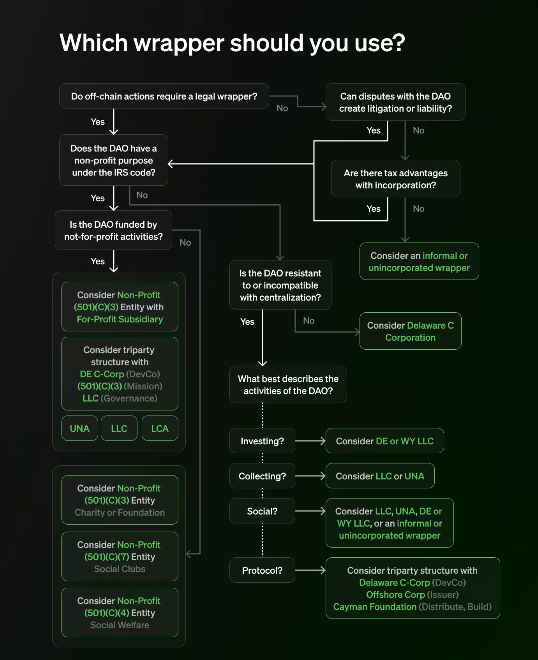
Therefore, in this article, we summarize the impact of legal wrappers on DAOs from our new white paper, which provides founders (and policymakers) with the first comprehensive overview of legal wrappers, paired with a framework to understand how these legal elements interact with a DAO’s purpose and operations.
Strategic Considerations
The potential scope of DAO-related legal entities may be broader than many founders assume, encompassing both commercial association forms and registered or unregistered nonprofit organizations. Given this diversity, we expect most founders will need to go through a similar reasoning process when choosing a legal wrapper.
Key considerations include:
The scope and purpose of the DAO’s operations;
Legal risks and tax liabilities associated with the DAO’s activities;
The size and permanence of the DAO’s membership;
The degree of decentralized governance adopted;
The resources available to the DAO;
Scope of DAO Operations
The need for a legal wrapper largely depends on whether the DAO’s sponsors intend for it to interact with the real world, and whether its activities could expose members to legal or tax liabilities. While informality offers significant benefits in speed and cost, off-chain commercial transactions require formal legal standing. Opening bank accounts, hiring lawyers and accountants, or hosting IRL events all require a legitimate legal identity. DAO sponsors and founders must carefully consider not only on-chain but also off-chain operations, and assess whether practical necessities justify adopting a legal wrapper.
At its core, legal wrapping is about risk mitigation. If a DAO or its members face litigation due to negligence or other issues, informality offers members little legal protection. Founders must evaluate these risks—and consider whether their DAO’s activities could create liability scenarios that extend to members and participants. While no one can predict the future, the potential liability of a simple token-gated Discord DAO is fundamentally different from that of a DAO governing a protocol with billions of dollars in TVL.
Sponsors of larger, more ambitious projects must also consider whether DAO activities could generate tax liabilities that, if unprepared for, might undermine or even jeopardize the project’s financial sustainability. If the DAO generates revenue that could be considered taxable income—such as from token sales, treasury diversification, or staking—founders should analyze who bears responsibility for that income and whether forming a legal entity could clarify liability and enable better tax treatment.
Degree of Decentralized Governance
Each type of legal wrapper entails some level of centralization and dependence on external actors. DAOs should consider how much they are willing to accommodate centralization in their operations. Notably, legal wrappers offer a wide range of options regarding how governance rights are distributed among owners, members, and investors. The DAO and its advisors must conduct a careful internal assessment of its purpose and goals, and analyze how well a legal wrapper can allow token holders to influence the behavior of those operating the legal entity, without risking the entity being disregarded by courts—potentially leading to adverse tax or liability outcomes.
Membership
The nature of a DAO’s membership—whether long-term or fluid—will determine which legal wrappers are available and appropriate.
Early on, DAOs must assess the long-term trajectory of their operations. Due to federal laws and regulations, many legal wrappers have limits on the number of members they can accommodate—often far fewer than the membership sizes of some prominent DAOs. Nevertheless, large-membership DAOs can still leverage other types of legal wrappers, or use traditional structures as “isolated” entities to compartmentalize specific liabilities or serve other purposes.
The liquidity of member entry and exit is another key factor influencing which legal wrappers are most advantageous. Many legal entities require shareholders or members to sign contracts and disclose their identities to formally join—an arrangement that may not suit DAOs aiming for a large, decentralized, and anonymous membership base determined by freely tradable token ownership. However, certain legal wrappers can accommodate more fluid membership or “ownerless” entities such as foundations or trusts designed for specific purposes, like facilitating future donations. That said, such structures may be novel and carry greater legal uncertainty in practice.
U.S.-Related Activities
The geographic location of DAO members and activities within the U.S. will also affect the availability of legal wrappers. Offshore wrappers such as ownerless foundations or trusts may be unavailable or tax-inefficient for projects with substantial U.S. connections. Conversely, projects with minimal U.S. ties may wish to avoid relying on U.S.-based legal wrappers to reduce tax and liability exposure in the United States. Therefore, DAOs should design governance mechanisms controlling their legal wrappers to ensure they do not inadvertently compromise the effectiveness of their legal structure.
DAO Resources
From a practical standpoint, DAOs should consider how many resources they are willing to dedicate to their legal structure. As noted, there is no perfect solution—complex DAOs may require custom structures, which can quickly become expensive. One viable option is to start with a simple structure and evolve over time, especially as the scope of DAO activities and available resources grow.
Legal Wrappers (Quick Overview)
Once founders understand the strategic considerations applicable to their DAO, the next step is to analyze which legal wrappers might be most suitable. Our white paper provides an in-depth analysis of these types, but here is a quick and comprehensive overview:
Unincorporated General Partnership
One risk of operating a DAO without a formal legal entity is that it may be deemed an unincorporated general partnership. While this theory has not yet been tested in court, it carries serious implications, potentially exposing DAO members to liability for the actions of other members or the DAO itself.
Corporation
The most common traditional legal entity helps isolate tax and legal liabilities for DAO projects, though it comes with structural limitations—such as requiring centralized governance via a board of directors—and constraints around membership and taxation. Corporations are often used as DevCos or as isolated entities (e.g., subDAOs) attached to a DAO, aimed at containing specific liabilities or serving special purposes.
LLC (Limited Liability Company)
LLCs are widely used in traditional settings and can offer greater structural flexibility than corporations, particularly in governance. LLCs can be member-managed and allow members to waive fiduciary duties toward each other, making them more compatible with decentralized governance. Some U.S. states have even passed specific DAO LLC laws to facilitate DAO operations. However, DAOs with very large or fluid memberships may face limitations in using LLCs, and even member-managed LLCs retain certain centralized aspects (e.g., tax representatives).
Nonprofit Options
DAOs with charitable missions may seek to form a nonprofit entity and apply for tax-exempt status in the U.S. This path grants legal personality and significant tax advantages, but restricts the DAO’s operational scope and its ability to distribute profits to members. Some projects adopt multi-entity structures combining for-profit and nonprofit entities.
UNA
An UNA (Unincorporated Non-Profit Association) functions similarly to a nonprofit general partnership. In certain states, it can offer limited liability to members and may elect to be taxed as a corporation by the IRS. UNAs may also provide a more flexible framework for fluid membership. While restricted in distributing profits to members, they can engage in some revenue-generating activities—though this may jeopardize their tax-exempt status. A drawback is that UNA regulations vary significantly by state, and there is little case law, making outcomes difficult to predict.
Co-Ops
Co-ops are a form of legal wrapper with a long history in the U.S., offering an alternative to the traditional corporate model by integrating ownership and control, typically requiring all members to be both owners and contributors. Some states have modernized co-op frameworks allowing investor participation and modifying the standard one-member-one-vote rule, prompting some DAOs to experiment with this structure.
Ownerless Foundations
Ownerless foundations are legal wrappers offered in certain offshore jurisdictions, functioning similarly to trusts governed by a board or council, which in turn can be directed by DAO voting. Such foundations can be used to disburse grants to further protocol development. However, DAO members are not owners of the foundation nor fall within its legal scope. Projects based in the U.S. face restrictions on controlling offshore foundations to preserve tax advantages and liability protections.
Special Purpose Trusts
This legal wrapper refers to a trust structure available in certain offshore jurisdictions, created by transferring assets to a set of trustees who then act according to voting instructions from DAO token holders. Trustees are subject to oversight by regulators and can be sued if they act improperly. Similar to ownerless foundations, such trusts can be used for asset custody, distribution, and entering legal agreements. A key advantage is that no government filings are required, as the structure arises purely from contractual arrangements between the person providing assets and those holding them.
Join TechFlow official community to stay tuned
Telegram:https://t.me/TechFlowDaily
X (Twitter):https://x.com/TechFlowPost
X (Twitter) EN:https://x.com/BlockFlow_News
 Paradigm