








Where the internet runs aground
TechFlow Selected TechFlow Selected
Where the internet runs aground
Web, Web 2.0, Web3—this is a path forward.
 Navigating Web3 tides with focused insights
By MasterPa
On April 4, 1957, Canadian diplomat Norman Herbert committed suicide in Cairo, sending shockwaves through Japanese public opinion. Nearly every intellectual and cultural figure in Japan was discussing the incident. The immediate cause of Norman's death was years of investigation by a U.S. Senate subcommittee on internal security, which accused him of being a Communist—a charge tantamount to social death during the era of McCarthyism.
Canada, Japan, and the United States—three countries linked together by one man.
Though Canadian by nationality, Norman was born and raised in Japan. His parents were missionaries who had come to Japan. At age 19, he returned to Canada to study at the University of Toronto, then went on to Cambridge. After graduation, since his parents still lived in Nagano, Japan, and because he was deeply passionate about Japanese history, he applied to the Canadian Foreign Service for a posting back to Japan.
Upon returning to Japan, Norman completed one of his seminal works, Soldier and Peasant in Japan: The Origins of Conscription. In it lies a famous line—also a reflection of his views on Japan’s political climate at the time:
"A free man cannot enslave others. But the cruelest, most shameless slave will become the most ruthless and violent depriver of another's freedom."
After the outbreak of war between Japan and the U.S., Norman, as a national of an enemy country, was repatriated. While waiting in Mozambique for personnel exchanges between the two governments, he encountered Tatsuo Doi, a Japanese scholar he had known from his research days at Harvard. Doi, a left-wing liberal intellectual well-versed in Marxist economics, dared not bring his personal documents and correspondence back to Japan. He entrusted Norman to safeguard them—and gave the books to him.
After the war, Norman returned to Japan as part of the Allied occupation forces. A devout Christian and, like Doi, a left-leaning liberal historian, he hoped to contribute to Japan’s postwar reconstruction. He performed exceptionally well and earned the deep respect of General MacArthur.
But this was also the time when McCarthyism began sweeping across America—an anti-Communist witch hunt. Naturally, Norman’s political affiliations came under scrutiny. Whether in Japan or the U.S., he had many friends among Communists. As early as around 1942, the FBI had begun monitoring him. And fatefully, while Doi took back only the books, the letters remained—and were seized by the U.S. government. Among those letters were correspondences with known Communists.
Beginning in the 1950s, the U.S. Senate Internal Security Subcommittee began leveling accusations against Norman. In 1957, the committee held another hearing, insinuating that Norman and others had conspired to overthrow the American government. Coincidentally, Doi had been invited by Harvard University to lecture in the U.S. that year, and the subcommittee summoned him to testify.
Having spent years under militarist Japan, Doi had no idea that America was no longer the country he once knew—the America still basking in the afterglow of Roosevelt’s New Deal. Unprepared for what awaited him, he assumed that as a guest of Harvard, he should avoid causing trouble for the university and simply comply with the hearing; surely, the subcommittee would show courtesy to a visiting scholar and go through the motions.
What awaited him instead was a grueling two-day interrogation. It was then that he discovered the U.S. government already possessed the old letters. The subcommittee tried to pressure Doi into naming Communists—including Norman. Doi struggled to protect Norman without implicating anyone. In the end, he admitted only to three individuals already known to the committee, and beyond “yes” said almost nothing else.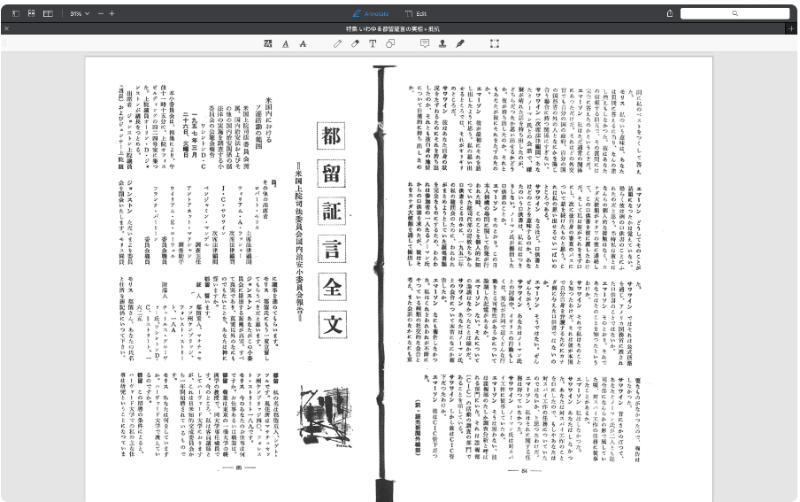
Full text of Doi's testimony
Eight days later, Norman died by suicide in Egypt. Japanese media extensively covered the event, blaming Norman’s death squarely on Doi’s testimony. Doi was thus thrust into immense public pressure.
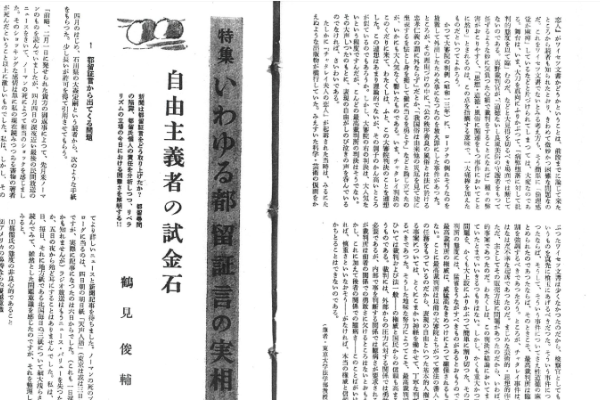
Kojin Karatani, a Japanese intellectual and friend of both Doi and Norman, wrote an essay titled "The Liberal’s Touchstone." Karatani argued that it was profoundly wrong for the Japanese press to target Doi—who was himself a victim—as the culprit. The U.S. Senate Internal Security Subcommittee had no right to summon Doi in the first place. As Karatani wrote:
"America is sometimes fascist, sometimes democratic. That is precisely why victims of war are pushed to the front—to make them appear as perpetrators."
Yet the Japanese media failed to recognize this, becoming unwitting accomplices of the subcommittee.
Still, Karatani did not spare his friend Doi. He pointed out a critical flaw: while Doi had indeed tried hard to protect Norman, he had not extended the same effort to protect Communists whose ideologies differed from his own. The three names Doi ultimately provided were drafters of key American Marxist policy documents. Karatani acknowledged that, given Doi’s exhaustion, naming these three—already known to the committee—was understandable. He admitted he might not have done better himself.
But Karatani went further, raising a vital question:
Doi is a liberal. He fought hard to protect Norman, who shared his stance. Yet he did not fight equally hard to protect Communists, whose views differed from his own.
According to Karatani, this reveals the dilemma of modern liberalism:
No nation today can claim to represent liberalism. Therefore, modern liberals must examine carefully which systems they choose to align with. Liberals can cooperate with capitalism, or with communism. But in different societies, the pressures differ. In a capitalist society like America, liberals face little pressure, while Communists bear the brunt. If liberals refuse to endure the pressure of aligning with Communists, then they abandon the very principle of liberalism. This, then, is the liberal’s touchstone.
Seven years later, this essay was selected as one of the most representative postwar essays in Japan.
Sixty-five years later, I began studying this history. For anyone researching postwar Japanese intellectual thought, Norman’s death is an unavoidable subject. So I set out to find Karatani’s original text.
I found myself stranded. On the internet.
Searching in Chinese yielded nothing—understandable. Not knowing Japanese, I turned to English. Nothing there either.
Fine, try Japanese—worst case, use translation software. The article was easy to locate in Japanese academic databases, but no digital version existed. For a week, in my spare time after work, I kept searching. No luck. I enlisted outside help, asking Ke Da to check the library at the University of Pennsylvania. He assured me Penn’s Asian collections were comprehensive—but even they didn’t have it.
This was earlier this year. One night at the end of April, just before bed, I suddenly felt I *had* to find this essay. A few days later, I finally located it within a book. But the book was only available secondhand from Japanese websites. No big deal—I could use a proxy buyer. The proxy accepted cheerfully, then messaged me: "Hey, personal courier services between China and Japan are temporarily suspended. No idea when they’ll resume."
Refund, please.
Then I discovered—Taobao actually offers a service to download Japanese academic papers! Found a shop, and the owner said he’d found it and would go to the library after work to download it. He added, “If you’d ordered half an hour earlier, I could’ve gotten it done today.” No matter, one night wouldn’t hurt. Excitedly, I waited to read it the next day.
Bad news: the shopkeeper went to the library and found the article wasn’t available for download.
This kind of obstacle might stop some, but not me—this time, it didn’t. "The Liberal’s Touchstone" wasn’t published alone; it appeared alongside other essays in a special issue of *Chūō Kōron* dedicated to Doi’s testimony. *Chūō Kōron* is a long-standing, major Japanese magazine, and in theory, every issue should be archived. Sure enough, the June 1957 edition could be found in libraries—just not in digital form.
And the June 1957 issue of *Chūō Kōron* could only be obtained by formal request: the library would photocopy it and mail it to the shopkeeper via registered mail. Only after receiving the physical copy could the shop scan and send it to me—an unusually complex process. From May 13 to June 5, I waited over twenty days before finally receiving the scanned pages.
From the beginning of the year until now—half a year has passed—before I finally laid eyes on this essay. In the age of the internet, this seems inconceivable. Even though Japan isn’t particularly known for its digital infrastructure, that such an important essay should require such effort to access still feels astonishing.
Neither trillion-dollar search engines nor increasingly powerful artificial intelligence could help me here. This is where we all run aground.
But perhaps this shouldn’t surprise us. If you work in humanities or history, this may be your daily reality. Consider this: China has a highly developed internet industry, yet if you tried today to find the exhibition catalog of your local most prestigious museum, you’d likely hit the same wall. Living in Beijing, for example, if I want to know whether a particular national treasure is currently on display at the Forbidden City, chances are I’d have to go there in person to find out.
There are countless such examples, even beyond niche academic fields. Suppose I want to travel today—many rural attractions outside cities have scarce online information, sometimes only a single photo taken ten years ago. During the pandemic, figuring out local防疫 policies (epidemic prevention measures) often couldn’t be resolved with a simple web search.
As someone working in tech and the internet, we often talk about Web3, blockchain, NFTs—these days. The concept of Web3 is intriguing because it implies a narrative: Web → Web 2.0 → Web3, a linear progression forward. The previous era is complete; all it needs to do is wait for the next technology to usher in a new age. In the Web3 era, there’s no need to study Web or Web 2.0—they’re outdated relics from the 1990s. Once a technology matures, the only thing left is to move on to the next.
So, what Web generation does putting an academic paper or a museum’s exhibition catalog online belong to?
In today’s discourse, we prioritize technological innovation far above technological diffusion. But innovation and diffusion should be equally important. Our obsession with the “new” has become dogma, while diffusion is dismissed as merely serving the “lower-tier markets.” Only after the elites in urban centers grow bored do we consider spreading it elsewhere.
I have a friend who went to Africa to build dams. Before he left, he told me:
"Hanyang, what you do is high-tech. The dams I’m building aren’t cutting-edge by Chinese standards today. If we wanted to, we could build the world’s best dams. But for Africans, a dam is ten thousand times more advanced than the internet. Without dams, there’s no electricity. Without electricity, there’s nothing.
Electricity, and the industry it powers, will fundamentally transform how people live. Their children will learn how the world works, understand how society functions, know Mendel, know Faraday, know how to take control of their own lives. They will no longer blindly bear many children, only to watch most die young, unaware of why, and never seeking answers. They will enter an entirely different nation, and become entirely different people."
In our current age, technology has largely been reduced to information technology. Within IT, any technology not currently trendy is too embarrassed to be considered a worthwhile idea. But dreams remain fantasies. There is no world where a new technology becomes globally dominant overnight. What exists instead is time.
Time is the enemy of technological renewal, yet it is only through time and persistent effort that new technologies become mature, and mature technologies become universally accessible. Whether it’s a dam, or a paper that can’t be found online.
Join TechFlow official community to stay tuned
Telegram:https://t.me/TechFlowDaily
X (Twitter):https://x.com/TechFlowPost
X (Twitter) EN:https://x.com/BlockFlow_News






