Conversation with 500 Global: The Web3 Investment Methodology of a Silicon Valley VC
TechFlow Selected TechFlow Selected
Conversation with 500 Global: The Web3 Investment Methodology of a Silicon Valley VC
Silicon Valley VC's Web3 investment strategy.
 Navigating Web3 tides with focused insights
By: 500 Global
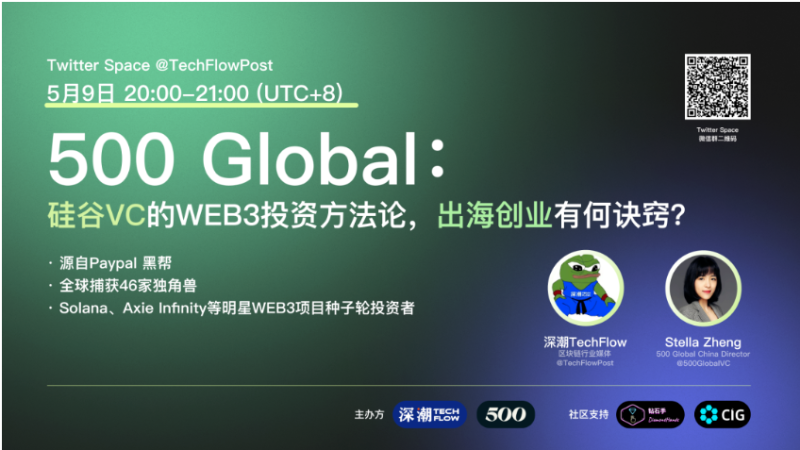
This past Monday, TechFlow, the Diamond Hands community, and Stella Zheng, Head of 500 Global China, held an AMA to share Silicon Valley VC's Web3 investment strategies. Over 180 people participated in this session. Below is a selection of insights shared by Stella during the AMA.
Q: What kind of firm is 500 Global?
A: 500 Global was originally known as 500 Startups—one of the most active early-stage VCs globally, on par with Y Combinator. The name came from our initial goal to invest in 500 startups. Today, we’ve invested in over 2,600 startups worldwide, including 46 unicorns and more than 120 near-unicorns. As such, we've built a highly successful portfolio across internet and software investments.
Our founder emerged from PayPal’s “mafia.” Dave initially worked with Peter Thiel at Founders Fund before co-founding 500 Startups with Christine. Our roots and DNA are deeply rooted in software. Our strategy has always been global, making small, frequent investments.
Q: As a Web2-focused Silicon Valley VC, how did you identify and invest in early opportunities like Solana and Axie Infinity?
A: Since we focus on very early-stage investments—pre-seed and seed rounds—we don’t impose strict limitations on sectors. We prioritize product, team, and vision. When we invested in Solana back in 2018, our Greater China team had only four members. Guided by our cross-border investment philosophy, we began exploring blockchain projects. At that time, we didn’t just back Solana—we also invested in several Chinese public chains. Ultimately, Solana became our biggest success, exceeding expectations.
We were primarily focused on layer-1 blockchains, so we invested in multiple chains and invited Solana into our San Francisco accelerator for a three-month program. Celer Network was part of the same cohort. As for Axie Infinity, it was backed by our Vietnam team. It was Eddie, partner at our Vietnam fund, who insisted on the investment. At the time, Axie had only 400 users and zero institutional funding history. Both projects were first funded by our thematic funds, followed by investments from the main 500 Global fund.
Back then, deal sourcing wasn't as competitive as it is today. Few VCs were investing in crypto, so identifying strong projects and convincing them to take our capital wasn’t particularly difficult. But if you ask whether we had perfect foresight or uniquely sharp eyes for winners—it wasn’t quite like that. I think we simply executed our investment strategy consistently, which naturally leads to one or two breakout teams. Honestly, predicting exactly which ones will succeed isn’t something anyone can do with 100% certainty. No one can perfectly predict the future.
Q: What factors do you consider when evaluating a project? What is your investment methodology?
A: Having operated for 12 years, we certainly have a well-defined methodology. Generally, we look for teams that already have a product—ideally an MVP or prototype. Even though we invest at the seed stage, we rarely back teams without a working product unless they’re a superstar team with exceptional pedigrees. That said, we actually prefer founders who are pragmatic rather than those boasting big names.
Regarding market evaluation, we conduct our own analysis. If the total addressable market (TAM) is too small, we won’t invest. Our logic is clear: a startup must have the potential to become a unicorn; otherwise, it’s not worth investing. One unicorn can offset 100 failed investments and cover all costs. Therefore, our success hinges on winning big. This is why we pay close attention to Web3—it’s a space full of possibilities.
We actively monitor Data Infrastructure, Middleware, DApps (GameFi, SocialFi), and DAO tooling. However, we approach these from a traditional VC perspective—focusing on scalability and ease of exit.
There isn’t any singular hot trend dominating Silicon Valley right now—funding activity spans various directions. While GameFi/NFT raised the most capital in Q1 2022, there’s no need for us to chase trends. We care more about growth potential over the next three to five years, not FOMO.
Many ideas aren’t new. Back in 2018, we saw e-scooter-related crypto projects in Silicon Valley—though they weren’t called "X-to-earn" then, the core concept of mining through user behavior was already present. Those projects didn’t take off until Axie popularized play-to-earn, after which many similar X-to-earn models emerged. So I don’t believe in fleeting “trends.” At its core, business remains the same—even in Web3, you must achieve product-market fit.
When assessing Web3 projects, I pay special attention to whether their Unique Selling Proposition (USP) makes sense. Then, I evaluate whether this USP offers a better experience than its Web2 counterparts. In my view, most crypto projects today mainly enhance liquidity, amplify financial attributes, and strengthen user incentives—essentially addressing financial problems.
Take Solana Pay, for example—I recommend trying it if possible (I haven’t yet, being based in China). It’s disruptive: transactions are fast and seamless. That’s real product adoption. In short, as a traditional VC, we avoid FOMO. We want to see tangible, usable products and hope to witness Web3 innovations that genuinely improve our economy and lifestyle.
Q: Recently, articles and discussions around “China has no Web3” have gained traction. How do you view Chinese entrepreneurial teams in this space? Do you have recommendations for financing, investment, and development for Chinese founders?
A: We’ve never evaluated startups based on ethnicity. Our co-founder Christine herself is of mixed Chinese and Korean descent, and we’re one of the top VCs in the U.S. supporting underrepresented minorities. We deeply value diversity. I’ve never believed that “there are no great Web3 founders from China.” Some of the world’s best entrepreneurs can come from anywhere.
Innovation centers are no longer centralized in Silicon Valley. Today, innovation is distributed—we see outstanding founders emerging from Korea, Japan, Southeast Asia, Australia, and beyond. China is no exception. Regulatory constraints have certainly impacted Chinese entrepreneurs. Since 2017–2018, domestic teams have largely been limited to consortium chains. Many Chinese teams went overseas, but few achieved major success. To some extent, this goes beyond regulation—it reflects gaps in mindset, strategic understanding, and international operational capabilities among Chinese Web3 teams.
That said, we’re closely watching the new generation of Web3 Chinese founders, who may hold advantages at the application layer. Projects like StepN demonstrate faster development cycles and stronger user proximity. Infrastructure may still be immature, but it will gradually improve. Chinese founders should leverage their strengths and focus on areas where they excel.
China has over 5 million developers, yet monthly active Web3 developers globally number only around 18,400—with even fewer from China. This gap highlights both a challenge and a massive opportunity. I don’t believe Chinese teams will miss out on Web3—they’ll just need to find the right entry point. Legal, compliance, and regulatory issues are manageable; the real challenge lies in user acquisition. You can currently attract users via simple tokenomics, but what comes next? Will existing incentive models continue working? How do you quickly find users and motivate them effectively? We’re eager to see breakout products emerge.
On fundraising, I’ve interacted with several Chinese crypto funds. They’re agile and often collaborate in groups, but their evaluation frameworks differ from North American or global VCs. Ultimately, it depends on what kind of product the team wants to build and which market they’re targeting. The right investor can provide meaningful value-add.
Today, numerous public chain hackathons and vertical Web3 accelerators exist. Many VCs and accelerators don’t restrict by sector. For teams aiming to go global, I encourage engaging with international VCs and accelerators. Present your project using narratives that resonate with global investors—it will help open doors to overseas markets.
Q: We noticed you recently launched an initiative to support Chinese entrepreneurs building Web3 products from scratch and expanding overseas. Can you tell us more about this effort? What kind of founders are you looking for, and what value can you offer?
A: Yes, this is a new initiative I recently launched—a dedicated Web3 vertical program called HaveTo Studio. Building on what we discussed earlier, we aim to identify talented developers, artists, and community operators in China who are passionate about Web3. Through screening and mentorship, we’ll help form globally-ready early-stage teams, invest in them, and support their international expansion.
I believe this leverages our brand strength. After all, we’ve backed over 2,600 startups and are connected to more than 5,000 founders—98% of whom operate outside China. Unlike our previous accelerator programs, this model involves deeper engagement and broader oversight, resembling a venture studio approach.
So let me put out a call—if you're ready to start a company, have the skills to execute, but lack overseas operational experience or brand credibility, join us. This represents a significant opportunity for Chinese Web3 founders. We aim to deliver real value-add and build something impactful together.
Join TechFlow official community to stay tuned
Telegram:https://t.me/TechFlowDaily
X (Twitter):https://x.com/TechFlowPost
X (Twitter) EN:https://x.com/BlockFlow_News