








How to Make $113 Million in 4 Months Through Stablecoin Arbitrage?
TechFlow Selected TechFlow Selected
How to Make $113 Million in 4 Months Through Stablecoin Arbitrage?
Stablecoin arbitrage is not a bridge too far; on the contrary, it can take you somewhere above the rainbow, high up in the sky.
 Navigating Web3 tides with focused insights
Author: EigenPhi
Translation: TechFlow intern
Top Five Takeaways
1. The MIM-UST arbitrage strategy has generated over $113 million in profits over the past four months.
2. It is essentially an advanced form of flash loan that requires no capital investment—only gas fees—and yields up to 650x returns, without needing to pay high miner bribes like sandwich attacks or possess smart contract coding skills.
3. This strategy has operated quietly on low-profile liquidity pools, thus escaping public attention, especially from sandwich attackers.
4. By using a flash loan approach, the strategy avoids exposure by not holding positions during transactions. Utilizing two stablecoins also reduces uncertainty caused by a single stablecoin depegging.
5. Tools like EigenPhi provide insights into the ever-increasing liquidity available via flash loans, offering nearly infinite free leverage—an opportunity such strategies exploit and warrant close attention.
"Work silently, let your success make the noise." — Anonymous
For months, MEV chatter around NFTs, sandwich attacks, and Flashbots has been deafening. To exploit these strategies, one must know how to weave complex logic into smart contracts—navigating various tokens and liquidity pools—which demands development, constant updates, and debugging as protocols evolve. Not to mention the massive capital required for successful sandwich attacks, especially involving stablecoins.
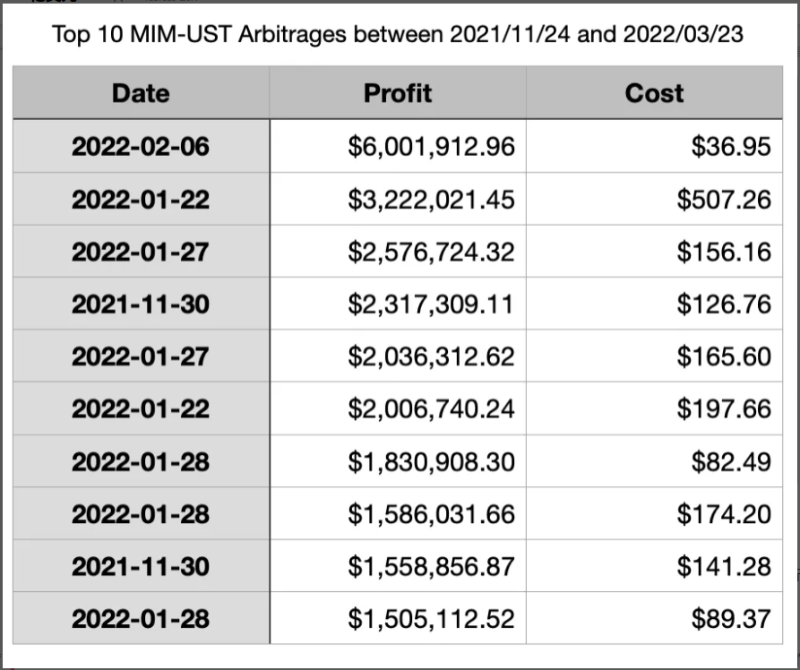
Yet since November 14, 2021, a simple arbitrage strategy between just two stablecoins—MIM and UST—has earned over $113 million in profit without deploying any custom smart contract. Over this four-month period ending March 23, 2022, it executed 1,419 profitable transactions under the radar, averaging $80,096 per trade with a cost of only $122.50. The highest single profit reached $6,001,912. Overall, the MIM-UST strategy achieved a return of 650x.
This article is the first deep dive into this phenomenon.
To a regular crypto investor, this entire process resembles someone sneaking into a McDonald's franchise unnoticed, discovering the secret menu, adjusting the fryer settings, and preparing a Kobe beef meal at the cost of a small fries. Meanwhile, others are stuck queuing up for sausage, egg, and cheese biscuits.

As the only DeFi MEV and arbitrage big data platform, EigenPhi uses internal algorithms to detect astonishing arbitrage opportunities hidden within countless seemingly ordinary transactions and discloses them publicly. Since uncovering this strategy, our sharp team has been monitoring the situation around the clock. But first, let’s dissect one of these trades to bring awareness to relevant parties.
The Four Pillars Behind the Strategy:
1. A strategy using only two stablecoins can generate abnormally high profits well above average.
2. Using two stablecoins minimizes risk from a single stablecoin depegging.
3. No programming is required to execute the strategy, making it highly productive and reducing operational expenses (OPEX).
4. No position is held during execution, eliminating exposure, while taking advantage of abundant arbitrage opportunities created by algorithmic stablecoin depegs.
Now, we can delve into the details to expose the mechanics.
Cracking the Magic
First, the strategy is fundamentally a flash loan practice—meaning you borrow tokens, earn profit, pocket it, and repay the loan—all within a single transaction. If anything goes wrong during execution, the lender loses nothing because the entire process reverts.
Typically, one would need to know how to code a flash loan. Not here. We’ll use a disclosed transaction via Eigenphi.io to understand how it works.
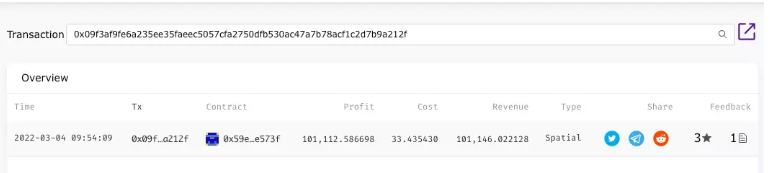
This trade made over $101,000 in profit while spending less than $30.10 in gas and swap fees across liquidity pools. We classify this arbitrage type as spatial arbitrage. Typically, spatial arbitrage involves identifying exchange rate differences for a specific token across different liquidity pools—commonly between Uniswap and Sushiswap. Traders benefit from exploiting price discrepancies. But here, something entirely different occurs.
Opening the transaction details on Etherscan reveals five participants collectively enabling the magic.

1. The contract starting with 0x59e: MIM CauldronV2 Lending Protocol, deployed by the Abracadabra.money team. It:
"Allows users to open loans, borrow MIM, leverage positions, and repay. Abracadabra.money is a lending platform that uses interest-bearing tokens (ibTKN) as collateral to borrow a USD-pegged stablecoin (Magic Internet Money—MIM), which can be used like any other traditional stablecoin."
2. The address starting with 0xd96 is Abracadabra.money’s Degenbox, deployed by Abracadabra.money, allowing creation of strategies for internally held assets. Degenbox is a vault for loans, particularly for UST here. The aforementioned Cauldron is built atop Degenbox.
3. The address starting with 0xff4 is the USTSwapper, deployed by Abracadabra.money.
4. The address starting with 0x55a is a Curve Plain Pool liquidity pool on Curve.fi for MIM-UST swaps. External actors set the exchange rates here.
5. The address starting with 0xb98 is the trader who initiated the transaction.
The diagram below illustrates the token exchange process.
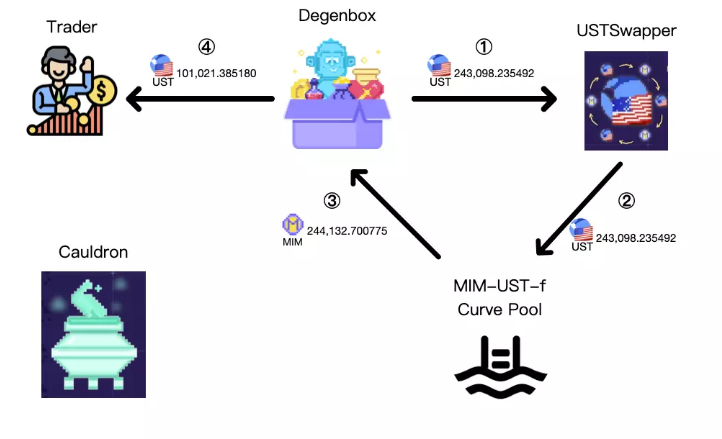
1. The trader borrowed 243,098.235492 UST from Degenbox and called USTSwapper.
2. The trader instructed USTSwapper to swap 243,098.235492 UST into 244,132.700775 MIM at the rate offered in the MIM-UST-f Curve pool.
3. The trader directed that 244,132.700775 MIM be sent back to Degenbox to repay the borrowed amount.
4. The trader instructed Degenbox to convert 244,132.700775 MIM back into UST and settle the loan taken in step 1. Based on its own published rate, Degenbox returned 344,119.620672 UST—retaining 243,098.235492 UST for the loan repayment and leaving 101,021.385180 UST as profit. The trader immediately withdrew the 101,021.385180 UST. Transaction complete.
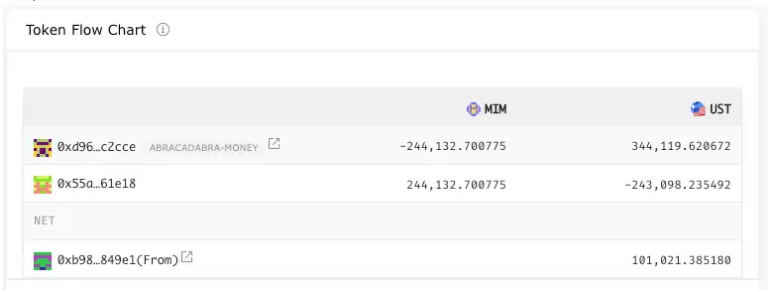
On EigenPhi, we simplify this confusing process by showing only meaningful transaction flows in the token flowchart below. You can see two liquidity pools involved. The first row shows Degenbox: the trader sent 244,132.700775 MIM and received 344,119.620672 UST. The second row is the MIM-UST-f Curve pool, where the trader received 244,132.700775 MIM in exchange for sending 243,098.235492 UST. The last row shows the trader gained 101,021.385180 UST as net profit.
But what incantation did the trader use to make all this happen undetected on a widely promoted DeFi lending platform?
We must dive into the code level to discover how the trader adjusted the fryer using the secret menu.
Code Dive: From Inside Out to Golden Ticket
Note: Continue reading only if you're interested in precise technical details. Otherwise, skip ahead—we simply want you to realize the trader possessed deep knowledge of the Cauldron V2 protocol, skillfully combining several internal methods like Lego blocks to execute a flash loan without writing or deploying a smart contract.
1. The trader used the cook() method of the Cauldron V2 protocol, assembling a set of executable instructions into a single transaction parameter—this is the prerequisite for a flash loan. Importantly, the cook() method can execute off-chain.
2. The trader called the ACTION_UPDATE_EXCHANGE_RATE method, triggering the contract’s internal accrue() function to access borrowable assets.
3. The trader invoked the internal _removeCollateral() method of Cauldron V2 to withdraw UST.
4. The trader called USTSwapper to swap UST for MIM.
5. The trader used the internal _repay() method of Cauldron V2 to return MIM to Degenbox and claim the arbitrage profit.
6. The _removeCollateral() method was called again to release the collateral.
7. The trader called the withdraw() method to withdraw the UST position. End.
Further exploration revealed that Degenbox’s code is a fork of SushiSwap’s vault: BentoBox, the foundation of Kashi—a lending and margin trading platform.
In summary, two key tools are needed to successfully execute this strategy:
1. Mastery of the cook() method in Cauldron V2, eliminating the need for tedious coding, debugging, and deployment.
2. Constant monitoring of exchange rate spreads to identify optimal timing.
Of course, only a few dollars worth of ETH were spent on gas—minimal cost, maximum gain.
Now, let’s check how many guests joined this private party.
Guest List at the Banquet Table
From November 14, 2021, to March 23, 2022, 1,086 trader addresses executed this strategy 1,419 times, as shown in the chart below. Blue bars represent daily transaction counts.
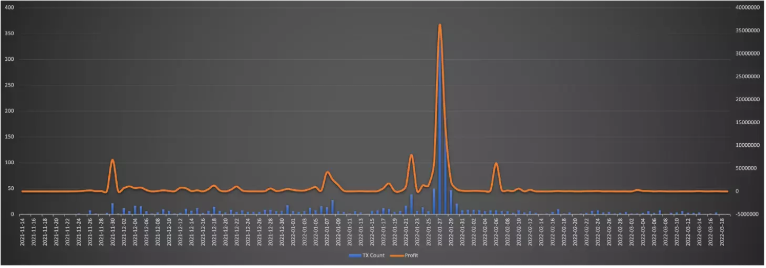
For easier readability, the next chart applies logarithmic scaling to profit amounts.
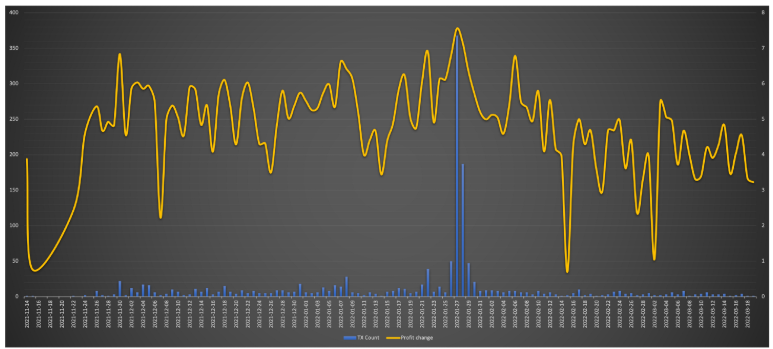
Profits and transaction volume peaked on January 27 and 28—the days when 0xSifu, CFO of "Frog Nation"—a loose collection of projects including Popsicle Finance, Wonderland, and Abracadabra—went public. The news severely impacted MIM, sparking speculation about its depeg from the dollar. On the 27th, MIM dipped to $0.9735; on the 28th, to $0.9776. These fluctuations created extraordinary arbitrage opportunities.
During these two days alone, 555 transactions captured over $50 million in profit out of the total $113.7 million across 1,419 trades—illustrating a perfect MEV storm triggered by diverging token exchange rates.
The table below shows the top 10 most profitable arbitrages using the MIM-UST strategy over its entire duration. We share data—including trader addresses and transaction IDs—for all 1,419 trades in the table. Please feel free to DYOR.
Conclusion: Stablecoins Can Fly You Over the Rainbow
Stablecoins are often seen as anchors on the blockchain. Stability implies low volatility, which usually means low returns. Yet the MIM-UST arbitrage strategy delivered a staggering 650x return, defying conventional wisdom—all thanks to its core mechanism: flash loans.
Over the past two years, flash loans have become the monetary multiplier in DeFi, introducing nearly unlimited, almost-free leverage powered by liquidity. EigenPhi’s data shows that 100% of arbitrage on DEXs is either flash loans or flash swaps. Therefore, similar scenarios demand special attention.
Leveraging knowledge and insights derived from DeFi big data, EigenPhi publishes findings on flash loan arbitrage to foster a healthier DeFi ecosystem.
For now, flash loans have thrust stablecoins into the Wild West. With proper understanding of newly created protocols, tools like EigenPhi, and unrestricted thinking and imagination, stablecoin arbitrage is no distant bridge. Instead, it can carry you somewhere above the rainbow—high and beyond.
Join TechFlow official community to stay tuned
Telegram:https://t.me/TechFlowDaily
X (Twitter):https://x.com/TechFlowPost
X (Twitter) EN:https://x.com/BlockFlow_News
 EigenPhi MEV Alert


