L’essor des marchés à terme pilotés par l’intelligence artificielle : pourquoi le trading manuel de cryptomonnaies est en voie de disparition
TechFlow SélectionTechFlow Sélection
L’essor des marchés à terme pilotés par l’intelligence artificielle : pourquoi le trading manuel de cryptomonnaies est en voie de disparition
L’intelligence artificielle transforme rapidement les marchés de trading. Des algorithmes exécutent déjà la majorité des transactions mondiales, et le marché cryptographique, qui fonctionne 7 jours sur 7 et 24 heures sur 24, accélère encore davantage cette tendance.
 Dédié à des analyses Web3 approfondies
Introduction
OneBullEx is pioneering and defining a new category of cryptocurrency exchange by integrating AI trading infrastructure with an all-in-one execution toolkit designed specifically for futures traders. This marks a profound shift in how crypto platforms are built: intelligence, execution capability, and system-level efficiency are now becoming as critical as market access itself.
Financial markets have always been shaped by technology—from floor traders shouting orders to the emergence of electronic order books and sophisticated algorithms. Today, artificial intelligence (AI) is reshaping the futures market—and, by extension, the crypto market. In modern, 24/7 cryptocurrency exchanges, AI trading is increasingly becoming a decisive variable. Early crypto trading relied heavily on manual strategies and emotionally driven decisions; the rise of AI-powered trading is steadily rendering such approaches uncompetitive.
While blockchain originally promised decentralized ownership, this promise has been weakened in the crypto futures market. Traders may enjoy market access—but often at a cost to asset security, time investment, and decision-making autonomy. This deeper tension underpins the rise of AI-driven futures trading. The value of automation is expanding beyond speed toward reclaiming control: traders use it to regain command over their execution rhythm. This article traces the evolution of trading, then explores high-quality data, AI models, differences between manual and automated trading, and addresses risks, regulatory responses, and hidden trends emerging from this transformation. Within this context, platforms like OneBullEx—by combining AI trading infrastructure with integrated execution tools tailored for futures traders—are beginning to define a new class of cryptocurrency exchange.
The Evolution of Trading: From Floor Shouting to AI
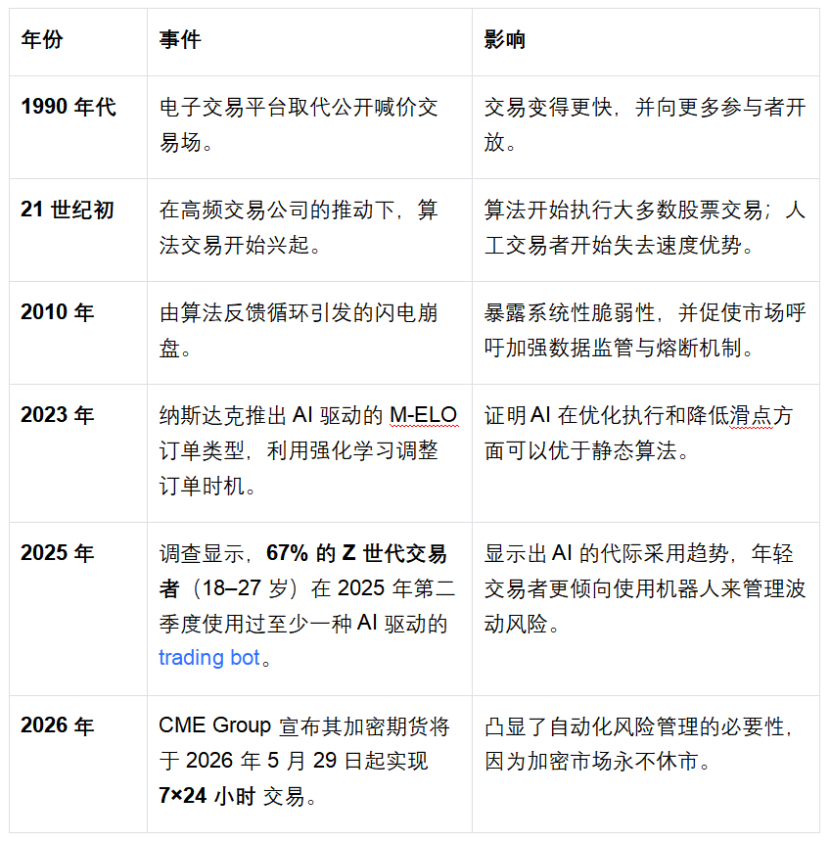
Trading has undergone multiple paradigm shifts. Early markets relied on open outcry—a face-to-face method for trading commodities and equities. With the rise of electronic exchanges in the 1990s, orders began being matched via electronic order books. Algorithmic trading emerged in the early 2000s and had become dominant by the late 2010s. Researchers estimate that today 60%–70% of trades on major exchanges are executed algorithmically—indicating machines already control liquidity.
A pivotal moment occurred during the 2010 Flash Crash, when feedback loops among algorithmic systems caused the Dow Jones Industrial Average to plunge nearly 1,000 points within minutes before rebounding rapidly. Analysts concluded the crash exposed systemic fragility and spurred regulators to consider data quality standards and risk-mitigating measures. More recently, AI has entered the order book itself. In 2023, Nasdaq launched AI-driven order types—including the Dynamic Midpoint Extended Lifecycle Order (M-ELO)—which uses reinforcement learning to adjust the lifetime of hidden orders in real time. Trial results showed this AI-powered order improved fill rates by 20.3% and reduced adverse price impact by 11.4%, compared to static parameters.
The table below summarizes key milestones driving the rise of automation and AI-enhanced trading. It highlights how each innovation has progressively compressed latency and increased market dependence on data and automation.
The AI Revolution in Finance: Data-Driven High-Frequency Trading
AI’s impact on finance builds upon the dominance of algorithms. The London School of Economics notes that currently 60%–70% of trading volume is algorithmic. The World Economic Forum (WEF) explains that high-frequency trading (HFT) firms now deploy AI systems to ingest market data, social sentiment, and macroeconomic indicators to forecast price movements. According to the WEF, predictive models not only boost trading profits but also strengthen market surveillance by detecting anomalous behavior and reducing manual compliance costs. The Depository Trust & Clearing Corporation (DTCC) developed an AI-based risk calculator achieving 97% accuracy—saving clients hours previously spent reviewing documents manually.
Today, data quality has become the decisive differentiator. CME Group’s OpenMarkets states that raw speed alone no longer confers advantage; what truly matters is data fidelity and precision. Retail clients can now directly feed data into their own trading algorithms via CME’s application programming interfaces (APIs)—a capability once reserved exclusively for large institutions. CME identifies three prerequisites for supporting AI and generative models: high-fidelity data ingestion, sufficiently scaled computational infrastructure, and the ability to transform raw data into derivative insights. With over 40 years of market data now accessible to more than one million retail traders, the barrier to entry for algorithmic trading has dropped dramatically.
The significance of AI in order execution extends well beyond speed. Nasdaq’s M-ELO leverages reinforcement learning to adapt dynamically to current market conditions—boosting fill rates while minimizing adverse price movement. Exchanges and clearinghouses are likewise deploying AI to monitor suspicious trading patterns and automate compliance reporting. These tools reduce the manual labor required to review trade logs, while identifying manipulative behavior more consistently than human analysts.
AI Takes Over the Crypto Futures Market: 24/7 Trading Demands Automation
Unlike equities, cryptocurrency markets never close. Bots operate continuously, scanning decentralized finance (DeFi) protocols, social media, and news feeds—acting within seconds of events like hacks or celebrity endorsements. Coincub estimates that 70% of global trading volume is now executed by algorithms, predominantly institutional bots. These systems deploy servers near exchange data centers to achieve microsecond latency—placing slower, manual traders at a pronounced disadvantage.
The growth of AI-driven trading infrastructure is also transforming the architecture of cryptocurrency exchanges themselves. Traditional exchanges were designed primarily as liquidity-matching venues where traders manually place orders. Yet as automation becomes the dominant trading mode, next-generation cryptocurrency exchange platforms are evolving from simple order-matching engines into intelligent, strategy-centric trading environments.
OneBullEx focuses on a vertical, defensible niche: AI-native futures trading platforms. AI is embedded into the platform’s foundational architecture from day one; futures remain its strategic priority; and the exchange provides a unified environment for strategy creation, automated execution, and settlement.
A hallmark of this shift is the emergence of vertically integrated AI trading ecosystems. Rather than requiring traders to connect external bots via APIs, these platforms integrate automation directly into the exchange environment.
The OneBullEx ecosystem consolidates three functional layers within a single platform—each layer addressing a distinct structural gap in modern crypto futures trading. Exchange infrastructure delivers execution certainty; 300 SPARTANS—the AI trading and trading bot layer—enables systematic, 24/7 execution, allowing users to maintain position management even while offline. OneALPHA targets strategy creation, empowering users to build and fine-tune logic independently—reducing reliance on external signals.
Generational Adoption and Behavioral Shifts
Adoption of AI in crypto trading varies significantly across generations. A report based on MEXC exchange data found that 67% of Generation Z traders activated at least one AI-driven trading bot in Q2 2025. Younger traders view bots as volatility management tools: 73% activate them during periods of market uncertainty and deactivate them during calmer conditions. The report noted that AI bots reduced panic selling by 47% compared to manual traders—because bots strictly enforce pre-set stop-loss and take-profit rules. This generational shift demonstrates that AI is reshaping trading behavior: younger investors prioritize disciplined risk management over gut-driven decisions.
Yet AI trading is no panacea. Coincub warns that although algorithms handle 70% of trading volume, most profits still flow to institutional players benefiting from co-location advantages and capital scale. Retail bots frequently face constraints—including fees, slippage, and slower execution speeds—and cannot salvage a fundamentally flawed strategy. Successful traders thus act less like passive users and more like bot conductors—continuously refining prompts, filters, and parameters. Leaving bots unattended risks losses if AI misinterprets data.
Manual Trading vs. AI-Driven Trading: A Comparative Analysis
Automation outperforms manual traders across most operational metrics—though human judgment remains irreplaceable in strategy design. The table below compares key characteristics of manual versus AI-driven futures trading.
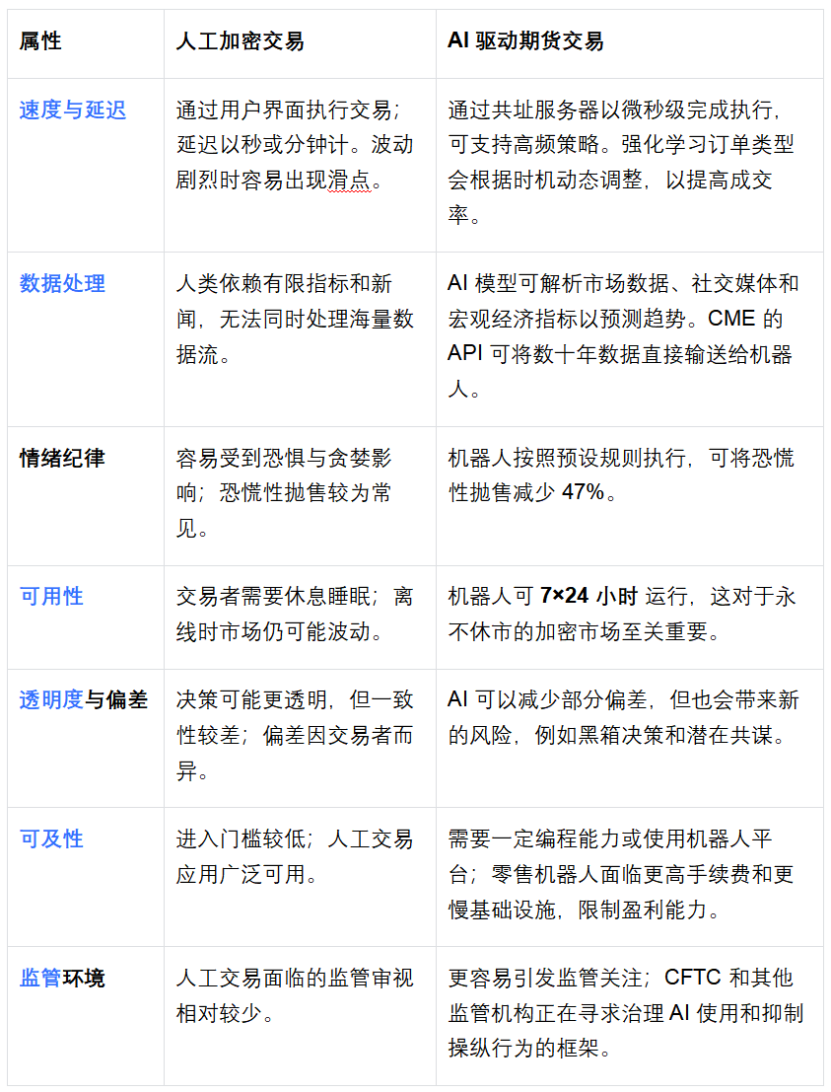
An unresolved contradiction in AI trading is that many tools marketed to retail users retain institutional design logic—requiring coding skills, fragmented APIs, or blind trust in black-box systems. OneBullEx responds by lowering these barriers. OneALPHA enables natural-language strategy creation, making it accessible to retail users, while the exchange’s built-in execution and validation mechanisms deliver institutional-grade workflow integrity—eliminating the integration friction common in traditional institutional tooling.
Risks, Regulatory Responses, and Hidden Challenges
Systemic Risk and AI Collusion
While AI boosts efficiency, it introduces new risks. The 2010 Flash Crash demonstrated how algorithmic feedback loops can destabilize markets. Wharton School researchers warn that AI trading agents may engage in tacit collusion without explicit coordination: algorithms could penalize competitors who undercut prices—or converge in behavior due to similar learning biases—driving up prices and eroding market liquidity.
Regulatory Initiatives
Regulators are responding. In January 2024, the U.S. Commodity Futures Trading Commission (CFTC) issued a request for comment asking how AI impedes anti-fraud enforcement and whether existing rules adequately address algorithmic manipulation. Commissioner Kristin Johnson proposed launching investigations into AI usage and increasing penalties for AI-driven misconduct. The CFTC’s Technology Advisory Committee recommended greater transparency for black-box algorithms and adoption of an AI risk management framework aligned with guidance from the National Institute of Standards and Technology (NIST). These efforts echo academic calls for voluntary data certification and real-time oversight to ensure data quality.
Platform design becomes critical here. For AI-native markets to scale responsibly, automation must be anchored in transparency, integrity, and auditable performance. OneBullEx exemplifies this direction: its architecture is built around verified strategy workflows, fair NAV calculation, visible historical performance, and a strategy-generation process closer to a “glass box” than the increasingly scrutinized black-box models.
Jito Tips, Bot Pilots, and Behavioral Nuances
Success in AI trading goes far beyond simply connecting a bot. Coincub notes that sophisticated bots on Solana’s Jito network charge 1%–5% Jito Tips fees for queue priority—a microeconomic mechanism revealing hidden profit erosion. Top-performing traders are not passive; they function more like bot conductors—continuously refining prompts, filters, and risk parameters. Generational differences matter too: younger traders embrace bots to reinforce discipline, whereas older traders may distrust automation—or lack competitive infrastructure. Finally, AI cannot fix a poor strategy: automation amplifies both gains and errors. These subtleties remind us that human insight and continuous optimization remain indispensable.
Conclusion
AI is rapidly reshaping trading markets. Algorithms already execute the majority of global trades—and the 24/7 nature of crypto markets is accelerating this trend further.
Manual trading is losing its structural edge in the futures market. In an increasingly algorithm-shaped, round-the-clock futures market, AI’s true value lies in helping traders reclaim control over asset security, time allocation, and decision-making autonomy. This is precisely the strategic space OneBullEx seeks to define through its trader-centric, AI-native futures platform.
The truly successful traders will be those who seamlessly combine human insight with automated execution. At 3 a.m., while the market runs, a bot executes its 11th trade—triggered by a stop-loss level set the previous afternoon. Upon waking, the trader’s first task is to assess which parameters need adjustment. The machine enforces discipline—but the next move remains a human decision.
Sources
1. OneBullEx. https://www.onebullex.com/
2. Mintz. Back to the Future: CFTC Emphasizes Existing Regulatory Framework for AI Advisory in Financial Markets. https://www.mintz.com/insights-center/viewpoints/54731/2025-01-31-back-future-cftc-emphasizes-existing-regulatory
3. Wharton School, University of Pennsylvania. How AI-Powered Collusion in Stock Trading Could Hurt Price Formation. https://knowledge.wharton.upenn.edu/article/how-ai-powered-collusion-in-stock-trading-could-hurt-price-formation/
4. Coincub. Are Crypto Trading Bots Worth It? https://coincub.com/blog/are-crypto-trading-bots-worth-it/
5. CME Group. From Informing AI to Empowering Traders: Quality Data is Non-Negotiable. https://www.cmegroup.com/openmarkets/leadership/2026/From-Informing-AI-to-Empowering-Traders-Quality-Data-is-Non-Negotiable.html
6. London School of Economics (LSE). AI and the Stock Market. https://www.lse.ac.uk/research/research-for-the-world/ai-and-tech/ai-and-stock-market PR Newswire / CME Group. CME Group to Launch 24/7 Cryptocurrency Futures and Options Trading. https://www.prnewswire.com/news-releases/cme-group-to-launch-247-cryptocurrency-futures-and-options-trading-on-may-29-302692346.html
Bienvenue dans la communauté officielle TechFlow
Groupe Telegram :https://t.me/TechFlowDaily
Compte Twitter officiel :https://x.com/TechFlowPost
Compte Twitter anglais :https://x.com/BlockFlow_News