Governance Fire Ignites on BNB Chain: Decoding DDDX's veToken Governance Model in the Dual AMM Algorithmic Trading Protocol
TechFlow Selected TechFlow Selected
Governance Fire Ignites on BNB Chain: Decoding DDDX's veToken Governance Model in the Dual AMM Algorithmic Trading Protocol
DeFi, NFT, DAO, donations, Web3 crypto circles—change every day. Behind the apparent prosperity, a war for control over decentralized liquidity is unfolding, with dramas akin to "Game of Thrones" playing out across every blockchain.
 Navigating Web3 tides with focused insights
DeFi, NFT, DAO, donations, Web3 — the crypto world evolves rapidly every day. Behind the apparent prosperity, a war for control over decentralized liquidity is unfolding across chains, akin to a "Game of Thrones." This is the veToken arms race ignited by governance battles surrounding Curve Finance.
Curve Finance is the largest decentralized stablecoin exchange protocol in the crypto world, with nearly $20 billion in total TVL across all chains. It pioneered the concept of governance voting, where community members lock the governance token CRV to obtain voting power (veToken), thereby influencing how Curve allocates emissions to specific pools — directly shaping the stablecoin ecosystem across DeFi. This battle has drawn dozens of innovative protocols and sparked governance wars on other blockchains.
The war has only just begun:
"He who controls the spice, controls the universe."
- Frank Herbert, Dune
While the governance war around Solidly rages on in the Fantom ecosystem, another front is opening on BSC — the core battleground being control over the governance rights of DDDX Protocol, a decentralized exchange built on BNB Chain.
DDDX Protocol
DDDX Protocol is a decentralized exchange protocol powered by a hyperbolic trading algorithm. It enables users to swap one stablecoin asset for another with minimal slippage — for example, converting BUSD into USDC or USDT directly via asset swaps. Additionally, DDDX introduces exchange curves between stablecoins and other BEP-20 assets, making it a hybrid of Uniswap and Curve.
Inspired by Solidly.Exchange, DDDX.io has made key improvements:
-
1. Adjusted non-stablecoin trading fees to 0.25%. Fee revenue drives community governance, and increasing fee income effectively incentivizes participation in voting.
-
2. Reduced emission rate of the governance token $DDDX. This helps reduce early sell pressure and supports long-term project sustainability.
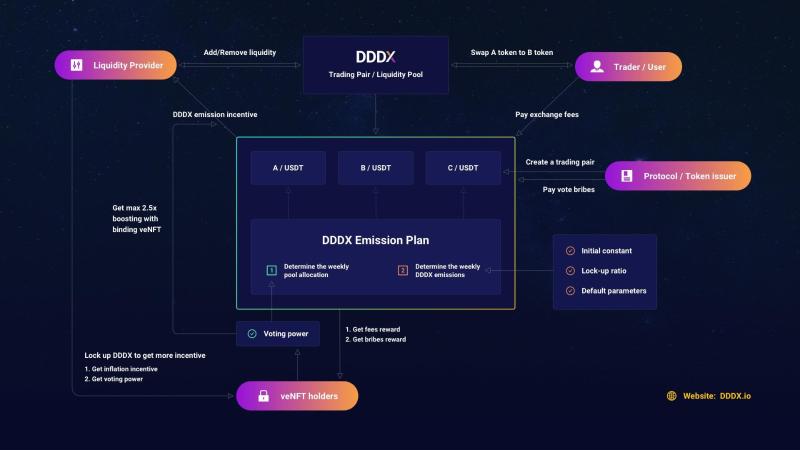
Like other decentralized exchanges (DEXs), DDDX facilitates asset swaps through liquidity pools. Users deposit assets into DDDX pools to provide liquidity and receive LP tokens representing their share. Each swap incurs a transaction fee (0.01% for stablecoin pairs, 0.25% for non-stablecoin pairs). Liquidity providers earn a proportional share of these fees — this is DDDX’s liquidity incentive mechanism.
$DDDX
$DDDX is the governance token of DDDX Protocol, but cannot be used directly for voting. Instead, it must be locked by LP holders to obtain veNFT — the voting-enabled governance token on DDDX Protocol. Once users convert their $DDDX into veNFT, the battle begins.
$veNFT
Unlike standard veTokens, DDDX Protocol's veNFT is a BEP-721 token — transferable, tradable, but indivisible. The veNFT balance decays linearly over time. A DDDX holder can choose to lock their DDDX for up to four years. For example, locking 1 DDDX for one year yields 0.25 veNFT; locking 1 DDDX for four years yields 1 veNFT. The longer the lock-up period, the higher the initial veNFT balance. However, the veNFT balance continuously decreases unless the user locks more DDDX or extends the lock duration.
Incentives for Voting Lockups
The incentives for voting lockups lie at the heart of this ecosystem resource struggle:
-
l Voting lockups reduce circulating supply of DDDX, increasing scarcity and driving up the price of $DDDX
-
l veNFT holders can vote to determine DDDX emissions — pools receiving more votes get more $DDDX, boosting their trading activity
-
l Whoever controls more veNFT gains greater influence in DDDX Protocol governance
Users participating in voting lockups indirectly obtain proof-of-stake during the lockup period. This strengthens trust between veNFT holders and the protocol, creating a self-reinforcing cycle.
Voting lockup incentives include: trading fee rewards, governance incentives, bribes, and LP boost rewards.
Trading Fee Incentives
Transaction fees generated by each trading pair are distributed proportionally to veNFT holders. For instance, suppose the BUSD/USDT pool on DDDX generates $10 million in trading fees over a given period. If User A holds veNFT and voted for this pool, and their veNFT represents 10% of total votes, then User A receives 10% of $10 million = $1 million in fee rewards. From a profit-seeking perspective, more active trading pairs attract stronger support.
Governance Incentives
As mentioned earlier, veNFT holders decide how much support DDDX Protocol gives to each trading pair — in other words, which pool gets more $DDDX emissions and thus captures a larger share of the DDDX ecosystem’s benefits.
This means both veNFT and DDDX have intrinsic value — they confer power: the ability to shape the future development of the entire DDDX Protocol.
If you’re an LP in a specific pool, you naturally want that pool to receive higher DDDX rewards. By converting your DDDX into veNFT and voting for your preferred pool, you increase your future DDDX income. This creates a recursive value accumulation mechanism, underpinned by trading fee rewards earned by veNFT holders.
Bribes (Bribery Rewards)
Given capital's profit-driven nature, third-party protocols seeking additional $DDDX rewards from DDDX Protocol offer bribes to $DDDX holders. They inject any token (other than $DDDX) into bribe pools to incentivize veNFT holders to vote for their trading pairs.
LP Boost Incentives
Liquidity providers who bind veNFT can accelerate DDDX mining, achieving up to 2.5x higher APY. This is another reinforcing feedback loop: the more veNFT a user holds, the more $DDDX they will earn in the future.
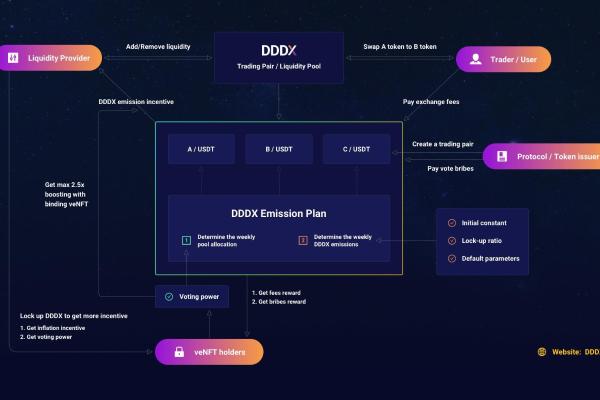
DDDX Protocol distributes $DDDX to trading pairs as incentives for liquidity providers, with the allocation determined by veNFT holder votes.
Thus, if a third-party trading pair secures enough veNFT votes, it no longer needs to use its own tokens to incentivize liquidity — instead, it can leverage $DDDX as its LP incentive.
This means trading pairs that win $DDDX holder votes save on liquidity funding costs and gain direct control over this foundational infrastructure.
This makes the act of voting itself highly valuable.
This naturally leads to the next question: How can one acquire as much veNFT as possible?
The answer: buy $DDDX on the open market and lock it to obtain veNFT.
But clearly, individuals face limitations. Thus, a new DeFi protocol called Double.Club was created — designed to maximize $DDDX holdings and enable ordinary users to gain greater returns in this governance battle.
The core function of Double.Club is allowing users to stake their DDDX Protocol LP tokens directly into the Double.Club protocol to earn additional rewards, including:
-
1. DDDX token incentives earned from the same trading pair on DDDX Protocol;
-
2. DOUBLE token incentives — for every 4.2069 DDDX earned, users receive 1 additional DOUBLE reward.
In terms of APR alone, staking LP tokens in Double.Club can yield up to 2000% higher annualized returns compared to staking them directly in DDDX Protocol.
$DOUBLE
DOUBLE is the governance token of Double.Club, deriving its value from:
Voting Lockups
Users may choose to lock DOUBLE to obtain vlDOUBLE for voting — a mechanism identical to locking DDDX to receive veNFT on DDDX Protocol.
However, unlike DDDX Protocol, which offers only four lock-up durations (1 week, 1 month, 1 year, 4 years), Double.Club allows users to lock DOUBLE for any period between 1 and 16 weeks. By locking DOUBLE, users gain the following benefits:
-
1. Earn DDDX rewards — 5% of DDDX income generated by Double.Club through liquidity migration and mining on DDDX Protocol will be distributed to locked DOUBLE holders.
-
2. Determine Double.Club’s voting power over DDDX Protocol pools.
By locking $DOUBLE, users gain valuable voting rights over how Double.Club allocates its veNFT weight to DDDX Protocol trading pairs. This creates a “governance-over-governance” structure — a form of voting nesting. Therefore, if veNFT is valuable because it determines how DDDX rewards are allocated, then the right to govern veNFT voting via DOUBLE is also inherently valuable.
DDDXdou
If a user already owns DDDX or veNFT, they can convert it into DDDXdou on Double.Club and then stake it. DDDX and DDDXdou are pegged at a 1:1 ratio. However, once DDDX is converted to DDDXdou, it cannot be reversed — this is a one-way conversion. Nevertheless, DDDXdou can be sold back into DDDX via the market.
When users stake DDDXdou, they receive the following rewards:
-
1. Earn DDDX rewards — 5% of DDDX income generated by Double.Club through liquidity migration and mining on DDDX Protocol will be distributed to DDDXdou stakers.
-
2. An additional 3.5% minting reward in DOUBLE.
Final Thoughts
DeFi has experienced explosive growth over the past few years. Foundational protocols like Uniswap and Curve, having stood the test of time and scale, have become indispensable core infrastructure in the evolution of DeFi. Around these leading DeFi protocols, governance battles for control over underlying infrastructure will continue — and undoubtedly grow even more intense.
Join TechFlow official community to stay tuned
Telegram:https://t.me/TechFlowDaily
X (Twitter):https://x.com/TechFlowPost
X (Twitter) EN:https://x.com/BlockFlow_News