








OpenSea's challenger dilemma: Airdrop competition intensifies amid weak communities, while viable paths forward remain unexplored
TechFlow Selected TechFlow Selected
OpenSea's challenger dilemma: Airdrop competition intensifies amid weak communities, while viable paths forward remain unexplored
Since OpenDAO fired the first shot at OpenSea with its DAO, platforms like LooksRare and X2Y2 have followed in quick succession.
 Navigating Web3 tides with focused insights
Author: Liu Quankai, WuShuo Blockchain
Airdrops are a trend, and anti-OpenSea has become a new narrative. Since OpenDAO fired the first shot in the DAO OpenSea movement, platforms such as LooksRare and X2Y2 have followed suit, distributing airdrops to OpenSea’s trading users, building their own NFT marketplaces to capture NFT traders and seize OpenSea's market share.
Building on NFT trading, LooksRare was the first to introduce transaction mining and staking rewards for token holders; X2Y2 continued with staking-based dividends and introduced a "list-to-mine" model, attempting to emphasize genuine trading activity.
Thanks to the public transparency of on-chain data, it is foreseeable that more ambitious developer teams will continue targeting OpenSea’s user base with airdrops to challenge its dominance. However, at present, platforms like LooksRare and X2Y2 still lack differentiated competitive advantages beyond airdrops and incentives. Their impact on challenging OpenSea remains limited. As the airdrop frenzy cools down and token rewards diminish, these platforms face significant challenges of their own. That said, each attempt is not without value—every challenger leaves behind lessons worth learning for future projects.
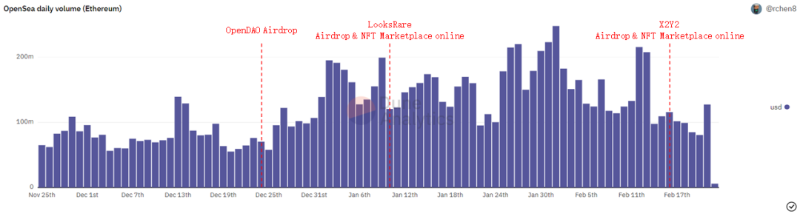
(Data source: Dune Analytics)
Among the three DAO OpenSea initiatives, OpenDAO avoids direct competition with OpenSea, while X2Y2 is too new to assess. Currently, only LooksRare can rival OpenSea in terms of trading volume. However, due to its transaction mining mechanism, the authenticity of LooksRare’s trading volume remains under scrutiny. Comparing trading volumes between the first and second phases of LooksRare’s transaction mining clearly shows that platform volume is directly driven by mining incentives. As token rewards decrease, trading volume drops sharply. In contrast, OpenSea reached a new monthly trading volume high in January this year despite the sudden emergence of LooksRare. Today, OpenSea’s daily trading volume is gradually overtaking LooksRare’s.
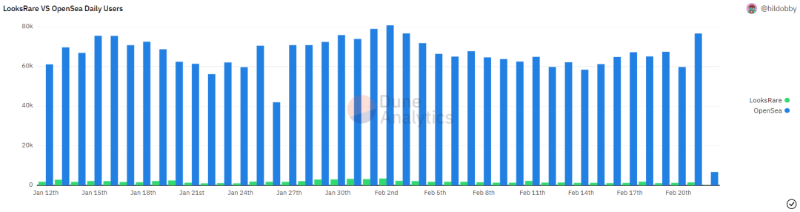
(Data source: Dune Analytics)
More meaningful than trading volume is the number of trading users. From start to finish, LooksRare has never seriously challenged OpenSea in terms of user numbers. In fact, during the 41 days since LooksRare launched on January 10, OpenSea saw higher growth in trading users than in the 41 days prior. Undeniably, the combination of airdrops and transaction mining has played an unmatched role in acquiring a certain number of users—but these users are mostly DeFi whales. They seek high-quality yield farming opportunities, chase optimal APYs, and lack strong product loyalty. Today, LooksRare faces declining both new and existing user counts (and rumors suggest the team, allegedly from Pancake, has already profited handsomely in WETH).
For NFT marketplaces, the core purpose of airdropping to OpenSea users is to steal OpenSea’s existing user base and convert them into new users on their own platform. Mining activities centered around airdrops aim to further solidify token holder engagement and increase user stickiness. However, the problem lies in the fact that growth in trading volume and users fueled by airdrops and mining is inherently unsustainable, because reward pools cannot maintain high APYs and output forever. Moreover, there isn’t necessarily a clear causal relationship between airdrops/mining and real platform growth. Users brought in by airdrops are often fungible token (FT) speculators; mining and fee-sharing keep token holders around, but for NFT users with genuine trading needs, airdrops are merely freebies. Wash trading holds little meaning. So what motivates these true NFT natives to stay and trade on the platform? So far, no one seems to have the answer.
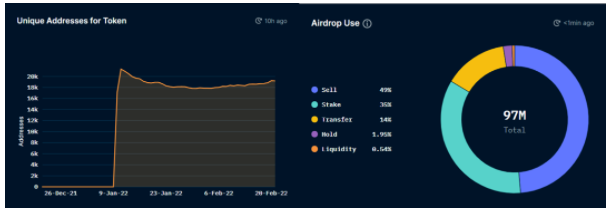
(Data source: Nansen)
NFT users can continue buying and selling NFTs on OpenSea, which offers deeper liquidity, while also collecting potential future airdrops from various OpenSea competitors. The number of LOOKS token holders peaked above 20,000, yet daily active trading users on LooksRare typically remain between 1,000 and 1,500—a very low conversion rate from token holders to actual platform users. Regarding airdrop usage, nearly half of recipients chose to sell immediately. For native NFT users, airdrops have become mere “freebies,” similar to how DeFi users farm project airdrops.
Furthermore, even if more teams try to challenge OpenSea in the future, they will likely do so by airdropping tokens to users based on OpenSea trading activity and associated on-chain data. This creates an awkward logic: continuing to trade on OpenSea may actually give NFT users greater eligibility for future airdrops.
Additionally, DAO OpenSea isn't just about airdropping to OpenSea users—it's about building broader communities centered around token holders. Looking at the launch results of LooksRare and X2Y2, the technical difficulty of going from idea to launching an NFT marketplace may not be high, nor does it require months or even years. Compared to investing time and resources into long-term community building, short-term profits gained from temporary surges in trading volume—driven by hype from airdrops or early mining mechanisms—are far more tempting.
Currently, it remains unclear how much weight community actually carries in these three DAO OpenSea projects. What we do see are disputes and scandals within OpenDAO’s founding team, controversies over wash trading and team token dumping at LooksRare, and confusion at X2Y2 due to multiple last-minute changes in airdrop rules. Of course, a highly visible and controversial project has more opportunities for improvement. But for projects branding themselves as part of the DAO OpenSea movement, the path toward genuine community building is still long.
The composition of NFT users suggests most may not be native crypto users and might not be particularly interested in DeFi products or features. Crypto Native ≠ NFT Native. Therefore, when NFT platforms implement mining mechanisms, they’re essentially using DeFi-style tools to attract users—this mismatches the actual needs of most NFT players, making user acquisition less effective than hoped.
To truly challenge OpenSea, the key lies in attracting NFT Natives—who make up the majority of trading volume—and involving them in community building. Relying on DeFi functionalities to sustain and attract users narrows the platform’s audience. Without addressing the absence of NFT Native users, the next wave of DAO OpenSea projects may end up cannibalizing the market share of earlier challengers.
Join TechFlow official community to stay tuned
Telegram:https://t.me/TechFlowDaily
X (Twitter):https://x.com/TechFlowPost
X (Twitter) EN:https://x.com/BlockFlow_News
 吴说区块链
吴说区块链






