








Messari Explains Secret Network: How Does It Provide Application-Layer Privacy for the Crypto Industry?
TechFlow Selected TechFlow Selected
Messari Explains Secret Network: How Does It Provide Application-Layer Privacy for the Crypto Industry?
Secret Network is one of the first privacy-focused smart contract platforms to launch. It is a Layer 1 blockchain built using the Cosmos SDK and Tendermint BFT, a delegated proof-of-stake consensus protocol.
 Navigating Web3 tides with focused insights
Author: Rasheed Saleuddin
Translation: Hu Tao, ChainCatcher
“The inevitable end of crypto is maximum decentralization and maximum privacy.” —— Naval Ravikant
Cryptocurrencies are redefining the power dynamics behind the next evolution of finance and application creation. They introduce a bottom-up approach to building new financial infrastructure, allowing users to govern network activity and help determine the direction of each project. Unlike today’s systems that manage our financial and capital formation processes, power rests in the hands of users themselves.
Public blockchains like Bitcoin and Ethereum operate according to these principles. Bitcoin was created in part as a check against central bankers prone to mismanaging monetary supply and abusing their immense power. Ethereum unlocked the ability to create globally accessible programmable applications that can be governed by communities of token holders and open-source contributors. These models set the stage for the first part of Naval's thesis on crypto: maximum decentralization.
However, while Bitcoin and Ethereum excel at distributing power to the majority, their current default public designs may not yet — or soon — offer complete solutions for Naval’s second outcome: maximum privacy.
In an era of surveillance capitalism and state-level monitoring, this lack of user privacy stands out sharply. The transparency of Bitcoin and Ethereum could even exacerbate existing concerns. Every financial transaction from every wallet can be monitored end-to-end, while supplementary solutions like mixers face liquidity and usability challenges that may limit the level of privacy they can provide.
Privacy coins such as Monero and Zcash have emerged to address these issues. They use advanced cryptography to obscure transaction details, protecting user privacy and enhancing security. However, since neither currently supports smart contracts, they fail to meet the needs of DeFi users, creating a market gap.
Secret Network aims to fill this void. It is one of the first blockchains to natively support programmable smart contracts with privacy built-in, launching on the Secret mainnet in September 2020. Secret will face obstacles in building a user base, such as overcoming the widespread perception that privacy comes at the cost of convenience. Yet private smart contracts also bring notable usability advantages and unlock significant new use cases. As privacy evolves from a nice-to-have feature to a necessity for sophisticated Web3 users, Secret Network may emerge as a leader in the field of private computation.
Privacy in Crypto
Privacy on blockchains is far from guaranteed. Transactions are at best pseudonymous, something hackers and ransomware attackers frequently learn the hard way. In short, cryptocurrency functions as a terrifying shadow banking system — a reality that seems to remain largely outside the concerns of U.S. political elites. From law enforcement or tax collection perspectives, this is often seen as beneficial.
But legitimate personal privacy and security concerns exist in everyday activities — issues that the most popular public chains cannot easily resolve.
Investment flows on blockchains are relatively easy to track. Blockchain analytics providers like Chainalysis specialize in analyzing movements or crypto transactions for exchanges and regulators. Websites like Nansen allow retail users to follow the wallets of crypto’s most prominent investors, tracking every deposit, token trade, and NFT purchase they make.
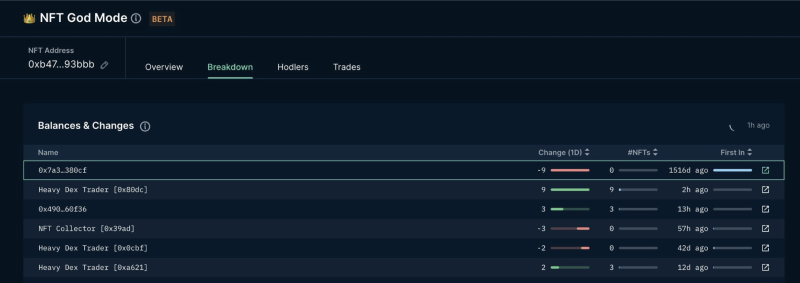
Source: Twitter
Investors, borrowers, and savers all deserve the confidentiality offered by regulated TradFi institutions. Consider the information required to share a credit score. But privacy solutions in crypto have failed to keep pace with the speed of application development and user growth.
Beyond its importance to DeFi, privacy is crucial for functional Web3, which emphasizes both decentralizing and privatizing user data. Do we really want Facebook, TikTok, or Spotify to know everything about us?
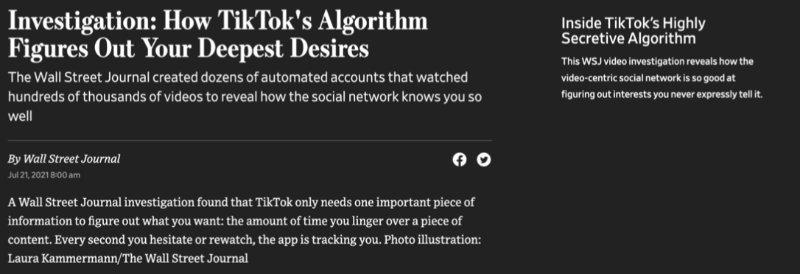 Source: Wall Street Journal
Do we want all our personal data easily available to centralized databases that can be hacked, risking identity theft or loss of funds?
Should every cup of coffee we buy or Uber ride we take be publicly visible? Once two parties transact on a blockchain, they know each other’s public keys and can track accounts associated with that person from then on. The total transparency provided by public distributed ledgers could be a major barrier to mass adoption of crypto payments — and a significant security risk.
Enter Secret Network
Crypto asset flows can be obscured to some extent through privacy coins like ZCash and Monero or Ethereum DApps like Tornado Cash. However, as noted earlier, privacy coins do not fully meet the demand for anonymity or security in this new financial environment. They are excellent for private transactions or wealth storage, but little else.
For a privacy network to attract users in the DeFi era, its privacy features must extend to the application layer as well.
Secret Network is one of the first privacy-focused smart contract platforms to launch. It is a Layer 1 blockchain built using the Cosmos SDK and Tendermint BFT, a proof-of-stake consensus protocol.
Like other Tendermint-based chains, Secret Network has block times of around six seconds and can process thousands of transactions per second. The chain currently supports 50 active validators, with an average of 167 delegators per node.
Secret originated from Enigma, a project out of MIT that raised $45 million in a 2017 ICO to build privacy technology for public blockchains. Secret Network is an independent Layer 1 blockchain launched by the Enigma community based on Enigma’s research and technology. The community also facilitated a swap between Enigma’s old ENG ERC-20 token and Secret’s native mainnet SCRT token. Since the network’s hard fork to secret-2 on September 15, 2020, private smart contracts with encrypted inputs, outputs, and states have been live on mainnet. This enabled early DeFi applications such as “secret tokens,” private versions of Secret’s native tokens or assets bridged from other chains.
Secret Network uses Intel Software Guard Extensions (Intel SGX), which divides protocol code into trusted and untrusted parts. The secure "enclave" component of a Trusted Execution Environment (TEE) executes the trusted code. TEEs are used in many devices, including smartphones and video game consoles, acting as a "black box" for computing encrypted data.
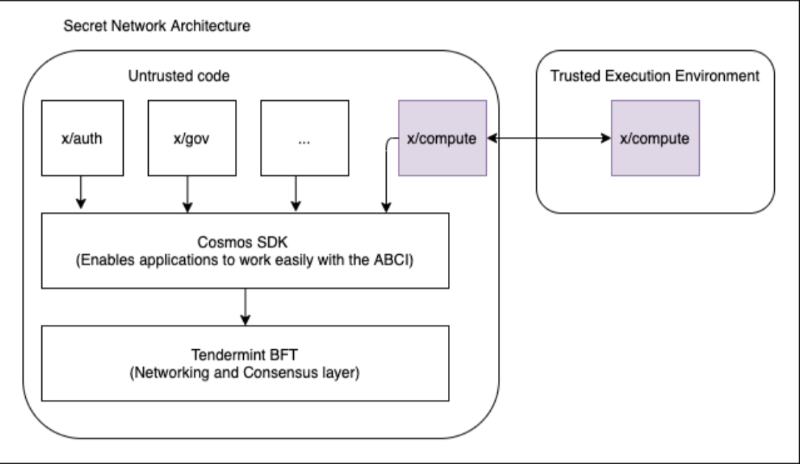
Source: Secret Network
The Secret Network TEE maintains the integrity of any encryption layer, ensuring transaction data remains secure and private during execution — even from validators. The only way to view encrypted information is through a set of "viewing keys." End users maintain full control over these keys, enabling them to access private transaction details so they can share them with others or professionals such as tax authorities.
The Secret Ecosystem
Secret Cross-Chain Bridge
While privacy is a key feature of Secret Network, privacy alone is insufficient to stand out in a competitive Layer 1 landscape. A Layer 1’s success will depend on the utility it offers new users. A rich ecosystem of applications across specific or multiple sectors increases network utility and appeal for developers looking to earn a living through crypto. But the challenge lies in finding a way to bootstrap a new ecosystem from scratch. This is a classic chicken-and-egg problem, as liquidity begets liquidity.
One of Secret Network’s core strategic developments is connecting to other networks with existing user bases and liquidity pools. With the right incentive structures, Secret Network can share in the activity generated by other blockchains without spending excessive resources building a new economy from the ground up. The project launched its first bridge on December 15, 2020, establishing a critical link with Ethereum.
Since then, it has also deployed bridges with BSC and Monero, and is developing communication gateways to Astar Network (a potential Polkadot parachain formerly known as Plasm Network) and a bridge to the rapidly growing Terra ecosystem.
Interoperability is also a core reason why Secret Network chose to build on the Cosmos SDK framework. The Cosmos SDK allows developers to add new functionality via plug-and-play modules. One such module implements the Inter-Blockchain Communication (IBC) protocol, enabling the network to communicate with other IBC-compatible chains. The SCRT token holder community has already expressed support for Secret Network adopting IBC, and the project has enabled these cross-chain communication capabilities in its Supernova upgrade.
Wrapping ERC-20 and BEP-20 tokens or Monero requires bridging through bidirectional smart contracts. For example, Monero (XMR) can be deposited into Secret in exchange for xXMR. Users can transfer funds back in the opposite direction (back to Monero) by burning the xXMR token to unlock native XMR on the Monero chain. However, for chains other than Monero, the bridging process is not fully anonymous, even though privacy is maintained on the Secret Network, as bridge transfers can still be tracked on the native chain.
Secret DeFi
Bridging existing chains is a crucial step. Undeniably, crypto at this point is a multi-chain universe. Innovation does not happen in isolation. But a Layer 1 also needs a compelling reason to capture attention and sustain engagement. That reason might be a shared goal or ethos among community members, such as a need for privacy, but more often it is an incentivized DeFi ecosystem that locks in activity. Secret now supports a decentralized exchange (SecretSwap), a governance token for Secret’s DeFi sector (SEFI), and peer-to-peer "auction" markets, forming the foundation of the chain’s application ecosystem.
Applications on Secret Network utilize a unique type of smart contract the project calls “Secret Contracts.” Unlike contracts used on Ethereum, these Secret Contracts can accept encrypted inputs and produce encrypted outputs, while keeping each contract’s state (its internal database) hidden. In marketing terms, Secret Network combines Ethereum-style smart contract execution, Monero-like transaction privacy, and the interoperability offered by Cosmos SDK chains.
 Source: Secret Network
While transaction privacy is a straightforward benefit of smart contracts with built-in confidentiality, Secret Contracts also offer reduced Miner Extractable Value (MEV) due to their encrypted state.
Due to its impact on security and user experience, MEV is a major source of concern and controversy within Ethereum. Because Ethereum is fully transparent, miners can see incoming transactions and alter transaction ordering or submit competing transactions that benefit themselves. In contrast, Secret Network’s confidential nature hides transaction data from validators — beyond what blockchain analysis tools (like block explorers) can reveal — preventing validators from reordering transactions or executing front-running attacks.
Notably, Secret Network’s native SCRT token is not a privacy coin. All SCRT transactions are public, similar to BTC or ETH. Like most new Layer 1s, SCRT serves as the network’s core governance and staking token. Its primary functions include voting on protocol changes, paying gas fees, and staking (as a validator or delegator) to help secure the chain. The “secret” aspect of Secret Network lies in its ability to hide the transaction history and state changes of tokens and contracts running on the network.
Secret NFTs
Secret Network’s privacy properties can extend to various token types, including NFTs. In April 2021, the first recipient of a community grant on the network published a reference implementation of the Secret NFT standard (SNIP-721) on mainnet. Like their fungible counterparts, Secret NFTs inherit the same privacy characteristics when transferred or processed by Secret Contracts.
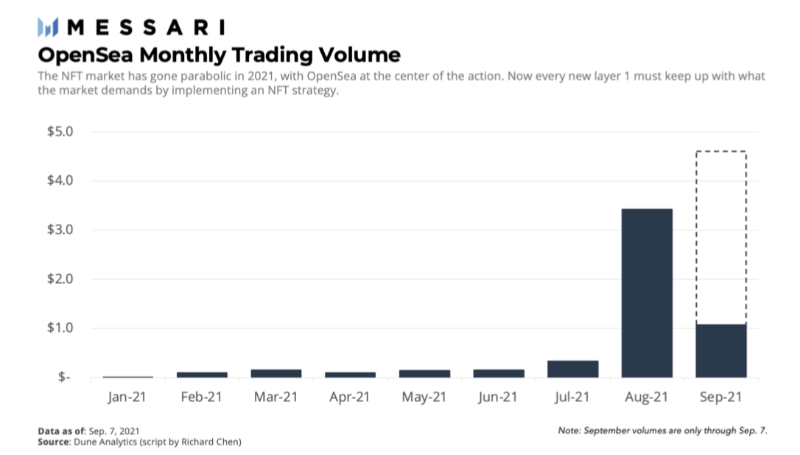
Following the explosive NFT market, prioritizing NFTs is a logical move for Secret Network or any new platform. The creation and sale of NFTs have grown parabolically over the past eight months, as shown by the monthly trading volume of popular NFT marketplace OpenSea.
While Ethereum has remained the center of NFT activity, its rising transaction costs may have already priced out a significant portion of the crypto population. Ethereum’s scalability limitations ultimately create a prime opportunity for new low-cost Layer 1s to absorb users and use cases that can no longer afford Ethereum’s fees. Secret Network stands to benefit from this situation, though competition on minimizing fees is fierce. Where Secret Network can differentiate itself is through the advantages brought by Secret NFTs.
Secret NFTs share the same characteristics as Ethereum’s ERC-721 tokens, while offering three new features: (1) hiding ownership of rare items, (2) privatizing metadata fields (how NFT signatures connect to off-chain data like artwork), and (3) controlling access to linked content.
The first feature has obvious appeal. As unique and often scarce items, NFTs can be relatively easily tracked using on-chain analysis tools. Secret Network’s privacy setup allows users to hold NFTs outside the public eye. The latter two attributes could enable new NFT use cases (game items with hidden abilities or art embedded with secret links) and allow artists or marketplaces to customize access to their products (important for exclusive events or the adult entertainment industry).
The Secret Network NFT sector is currently small. Secret Heroes is the network’s first game, and according to the project’s latest roadmap update, an NFT marketplace is in development. Despite current adoption levels and late entry timing, Secret could carve out a niche in the NFT market by offering one of the few privacy-centric solutions for non-fungible assets.
Competitive Landscape
Secret’s path toward fully implemented privacy smart contracts is pioneering. It is one of the first networks to support issuing tokens with privacy attributes and smart contract functionality without compromising transaction privacy.
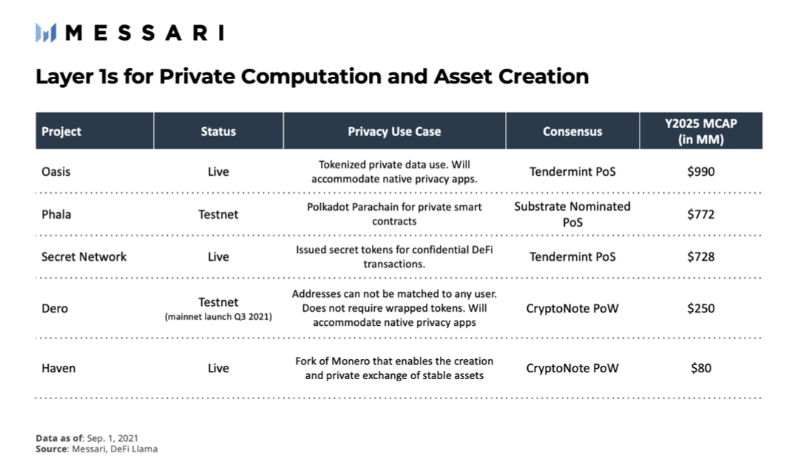
Each of these privacy-focused Layer 1s aims to offer differentiated functionality. Dero intends to support native assets (non-contract-enabled tokens) and smart contracts but remains in testnet phase. Haven is a fork of Monero designed to support a token ecosystem pegged to external assets, such as USD-pegged stablecoins. Phala focuses on delivering privacy within the Polkadot ecosystem.
Other privacy solutions appear in the form of (1) privacy coins, (2) mixers, and (3) Ethereum-based transaction shielding contracts.
For strictly private transactions and value storage, Monero and Zcash are well-known privacy coins using thoroughly researched privacy technologies, though they reside in regulatory gray areas. Zcash has made some progress in U.S. exchanges, securing coveted listings on Coinbase and Gemini. However, given that some exchanges have previously delisted XMR due to legal concerns, Monero remains outside the comfort zone of most regulators. Both Monero and Zcash are one-trick ponies. They handle private value transfer well, but currently do not support smart contracts. Privacy without DeFi or Web3 is only a partial answer.
On-chain mixers like Tornado Cash break the chain of asset transaction history. They make it difficult to match input and output transactions, giving users the same assets in a new wallet without transaction baggage. However, mixing is an effective but incomplete solution, as it gives users a fresh start but does not prevent them from being re-exposed. Moreover, mixers require substantial liquidity to optimize privacy, as transaction inputs must be of identical size, making matching harder when volumes are low.
For those wanting to retain access to the Ethereum ecosystem, Railgun, Aztec, and Offshift appear to be viable options. However, Aztec is not fully decentralized, and the other two face significant technical hurdles that keep them off mainnet launch.
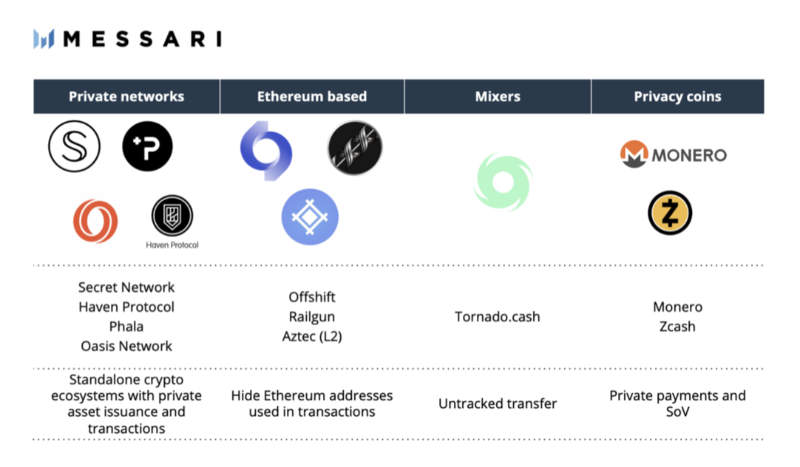
To its advantage, Secret enjoys first-mover status, and if it can maintain momentum through recent market rallies, it has the potential to become a trendsetter in the privacy space. Its early position within the interconnected Cosmos ecosystem may signal positive signs for adoption. As the Ethereum community well knows, DeFi is highly reflexive. A bit of momentum in the liquidity side driven by token incentives can snowball into rapid adoption. The decisive factor will be whether Secret’s Supernova upgrade and an increasing number of on-chain privacy use cases can help the network gain further traction.
The Future
Secret has invested heavily in growing its application ecosystem and product offerings. The project and its community have established a grant program with 20 million SCRT to help fund applications built on the network. It has also completed integration with Band Protocol, a necessary DeFi building block that provides price data for on-chain exchanges and other financial applications such as lending and derivatives protocols.
Secret Network’s core value proposition is in its name: private computation. Privacy in crypto is difficult — technically, regulatorily, and in terms of user adoption. Secret has addressed the first challenge and developed solutions to help tackle the second when the time is right. However, user adoption of privacy solutions will remain a major hurdle, as users typically prioritize convenience and familiarity over privacy.
Our privacy is under attack — in Web2 for some time now, and increasingly in crypto. Unless consumer behavior undergoes a dramatic (perhaps necessary) shift, the situation may only worsen. Do we value our privacy enough to rebuild the DeFi ecosystem on a privacy-first Layer 1? Do we merely value it slightly, using privacy networks as supplementary services when needed? Or will we succumb to the looming threat of state surveillance?
Join TechFlow official community to stay tuned
Telegram:https://t.me/TechFlowDaily
X (Twitter):https://x.com/TechFlowPost
X (Twitter) EN:https://x.com/BlockFlow_News
 Messari






