Republic Realm: Why Is Virtual Real Estate Worth Investing In?
TechFlow Selected TechFlow Selected
Republic Realm: Why Is Virtual Real Estate Worth Investing In?
In 2021, "metaverse" became a buzzword breaking out of its niche into many industries. Similarly, across the Pacific in the Western world, the "metaverse" was also developing at full speed.
 Navigating Web3 tides with focused insights
Written by: Republic Realm
Translated by: Tug, Foresight Ventures
2021 was a groundbreaking year for the entire metaverse ecosystem. As the concept of Metaverse gained increasing mainstream attention, prices for land and assets within the Metaverse began approaching those of the real world. Celebrity entries, collaborations with well-known brands, soaring valuations of various Metaverse tokens, and the rise of play-to-earn (P2E) games collectively propelled the Metaverse’s leap forward last year.
This report reviews the development of the virtual real estate commercial ecosystem in the Metaverse during 2021 and discusses key market trends associated with it. These include: entry of mainstream traditional players; commercial applications of Metaverse technology (including gaming and transactions); and the impact of non-fungible tokens (NFTs) on the overall Metaverse.
This report consists of three parts:
1) Definition and current state of blockchain-based metaverses and virtual real estate.
2) Comprehensive data analysis and investment rationale for four major metaverse projects.
3) Observations and predictions on emerging trends in the current metaverse industry.
Key Findings:
1) In 2021, total sales of digital real estate and prices of other metaverse assets saw significant increases.
2) The Sandbox is pulling ahead of other metaverses across several key metrics.
3) Gaming and the Metaverse are inseparable. Both benefit from the liquidity provided by digital land sales.
What Is Metaverse Real Estate?
Introduction
Virtual worlds are not a new concept. Games like Second Life and Eve Online, launched as early as 2003, were specifically designed as virtual worlds for adults. These games successfully established complex internal economies and attracted millions of users at their peak. They gained popularity even while people still largely relied on real-life interactions. However, interest declined as new crypto-native platforms emerged.
In 2004, Ailin Graef (avatar name Anshe Chung) began accumulating virtual real estate in Second Life. Starting with less than $10, she became the first person to achieve a net worth exceeding $1 million through purely virtual-world business transactions. Today's enthusiasm around virtual real estate and NFT speculation can be traced back to the mythos surrounding Anshe Chung.
Since then, human interaction and socialization have become increasingly virtual. Most people have already shifted their social and work relationships onto smartphones or laptops. If there is a tipping point where more interaction occurs on computers than face-to-face, we are likely at it now. The sudden global pandemic accelerated this shift. These new habits may lead to permanent behavioral and cultural changes, irreversibly altering our previous norms.
Blockchain Metaverses
"Metaverse" refers to expansive virtual worlds created by companies such as Somnium Space and Star Atlas. Metaverse real estate refers to sellable land assets within these worlds. Built on blockchains (a fundamental standard for all metaverses covered in this report), "land" in the Metaverse can typically be bought and sold as non-fungible tokens (NFTs).
Enough people believe that this virtual real estate is scarce and valuable enough to spend large sums of money on it. For this reason, ownership of virtual property has become a digital status symbol for early investors.
Beyond status, ownership represents something greater — contribution to the metaverse community ecosystem. Development of Metaverse real estate significantly impacts how players interact within it. It becomes spaces where people participate, explore, build, and socialize. Here, people replicate real-life interactions while simultaneously enhancing land value.
Investment in virtual real estate is conducted via purchasing and exchanging non-fungible tokens (NFTs), a special type of cryptocurrency representing something unique. Thus, NFTs are not interchangeable, contrasting fundamentally with fungible cryptocurrencies like Bitcoin. Each NFT is distinct; indivisible and non-interchangeable.
While not as liquid as some cryptocurrencies traded on major exchanges, virtual real estate NFTs can be transacted on NFT markets in ways more streamlined and transparent than real-world real estate deals.
Ownership records of virtual real estate NFTs are stored on decentralized blockchains, avoiding the cumbersome processes of traditional deeds or title transfers. Landholders are permanent owners of the digital asset, even if the game servers shut down.
Potential buyers of virtual land must familiarize themselves with these new rules. In virtual worlds, what matters most is bringing humanity and life into digital spaces, gathering players together, and encouraging immersion and interaction. (These settlements are often called "content clusters.") In virtual worlds, originality and design matter more than location or budget.
Although daily active user counts in metaverses remain relatively low, when users begin flooding into them, selling real-world products in virtual worlds will become a highly profitable marketing strategy. Indeed, as consumers become increasingly willing to buy virtual goods from their favorite brands, this marketing could accelerate mass adoption of the Metaverse.
The blending of virtual environments with real-world spending is nothing new. For years, players have purchased in-game skins, gear, and health boosts. All these transactions will eventually occur inside metaverse malls.
Imagine the possibilities for a company like Nike. Instead of opening stores on every street in America, Nike could establish an astonishing virtual retail experience in one metaverse, enabling sales anytime, anywhere, to anyone. Eventually, every company will realize they need a virtual presence in a Metaverse like Decentraland, just as they know they must have a website on the internet.
The result is self-fulfilling. As content in the Metaverse becomes more compelling, more people arrive, attracting further corporate sponsorships.
More importantly, participants in this virtual economy recognize they're living through an exciting time. The possibility of escaping to a new world and reinventing oneself will always be appealing, even to our most stubborn skeptics. Add vibrant graphics, art, music, and new friends from around the globe, and it's easy to see why the Metaverse is such a hot topic.
Early adopters of virtual real estate have the opportunity to enter at prices still relatively affordable compared to real-world markets. Like pioneers in fast-growing real-world areas (Villages in Florida; Austin, Texas; Las Vegas), those who invest early and hold long-term stand to benefit.
The “Meta Effect”
In October 2021, Facebook announced it would rebrand as "Meta." This announcement immediately raised public awareness of the Metaverse. Overnight, the Metaverse became a buzzword. News media worldwide began asking, “What is the Metaverse?” Facebook sent a clear signal to the world: the Metaverse is the future of the internet.
Facebook’s announcement not only increased the number of Metaverse land sales but also caused substantial price increases for tokens across various blockchain-based metaverse platforms.
For example, SAND, which traded at $0.99 before the announcement, reached a 2021 high of $8.40 — a 748% increase. Meanwhile, Decentraland’s MANA rose from $0.76 to $5.79, up 662%. These surges brought SAND’s fully diluted market cap to $18 billion and MANA’s to $7 billion.
Game tokens also saw dramatic gains during the same period. Star Atlas’ ATLAS token rose 133%, from $0.09 to $0.21, while Gala Games’ GALA surged 953%, from $0.08 to $0.82.
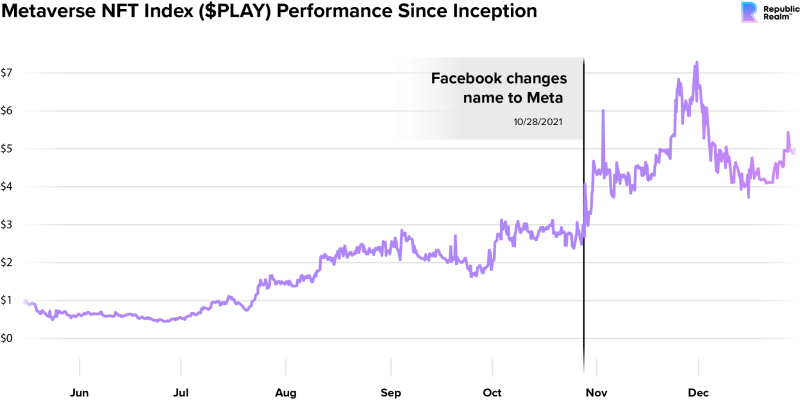
Figure: $PLAY Index, composed of SAND, AXS, MANA, ILV, ENJ, GALA, YGG, and AUDIO
As metaverse token prices rose, investors also turned to metaverse land. From Meta’s announcement through the writing of this article, The Sandbox’s average land price increased by 349%, rising from $2,702 to $12,136, while Decentraland’s virtual land prices climbed 26%, from $10,755 to $13,602.
NFT assets within games also benefited from this surge in Metaverse interest. Republic Realm’s Fantasy Islands, an island development project in The Sandbox, sold out in September at 5 ETH each (around $15,000 at the time). By Q4 2021, these islands traded as high as 50 ETH ($195,152), equivalent to house prices in the real world.
Additionally, a digital yacht from the series The Metaflower Super Mega Yacht sold for 149 ETH ($650,000). Meanwhile, homes in Wilder World metaverse fetched prices as high as $160,000. In Star Atlas, a space game built on Solana where all assets are tokenized, some buyers paid as much as $3 million for virtual starships.
Merging Physical and Digital Lives
In the Metaverse, each user is represented by an animated "Avatar." Users can dress and design their avatars according to personal aesthetics, similar to fashion in the real world. Prices for clothing and accessories vary, with some carrying greater social value than others. Since people’s physical identities are inseparable from their digital ones, the value of NFT accessories grows increasingly important across the metaverse ecosystem.
Popular NFT avatar projects like Meebits, CloneX, and Bored Ape Yacht Club further emphasize the convergence of NFTs, metaverse real estate, and digital wearables. While these NFT collections currently exist as PFPs ("profile pictures"), each has a roadmap pointing toward Metaverse utility. These avatars could eventually serve as 3D characters in Metaverse games, VR experiences, and social interactions.
Luxury brands have also begun migrating into the digital realm via digital wearables. Adidas, a legacy sportswear brand, recently launched its own avatar initiative, collaborating with the Bored Ape Yacht Club to create a series of NFT wearables. RTFKT, a leading virtual footwear creator (recently acquired by Nike), has sold NFT metaverse sneakers for as much as $10,000. Digital fashion companies like Tribute Brand, DRESSX, and The Fabricant have also launched successful digital wearable collections. In May 2021, a virtual Gucci handbag sold for 350,000 Robux ($4,115), $700 more than the physical version ($3,400).

Figure: Gucci’s luxury handbag, physical (left) and virtual (right)
Celebrities Enter Metaverse Real Estate
While Facebook’s rebranding to Meta was undoubtedly a major catalyst for rising Metaverse interest, other milestones also brought the Metaverse into the mainstream spotlight. As celebrities began entering the Metaverse to expand their brands, social media and news headlines amplified these activities. For instance, a plot of land next to Snoop Dogg’s house in The Sandbox sold for $450,000 (Snoop Dogg tweeted it was a “great deal”).

Figure: Snoop Dogg’s tweet
Coverage of the Metaverse expanded beyond crypto-focused media to renowned international outlets like Reuters, CNBC, The New York Times, Bloomberg, CNN, and The Wall Street Journal. In November 2021, The Wall Street Journal reported that Republic Realm acquired land in The Sandbox from gaming giant Atari for $4.3 million — the most expensive virtual land purchase in history.
The Four Leading Metaverses
Currently, the four leading metaverses—Decentraland, The Sandbox, Cryptovoxels, and Somnium Space—share many key characteristics, including:
1) Significant user interest and game asset sales data observed.
2) Free to use.
3) Limited supply of tokenized (NFT) land.
4) Land can be bought and sold via primary and secondary sales on marketplaces like OpenSea and Rarible.
5) Landowners have full freedom to develop any project on their plots.
6) No explicit goals. Players can spend time in the Metaverse however they choose.
Landowners have created a wide range of venues and activities in the Metaverse, including casinos in Decentraland, a crypto art museum in Somnium Space, and various interactive video games under development in The Sandbox.
Decentraland

Figure: One of Decentraland’s featured districts
Decentraland, developed by two Argentine software engineers Esteban Ordano and Ari Meilich, is a multiplayer role-playing game. The virtual world centers around a plaza called Genesis Plaza. It shares similarities with earlier virtual games like SimCity and Second Life, as well as newer multiplayer games like Minecraft and Fortnite.
What distinguishes Decentraland from predecessors like SimCity is its cryptocurrency-based economic system. Users can buy, sell, and develop all plots (called “LAND” in-game) except roads and plazas using Decentraland’s native cryptocurrency, “MANA.” MANA has a fully diluted market cap of approximately $7 billion, a growth of over 322 times from its ~$20 million market cap at its 2017 ICO.
Decentraland has seen extensive participation from major brands and influencers. In July last year, Sotheby’s launched a virtual replica of its London gallery in Voltaire Art District within Decentraland. Paris Hilton also hosted a virtual concert here featuring musicians like Deadmau5, Alabaster dePlume, and 3lau.

Figure: Sotheby’s location in Decentraland
The Sandbox

Figure: One of The Sandbox’s many vibrant locations
Developed by a French team, The Sandbox is designed similarly to Minecraft—the best-selling video game of all time, with over 228 million copies sold since launch. Although the Sandbox game isn’t fully live yet, on November 29, 2021, the team released an alpha version to many users, allowing them to experience early gameplay.
One of The Sandbox’s most notable features is its parcel map, which allows buyers to place images on the plots where their properties sit. Over the past 12 months, the map has displayed logos of popular companies ranging from Atari to The Walking Dead to Smurfs.

Figure: The Sandbox map. Owners can freely imprint any image, usually logos, on their land.
To date, The Sandbox has secured over 165 IP partnerships, including Adidas, Snoop Dogg, The Walking Dead, Care Bears, Atari, CryptoKitties, Shaun the Sheep, and Square Enix (creator of Tomb Raider and Final Fantasy). Each partner intends to develop content on their land, such as multiplayer games and social experiences, as brands aim to establish a permanent presence in the Metaverse. Meanwhile, NFT projects like Bored Ape Yacht Club, CyberKongz, Party Degenerates, and Solana Monkey Business have purchased land in The Sandbox, each planning to develop their own estates for community spaces, games, and events.
Cryptovoxels

Figure: Several players gathered in Cryptovoxels
Cryptovoxels is a virtual world built on the Ethereum blockchain by Nolan Consulting, an independent game developer based in Wellington, New Zealand. The main area is a large square continent called "Origin City," subdivided into districts like "Memes," "Mars," and "Kitties." Avatars in this world have a distinctive mannequin-like appearance, though players can further customize their look.
Cryptovoxels allows players to display their own NFTs on their properties. For this reason, many enthusiasts from the emerging "digital art" ecosystem have gravitated toward Cryptovoxels. Digital art galleries are common here. The interface also enables users to view and bid on art auctions.
Somnium Space
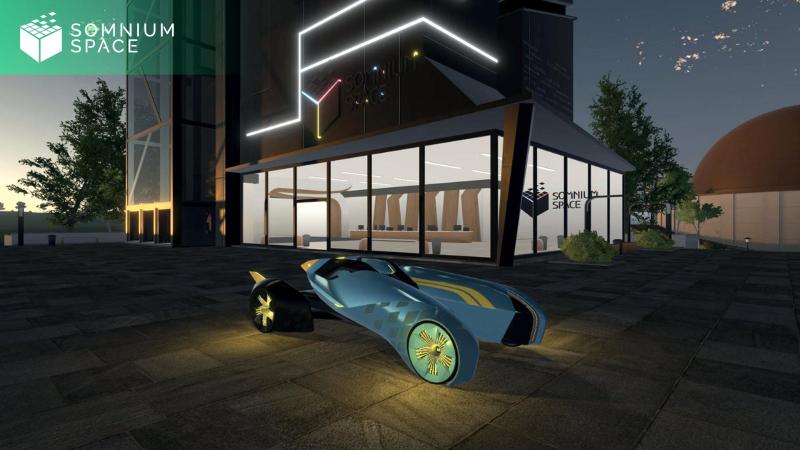
Figure: Somnium’s realistic world
Founded in 2017 by a Czech team, Somnium Space offers both desktop and VR compatibility. Unlike typical grid layouts, Somnium Space parcels lie along rivers and vary in size and shape. The map includes several hilltops offering expansive views of the world.
Somnium Space has also successfully forged partnerships within its Metaverse. Landowners include prominent entities such as cryptocurrency exchange Gemini, which co-headquartered with Nifty Gateway. FTX, another crypto exchange, also launched its headquarters in Somnium Space. These companies exemplify simultaneous existence in both physical and virtual worlds. Republic Realm has also established the Republic Realm Academy in Somnium Space, providing virtual classrooms, headquarters, and gathering spaces for its metaverse education program.

Figure: FTX’s Somnium headquarters

Figure: Gemini’s Somnium headquarters

Figure: Republic Realm Academy
This is Republic Realm’s educational institution, which recently built a campus in the Somnium Space metaverse.
Virtual Real Estate Investment Logic
Monthly average price changes for plots in each Metaverse reflect one thing: the market is indeed volatile. Any crypto investor should be very familiar with this.
In June 2021, the average price of land across the four metaverses was about $6,000. By December 2021, their average price approached $12,000. While Decentraland and Somnium Space frequently exceeded $10,000 in average monthly prices over the two-year span, Cryptovoxels and The Sandbox only surpassed $10,000 in land sale prices in November this year.

Figure 1: Average monthly price of land in Cryptovoxels, Decentraland, The Sandbox, and Somnium Space
Land Scarcity
Similar to real-world land, scarcity is a core driver of Metaverse land value.
Each Metaverse has a different total supply of plots, clearly defined in its whitepaper (similar to a company’s charter). Conceptually, the more land available in a given Metaverse, the more potential participants and projects can be built. However, more land means that without a deep user base to develop and activate parcels, the Metaverse could easily become a "ghost town."
Scarcity is a latent driver of value across all virtual worlds. At the start of any Metaverse project, developers specify the total number of plots to be created. This is analogous to "fully diluted shares outstanding" used in stock valuation. The total value of all land in a Metaverse roughly equals the average price per plot multiplied by the total number of plots. This metric helps estimate and compare the total value of different metaverses.
Because Metaverse development teams often hold large portions of land in their treasury, founding teams have an incentive to support land asset value by encouraging development and slowly releasing new land, avoiding sudden "dilution" that could erode asset prices.
The table below illustrates the total land count and other data for each Metaverse.
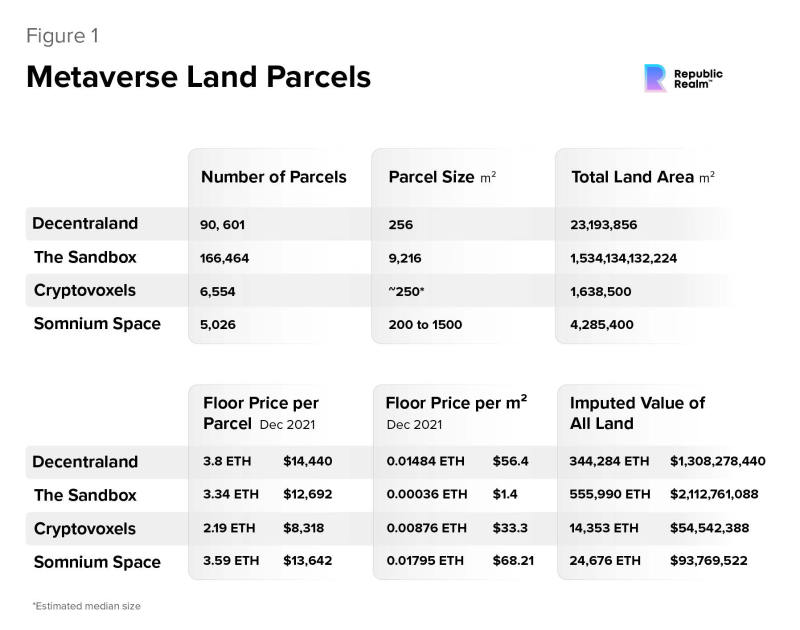
Figure 2: Metaverse Parcel Data
There are only 268,645 plots across the four metaverses, compared to approximately 19 million circulating Bitcoin. While the number of metaverses cannot be capped, neither can the number of BTC competitors. Despite numerous cryptocurrencies attempting to displace BTC as digital stores of value through fierce competition, BTC’s unique status remains unshaken. Similarly, while Metaverses like The Sandbox and Decentraland may be replicated multiple times in the future, their unique gameplay, partnerships, and player communities won't frictionlessly migrate to the next competitor—unless the rival holds a clear competitive advantage.
Consider Manhattan. Manhattan’s real estate is valuable not because of superior geography. In fact, many islands along the U.S. East Coast share similar terrain and even better climates, yet none match Manhattan’s value. Why?
Manhattan is valuable because hundreds of thousands of people have built things there over centuries—offices, theaters, schools, housing, etc. Its value stems from development quality (equivalent to content in the Metaverse) and societal consensus on its worth.
Different Sizes, Different Prices
The Sandbox uses uniformly sized parcels of 96x96 meters, significantly larger than Decentraland’s 16x16 meter plots. In contrast, Cryptovoxels and Somnium Space offer parcels of varying sizes. Somnium Space parcels come in small, medium, and extra-large, ranging from 200 to 1,500 square meters, while Cryptovoxels parcels vary widely. Although a single plot in The Sandbox costs roughly the same (~$10,000) as land in other metaverses, its price per square meter is 41 times cheaper than Decentraland’s and 24 times cheaper than Cryptovoxels’.
2021 Land Sales Data
Despite growing market interest in the Metaverse over recent months, the actual number of plots sold in 2021 was lower than in 2020. This was mainly due to The Sandbox intermittently offering public land sales throughout 2020. Additionally, five-digit starting prices deterred many buyers.
Figure 3 shows the total number of plots sold monthly in 2020 and 2021. As shown, the majority of land sold belongs to The Sandbox.
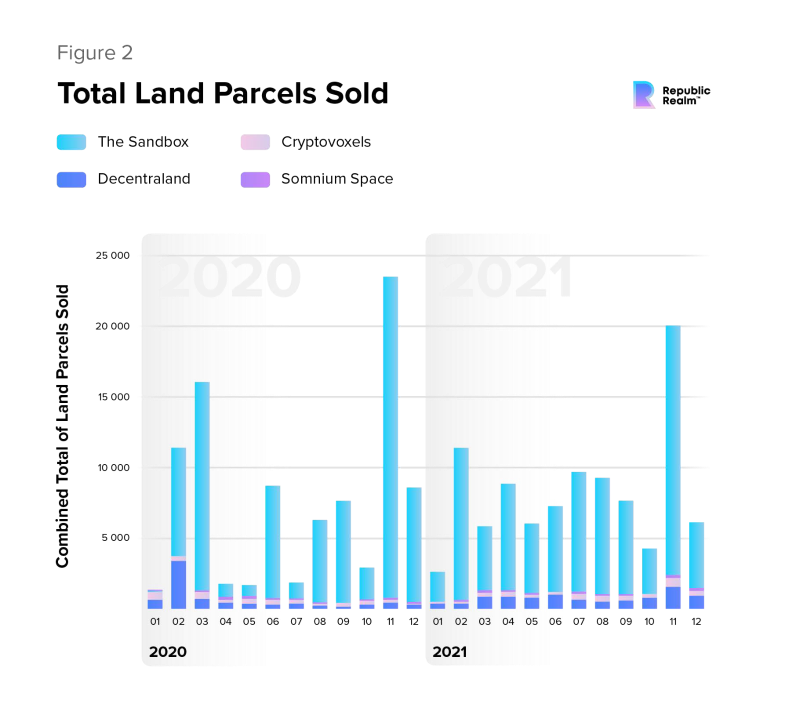
Figure 3: Monthly units of land sold in Decentraland, Cryptovoxels, The Sandbox, and Somnium Space
The Sandbox shows significantly higher sales figures in both November 2020 and November 2021, with over 20,000 parcels sold during those periods. In November 2020, The Sandbox concluded its “Presale 4.3,” which included over 1,800 “premium land” parcels, each located near land owned by well-known partners like Binance. The recent spike in November 2021 was primarily driven by Facebook’s late-October rebranding, which boosted sales across all four metaverses.
Overall, the land unit sales data from the four metaverses provides a clear signal: interest in The Sandbox land far exceeds interest in other metaverses. This is particularly striking because it is the only one among the four that hasn’t officially launched yet.
Although The Sandbox accounts for only 62% of all metaverse land, in every month of 2021, The Sandbox land sales accounted for at least 73.5% of total volume.
When considering total dollar value of land sales, The Sandbox appears even more anomalous. For example, in early 2020, The Sandbox accounted for 0.79% of total sales, but by December 2021, it typically represented over 70% of monthly land sales.
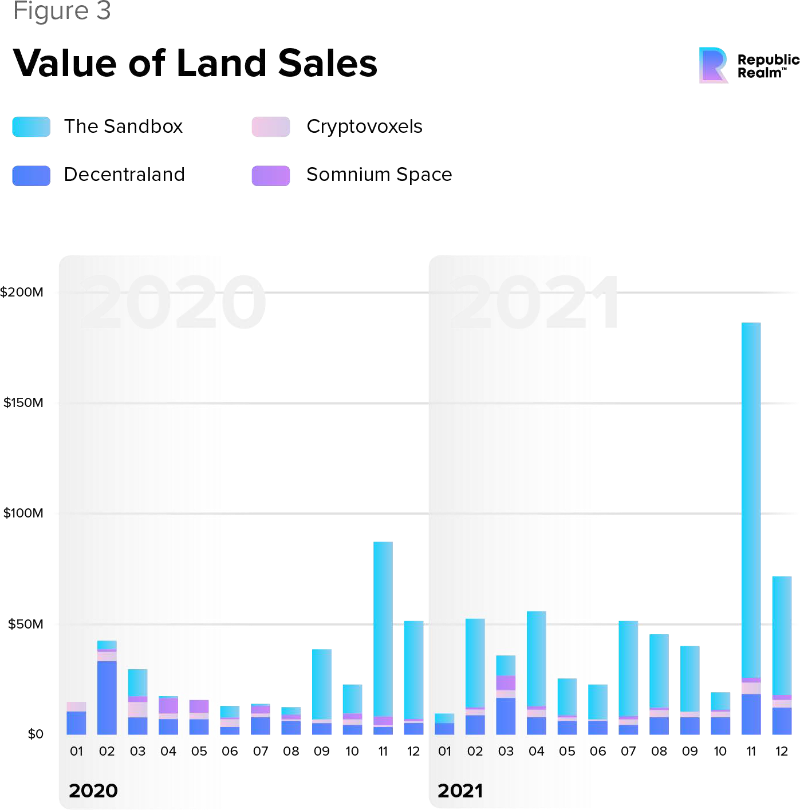
Figure 4: Value of land sales in Decentraland, Cryptovoxels, The Sandbox, and Somnium Space
In November 2020, the four metaverses collectively sold $87,114,159 worth of virtual land. A year later in November 2021, the total reached $186,302,763—a 114% year-over-year increase.
At the time of writing on December 19, 2021, December 2021 was already the third-highest month in terms of total value, surpassing $70 million.
In 2020, Decentraland and The Sandbox had roughly equal total sales. Since 2020, The Sandbox has steadily overtaken Decentraland’s former record in land sales. (In 2021, The Sandbox averaged 64% of total transaction value, compared to Decentraland’s 25%.)
As the newest platform among the four metaverses, The Sandbox’s success partly owes to launching during the Metaverse hype cycle. However, its performance far exceeding peers suggests its success may not be solely luck-driven.
More Buyers Are Entering the Market
More companies and individuals are buying Metaverse land than ever before.
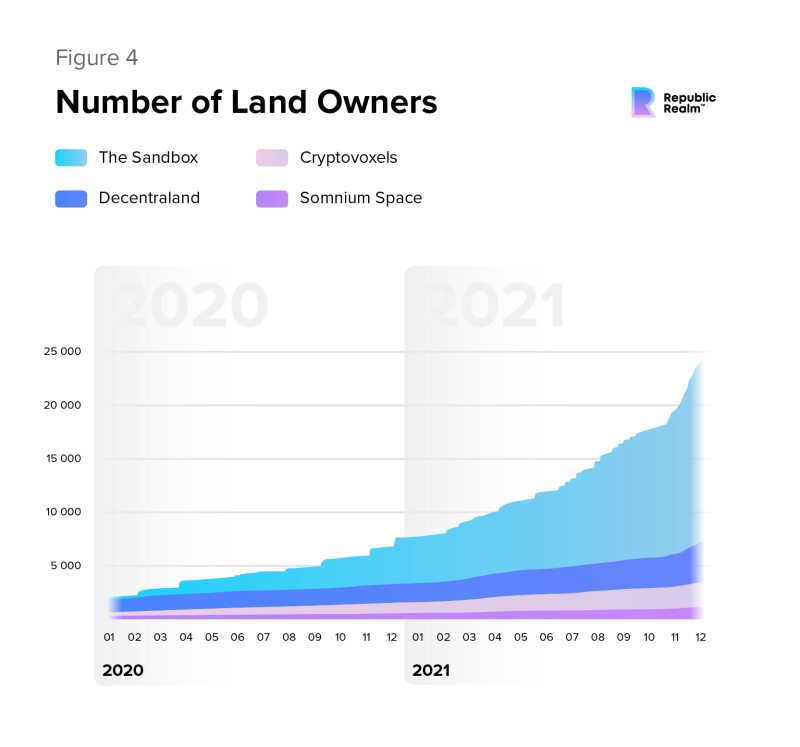
Figure 5: Cumulative total of landowners in Cryptovoxels, Decentraland, The Sandbox, and Somnium Space
Since early 2020, the cumulative number of landowners across the four metaverses has increased by 1,132%, reaching a total of 24,598 by mid-December 2021.
Like other discussed metrics, this number is heavily influenced by The Sandbox, which accounts for nearly 70% of the total despite holding 62% of the land. Meanwhile, Decentraland owners make up about 15% of all metaverse owners, although Decentraland holds 30% of total plots. The number of parcels per owner in each metaverse could significantly affect future land prices, as land in certain metaverses may be concentrated in fewer hands.
Research Conclusions on the Four Major Metaverses
Virtual land in The Sandbox had a breakout year in 2021. Across multiple metrics, the platform demonstrated undeniable dominance over the other three metaverses. While we are enthusiastic about The Sandbox, we also believe interesting land-buying opportunities exist in the other three metaverses, especially Somnium Space and Cryptovoxels, where land is even scarcer.
Currently, the average price per plot in these four metaverses ranges between $10,000 and $15,000. We attribute this price convergence to buyers’ inability to assess whether land in one Metaverse is more valuable than in another.
So far, land scarcity in Metaverse real estate does not equate to higher land value. Instead, in the Metaverse, more land means greater total value. While an individual plot in The Sandbox may not be more valuable than a plot in another Metaverse, the total value of The Sandbox’s real estate exceeds the combined total of the other three.
As more Metaverse platforms launch, we expect new land trading patterns to emerge, favoring those with high-quality content, strong community engagement, organic game mechanics, and user-centric design. Currently, The Sandbox is the clear frontrunner in this space.
Other Metaverse Platforms
At their core, metaverses are video games, and game development takes a long time—years, not months. This means more realistic, interactive metaverse projects may take time to materialize. Compared to the current hype around the Metaverse concept, real-world technology lags behind. However, several exciting projects at different planning stages hint at a promising technological future for the Metaverse.
We’re closely watching projects that are realistic, multifunctional platforms built on blockchain by industry leaders. Platforms like Star Atlas, Pixelynx, SPACE, and Big Time, once launched, are likely to astonish everyone. Virtual economies will rise on robust internal systems, e-commerce will transform into high-quality experiences, and community-driven collaboration models will be redefined.
As “insiders” in the Metaverse ecosystem, Republic Realm often gains access to land before a Metaverse project launches. Entering early at relatively low cost is a strategy to reduce investment risk in metaverse real estate.
In recent months, Republic Realm has invested in the following projects:
1) Aavegotchi – Aavegotchi are crypto-collectible avatars used to explore the Aavegotchi digital universe. Each Aavegotchi has a rarity score based on a unique combination of traits. Drawing inspiration from Tamagotchi’s success, Aavegotchi aims to bring the classic pet concept onto the blockchain.
2) BigTime – BigTime is a multiplayer action RPG founded by Ari Meilich, former CEO of Decentraland. Hailed as the first AAA-grade NFT action RPG, the project has attracted top development talent from traditional gaming, including Carlo Arellano, former concept artist for World of Warcraft, and Tom Zhao, former concept artist for League of Legends.
3) Bit.Country – Bit.Country is a platform helping users build their own metaverse. Using 3D worlds, NFTs, and play-to-earn mechanics, creators can elevate community engagement to a new decentralized level. Without technical skills, creators can even launch their own social tokens for circulation in their designed virtual world.
4) BYOVerse – BYOVerse innovatively introduces the concept of “consumables in the Metaverse.” Its ecosystem revolves around BYOPills—an NFT that provides different utilities when “consumed.” They also plan to sell BYOLand, the land units composing BYOVERSE. The components and attributes of a user’s BYOPill significantly influence the terrain and resources of their BYOLand.
5) Cradles – Cradles is a fantasy RPG set in a prehistoric era, compatible with VR. The world is divided into main cities and adventure zones, inhabited by extinct Triassic-era animals. Cradles transports players to an era before human civilization. Players can embody these creatures—soaring as pterosaurs or stomping as mammoths. Through materials earned in-game, players can create NFTs and sell them to others.
6) DeHorizon – DeHorizon aims to create a cross-chain virtual carnival where metaverse users can play user-generated games. Managed by the DEVT (Decentralized Eternal Virtual Traveler) governance token, owners can decide the future of game development. Its current game ecosystem includes Battleroyale “DeTournament” and Dragon-racing “DeQuidditch.”
7) Dvision – Dvision’s Metaverse consists of many Meta-Spaces—sellable land units. In Meta City, users can play games, win NFT prizes, and trade NFTs on the marketplace. Using the $DVI token, players can conduct transactions via connected wallets.
8) Embersword – In the world of Thanabus, players battle each other (PVP) and engage in quests (PVE) for token rewards. Embersword’s economy runs on Polygon, supporting blockchain-based sales of land and items. Across four nations, players can own parcels, settlements, towns, and cities.
9) Highstreet – Highstreet is building the future of e-commerce by connecting physical brands to metaverse spaces. Serving as a launchpad for brands to establish virtual identities, Highstreet aims to connect brands and users in a shared virtual space. Products and storefronts in this interface can be owned and sold by real-world brands.
10) Mirandus – Developed by blockchain gaming company Gala Games, Mirandus brings the medieval era into the future with a play-to-earn MMORPG. Mirandus is divided into 1,625 independent covenants, each with tradable real estate including castles, barns, grand temples, tanneries, stables, and more.
11) Nifty Island – As a pioneer of a new type of social media and social metaverse, Nifty Island is building an ecosystem for creators and collectors to showcase art, games, and community interaction. Every player receives an island at the start, eliminating competition for scarce land allocation.
12) Pixelynx – As various entertainment media enter the metaverse, Pixelynx is developing technologies to enhance audio and music experiences within it. Betting on blockchain as the ultimate path to optimize gaming and music, Pixelynx has made acquisitions across companies and assets, aiming to bring music into Web 3.0.
13) Star Atlas – Star Atlas is a futuristic virtual game metaverse set in outer space. Three factions rule the explorable universe: (1) MUD, ruled by humans; (2) ONI, ruled by alien races; and (3) Ustur, ruled by sentient robots. As a AAA-grade NFT game on Solana, players can own starships as NFTs and use them to seek valuable resources across the universe.
14) SPACE – SPACE is building a commercial Metaverse optimized for merchandise trading, socializing, and creating unique experiences. Primarily targeting art, music, and fashion, it leverages blockchain’s ability to verify digital authorship and pay royalties to creators. Their Metaverse is divided into distinct “Spaces,” organizing user-owned economies.
15) Treeverse – Treeverse aims to meet communities’ needs for equitable participation. While NFT communities are mostly centered on Web 2.0 platforms like Discord and Twitter, Treeverse wants to bring these communities into a Web 3.0 metaverse and gamify community experiences.
16) Wilder World – Wilder World brings the open-world feel of Grand Theft Auto, tokenized real estate, and luxury markets into Web 3.0 via a DAO hub and play-to-earn model. Life in the city of “Wiami” is filled with entertainment, luxury, and leisure.
New metaverses mean diversity across different blockchains. In recent months, Republic Realm has researched projects built on many different chains, including Ethereum, Solana, Binance Smart Chain, Polygon, Immutable X, Avalanche, Harmony, Near, Cosmos, Polkadot, Aave, Terra, Enjin, Flow, and Wax.
So far, projects built on Ethereum (including sidechains), Solana, and BSC have attracted the most users, but the race for dominant metaverse gaming chains is far from over. One of the year’s most successful games, DeFi Kingdoms, is built on the Harmony chain and is about to bridge to Avalanche. This 2D fantasy project, with nostalgic RPG elements, solid DeFi features, and immersive virtual experience, has swept the gaming space. If DeFi Kingdoms maintains its current trajectory, we’ll undoubtedly see more applications adopting EVM-compatible chains.
Metaverse Real Estate and Play-to-Earn Games
The most prominent P2E game in the Metaverse space is Axie Infinity, which experienced record-breaking growth in 2021. In this game, players earn in-game token rewards (AXS, SLP) by battling creatures called "Axies," which can be traded on cryptocurrency exchanges like Binance and Coinbase. Axie Infinity reportedly reached a $30 billion valuation in October, largely due to its Q3 performance making it the highest-volume NFT series ever, surpassing NBA Top Shot and CryptoPunks. Axie generated $2.08 billion in NFT sales in Q3 2021, accounting for nearly 20% of total NFT volume during that period. The platform had over 2 million daily active users this year, earning recognition from the broader gaming industry.
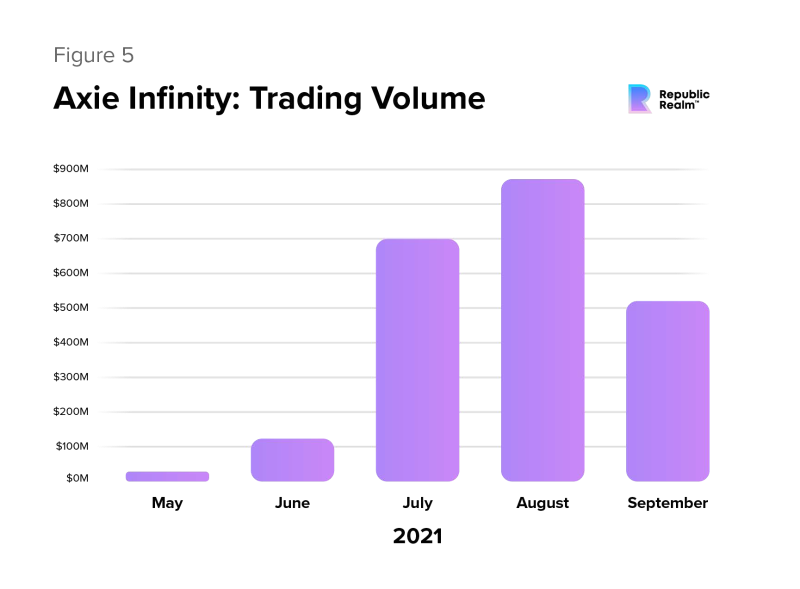
Figure 6: Axie Infinity trading volume in millions of USD
Beyond NFTs and gaming components, players can also purchase digital land within the game. Axie Infinity land, known as Terra, incorporates traditional real estate economics such as location-based pricing and the ability to rent or develop plots. These lands occasionally spawn equipment assets. Today, gamers actively prospect land in the Axie Infinity metaverse, with Terra plots selling for as much as $250.
At the heart of any game is a simple transaction between players and the platform—time exchanged for enjoyment. As blockchain developers began exploring the gaming industry in recent years, innovative solutions like roll-ups and sidechains have yielded results through creative game designs. Sky Mavis developed the Ronin chain specifically for Axie Infinity, offering a more flexible blockchain gaming solution than Ethereum. After achieving unprecedented popularity, Gods Unchained carefully built Immutable X—a fast, gas-free Layer 2 Ethereum protocol. Thanks to these technological breakthroughs, both projects have reaped massive benefits. This type of development continues to attract our interest, including scalable NFT protocols, projects built on emerging blockchains, EVM compatibility, and non-gaming platforms.
Other breakthrough developments include EIP-3664, a new NFT standard soon to be implemented by Cradles. It envisions a modular system for NFTs, allowing components of digital game assets to be removed, sold, or added to other assets—reminiscent of RPG mechanics familiar and beloved by players. Theoretically, this new standard would allow infinite asset expansion without redundant work and could likely open doors to cross-chain collaboration.
Conclusion
2021 largely solidified key technologies where the Metaverse serves as a primary application, including VR and Web 3.0. An 114% year-over-year increase in total land sales
Join TechFlow official community to stay tuned
Telegram:https://t.me/TechFlowDaily
X (Twitter):https://x.com/TechFlowPost
X (Twitter) EN:https://x.com/BlockFlow_News