Coinbase: Ethereum Scaling Solutions Explained
TechFlow Selected TechFlow Selected
Coinbase: Ethereum Scaling Solutions Explained
If blockchain based on smart contracts is to continue evolving and support financial and Web 3 applications for billions of users, scaling solutions will be required.
 Navigating Web3 tides with focused insights
Authors: Justin Mart & Connor Dempsey
Translation: Alex, TechFlow
By the end of 2021, Ethereum had evolved to support thousands of applications from domains such as DeFi, NFTs, and GameFi. The network settles trillions of dollars in transactions annually, with over $170 billion locked on its platforms.
But as the saying goes, where there’s money, there are problems. Ethereum's decentralized design ultimately limits its transaction throughput to about 15 transactions per second. Given that demand for Ethereum far exceeds this capacity, the result has been long wait times and transaction fees reaching as high as $200. This ultimately deters many users and restricts the types of applications Ethereum can support today.
If smart contract blockchains are to continue evolving and adequately support financial and Web3 applications for billions of users, scaling solutions will be essential. Fortunately, the “cavalry” is already arriving—many proposed solutions have recently launched.
Competition or Complementarity?
The goal is to increase the number of transactions that publicly accessible smart contract platforms can handle while preserving sufficient decentralization. Remember, scaling a smart contract platform through a centralized solution managed by a single entity is trivial (Visa handles 45,000 transactions per second), but we’d quickly return to square one—a world owned by a few powerful centralized players.
There are two main approaches to solving this:
(1) Build entirely new networks that compete with Ethereum and can handle more activity
(2) Build complementary networks that absorb Ethereum’s excess capacity.
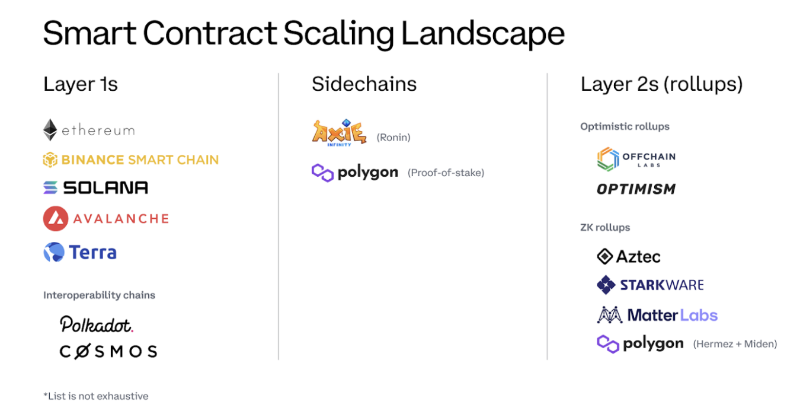
Broadly speaking, these fall into several categories:
1) L1 Blockchains (competing with Ethereum)
2) Sidechains (partially complementary to Ethereum)
3) L2 Networks (complementary to Ethereum)
While each architecture and approach differs, the goal remains the same: to allow users to actually use the network (e.g., interact with DeFi, NFTs, etc.) without paying exorbitant fees or enduring long wait times.
Layer 1s
Ethereum is considered a Layer 1 blockchain—a standalone network that secures user funds and executes transactions all in one place. Want to use a DeFi app like Uniswap to swap 100 USDC for DAI? Ethereum is where it all happens.
Competing L1s can do everything Ethereum does—but within an entirely new network. They differ in that their new system designs enable higher throughput and lower transaction fees, typically at the cost of increased centralization.
Over the past 10 months, new L1s have emerged en masse, with the total value across these networks surging from $0 to around $75 billion during that period. The space is currently led by Solana, Avalanche, Terra, and Binance Smart Chain, each boasting growing ecosystems valued at over $10 billion.
Top non-ETH L1s by TVL
All L1s are competing to attract developers and users. Building and using applications without Ethereum’s tools and infrastructure is difficult.
To bridge this gap, many L1s adopt a strategy called EVM compatibility.
EVM stands for Ethereum Virtual Machine—it is essentially the brain that performs computations to enable transactions. By making their networks EVM-compatible, Ethereum developers can easily deploy their existing Ethereum applications to a new L1 by simply copying and pasting their code. Users can also access EVM-compatible L1s using existing wallets, simplifying migration.
Take Binance Smart Chain (BSC) as an example. By launching an EVM-compatible network and adjusting consensus design for higher throughput and cheaper transactions, BSC saw a surge in usage last summer from dozens of DeFi applications—all similar to popular Ethereum apps like Uniswap and Curve.
Avalanche, Fantom, Tron, and Celo have followed a similar path.
In contrast, Terra and Solana currently do not support EVM compatibility.
TVL comparison: EVM-compatible vs non-EVM-compatible L1s
Interoperability Chains
In a slightly different L1 category are blockchain ecosystems like Cosmos and Polkadot. Instead of building new standalone blockchains, these projects create standards enabling developers to build application-specific blockchains that can communicate with each other. For instance, tokens from a gaming blockchain could be used in an app built on a separate blockchain designed for social networking.
Currently, over $100 billion worth of assets reside on chains built using Cosmos standards, which are ultimately interoperable. Meanwhile, Polkadot recently reached a milestone, unifying its blockchain ecosystem.
In short, Ethereum’s direct competitors now present a diverse landscape—and even more are on the way.
Sidechains
The distinction between sidechains and new L1s is admittedly blurry. Sidechains are very similar to EVM-compatible L1s, except they’re specifically designed to handle Ethereum’s overflow rather than compete directly with Ethereum as a whole. These ecosystems stay closely tied to the Ethereum community and host Ethereum applications in a complementary fashion.
Axie Infinity’s Ronin sidechain is a prime example. Axie Infinity is an NFT game originally built on Ethereum. As Ethereum fees made gameplay prohibitively expensive, the Ronin sidechain was created to allow users to transfer their NFTs and tokens to a low-cost environment. This made the game affordable for more users and preceded its explosion in popularity.
At the time of writing, users have transferred over $7.5 billion from Ethereum to Ronin to play Axie Infinity.
Polygon POS
While sidechains like Ronin are application-specific, others serve more general-purpose use cases. Currently, Polygon’s Proof-of-Stake (POS) sidechain leads the industry, hosting nearly $5 billion in value and over 100 DeFi and gaming applications—including well-known names like Aave and Sushiswap, along with Quickswap, a Uniswap clone.
Similarly, Polygon POS looks no different from an EVM-compatible L1 at first glance. However, it was built as part of a framework designed to scale Ethereum—not compete with it. The Polygon team envisions a future where Ethereum remains the dominant blockchain for high-value transactions and value storage, while everyday transactions shift to Polygon’s low-cost chain. (Polygon POS also maintains a special relationship with Ethereum via a checkpointing process).
Given transaction fees of less than a cent, Polygon’s vision appears plausible. Assisted by incentive programs, users flocked to Polygon POS, whose daily transaction volume even surpassed Ethereum’s (though spam transactions inflated this figure).
Layer 2s (Rollups)
L1s and sidechains both face a clear challenge: securing their own blockchains. To do so, they must pay a new set of miners or proof-of-stake validators to verify and secure transactions—typically funded through inflation of a native token (e.g., Polygon’s $MATIC, Avalanche’s $AVAX).
However, this comes with significant drawbacks:
1) Owning a native token naturally makes your ecosystem more competitive rather than complementary to Ethereum
2) Verifying and securing transactions is complex and challenging, and your network bears responsibility indefinitely
Wouldn’t it be great if we could create scalable ecosystems that leverage Ethereum’s security?
Enter Layer 2 networks—especially “rollups.”
In short, L2s are independent ecosystems built on top of Ethereum, relying on Ethereum for security.
Crucially, this means L2s don’t need native tokens—making them not only more complementary to Ethereum, but inherently part of Ethereum itself.
Even Ethereum’s roadmap pays homage to this idea by stating that Ethereum 2.0 will be “rollup-centric.”
How Rollups Work
L2s are commonly referred to as rollups because they "roll up" or bundle transactions, execute them off-chain, and then send the updated data back to Ethereum. [Instead of having the Ethereum network process 1,000 Uniswap trades individually (expensive!), computation is offloaded to an L2 rollup before submitting the final result back to Ethereum (cheap!).]
But when results are sent back to Ethereum, how does Ethereum know the data is correct and valid? How does it prevent anyone from submitting false information? These questions define the key differences between the two types of rollups: Optimistic rollups and ZK rollups.
Optimistic Rollups
When submitting results back to Ethereum, Optimistic rollups “optimistically” assume they are valid. In other words, they let rollup operators publish whatever data they want (including potentially incorrect/fraudulent data) and assume it’s correct—an undeniably optimistic outlook! But mechanisms exist to combat fraud. As a check-and-balance, after any withdrawal there is a time window during which anyone can flag fraud (remember, blockchains are transparent—everyone can see what’s happening). If one of these observers can mathematically prove fraud occurred (by submitting a fraud proof), the rollup will revert the fraudulent transaction, penalize the bad actor, and reward the observer (a clever incentive mechanism!).
Downside: There is a brief delay when transferring funds between rollups and Ethereum, waiting for potential fraud detection. In some cases, this can last up to a week—though we expect these delays to decrease over time.
The key point is that optimistic rollups are intrinsically linked to ETH and ready to help scale Ethereum today. As a result, with leading DeFi projects migrating to the top optimistic rollups—Arbitrum and Optimistic Ethereum—we’re seeing strong early growth.
- Arbitrum & Optimistic Ethereum
Arbitrum (by Off-chain Labs) and Optimistic Ethereum (by Optimism) are the two major projects implementing optimistic rollups today.
Notably, both are still in early stages, with both teams maintaining a degree of centralized control but planning to decentralize over time.
It’s estimated that once mature, Optimistic Rollups could improve scalability by 10–100x.
Even in their early phases, DeFi applications on Arbitrum and Optimism have already accumulated billions in value.
Optimism is earlier in its adoption curve, deploying over $300 million in TVL across 7 DeFi apps—most notably Uniswap, Synthetix, and 1inch.
Arbitrum has gone further, with around $2.5 billion in TVL across 60+ applications—including familiar DeFi protocols like Curve, Sushiswap, and Balancer.
Arbitrum was also selected as Reddit’s preferred scaling solution as they prepare to launch community points for the social media platform’s 500 million monthly active users.
ZK Rollups
Whereas optimistic rollups assume transactions are valid and leave room for others to prove fraud, ZK rollups actually prove transaction validity to the Ethereum network.
Alongside the bundled transaction results, they submit a so-called validity proof to an Ethereum smart contract. As the name suggests, validity proofs allow the Ethereum network to verify that transactions are legitimate, preventing relayers from cheating the system. This eliminates the need for a fraud-proof window, making fund transfers between Ethereum and ZK rollups practically instant.
While instant settlement and no withdrawal delays sound ideal, ZK rollups come with trade-offs.
- First, generating validity proofs is computationally intensive, requiring high-performance machines to operate efficiently.
- Second, the complexity around validity proofs makes supporting EVM compatibility more difficult, limiting the types of smart contracts deployable to ZK rollups.
Therefore, optimistic rollups were first to market and are better positioned to solve Ethereum’s scaling issues today, but in the long run, ZK rollups may emerge as the superior technical solution.
-
Adoption of ZK Rollups
The ZK rollup space is deep, with multiple teams actively developing and operating solutions. Notable players include Starkware, Matter Labs, Hermez, and Aztec.
Today, ZK rollups mainly support relatively simple applications like payments or exchanges (due to current limitations on supported application types). For example, the derivatives exchange dYdX adopted Starkware’s (StarkEx) ZK rollup solution to support nearly 5 million transactions per week and over $1 billion in TVL.
However, the ultimate prize lies in ZK rollup solutions that are fully EVM-compatible, capable of supporting popular general-purpose applications (like full DeFi suites) without the exit delays associated with optimistic rollups.
Key contenders in this race include Matter Labs’ zkSync 2.0, Starkware’s Starknet, Polygon Hermez’s zkEVM, and Polygon Miden—all currently working toward mainnet launches. (Meanwhile, Aztec focuses on applying zk proofs to privacy).
Many industry insiders (including Vitalik) believe ZK rollups represent the long-term scaling solution for Ethereum, primarily due to their ability to natively process thousands of transactions per second without compromising security or decentralization.
As Ethereum scaling progresses, the upcoming fully EVM-compatible ZK rollups will be among the most critical developments to watch.
A Fragmented World
Long-term, these scaling solutions are necessary if smart contract platforms are to reach billions of users.
However, in the short term, these solutions pose significant challenges for users and crypto operators. Navigating from Ethereum to these networks requires cross-chain bridges, which are complex and potentially risky for users. For example, several cross-chain bridges have been targeted in attacks exceeding $1 million.
Moreover, a multi-chain world fragments composability and liquidity. Consider that Sushiswap is now deployed on Ethereum, Binance Smart Chain, Avalanche, Polygon, and Arbitrum. Where Sushiswap’s liquidity was once concentrated on a single network (Ethereum), it is now spread across five separate networks.
Ethereum applications have long benefited from composability—i.e., Sushiswap on Ethereum seamlessly integrating with other Ethereum apps like Aave or Compound.
As applications expand to new networks, apps deployed on one L1/sidechain/L2 are no longer composable with those on another layer, limiting usability and creating challenges for users and developers alike.
An Uncertain Future
Will new Layer 1s like Avalanche or Solana continue growing to rival Ethereum?
Will blockchain ecosystems like Cosmos or Polkadot surge in prominence?
Will sidechains continue operating in harmony with Ethereum, absorbing its excess capacity?
Or will rollups combined with Ethereum 2.0 ultimately prevail?
No one can say for sure.
While the future is uncertain, everyone can take comfort in knowing that so many talented teams are working to solve some of the most challenging problems facing open, permissionless networks.
Just as broadband eventually enabled the internet to support revolutionary applications like YouTube and Uber, we believe we’ll one day view the winning scaling solution with the same clarity.
TechFlow is a deep-content platform focused on alternative asset investment. Follow our official account for more insights, or add WeChat TechFlow01 to join the TechFlow community and participate in discussions.

Join TechFlow official community to stay tuned
Telegram:https://t.me/TechFlowDaily
X (Twitter):https://x.com/TechFlowPost
X (Twitter) EN:https://x.com/BlockFlow_News