StarkNet Alpha Launches on Ethereum Mainnet: A Guide to ZK-Rollups and Ethereum's Scaling Journey
TechFlow Selected TechFlow Selected
StarkNet Alpha Launches on Ethereum Mainnet: A Guide to ZK-Rollups and Ethereum's Scaling Journey
Since current on-chain application projects have a huge demand for Ethereum block space, but block space is limited, the network can easily become congested, slowing down transaction confirmation speeds and increasing gas fees.
 Navigating Web3 tides with focused insights
Author: Timothy Craig
Translation: zombit
StarkNet Alpha, Ethereum’s highly anticipated ZK Rollup scaling solution, went live on the Ethereum mainnet yesterday, offering relief from Ethereum's current high transaction fee environment. While several scaling solutions have already been adopted in practice, ZK-Rollup (Zero-Knowledge Rollup) technology has consistently been viewed as the ultimate answer to scalability—why is that?
Ethereum's Scalability Problem
High gas fees have become a major issue for Ethereum. Since transaction fees are paid in ETH, rising asset prices directly increase network usage costs. ETH has risen 460% this year, meaning dollar-denominated transaction costs have also increased by 460%. Additionally, fees depend on network congestion. With current dApps placing immense demand on Ethereum's limited block space, the network easily becomes congested, slowing transaction confirmations and driving up gas fees.
The high cost of using the network hinders user participation in DeFi (decentralized finance) and NFTs, even excluding them from DAOs. Many crypto enthusiasts have migrated to other Layer-1 blockchains like Solana (SOL) and Avalanche (AVAX).
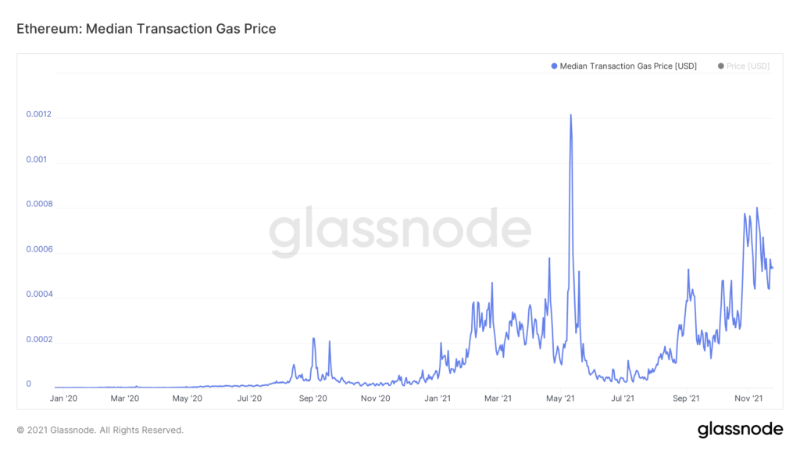
Median Ethereum transaction gas price
Over the past few years, several scaling solutions have been developed to alleviate Ethereum's congestion and high transaction costs. Polygon, launched in 2019, was arguably the first Ethereum scaling solution to gain significant traction. It uses a scaling framework called Plasma, which moves transactions off the main Ethereum blockchain onto a dedicated sidechain. Many native Ethereum DeFi applications, such as Curve (CRV) and Aave (AAVE), have deployed on Polygon.
While the Polygon network successfully attracted users with low transaction fees, it has often been criticized for its security and centralization concerns, leading some to argue it isn’t a true scaling solution. The network manages its own PoS consensus mechanism through independent validators, meaning it does not rely on Ethereum’s mainnet for transaction validation. As of press time,
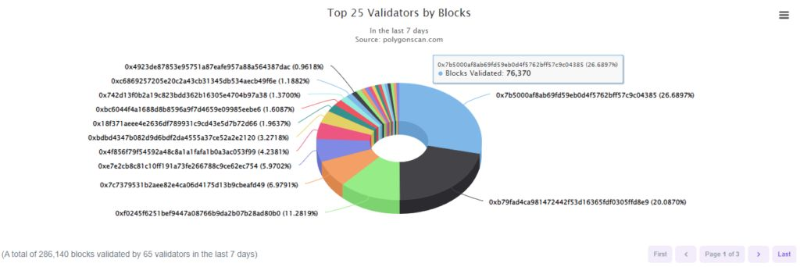 Top 25 validator share of the Polygon network
Rollups
Recently, Rollup-based scaling solutions have sparked intense discussion within the Ethereum community. As the name suggests, Rollups bundle computation data and send validity proofs back to the Ethereum mainnet. This saves block space and reduces the amount of data submitted to the main chain. Because transactions are grouped together, gas fees can be shared among many users. Rollups offer near-instant transaction speeds and can reduce fees by 50 to 200 times while maintaining Ethereum’s security and decentralization.
Currently, there are two types of Rollup solutions: Optimistic Rollups and Zero-Knowledge Rollups (ZK-Rollups).
What is an Optimistic Rollup?
Optimistic Rollups assume that transactions sent back to the main chain are valid unless challenged. Only when a validator submits a fraud proof demonstrating fraudulent activity will a transaction be rejected. In other words, Optimistic Rollups follow a “guilty until proven innocent” approach to transaction validation.
Optimistic Rollups have seen real-world adoption, partly because they make application development easier. They natively support full smart contract functionality, allowing developers to write applications using Ethereum’s Solidity programming language. According to L2beat, Arbitrum—the largest Optimistic Rollup network—has attracted over $2.5 billion in total value locked (TVL) in DeFi applications and hosts many popular Ethereum DeFi protocols.
However, due to their validation method, Optimistic Rollups face challenges. Funds withdrawn back to the Ethereum mainnet must undergo a challenge period (Dispute Time Delay) lasting up to one week, causing user inconvenience and disrupting composability. While Optimistic Rollups represent an improvement over Plasma-based solutions like Polygon, they are generally considered inferior to ZK-Rollups. Optimistic Rollups offer up to 77x scalability improvements, whereas ZK-Rollups can achieve up to 500x improvements—with no challenge period.
What is a ZK-Rollup?
ZK-Rollups generate cryptographic proofs when bundling transactions to the main chain, proving their validity. Transactions are only accepted on Ethereum once these proofs are verified. Unlike Optimistic Rollups, ZK-Rollups adopt a “innocent until proven guilty” verification model.
However, ZK-Rollups have not yet reached the same level of compatibility as Optimistic Rollups. Each transaction must be accompanied by a validity proof, making them more technically complex to develop. Currently, ZK-Rollups can execute simple tasks like direct transfers and swaps. While integrating smart contracts is possible, it remains more challenging than with Optimistic Rollups.
Earlier this year, Ethereum co-founder Vitalik Buterin predicted that fully composable ZK-Rollups would take several years to develop. However, developers have moved faster than expected. Several ZK-Rollup projects are now preparing deployments that offer full composability and interoperability—even enabling communication between multiple Rollups.
The evolution of ZK-Rollups will enable shared communication frameworks between Ethereum’s mainnet and multiple Layer-2 networks. Networks will be able to share liquidity and overcome the biggest adoption hurdles faced by Layer-1 blockchains. Instead of competing for liquidity to maintain efficient trading on decentralized exchanges, ZK-Rollup-based networks will scale Ethereum collaboratively.
ZK-Rollups also possess a unique feature: transaction costs decrease as more people transact. The cost of submitting a batch changes little regardless of size. As more transactions are bundled into a single batch, the cost is distributed across more users. Since ZK-Rollups can theoretically process nearly infinite transactions per batch, gas fees could drop to just a few cents when user volume is high—a phenomenon known as "validity proof amortization."
Although Ethereum still faces scalability challenges, developers are already deploying Layer-2 ZK-Rollup networks that promise full composability and compatibility with smart contracts, other Layer-2 solutions, and the Ethereum Virtual Machine (EVM).
Types of ZK-Rollups
Currently, two distinct types of ZK-Rollups are being used in Ethereum scaling solutions.
- SNARKs
The first and most widely used type is ZK-SNARKs, short for Succinct Non-Interactive Arguments of Knowledge. It was the first form of zero-knowledge proof discovered and has been used since 2016 by privacy-focused blockchain project Zcash (ZEC). This technology forms the foundation of most ZK-Rollup developers’ codebases and databases and is considered a strong contender for Ethereum scaling.
However, SNARKs have a drawback: they require a trusted setup phase involving secret keys used to generate transaction proofs. If these keys are not properly destroyed after setup, they could be exploited to mint tokens out of thin air or forge transactions.
One prominent SNARK-based scaling solution is Matter Labs’ zkSync, launched in June 2020. Its current iteration claims to handle up to 2,000 transactions per second, with plans for higher throughput. In May this year, the platform began working on deploying smart contracts in an EVM-compatible environment, launching its zkEVM testnet.
zkSync focuses on making the transition from Ethereum mainnet as seamless as possible. Developers building on zkEVM can use Solidity, Ethereum’s native programming language. Recently, Matter Labs raised $50 million in a Series B round led by a16z to accelerate zkSync’s development. The company has also partnered with several major Ethereum DeFi platforms, including Curve, Aave, and 1inch.
- STARKs
The alternative ZK-Rollup approach is STARKs, short for Scalable Transparent Arguments of Knowledge. STARKs hold advantages over SNARKs because they rely solely on hash functions and do not require a trusted setup, making them theoretically more secure than SNARKs.
StarkWare was the first company to use STARKs to scale Ethereum and remains the primary driving force behind STARK-based technology. The company’s co-founders, Eli Ben-Sasson and Michael Riabzev, are the inventors of STARKs. StarkWare created Cairo, a Turing-complete programming language for STARK-based ZK-Rollups. The “StarkEx protocol” was the first product built using Cairo.
StarkEx is an application-specific scaling solution currently used by several Ethereum projects, including dYdX, Immutable X, Sorare, and DeversiFi. StarkWare’s upcoming release, StarkNet, is a permissionless ZK-Rollup network that allows developers to build and deploy applications directly on Layer-2. StarkNet aims to become a truly decentralized, multi-application scaling solution.
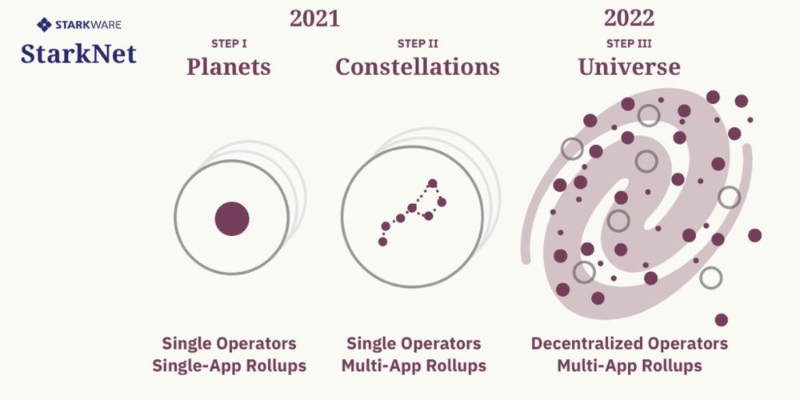
StarkNet development roadmap
ZK-Rollups are poised to transform how the crypto community interacts with Ethereum. With the emergence of high-speed, low-cost networks like zkSync and StarkNet, more Ethereum mainnet transactions will be offloaded to Layer-2, bringing Ethereum closer to its vision of becoming a scalable, secure, and decentralized blockchain network.
Join TechFlow official community to stay tuned
Telegram:https://t.me/TechFlowDaily
X (Twitter):https://x.com/TechFlowPost
X (Twitter) EN:https://x.com/BlockFlow_News