Breathing New Life into DeFi: How Stacks 2.0 Unlocks the Immense Value of Native Bitcoin
TechFlow Selected TechFlow Selected
Breathing New Life into DeFi: How Stacks 2.0 Unlocks the Immense Value of Native Bitcoin
Leveraging Bitcoin's strong consensus and liquidity to bridge the traditional world with the crypto world, the industry will unlock infinite possibilities in the new year.
 Navigating Web3 tides with focused insights
As the digital asset with the highest market capitalization, Bitcoin's consensus attributes, liquidity, and social impact surpass those of any other token, and it is bound to integrate into the innovation wave of decentralized finance (DeFi).
At the beginning of the new year, looking back at 2020, the digital asset industry centered around Bitcoin has experienced a remarkable year:
- From the sluggish market following the March 12 crash at the beginning of the year, to the calm response to the "halving" event in mid-year;
- The explosive growth of the DeFi boom in the second half, followed by Bitcoin breaking historical highs and further expanding beyond niche circles by year-end.
We have witnessed the vibrant momentum of the crypto world advancing in a relay-like fashion, and come to realize that leveraging Bitcoin’s strong consensus and liquidity to bridge the traditional and crypto worlds will unlock infinite possibilities for the industry in the coming year.
Key Takeaways:
● Ethereum DeFi’s Three Major Challenges:
○ Limited scalability: Significantly increases users’ transaction time and costs;
○ Security concerns: Frequent security issues in DeFi, frequent hacker attacks, severe losses for projects and users;
○ Asset scale limitations: If the market continues its exponential growth trend, Ethereum will hit an “asset ceiling.”
● Bitcoin’s Advantages and Bottlenecks in Unlocking DeFi:
○ Growing willingness among holders to enter the DeFi space, increasingly recognized by traditional financial institutions;
○ Further development of DeFi requires Bitcoin: Bitcoin boasts a powerful developer community, a battle-tested PoW consensus mechanism proven most secure, and far exceeds other assets in awareness, consensus, and circulation;
○ A long-standing bottleneck is the lack of scalable smart contracts on the Bitcoin blockchain.
● Stacks 2.0, evolved from Blockstack, unlocks Bitcoin’s DeFi potential:
○ Stacks 2.0 innovates around Bitcoin’s settlement protocol without altering Bitcoin itself, enabling native Bitcoin smart contracts and decentralized applications;
○ PoX is a novel consensus mechanism bridging Bitcoin and smart contract chains, cleverly combining the best of both: mining secured by Bitcoin’s security, smart contracts executed on Bitcoin’s blockchain, with STX miners writing new blocks on the connected Stacks blockchain;
○ Native programming language Clarity allows smart contracts to act based on activities observed on the Bitcoin blockchain, ensuring “what you see is what you get.” Clarity eliminates intermediaries like EVM, reducing error risks;
○ Transactions on the Stacks blockchain can scale independently, relying only on Bitcoin for finality, opening new opportunities for “DeFi + Stacks 2.0.”
Which Soil Is Better Suited for DeFi to Flourish: Bitcoin or Ethereum?
Starting mid-2020, DeFi projects flourished, bringing a turnaround to the sluggish market.
However, Ethereum’s foreseeable asset ceiling, network bottlenecks, and fundamental smart contract security vulnerabilities gradually emerged and were amplified as the market rapidly expanded, intensifying market participants’ demands for assets, security, and liquidity.
Compared to Ethereum, Bitcoin—the asset with the largest market cap—has superior asset qualities, liquidity, and value over any other token. Although Bitcoin’s history seems short compared to traditional financial markets, its unique characteristics have won favor among numerous investors, attracted concentrated institutional inflows this year, and are gradually becoming an indispensable part of the global economy—making it naturally suited to integrate into the DeFi wave.
Ethereum DeFi’s “Three Major Challenges”
Limited Scalability
The DeFi liquidity mining surge brought massive user influx to Ethereum, driving miner revenues up but also exposing the network’s performance bottlenecks. During peak periods, gas fees surged dramatically, causing network congestion and pushing transaction fees above $100, significantly increasing transaction time and cost.
According to data from Ethereum block explorer Etherscan, Ethereum’s daily transaction volume exceeded 1.4 million on September 17, 2020, breaking the 2018 record. At that time, Ethereum’s price hovered near its historical high of $1,400. On the same day, Ethereum’s network transaction fees reached 42,700 ETH, also setting a new record.
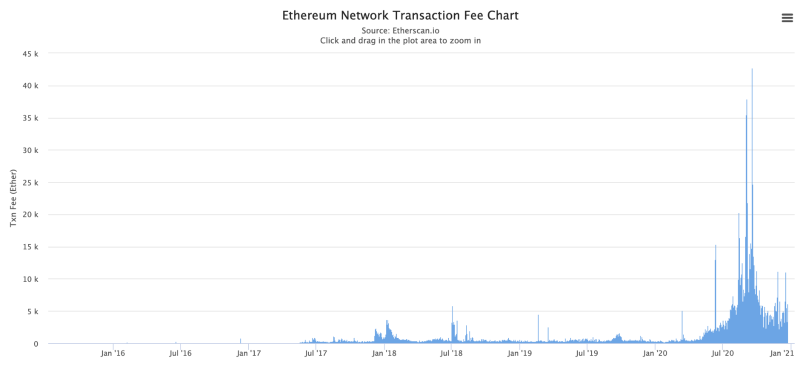
(Ethereum Network Transaction Fees, Source: Etherscan.io)
Ethereum’s scalability challenges not only dampen user participation but also restrict project innovation and growth.
In response, the Ethereum development community launched urgent efforts. Ethereum 2.0, aimed at solving scalability, throughput, and security issues, completed the genesis launch of its beacon chain in early December 2020. However, due to the complexity of transitioning from Proof-of-Work (PoW) to Proof-of-Stake (PoS) and deploying sharding technology, the full rollout of Ethereum 2.0 remains a long and complex process, likely to be delayed.
Smart Contract Security Concerns
Just like network performance, smart contract security failed to keep pace with market developments. Contract vulnerabilities are like hidden time bombs waiting for hackers to discover and detonate.
For example, Cover Protocol—an insurance protocol designed to protect digital assets—was exploited in late December 2020 via a “minting out of thin air” attack. Attackers cashed out across multiple DEXs, causing the token price to plummet, even approaching zero. “Insurance protocols unable to insure themselves” once again sounded the alarm on security.
Muneeb Ali, founder of Stacks and CEO of Hiro Systems PBC (formerly Blockstack PBC, referred to as Hiro below), commented on Twitter about this incident: “All these DeFi vulnerabilities (latest being Cover)—maybe we should pause and ask ourselves if scripting languages similar to JavaScript are really suitable? Formal verification is needed; manual audits alone aren’t enough.”
Hiro’s Jude Nelson previously wrote an article listing eight common smart contract vulnerabilities: Reentrancy, Access Control, Overflow and Underflow, Unchecked Return Values for Low-Level Calls, Denial of Service, Bad Randomness, Time Manipulation, and Short Address Attacks.
Smart contracts are now standard on public blockchains, using various programming languages. Stacks’ native contract language, Clarity, effectively prevents the aforementioned vulnerabilities.
Take the “Unchecked Return Values for Low-Level Calls” vulnerability as an example. One of Solidity’s deep features is low-level functions like call, callcode, delegatecall, etc. These functions handle errors differently from other Solidity functions—they don’t propagate exceptions or revert execution but return an error value while the code continues running, creating an opening for hackers. In contrast, all publicly called functions in Clarity must return either an ok or err type, enforcing non-termination. If a function returns err, the transaction halts and the contract stops executing—eliminating the possibility of exploiting such vulnerabilities at the root level.
Ethereum’s Asset Ceiling
As 2021 began, cryptocurrencies represented by Bitcoin and Ethereum continued hitting new price highs. Ironically, if the market maintains its geometric growth trend, Ethereum will soon hit its “asset ceiling.”
According to CoinMarketCap data on January 4, 2021, Ethereum—the second-largest cryptocurrency—had a market cap of approximately $113.7 billion, still nearly five times smaller than Bitcoin’s $572.8 billion (a difference of ~$460 billion). This implies $460 billion in funds remain inefficiently locked outside DeFi due to Ethereum application protocol constraints, potentially failing to meet market demand.
“Collateralized lending” is the core driver behind DeFi’s explosive growth. In June 2020, the Compound community proposed modifying COMP’s distribution mechanism, introducing the concept of “Farming” (mining), launching the era of liquidity mining and drawing users into fields of “Token crops.” According to DeBank data, as of January 4, 2021, total borrowing in the Ethereum DeFi market surpassed $3.6 billion—meaning the ceiling on collateralized lending also caps DeFi innovation.
Yet, applying traditional financial data models reveals that Ethereum’s current lending scale is still too small, not too large.
For instance, according to DataBao on January 4, 2021, among 3,926 A-share companies analyzed, 2,594 had pledged shares—over 66%. As shown in the chart below, most pledge ratios fall between 10%-30% or below 10%.
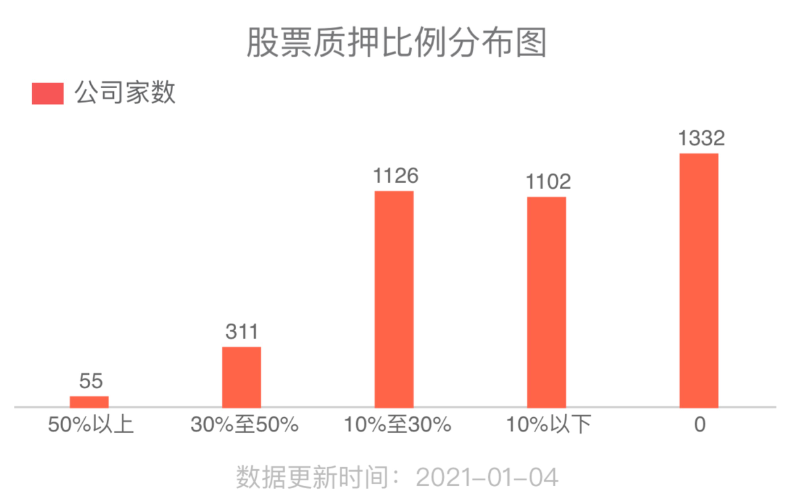
(Source: DataBao)
Using A-share equity pledge data as a model (an extremely conservative estimate), assuming a rough 10% pledge ratio, we find that Bitcoin’s $572.8 billion market cap alone could generate around $57.2 billion in latent lending demand—currently untapped. In comparison, Ethereum’s $3.6 billion lending scale pales in significance, barely a starter.
Summary: DeFi Needs Bitcoin, and Bitcoin Needs Its Own Native DeFi
In fact, Bitcoin has already entered the DeFi space, proving holder acceptance. The most common current solution is “wrapped tokens”: protocols like wBTC and renBTC convert Bitcoin into ERC-20 “Bitcoin-pegged tokens.” According to DeBank data, Bitcoin flowing into DeFi briefly exceeded 150,000 BTC in early November 2020.
BadgerDAO, focused on better integrating Bitcoin into DeFi, launched on December 4, 2020, and was warmly received. Within one month, its total value locked (TVL) surpassed $550 million, ranking 10th among DeFi projects, demonstrating strong demand from Bitcoin holders for DeFi.
It’s well known that Bitcoin enjoys the broadest acceptance among traditional institutional investors. Unlike the bull run at the end of 2017, this rally is dubbed the “institutional bull,” driven largely by institutional investors like Grayscale. More mainstream and traditional financial institutions are initially allocating to Bitcoin, holding it in the largest quantities. If these institutions enter the DeFi arena, they will bring their Bitcoin—generating asset scale and effects unmatched by today’s Ethereum.
Finally, Bitcoin—fully decentralized and securely operating for over a decade—is the most secure asset in the blockchain space. It has a loyal and robust developer community, a PoW consensus widely regarded as the most secure and reliable, with no single point of control or alteration. Its recognition, consensus, and circulation dwarf all other crypto assets.
If institutions enter the DeFi arena, they will demand the highest standards of asset security and stability. Bitcoin is the only asset meeting these criteria. It’s easy to imagine that institutional-grade capital may prefer a DeFi ecosystem built natively on Bitcoin rather than “pegging” their Bitcoin onto Ethereum—a risky network that cannot be optimized quickly.
Stacks 2.0 Brings Secure Scalability to Native Bitcoin
To address these issues and enhance DeFi’s accessibility, many teams and projects aim to bring Bitcoin into DeFi. As mentioned, the currently accepted approach remains centralized “wrapped BTC” solutions—converting native Bitcoin into ERC-20 versions on Ethereum.
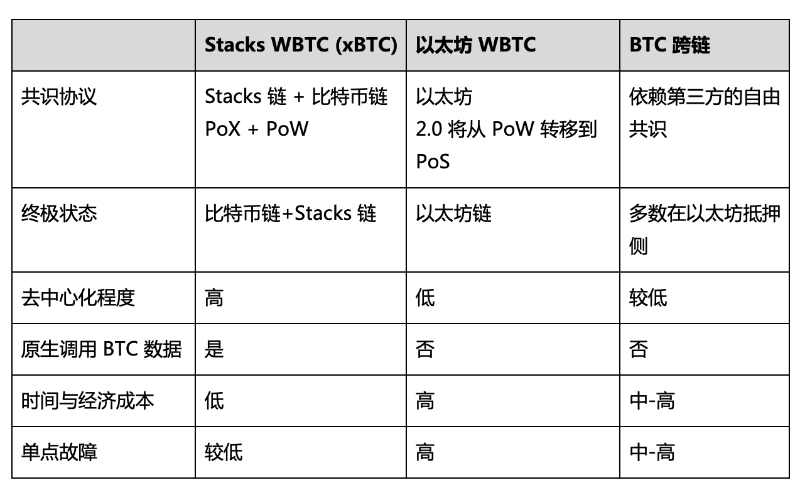
Such centralized “cross-chain asset” methods suffer from single-point risk, centralization, trust, and cost issues. Institutions and large holders typically avoid third-party cross-chain solutions—as this means entrusting their coins to a DeFi protocol. Enabling native Bitcoin access to DeFi would open the door for institutional capital.
The distributed computing network Stacks focuses on this innovative solution. The Layer-1 blockchain Stacks 2.0 enables decentralized apps and smart contracts while securing transactions through native Bitcoin, achieving maximum safety.
Unleashing the Power of Native Bitcoin
Bitcoin can be seen as blockchain’s first and most powerful, secure application—it provides a new form of currency immune to control or alteration by any party. The Bitcoin network not only underpins the currency itself but also serves as a universal settlement protocol.
Bitcoin’s immutable, counterfeit-proof foundation and elegant design, though limiting its business functionality, represent its inherent strengths and consensus—qualities that should not be abandoned when integrating into DeFi.
Just as TCP protocol is the internet standard without needing modification for higher-layer innovations, decentralized protocols and applications in DeFi can be built atop Bitcoin. As early as 2017, Hiro’s predecessor Blockstack proposed the concept of a decentralized application layer, gaining recognition from top-tier investors.

(Source: Stacks)
Many liken Bitcoin to “digital gold.” This highlights its store-of-value function but overlooks its programmable nature and other expandable uses. Stacks 2.0 aims to correct this misconception, exploring innovations around Bitcoin’s settlement protocol without changing Bitcoin itself, enabling native Bitcoin DeFi smart contracts and decentralized applications.
Stacks 2.0 uses Bitcoin as the value settlement standard and introduces a new consensus algorithm between two blockchains called Proof of Transfer (PoX), connecting the Bitcoin network and Stacks blockchain while extending Bitcoin’s capabilities.
PoX mining anchors Bitcoin’s security, allowing smart contracts to operate on the Bitcoin blockchain, while STX (Stacks’ token) miners write new blocks on the connected Stacks blockchain—unlocking a new experience combining “Bitcoin + DeFi smart contracts and applications” via PoX.
Envisioning the New Experience of DeFi + Stacks 2.0
At the beginning of this article, we discussed Ethereum DeFi’s “three major challenges.” Next, we’ll detail how Stacks 2.0 addresses each one.
Regarding transaction scalability, Stacks 2.0 blockchain transactions can scale independently, without relying on the Bitcoin chain, using Bitcoin only for finality. Thousands of transactions on the Stacks blockchain produce a hash settled on every Bitcoin block as part of consensus.
Additionally, Stacks introduces microblocks, enabling preliminary confirmation within seconds. Microblocks are a key area for future scalability research—faster consensus algorithms could theoretically run on microblock data anchored to each Bitcoin block. Meanwhile, Bitcoin serves as Stacks’ foundational settlement protocol, storing block hash archives and tightly linking transactions to Bitcoin.
Moreover, from inception, the Hiro team aimed to build a complete ecosystem supporting decentralized app (DApp) development, data storage, identity verification, and more—seeking to maintain traditional internet performance while using decentralization to solve trust issues and safeguard security.
Safeguarding Security
Stacks’ decentralized authentication system (DID) allows users to manage their own data and identity, authorizing DApps to read information during login or usage. Even developers never access user data or sensitive info, fundamentally preventing malicious behavior.
Furthermore, the native smart contract language Clarity enables DeFi smart contracts to act based on behaviors observed on the Bitcoin blockchain, ensuring “what you see is what you execute.” Developers can know exactly what a program will do just by reading the code. Clarity is also Turing-incomplete, avoiding “Turing complexity.” Finally, Clarity is published and executed directly by nodes, eliminating intermediaries like EVM and further reducing error and attack risks.
With Stacks 2.0, centralized cross-chain solutions become obsolete—we now have a superior way to bring BTC into DeFi. The table below compares these approaches:
How Stacks 2.0 Builds Smart Contracts
Stacks 2.0 brings smart contracts and decentralized apps to Bitcoin primarily through two components: the novel consensus algorithm PoX and the native smart contract language Clarity.
Proof of Transfer (PoX)
Stacks 2.0 establishes a new consensus algorithm between two blockchains: PoX (Proof of Transfer Mining with Bitcoin).
Specifically, Stacks uses Bitcoin as the base chain and Stacks as the connected chain. PoX repurposes already-mined Bitcoin as “proof of computation,” with miners using Bitcoin as the cost of mining.
Stacks miners use Bitcoin to mine newly minted STX tokens. Stacks holders can lock STX in consensus to earn Bitcoin, making STX a unique crypto asset priced in BTC and generating BTC yields. This process treats Bitcoin as a settlement protocol.
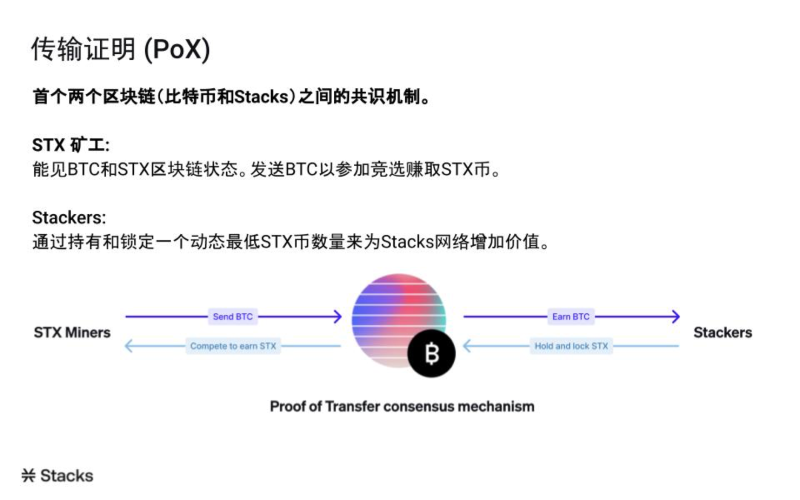
(Source: Stacks)
Smart Contract Language Clarity
Clarity is a new smart contract programming language developed over the past two years by computer scientists from Princeton and MIT. It prioritizes predictability and security and launched alongside the Stacks 2.0 mainnet.
Stacks 2.0 anchors Clarity smart contracts to Bitcoin, making costs and performance transparent for developers and automated validation. Clarity contracts include built-in SPV proofs for Bitcoin, simplifying interaction for developers.
Not all decentralized apps require smart contracts, but Clarity unlocks various interesting features for them. Use cases include, but are not limited to: access control (e.g., pay-to-access); non-fungible and fungible tokens; business model templates (e.g., subscriptions); application-specific blockchains; decentralized autonomous organizations (DAOs), etc.
From a language design perspective, Clarity differs from most smart contract languages in two ways: first, it is interpreted and broadcast uncompiled on the blockchain; second, it is decidable (non-Turing-complete).
Using an interpreted language ensures executed code is human-readable and auditable. Decidable languages like Clarity allow precise determination of code execution for any function, greatly reducing smart contract vulnerabilities and enabling developers to write logic directly around Bitcoin’s state. This makes Clarity scalable and suitable for large-scale applications.
Additionally, Clarity allows full static analysis of a smart contract’s entire call graph. Runtime costs and data usage can be analyzed, enabling developers to predict exactly what a Clarity program will do and how much it will cost—greatly reducing the likelihood of errors and hacker exploits.
Stacks 2.0 Incentive Mechanism
Stacks’ long-term value typically depends on network growth and demand for Clarity smart contracts. To execute Clarity contracts on the network, users must pay STX, Stacks’ native token, as gas fees. For example, a decentralized exchange built with Clarity contracts requires STX to execute trading logic.
STX Token Economics
The amount of Bitcoin rewards earned by STX holders depends on both token incentives and network usage.
The Stacks genesis block contained 1.32 billion STX. The cryptocurrency has a predetermined future supply, reaching approximately 1.818 billion by 2050 (reduced from the original 2.04 billion design). By the end of January 2021, about 1.006 billion of the initial 1.32 billion STX will be circulating, with the remainder released monthly per unlock schedules.
Block rewards will be set at 1,000 STX per block for the first four years, halving every four years, stabilizing at 125 STX per block thereafter. Additionally, Stacks block time aligns with Bitcoin’s—approximately one block every 10 minutes.
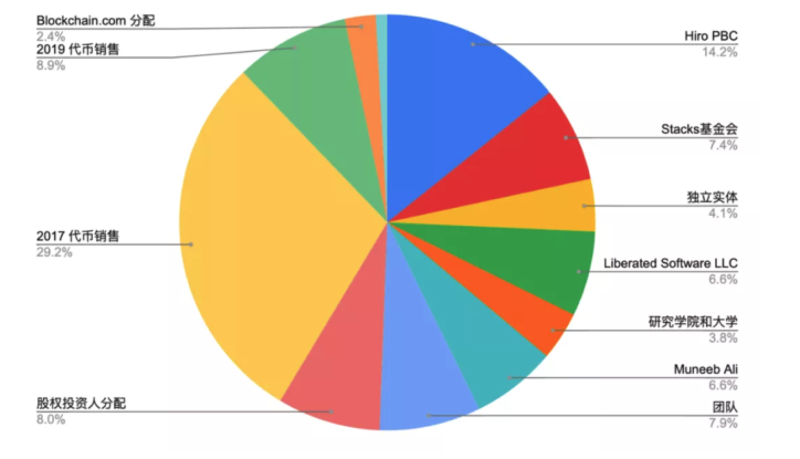
(STX Token Distribution, Source: Stacks)
Value of the Stacks System
Hiro focuses less on commercial profit and revenue, returning instead to the network itself—aiming to attract more developers to build blockchain applications and use cases on Stacks. These apps then develop their own business logic, fostering ecosystem growth and providing comprehensive tools for more DeFi developers and teams.
Goodbye Blockstack, Hello Hiro
Recently, Blockstack PBC officially announced its rebranding to Hiro, marking a shift in identity. Stacks 2.0 will be community-driven; Hiro won’t run its own nodes but will focus on developing tools for the network. Let’s review Blockstack’s journey.
At the end of 2017, Blockstack—the predecessor of Hiro—was founded and raised $50 million from investors including Union Square Ventures (invested in Algorand, Helium, YouNow, Coinbase); Winklevoss Capital (founded by Cameron and Tyler Winklevoss, invested in BlockFi, AngelList, Staked); ZhenFund (founded by renowned angel investor Xiao Ping Xu); and over 800 other funds and individuals including Blockchain Capital, Digital Currency Group, Kevin Rose, Michael Arrington, and Qasar Younis (former COO of Y Combinator).
In Asia, Blockstack also attracted investment from Hashkey Capital, SNZ, Spartan Group, and Japanese listed group Recruit.
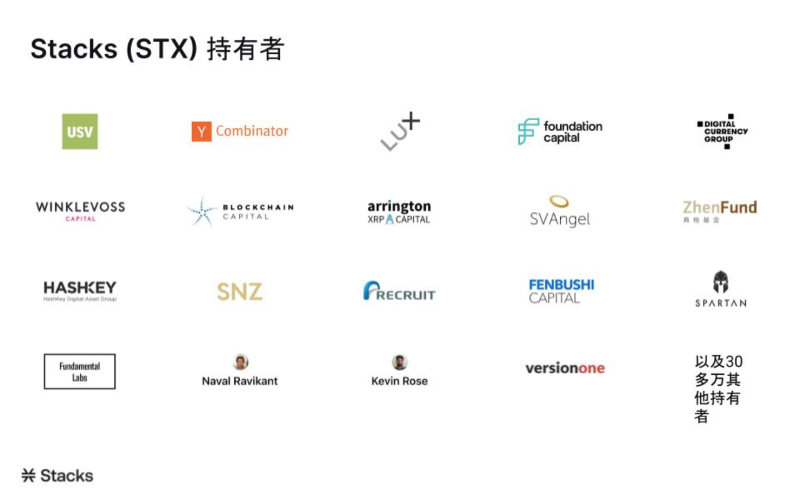
(Source: Stacks)
Hiro’s core team members have extensive R&D experience in distributed systems, including six PhDs in the field and two scientists who received the U.S. Presidential Early Career Award. The Blockstack whitepaper has been cited in over 15,000 research papers published in academic journals such as USENIX, ATC, and DCCL.

(Core Team Members and Affiliated Universities, Source: Stacks)
Compliance Pioneer, Moving Forward
Mid-December 2020, the U.S. Securities and Exchange Commission (SEC) filed a lawsuit against Ripple and two executives, accusing them of conducting over $1.3 billion in unregistered securities offerings. The news caused shockwaves—within days, Ripple’s XRP token lost 70% of its value, major platforms like Coinbase suspended XRP trading, and prominent institutions announced divestment.
Throughout the crypto industry’s evolution, the SEC has repeatedly penalized projects, showing no sign of regulatory relaxation. Ripple’s lawsuit—not only massive in scale but damaging to its own development—cast a shadow over industry-wide compliance.
Industry-wide blockchain compliance is inevitable. Blockstack, Hiro’s predecessor, took the opposite approach from Ripple, becoming a compliance benchmark.
In April 2019, Blockstack became the first company to conduct a token sale under SEC-approved Regulation A+, creating a new compliant path for crypto assets and opening doors for institutional capital. Reg A+ is an exemption allowing companies to raise up to $50 million through public advertising—effectively a compliant “mini IPO.”
Since then, Blockstack has consistently worked toward building a compliance framework, transitioning from “SEC-regulated” to “beyond regulation” in the U.S. This ongoing effort is nearing completion.
According to Reuters, Hiro released a legal memo summary stating that after the launch of the Stacks 2.0 blockchain in January 2021, the network will achieve decentralization, and under U.S. law, Stacks’ cryptocurrency STX will no longer be considered a security. Hiro will cease SEC filings, compliant U.S. crypto exchanges will be able to list STX, and U.S. residents and institutions will freely trade STX—providing tremendous momentum for the Stacks ecosystem.
Stacks 2.0 Launch Imminent
The Stacks 2.0 network is scheduled to launch on January 14, 2021. Prior to mainnet 2.0 going live, the entire ecosystem continues progressing toward decentralization. Hiro, like other independent entities, is one organization within the broader Stacks ecosystem, collaborating with other participants to co-develop the project.
OKCoin is expected to become the first U.S.-based compliant exchange to list STX and serve as a launch partner for Stacks 2.0. Beyond listing, OKCoin supports users earning Bitcoin rewards through Stacking. More exchanges are likely to follow.
According to Stacks’ earnings model, STX holders can lock their tokens for about two weeks at a time. In return and as contribution to network growth, they receive annual rewards denominated in Bitcoin.
Stacking funds never leave the wallet, require no special hardware or software, ensure high security, generate yield, and reward in STX-native assets—reducing selling pressure.
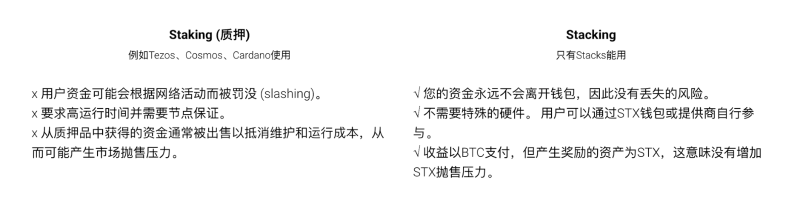
(Stacking Model, Source: Stacks)
Currently, there are over 500 apps and 7,000+ developers on Stacks. Notable apps include Graphite (similar to Google Docs) and Sigle (decentralized open-source blogging).
The Stacks Foundation also offers a grant program for developers and researchers, offering up to $5,000 for contributions to infrastructure, community resources, tools, research, and education.
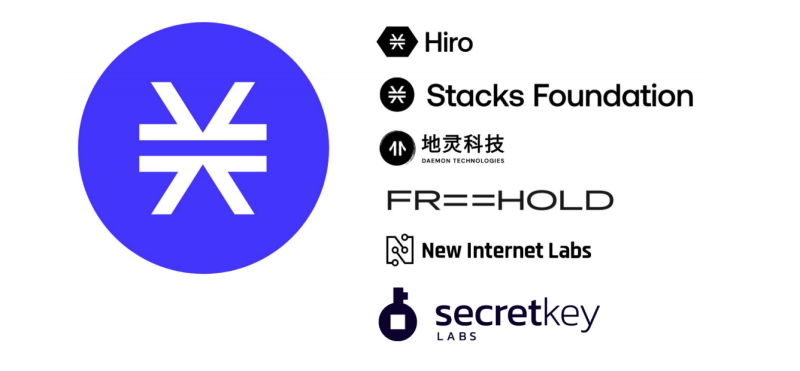
(Source: Stacks)
Stacks 2.0, upon launch, will feature several key independent entities:
Hiro: Focused on providing and maintaining developer tools for the Stacks ecosystem
Stacks Foundation: Supports ecosystem development through governance, R&D, education, and grants
Daemon Technologies: Focuses on supporting Stacks mining and Stacking operations
Secret Key Labs: Provides a Chinese mobile wallet enabling direct participation in Stacking
Conclusion
Although Bitcoin has only existed for about 10 years since its 2009 inception, it remains the strongest in consensus, highest in liquidity, and largest in asset share within the crypto world. The “institutional bull” rally since late 2020 revealed growing institutional participation and the unstoppable force of DeFi innovation. Active institutional investors, combined with emerging DeFi innovations, could form a powerful synergy, propelling the entire crypto ecosystem into an unprecedented new era. The convergence of Bitcoin and DeFi may be the most impactful milestone of 2021. The launch of Stacks 2.0 will greatly accelerate this transformation.
Join TechFlow official community to stay tuned
Telegram:https://t.me/TechFlowDaily
X (Twitter):https://x.com/TechFlowPost
X (Twitter) EN:https://x.com/BlockFlow_News