Bitcoin, the Taiping Heavenly Kingdom, and Ponzi Schemes
TechFlow Selected TechFlow Selected
Bitcoin, the Taiping Heavenly Kingdom, and Ponzi Schemes
From historical experience, when impoverished people at the bottom rise up in revolution and seize power, most aim to become emperor, and often oppress and trample upon the working class they originally came from even more brutally than the old aristocracy.
 Navigating Web3 tides with focused insights
The purpose of this article is not to predict price movements. We only explore the essence: Is Bitcoin truly decentralized and capable of replacing the U.S. dollar and gold as an asset?
Bitcoin's Frenzy = A Gauge for Central Bank Money Printing
Bitcoin has broken free from gravity, repeatedly hitting new highs. Research reports forecasting further gains are flying like snowflakes, with the most extreme target reaching $400,000.
In our view, the main drivers behind Bitcoin’s rise since last year are:
-
Excessive monetary easing by global central banks leading to real currency depreciation;
-
Support from financial payment platforms such as PayPal added a layer of “credibility”;
-
Gold’s role as an inflation hedge has been temporarily disrupted—mainly due to emerging markets selling off during the pandemic, while risk parity fund rebalancing and style rotation have caused gold to frequently move in tandem with equities and the VIX;
-
Public endorsements from prominent global macro fund managers like Tudor and Druckenmiller.
The frenzy around Bitcoin over the past year is not about value discovery. It is not a normal asset but rather functions like a thermometer, measuring the intensity of asset bubbles fueled by central banks’ put-option-style liquidity injections.
Market Capitalization
There are currently approximately 18,587,290.19 Bitcoins in existence. At the weekend price of $32,000 per coin, Bitcoin’s total market cap stands at roughly $600 billion.
Globally, developed gold reserves amount to about 190,040–197,576 tons. Based on the December 31 closing price of $1,901.6 per ounce, gold’s total market value is approximately $11–12 trillion.
Even after its massive surge, Bitcoin’s total market cap remains around just 5% of gold’s valuation. As an asset or wealth reservoir, Bitcoin can absorb far less wealth than gold. Of course, this does not preclude the possibility that Bitcoin could surpass gold in the future.
Scarcity
Gold is indeed one of the scarcest metals.
Bitcoin claims to be issued in limited quantity and cryptographically secure. However, blockchain algorithms can be infinitely replicated—you can create Ethereum, or any number of other creatively named cryptocurrencies. Thus, Bitcoin is not truly scarce. The key lies in whether cryptocurrency X can brainwash people like a religion, establish faith, and thereby build credit. The so-called "credit" of blockchain tokens, if not backed by tangible assets, is merely a psychological projection—one that risks sudden collapse.
Moreover, technology advances. With the rise of quantum computing—or even more advanced algorithms—Bitcoin’s security and confidentiality will inevitably face challenges. When that time comes, its perceived scarcity will shatter into nothingness.
Wealth Distribution
Bitcoin boasts decentralization, echoing populist slogans like land redistribution, equality, and public ownership—akin to peasant uprisings.
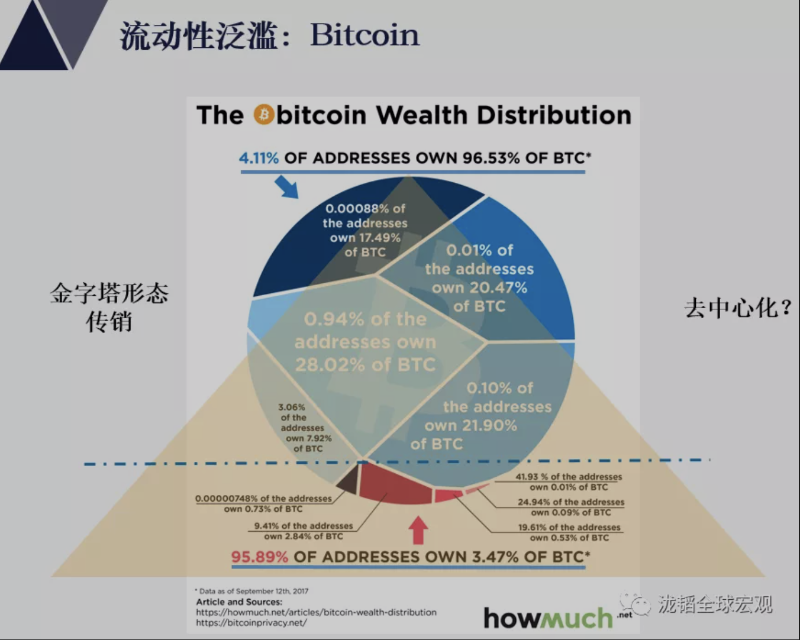
But looking at actual holder distribution data, anyone with stock investment experience would be shocked by its Ponzi-like or pyramid-scheme structure:
8.8 out of every million addresses (individuals) control 17.5% of all Bitcoin;
1 out of every 10,000 addresses controls 20.5%;
1 out of every 1,000 addresses controls 28%;
4% of addresses hold 97% of all Bitcoin;
96% of addresses hold only 3.5%;
42% of addresses hold merely 0.01%.
Compare this to wealth distribution in the United States:
The top 1% own 3% of national wealth;
The bottom 50% own 2%;
The top 10% hold 93% of stocks and mutual funds (2016 data).
The degree of wealth inequality in Bitcoin is worse than anything seen in the real world.
In reality, the poor still have basic consumption assets—food, clothing, shelter—as a minimal moat.
In the Bitcoin world, holders have no such protection.
Despite its claim of decentralization,
Bitcoin is in fact an extremely centralized ecosystem;
Parasites at the top of this pyramid
manipulate ordinary people through religious-like indoctrination,
driving the masses into chasing marginal speculative gains,
thus inflating the entire pool and enriching those at the very top.
The market manipulation tactics behind Bitcoin
are essentially identical to how DeLong Group in Xinjiang manipulated stock prices, capital groups colluded to inflate liquor stocks, or real estate speculators and elites monopolized property (including vacant homes),
and arguably even worse,
because at least the latter involve physical assets as collateral.
Bitcoin is nothing more than an intangible symbol, a concept.
Now consider gold:
Central banks of the world’s top 30 economies collectively hold 31,365 tons of gold—only 16.5% of total developed global reserves.
The U.S. central bank holds 8,133 tons—just 4.3%.
Gold’s sheer size makes it an asset with extremely low concentration—especially compared to Bitcoin—and thus much closer to being genuinely decentralized.
Of course, in countries with strict foreign exchange controls or economic sanctions like Iran or Turkey, gold may be less accessible than Bitcoin. But this alone cannot justify Bitcoin’s inflated valuation and distorted ecosystem.
Low Liquidity
Bitcoin’s maximum supply is capped at 21 million coins—an insufficient amount to provide one coin per person in any major economy. This “asset” is inherently illiquid, prone to manipulation and speculation, similar to small-cap stocks.
I personally remain skeptical of large funds publicly promoting such illiquid assets. They should be aware of how quickly their statements can influence Bitcoin’s price.
Illiquidity combined with a fixed supply creates a dynamic where “supply” is severely lower than “demand”—a condition akin to scarcity marketing. Once faith is successfully propagated like a religion, even a multi-hundred-billion-dollar market cap can soar effortlessly, like a pig caught in a strong wind. Real estate, especially first-tier cities and school-district housing, shares this trait.
However, low liquidity also means that whenever major holders or long-position leaders cash out significantly, they must artificially induce large price swings. These characteristics—low liquidity and high volatility—make Bitcoin poorly suited to serve as money. Furthermore, money ultimately represents national credibility—a reflection of comprehensive national power including economy, military strength, and culture.
The False Revolution and Fake “Decentralization” of the Taiping Heavenly Kingdom
Led by Hong Xiuquan, these impoverished rebels initially rallied under revolutionary slogans like land redistribution, using religion to attract desperate, disenfranchised people seeking equality and prosperity.
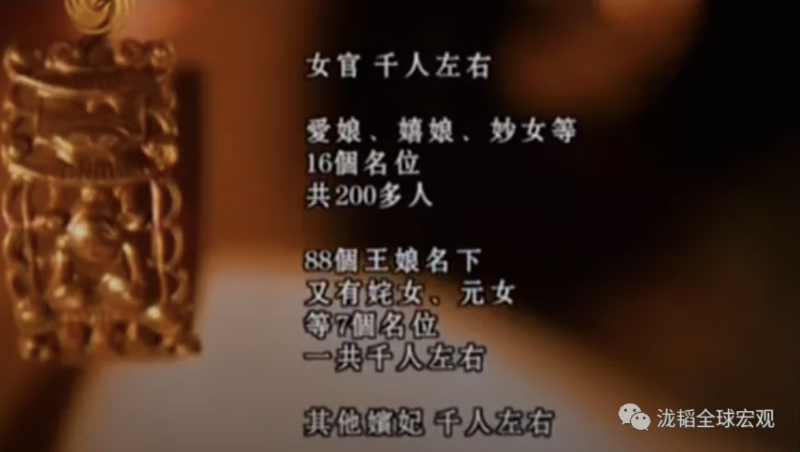
After seizing cities and looting vast social wealth, they did not redistribute land or wealth. These former victims were never truly interested in overthrowing the Qing dynasty—they rushed instead to declare themselves kings and emperors, dressing in gold and jewels. The Heavenly Kings indulged in extravagant pleasures, maintaining harems far more excessive than the old imperial court, while simultaneously imposing inhumane rules forbidding male-female interaction among fellow Taiping followers—even separating husbands from wives, fathers from daughters, and mothers from sons.
Below are excerpts from Hong Xiuquan’s *Poems of the Heavenly Father*, used to discipline his concubines—revealing the deeply feudal, authoritarian, and brutal mindset:
Failure to serve sincerely—First offense, deserves a beating.
Stubborn refusal to obey—Second offense, deserves a beating.
Daring to look directly at one’s husband—Third offense, deserves a beating.
Irreverent speech toward the King—Fourth offense, deserves a beating.
Restless and uncalm demeanor—Fifth offense, deserves a beating.
Speaking too loudly—Sixth offense, deserves a beating.
Silent when called upon—Seventh offense, deserves a beating.
Showing displeasure on one’s face—Eighth offense, deserves a beating.
Looking left and right furtively—Ninth offense, deserves a beating.
Speaking without calmness—Tenth offense, deserves a beating.
From the perspective of wealth distribution, Bitcoin advocates resemble the peasant revolutionaries of the Taiping Heavenly Kingdom—they have long abandoned the ideals of decentralization (land equality). Their rallying cry against central banks and emperors is not driven by love for humanity, freedom, or equality, but by the desire to become kings themselves, building their own ecosystems and exploiting the masses through even harsher authoritarianism to consolidate their power.
Historically, when impoverished underclasses rise in revolution, once they gain power, most seek only to crown themselves emperors—and often oppress their own former working-class peers with greater cruelty than the old aristocracy ever did.
We reiterate: the purpose of this article is not to predict Bitcoin’s price direction, but to examine fundamental questions. It does not constitute any trading or investment advice.
Join TechFlow official community to stay tuned
Telegram:https://t.me/TechFlowDaily
X (Twitter):https://x.com/TechFlowPost
X (Twitter) EN:https://x.com/BlockFlow_News