Fundamental Support Behind Bitcoin Breaking Through $23,000
TechFlow Selected TechFlow Selected
Fundamental Support Behind Bitcoin Breaking Through $23,000
This article will analyze the fundamental support behind Bitcoin's breakout above $23,000 in 2020 based on three fundamentals.
 Navigating Web3 tides with focused insights
On December 17, Bitcoin surpassed $23,000, reaching its all-time high.
In summary, the 2020 bull market was supported by three fundamental factors:
- The "Black Thursday" crash on March 12 accelerated de-bubbling in the crypto market; DeFi subsequently warmed up and drove market recovery, with a full-scale DeFi rally emerging in the second half of the year;
- Dollar quantitative easing increased Bitcoin's appeal as a hedge asset, prompting institutional whales—led by Grayscale—to accumulate crypto assets;
- The launch of Eth2.0.
This article analyzes the fundamental drivers behind Bitcoin’s breakthrough past $23,000 in 2020 through these three key aspects.
Fundamental One: DeFi TVL Demand Stimulated Market Recovery
On June 16, Total Value Locked (TVL) stood at 1.113 billion USDT, rising to 14.874 billion USDT by December 1—an increase of 1,236.38% over six months. This growth stemmed from improvements in core DeFi infrastructure.
These include Automated Market Makers (AMM) (e.g., Uniswap), liquidity mining (e.g., Compound), dynamic rebalancing of liquidity pools (e.g., Balancer), smart asset management (YFI), flash loans (e.g., Aave), data oracles (ChainLink), defensive mechanisms (SushiSwap), proxy aggregation protocols (CVP), and decentralized bug bounty programs (e.g., bZx).

Data source: DeFi Pulse
Notably, despite the industry's largest black swan event on March 12, it did not hinder technological development in the crypto space. On the contrary, bear markets allow projects to focus on innovation and lay solid foundations for future leadership.
Looking back at late 2017 to mid-2018, the crypto market was dominated by FOMO and speculation.
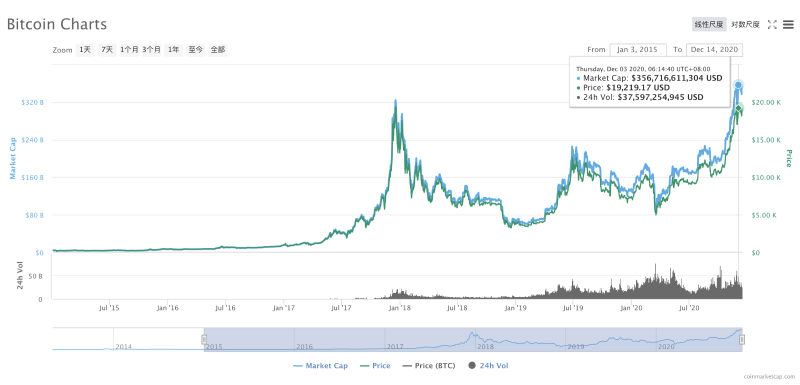
From another perspective, since Bitcoin’s previous all-time high, events such as the BCH fork on November 15, 2018, and the Bitcoin crash on March 12, 2020, have gradually helped the crypto market shed excess speculation and deflate bubbles.
Data source: CoinMarketCap
From the price chart, the crypto market has experienced turbulence—BTC plunged after the BCH fork on November 15, 2018, and again on March 12, 2020. However, driven by growing demand from DeFi, institutional support like Grayscale, and other factors, Bitcoin saw a resurgence, surpassing its November 2017 peak of $21,961.98.

Data source: MXC Mexc Exchange
Fundamental Two: Behind Grayscale’s Holdings, Dollar QE Boosted Bitcoin’s Safe-Haven Appeal
If DeFi revived the crypto market in Q2, then starting in Q3, the surge in assets managed by Grayscale began to significantly influence the market. From early June to December 14, BTC rose 101.03% cumulatively.
Grayscale launched its Bitcoin Trust product GBTC shortly after its founding in 2013. The trust’s holdings began rising sharply in Q2 2020.
According to Grayscale’s quarterly report, its crypto asset management reached approximately $4.816 billion in Q3, an increase of $1.284 billion from Q2, representing year-on-year growth of 36.35% and quarter-on-quarter growth of 143.72%. As of December 14, Grayscale’s total digital asset management reached $12.703 billion.
Grayscale itself does not hold Bitcoin directly but provides crypto asset trust services, currently offering nine trust products: GBTC, BCHG, ETHE, ETCG, ZEN, LTCN, LXM, XRP, and ZEC.

Data source: Grayscale GBTC_Q3-2020_10Q Report
We might ask: Why did Grayscale’s asset management begin growing rapidly at this particular time?
From a macroeconomic perspective, Bitcoin’s safe-haven properties became prominent under the U.S. quantitative easing policy.
Throughout 2020, the U.S. massively expanded its dollar supply and bond issuance to stimulate economic growth, injecting up to $18 trillion in base money liquidity and economic stimulus measures over 34 weeks. By September of that fiscal year, the U.S. budget deficit had tripled to over $3 trillion.
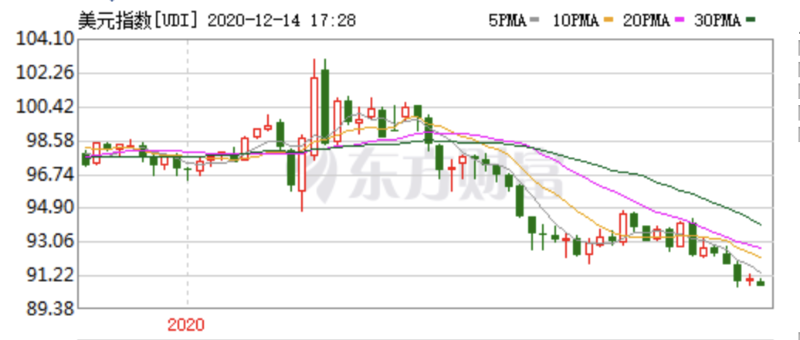
On March 20, 2020, the U.S. Dollar Index stood at 103.01; by December 14, it had fallen to 90.63—a decline of about 13.66%.
Data source: East Money
On December 1, Grayscale ran another ad campaign urging people to abandon gold and invest in Bitcoin instead, claiming that in the digital world, gold is a drag on investment performance.
While the author disagrees with this view, as an investment vehicle, Bitcoin serves more as a complement to gold rather than a replacement.
In an environment of unlimited QE, labor, natural resources, and hard assets are ways to preserve wealth. As an emerging hard asset, Bitcoin offers advantages over gold, including privacy and convenience.
Fundamental Three: The Launch of Eth2.0 Pushed the Crypto Market to New Heights
The launch of Eth2.0 was a milestone event for both the crypto market and Ethereum.
On December 1, ETH2.0 officially launched.
After the launch, the Ethereum network split into two chains: one PoW chain with the ETH token, and one PoS chain (the Beacon Chain) with the BETH token.
The Beacon Chain operates independently of Eth1.x without functional capabilities. The Eth1.x chain continues producing blocks via PoW, while the Beacon Chain uses PoS.
At this stage, ETH tokens on the Eth1.x chain coexist with BETH tokens on the ETH2.0 Beacon Chain.
The Beacon Chain prepares for the sharding phase (Eth2.1), managing validator selection, staking funds, random number generation, block proposer selection, forming validator committees to vote on proposed blocks, and administering rewards and penalties.
Following the launch of Eth2.0, centralized exchanges such as MXC Mexc, Coinbase, and Huobi announced support for ETH staking.
Centralized platforms help users overcome the minimum staking requirement of 32 ETH.
It should be noted that users can use smart contracts to exchange ETH for BETH one-way, or choose not to exchange—but reverse conversion is not allowed. Users lock ETH into specific contracts on the PoW chain to qualify as validators on the Beacon Chain and earn BETH rewards, but newly minted BETH cannot be withdrawn back to the PoW chain.
To participate in Staking on the Beacon Chain and earn rewards, users must stake at least 32 ETH to become a validator. Funds are locked for potentially 1–2 years or longer, with no redemption allowed during this period—the exact duration depends on the progress of Eth2.0.
According to Etherchain data, as of 5:00 PM on December 10, the Ethereum deposit contract address 0x00000000219ab540356cbb839cbe05303d7705fa held 1,331,873 ETH, worth $750 million, representing 1.16% of the current ETH (excluding BETH) market cap.
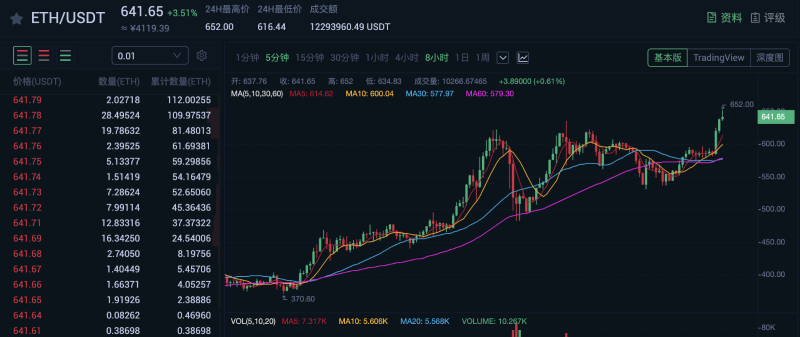
Data source: MXC Mexc Exchange
According to MXC Mexc trading data, from November 3 to December 17, ETH rose from 370.6 USDT to a high of 652 USDT, achieving a cumulative peak gain of 75.93% over 44 days.
Although the 2020 crypto rally initially stemmed from the DeFi boom, there is no doubt that the fourth-quarter surge was driven by two fundamentals—growth in Grayscale’s assets under management and the launch of Eth2.0—as well as shifts in supply and demand dynamics, such as increased buying pressure from ETH staking.
Conclusion:
First, the DeFi boom enabled DEXs and CEXs to bridge decentralized and centralized markets, creating a dual-circulation ecosystem between primary markets (DEXs) and secondary markets (CEXs).
Within the DeFi landscape, participants include farmers (liquidity providers on DEXs), secondary market traders, DEXs, and CEXs.
When a DeFi project gains popularity, it naturally creates trading demand on secondary markets, allowing traders on CEXs to profit. Before and after a DeFi asset launches on a DEX, many secondary market traders (demand side) buy the asset at lower prices from farmers (supply side) on DEXs, enabling farmers to monetize their mined tokens.
After acquiring an asset, secondary market traders wait for its price to rise before selling it at a higher price on CEXs to other traders, effectively acting as wholesalers in the process.
In this cycle, DEXs, farmers, CEXs, and traders all benefit, while CEXs and DEXs serve as transaction facilitators (intermediaries), capturing significant traffic.
Second, the contrast between DeFi’s popularity and its high entry barriers has directly driven innovation in DeFi mining products offered by centralized exchanges.
By participating in liquidity mining on behalf of users, exchanges reduce entry barriers, attract DeFi user traffic, and earn mining fees.
Major exchanges including Binance, Huobi, and MXC Mexc launched liquidity mining products such as Binance Savings, Huobi Mining Treasure, MXC’s DeFi Mining Treasure, and MX DeFi. Additionally, due to the risk of impermanent loss in liquidity mining, MXC Mexc quickly introduced a “compensation mechanism for impermanent loss” to reduce user risks after launching its product.
Furthermore, despite long-standing criticisms of slow transaction speeds and high gas fees on Eth1.x, Ethereum still maintains its dominance among public blockchains outside of Bitcoin.
This year, Polkadot’s mainnet launch and successful cross-chain transfers on its testnet were major industry events, yet they did not trigger a market rally. Nonetheless, once Polkadot fully enables interoperability of assets and value information across different networks, it could become the next catalyst for the crypto market.
Finally, from a broader fundamental perspective, Bitcoin’s value appreciation will increasingly depend on its strengthening role as a store of value within the macroeconomic environment.
Join TechFlow official community to stay tuned
Telegram:https://t.me/TechFlowDaily
X (Twitter):https://x.com/TechFlowPost
X (Twitter) EN:https://x.com/BlockFlow_News