USDD Launches 1% Stability Fee Promotion for ETH/WBTC Vault and Goes Live with wstETH Vault
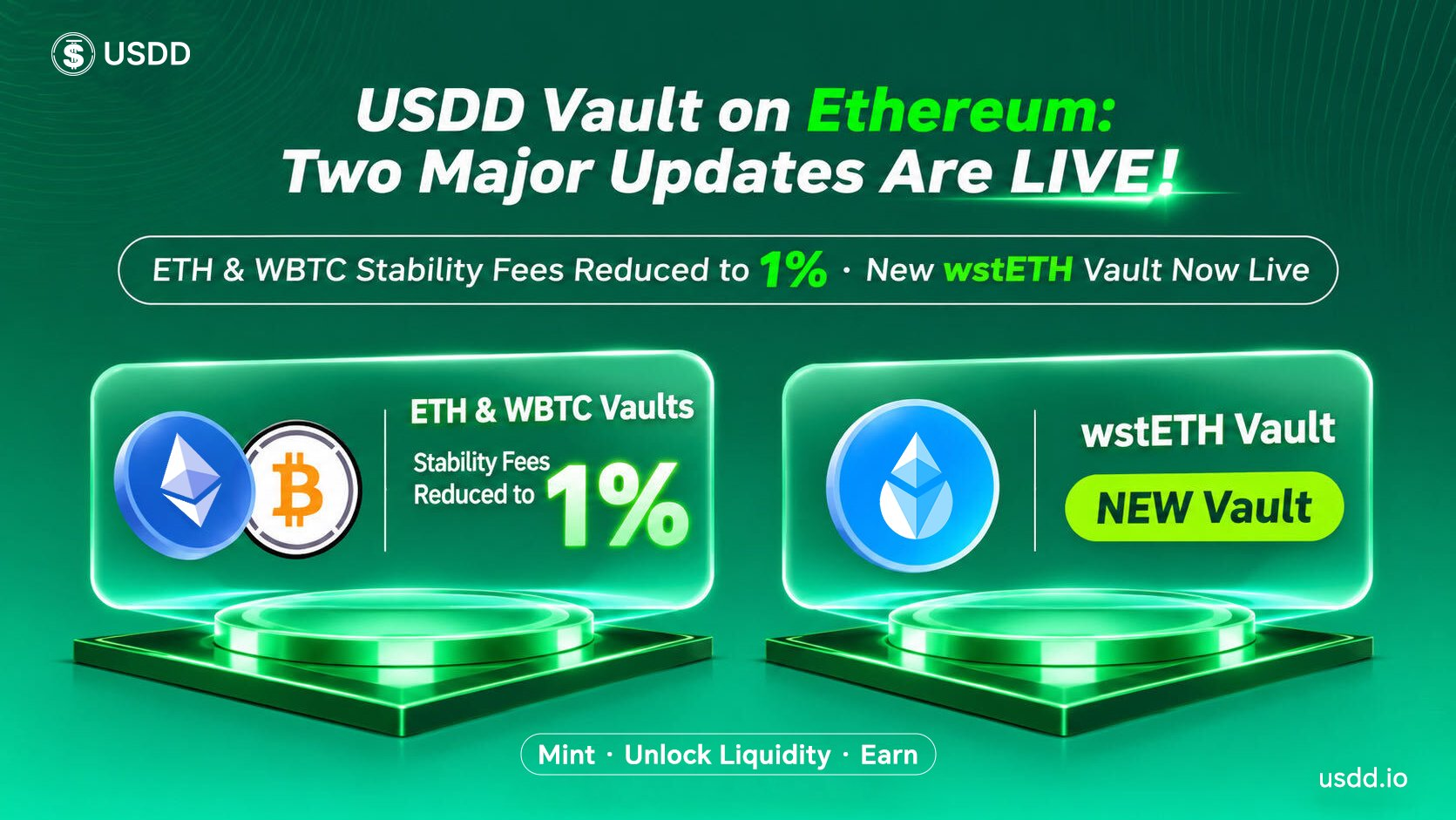
On November 27, decentralized stablecoin USDD announced a one-month promotional campaign offering a 1% stability fee discount for ETH and WBTC Vaults, and launched the wstETH Vault on Ethereum. The official stated that these two initiatives aim to meet emerging market demands and continuously strengthen its role as a multi-format on-chain financial service infrastructure. As a rapidly growing decentralized stablecoin, USDD is expanding its Vault collateral assets and yield scenarios to provide DeFi users with more flexible and lower-cost channels for unlocking on-chain liquidity.
On November 24, according to media reports, the decentralized stablecoin protocol Sky (formerly MakerDAO) suspended new DAI borrowings for five categories of Maker Vaults, all of which were ETH and wstETH collateral types, and adjusted their respective debt ceilings to zero. This news indicates that some pathways for users to release liquidity from ETH-denominated assets through mainstream channels are narrowing, highlighting the market's growing demand for flexible and sustainable on-chain lending options.
To meet the asset management needs of DeFi users, USDD stated that from November 27 to December 26, users minting USDD via ETH or WBTC Vaults will only need to pay a 1% stability fee. They can also mint USDD through the newly launched wstETH Vault to unlock liquidity without needing to sell the underlying assets.
According to public information from major stablecoin minting platforms, the mainstream stability fee for decentralized stablecoin protocols typically ranges from 7% to 15%, while USDD's stability fee ranges between 0.5% and 5%, which is below industry levels. The newly introduced limited-time 1% discounted rate is clearly at the lower end of the industry. This campaign will significantly reduce minting costs for users and help them gain more room for asset operations.
Additionally, official USDD data shows that its Vaults offer various collateralization ratio and debt ceiling parameters, allowing users to choose flexibly based on their risk preferences. Based on this, users can also deposit the minted USDD into USDD Earn, which currently offers a base APY of approximately 4% with no lock-up period; or participate in advanced yield strategies on platforms like Binance Wallet through sUSDD, achieving an integrated solution of "unlocking liquidity + earning yields."
Meanwhile, the wstETH Vault launched by USDD on Ethereum aligns well with its characteristics of stable holding and diversified returns. wstETH possesses multiple yield attributes, allowing users to maintain exposure to ETH and continuously earn staking rewards while using wstETH as collateral to mint USDD and release asset liquidity. Throughout the entire process, there is no need to unstake or sell assets, effectively balancing asset appreciation, staking yields, and capital flexibility.
USDD's own mechanisms will further amplify the characteristics of wstETH. USDD adopts a modular overcollateralization mechanism where users can deposit supported crypto assets to open a Vault and mint USDD at the corresponding minimum collateralization ratio. Debt accumulates based on the stability fee, and when the collateralization ratio falls below the threshold, it is liquidated through a Dutch auction. Furthermore, USDD utilizes the Peg Stability Module (PSM) to enable 1:1 zero-slippage exchange between USDD and USDT/USDC, providing an arbitrage convergence mechanism for maintaining the peg.
USDD Vaults are also independent isolated positions, meaning collateral will not be lent to other users, thereby avoiding the risk of non-performing loan contagion. This grants it not only lower stability fees, lower liquidation penalties, higher capital utilization rates, and loan-to-value (LTV) ratios, but also enhanced security.
While expanding Vault functionalities, USDD continues to advance collaborations with mainstream platforms. Recently, USDD jointly rolled out a series of yield campaigns with Binance Wallet, Gate DEX, Pendle, and Morpho: the Binance Wallet Strategy campaign has cumulatively offered hundreds of thousands of dollars in rewards, the Gate DEX dual-chain Bonus campaign continues to ramp up incentives, and the TVL of the sUSDD fixed-yield market on Pendle once approached $40 million. Protocol funds are allocated via the Smart Allocator to mature DeFi protocols such as Aave, JustLend, Morpho, and Spark, generating cumulative earnings exceeding $35 million. This provides internal support for USDD Earn and ecosystem incentives, demonstrating fully validated revenue-generating capabilities in the market.
According to the monthly transparency report released by USDD for October 2026, by the end of the month, the circulating supply of USDD was approximately 1.5 billion tokens, the reserve asset scale was around $2.21 billion, and the collateralization ratio remained at 146.99%. During the month, the market cap growth of USDD once led the stablecoin sector. Currently, USDD is deployed on mainstream networks including TRON, BNB Chain, and Ethereum.
USDD's official representatives stated that they will continue to expand on-chain liquidity channels, enabling users to unlock crypto asset liquidity at lower costs and create greater utility value for assets. From Vault minting and interest-bearing yield strategies to low-cost transfers, USDD is gradually evolving into a decentralized financial infrastructure that combines stability, yield generation, and practicality.