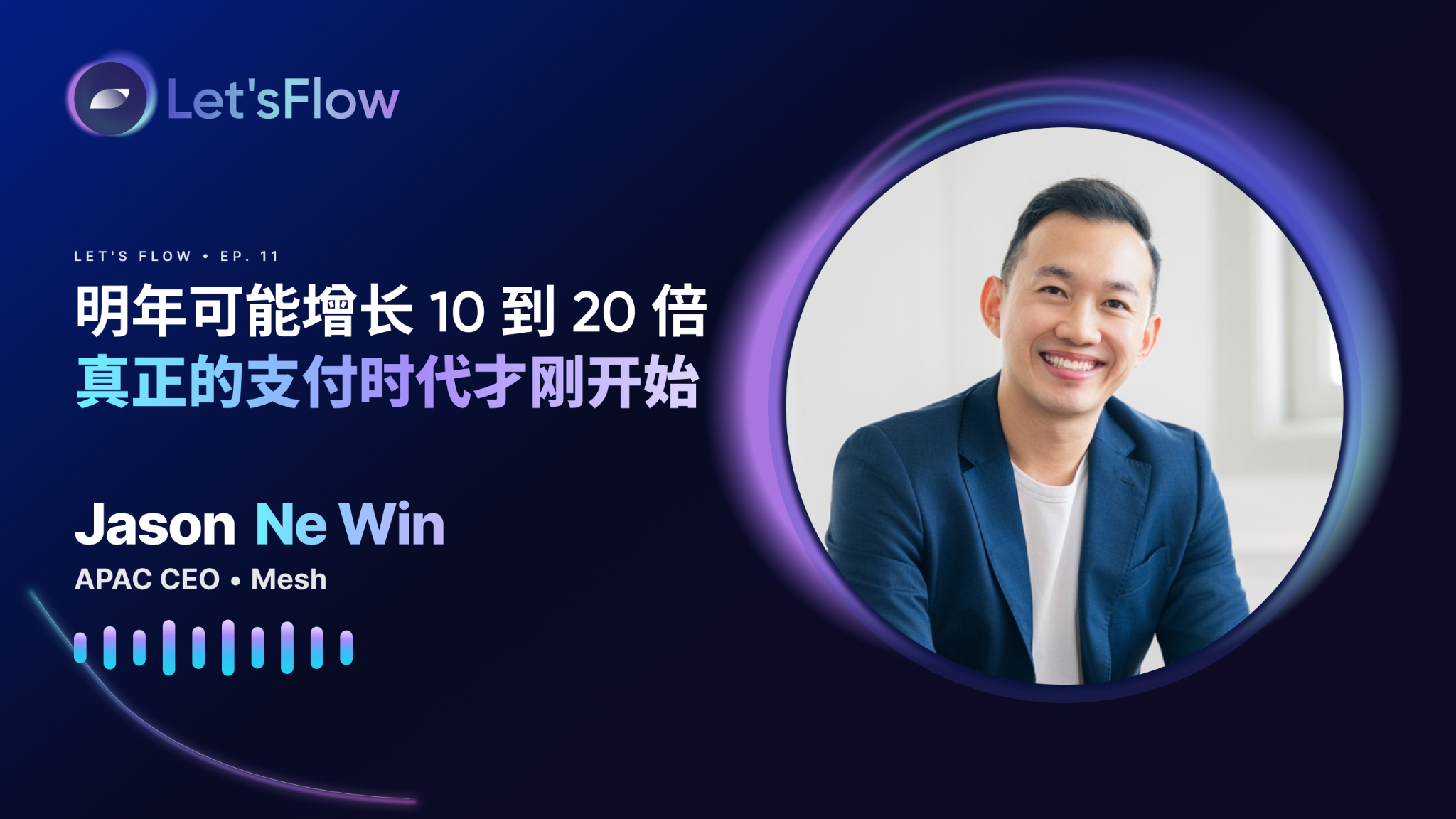
Interview with Mesh APAC CEO: The True Payment Era Has Only Just Begun; Could See 10x to 20x Growth Next Year
In the past, it was young people in T-shirts talking about crypto applications; this year, 75% are in suits discussing payments and rails.
As Mesh APAC CEO, this is Jason Ne Win's most intuitive observation of this year's Singapore Token2049.
Despite the topic being highly popular and everyone passionately discussing real-world adoption, Jason still believes that crypto payments are at a very early stage, for the following reasons:
Giant friction in user experience: when a regular user buys a pair of shoes, they still have to deal with insufficient wallet balances, cross-chain swaps, and gas fees;
Highly fragmented ecosystem: up to $2.6 trillion in crypto assets are scattered across different exchanges, wallets, and public chains, isolated from each other and difficult to interoperate.
Assets are already everywhere on-chain, but payments haven't truly entered the real world yet. What's missing in between is no longer a new chain or a new card, but a "super adapter" that tightly connects these two worlds.
This is precisely the ecological niche Mesh aims to occupy, and also Mesh's core positioning: a payment orchestration network.
From connecting 300+ partners to partnering with Visa to launch Tap to Pay, reaching 175 million merchants worldwide; from using the "Grandma Test" to reshape frictionless payment experiences to pioneering an agent payment network to welcome the AI era, how does Mesh integrate crypto into the global commercial payment network more conveniently and securely?
Meanwhile, as everyone competes to become the next winner in crypto payments, why can Mesh, as the "super adapter" for crypto payments, confidently state that "no matter who wins, Mesh will benefit"?
With these questions in mind, we had an in-depth conversation with Mesh APAC CEO Jason.
Think Like a Founder
TechFlow:
We're very glad you could join our podcast. Please start with a brief self-introduction.
Jason:
Hello everyone, I'm Jason Ne Win, currently serving as Mesh APAC CEO. Before joining Mesh, I worked at Binance for five years.
My core responsibility is driving Mesh's business expansion in the APAC region, including building the regional market footprint, deepening relationships with strategic partners, and participating in the company's product planning and business strategy.
However, my work isn't limited to APAC. The crypto industry and capital flows are inherently global, with tight connections between different markets like APAC, the Middle East, and Europe. Therefore, I also drive synergy across regions to help Mesh build a broader global partnership network.
TechFlow:
You previously served as Chief of Staff for two CEOs of Binance, one is CZ and the other is Richard. How do you think this experience shaped you?
Jason:
The experience at Binance might be one of the best learning opportunities in my six-year crypto career. I had the privilege of learning from both CZ and Richard. They are two extremely capable leaders with vastly different styles.
I learned a lot from CZ, most importantly, to "think like a founder": treat the project like your own "child," protecting it and proactively seeking solutions when facing problems.
Another crucial skill is adaptability under high pressure: you might attend over a dozen meetings in a day, each requiring immense focus, but you need to adjust quickly and throw yourself into the next task at your best. This resilience and focus were excellently demonstrated by CZ. In short, without CZ and without Binance, there would be no me today, and I am deeply grateful for that.
What Richard brought to me was a different management perspective. As a professional manager CEO, he gave me a deeper understanding of professional management, institutional partnerships, regulation and compliance, and how to drive business growth through systems and organizational management.
Of course, the people who truly benefited me extended beyond just the two of them. Binance has a group of exceptionally talented co-founders and executives, including He Yi, as well as many managers who don't often appear in the public eye. I learned a lot from each of them.
Now, I often ask myself two questions in my work:
What would CZ do? What would Richard do?
Over time, these have evolved into three management principles:
First is resilience and problem-solving capability. I've always believed that no problem is unsolvable. The key lies in clearly seeing the issue, figuring out the solution, and then executing firmly.
Second is execution. While strategy and roadmaps are certainly important, getting things done quickly and thoroughly is equally crucial. If the direction is wrong, adjust rapidly.
Third is identifying and utilizing talent. An individual's capabilities are ultimately limited, but an outstanding team can multiply an organization's efficiency. Finding the right people and placing them in the right positions is equally vital.
The "Super Connector" of the Stablecoin Payment Network
TechFlow:
During the Singapore Token2049 event, many people saw numerous Mesh logos and event activations, so we'd like you to introduce Mesh and what the team is currently working on.
Jason:
I'm glad to see that our investments at Token2049 generated very tangible impact, which indeed brought us opportunities to connect with more partners.
To describe Mesh in the simplest sentence possible: we are a payment orchestration layer. Currently, approximately $2.6 trillion in crypto assets are scattered across different exchanges and wallets. Mesh's job is to connect these fragmented assets and liquidity.
Mesh has already established connections with 300+ partners, linking roughly 900 million crypto asset holders and millions of merchants, which forms the foundational layer of Mesh.
Our partners include Binance, Coinbase, OKX, as well as PayPal, Shift4, Nuvei, Kalshi, etc. From exchanges and wallets to major payment service providers and payment gateways, our partnership list continues to grow. Just two weeks ago, we also announced a partnership with Visa for Tap to Pay. We are currently one of Visa's first pilot partners. This is a cardless payment product that enables stablecoin payments to reach the approximately 175 million merchants covered by the Visa network.
Through this partner network, we can connect crypto assets to entities that wish to accept crypto payments, such as e-commerce platforms, prediction markets, merchants, payment service providers, and more.
In summary, what Mesh does is quite simple: enabling crypto assets scattered across different platforms to truly enter the global commercial payment network.
TechFlow:
Before diving into Mesh, many people might still be unfamiliar with the overall landscape of stablecoins or payments. Could you map out the entire stablecoin value chain: who the main players are at each layer, their representative names, and where Mesh fits in?
Jason:
Observing today's industry ecosystem, I believe it has formed a complex neural network.
There might be over ten different roles, with particularly key ones including:
The first category is issuers. Representative players include Circle, Tether, Ripple, and PayPal, among which Circle and Tether remain the largest by scale. Additionally, there are consortium stablecoins like USDG.
The second category is networks. This includes mature public chains like Ethereum and Solana, as well as emerging payment networks like Arc and Tempo.
Further down, there are licensed institutions and payment service providers handling fiat on/off ramps, plus the distribution layer everyone is very familiar with, namely exchanges and wallets. Additionally, services like custody and OTC are also vital parts of the entire industrial ecosystem.
Mesh sits in the middle of this neural network: whether you are an exchange, wallet, stablecoin, or network, we aim to connect and orchestrate in a neutral manner.
I like to use a very simple analogy: if you've been using an iPhone over the past decade, you've probably gone through many generations of charging cables and ports. Mesh acts like a super adapter, helping you connect everything regardless of whether it's USB-C, USB 2.0, or anything else.
TechFlow:
We noticed that Mesh founder Bam recently mentioned that Mesh approaches problem-solving primarily around user experience. Where do you think the current stablecoin payment experience gets stuck? And to what extent will Mesh address these pain points?
Jason:
Bam once proposed a standard called the "Grandma Test": if your grandparents were to use this product, could they complete a payment easily?
In recent years, crypto payments have obviously not passed this test. But if we want stablecoins to truly go mainstream and allow funds to flow frictionlessly, this situation must change.
In this regard, Web2 incumbents like Visa, Apple Pay, Google Pay, and Amazon have done an excellent job. Users don't need to understand the underlying clearing network or worry about how funds move; they just complete the payment.
What Mesh wants to do is bring this Web2-level payment experience to Web3. Specifically, users only need to authorize their wallet or exchange account, leaving the complex backend processes to Mesh. We aim to reduce the choices, clicks, and judgments users need to make, making payments simpler while maintaining security.
For example: suppose you want to buy a $100 pair of shoes and plan to pay with USDC or USDT, but your wallet only contains $20 USDC. Under traditional methods, this transaction might fail outright. You'd have to return to the wallet, top up stablecoins, possibly prepare gas fees for the corresponding blockchain, and then retry the payment.
But through Mesh's Smart Funding, the system instantly recognizes your asset status. If you only have $20 USDC but other assets like ETH in your wallet, Mesh can execute the necessary asset conversions based on transaction needs. Meanwhile, we also check if gas is sufficient on the corresponding network and handle related issues.
A series of operations that would originally require manual intervention by the user can all be handled in the background. Users simply complete the payment without needing to understand the complexity behind it.
This is the UX upgrade we envision: not asking users to learn more technology, but making the process simpler without altering the payment methods consumers and merchants are already accustomed to.
TechFlow:
You just mentioned that Mesh sits in the middle of the entire structural stack. Why did Mesh choose to focus on the network layer? Did the team ever consider creating their own card or wallet?
Jason:
Actually, six years ago, Mesh started as a To-C company primarily offering financial products to consumers, having already accumulated several hundred thousand users and achieved solid business growth. But our founder, Bam, later realized that opening up our underlying technology capabilities to serve more enterprises and partners could generate greater economies of scale.
Consequently, the company gradually shifted: To-C is our past, while To-B and B2B2C are our present and future. Over the past two years, we've also completed Series A, B, and C funding rounds, with notable investors like PayPal, Coinbase, and Dragonfly.
As for building our own wallets or payment cards, those aren't in our product roadmap. We prefer to leave those aspects to professional and mature partners. What we do is build the rails—the behind-the-scenes work that users might not even notice, but as long as we're there, the transactions run smoothly.
Our goal isn't to replace partners, but to empower them. Ultimately, these capabilities trickle down to consumers, helping them pay more conveniently, faster, and cheaper, without even needing to know if they're using stablecoins or fiat.
Because We Connect Everyone: No Matter Who Wins, Mesh Will Benefit
TechFlow:
Once stablecoin payments truly scale, which segment of the value chain will capture the most long-term value? Existing networks, acquirers, issuers, exchanges, or players like Mesh? Who do you think will become the most critical as the industry evolves?
Jason:
I believe participants across the entire industrial chain can all become winners. While this view might sound politically correct, I genuinely hold this belief.
Over the past two years, stablecoin enthusiasm has remained consistently high. If you've attended Token2049 continuously over recent years, you'll notice that it used to be many young people in T-shirts chatting about crypto apps, whereas this year about 75% are in suits talking about payments and rails. The industry is evolving, and so is the meaning and value of stablecoins.
Yet despite this heat, stablecoins remain in an early stage: adoption rates are still in single digits. Globally, there are roughly 200 types of stablecoins, but USD-denominated stablecoins still dominate, accounting for about 99.5% of circulating volume. This doesn't align with reality, where every country has its own currency and a massive foreign exchange market—things that barely exist within the stablecoin space.
Therefore, we predict that non-USD stablecoins will grow next. Stablecoins will gradually become a more accurate reflection of "money." If the Japanese Yen accounts for about 5% of global currencies in the fiat world, theoretically, JPY stablecoins should approach that proportion. Thus, every participant today, as long as they get the direction and execution right, will be a structural winner.
Of course, the way to "win" differs and will evolve over time. For example, people generally view issuers as the net beneficiaries of stablecoin growth. However, issuers are now shifting their mindset. Previously, most of their revenue and profit came from interest yields, but with the emergence of models like USDG, issuers and partners are rethinking profit sharing and revenue splits.
This is why we've seen many issuers refuse to stagnate over the past two years, starting to build their own networks and expanding businesses into custody and payments, rather than just issuing stablecoins.
Finally, we believe that no matter who wins, Mesh will benefit because we connect everyone. The more fragmented and friction-ridden the landscape becomes, the more Mesh is needed to solve these challenges, making things easier for all parties and facilitating smoother fund flows.
TechFlow:
We know Mesh announced its partnership with Visa a few days ago, which will open up more real-world use cases for stablecoins, especially on the merchant side. Now that the partnership is live, what are the top three priorities for the team going forward?
Jason:
First, screening partners and determining cooperation priorities. The market's interest in this partnership is currently very high, with many institutions hoping to participate in subsequent launches or pilots. But we need to carefully evaluate each partnership, including economic models, collaboration methods, and the priority level of different partners. Because for Mesh, partnerships aren't one-off projects; they are long-term relationships.
Second, defining execution and pace. A large amount of behind-the-scenes work still needs to advance, including hiring, team building, and various specific implementation tasks.
Third, figuring out how to embed into the market. We need further research on where demand is most urgent, where product acceptance is highest, and which regions/markets should prioritize rolling out this service. Payment environments vary across markets, so we need tailored rollout strategies based on local conditions. Visa and other partners have provided significant assistance in this area, but we must continue our own research as well.
TechFlow:
As more stablecoins and wallets come online, we're also observing a trend: could solving fragmentation accidentally create new fragmentation? How do you view this issue? Between "unified settlement assets" and "unified network layers," which do you value more?
Jason:
Indisputably, in the pursuit of solving fragmentation, the industry might indeed generate new forms of fragmentation.
But for Mesh, this isn't an unmanageable problem. Our role is to absorb this fragmentation. New stablecoin issuers can enter the market, and new underlying networks will constantly emerge. What Mesh does is integrate them through connection and orchestration.
Like the "super adapter" I mentioned earlier: we don't need to stop new interfaces from appearing; instead, we enable different interfaces to connect with each other. Fragmentation may persist, but users shouldn't bear the complexity resulting from it.
Between a "unified settlement asset" and a "unified network layer," I place more value on the latter, which is exactly what Mesh focuses on.
Moreover, building a unified settlement asset isn't easy: different countries have distinct monetary systems, regulatory requirements, and financial interests. It's hard to get all nations to accept a single stablecoin as a core settlement asset. Especially for some countries, they don't want their financial systems to overly rely on USD stablecoins; instead, they hope to develop their own solutions, whether CBDCs or regulated stablecoins denominated in local currencies. This ties directly to their considerations regarding capital flows and outflows.
TechFlow:
Exchanges are also launching their own cards, such as Binance, Bybit, Bitget, etc., which seems more like a closed-loop traffic strategy, and some of these exchanges are also your partners. Can you share how Mesh convinces exchanges or other partners to hand over payment rails to an external network? What were their main concerns when securing these partnerships?
Jason:
Actually, we didn't spend much effort convincing partners. Often, they came to us first. Because looking at the product itself, the capabilities we provide already speak for themselves.
Prior to this, an exchange's core business centered on crypto trading: buying and selling crypto assets, derivatives, and perpetual contracts. Over the past two years, they've taken on two new commercial directions:
One is RWA, tokenizing stocks, traditional assets, and in the future, private credit, real estate, etc., giving users access to attractive global equities and other assets.
The other new direction is payments. Exchanges want crypto assets to have more real-world use cases, with the long-term goal even becoming the "WeChat" of the crypto world, integrating trading, payments, and daily applications into a single ecosystem.
What Mesh does is actually quite simple: regarding payments, we help them implement it better and faster. We're likely the only player capable of delivering exactly that.
So our so-called "persuasion" is simply telling them: use Mesh, and you can provide exponentially more utility and real-world scenarios to your users, leveraged through major partners like PayPal and Shift4. This process is actually a fairly smooth conversation; we aren't competitors but collaborative partners.
Hoping for a J-Shaped Growth Curve in AI Payments
TechFlow:
Both stablecoin payments and AI are currently very hot. If more and more AI agents can complete payments, what will the key metrics for a payment network shift from DAU to? Such as payment success rate, latency, API settlement depth, or compliance approval rates, etc.?
Jason:
I believe all these metrics will continue to exist, but their relative importance will shift.
For instance, DAU will remain a useful reference point. However, as AI Agents increasingly execute payments on behalf of users, standalone DAU might no longer be the optimal metric for measuring payment network usage.
In comparison, payment success rates, transaction volumes, and TPV (Total Payment Volume) will remain crucial metrics. Because these figures measure how much actual economic activity is happening, not just how many users opened the product.
Therefore, I expect some traditional metrics to gradually fade out, but core metrics like TPV will continue to play a long-term role.
TechFlow:
Is Mesh currently preparing for this trend? Or what actions have you already taken?
Jason:
Yes, we've already started preparing. About a month ago, Mesh launched the Agentic Payments Network, and we're currently engaged in in-depth discussions with many interested partners.
Of course, I believe the entire industry is still in a very early stage. But we hope to prepare in advance for that critical inflection point.
We're anticipating not a steady growth curve, but a J-shaped curve. When agent payments truly hit takeoff, the market could undergo massive changes in a very short timeframe. Nobody knows exactly when this inflection point will arrive—it could be tomorrow or two years from now—but we can't wait until it happens to start positioning ourselves. We must prepare for this future ahead of time.
TechFlow:
So what are Mesh's current core internal KPIs? What are the three things you're focusing on most right now?
Jason:
The first thing remains always people: finding the right individuals and ensuring they have sufficient resources and tools to grow, ultimately allowing them to maximize their value. This won't change.
Second is building better products for partners. We need to continuously accelerate product development and iteration speed. We mentioned Visa Tap to Pay twice just now, which represents a new product direction. But product development isn't just about expanding new payment scenarios; it also includes supporting more assets, underlying networks, and so on.
Third, preparing for the future, especially in the AI and agent payment sectors. Who will win this race? What kinds of protocols and operational mechanisms will eventually form? Many questions remain unanswered, so we need continuous research and experimentation to prepare for various possibilities.
Singapore May Become Cross-Border Payment Hub, Stablecoin Adoption Set to Grow 10-20x by 2027
TechFlow:
As Mesh's APAC CEO, you must have a fairly deep observation of the Asian-Pacific market. Looking across the entire region, from Mainland China and Hong Kong to Japan, South Korea, and Southeast Asia, what stage of stablecoin adoption do you think each market is currently at? Which markets offer the most noteworthy opportunities?
Jason:
I usually view the APAC market through two dimensions.
The first is cross-border payments. This is also where I invest heavily, though cross-border business isn't confined to a single country or region.
The second is application scenarios within individual countries or regions. Viewing from this angle first, I believe Mainland China holds enormous potential, practically limitless. But currently, I feel the Chinese government is still conducting highly cautious evaluations on this. We look forward to further market opening and are very eager to participate in the future.
Additionally, Japan and South Korea are two extremely important markets in APAC. They possess massive domestic economic scales in their own right. Even if focusing solely on the local markets of Japan or Korea, there's opportunity to build billion-dollar businesses. Therefore, we've invested considerable time in these two markets—for example, we recently announced a joint venture partnership with SBI and Money Forward in Japan.
Southeast Asia as a whole is also a massive market, but regulatory environments vary significantly across countries. Markets like Vietnam, Thailand, and Indonesia still maintain relatively strict restrictions on stablecoin or crypto payments at present. What we can do at this stage is build infrastructure and partnerships in advance, so we can swiftly meet demand when these markets open up further.
TechFlow:
You just mentioned South Korea and Japan. In your view, what are the primary obstacles currently hindering the practical implementation of stablecoin payments?
Jason:
The main obstacle remains regulation.
Japan is currently relatively more open and has already begun piloting JPY stablecoins. South Korea hasn't reached this step yet, as it has more factors to balance regarding financial and national security. However, from a commercial demand perspective, enterprises in both Japan and South Korea are highly eager to push this forward.
They are waiting for regulations to clarify further, and we are waiting as well, because the potential here is truly immense: via blockchain technology, more financial activities and payment scenarios can go on-chain, enabling end-users to complete payments more smoothly, conveniently, and at lower costs.
TechFlow:
If looking strictly at next year, which market in APAC do you think is most likely to achieve stablecoin payment scale first? And why?
Jason:
I believe cross-border payments will likely be the first to scale, and Singapore will serve as an excellent hub. We can start from Singapore to connect other APAC countries and regions, including Southeast Asia, and potentially extend further into Latin American markets.
TechFlow:
You just mentioned that the entire stablecoin payment structure will win together in the future. In your opinion, how many years will it take for this structure to truly win?
Jason:
I believe that by the end of 2027, we will see stablecoin adoption rates grow at least 10 times, even 20 times. Meanwhile, stablecoin market caps will better reflect the true monetary structure, leading to more locally denominated stablecoins.
Join TechFlow official community to stay tuned
Telegram:https://t.me/TechFlowDaily
X (Twitter):https://x.com/TechFlowPost
X (Twitter) EN:https://x.com/BlockFlow_News
 深潮TechFlow