70 Minutes in Bangkok: He Yi’s Anxiety and Binance’s Trump Card
Written by: Xiaobing
In a conference room in Bangkok on a November afternoon, He Yi’s first words to the room full of journalists who had traveled from afar were a warning: If someone you don't know well invites you out for drinks here, absolutely refuse. Don't do it. It sounds like a joke amid all the laughter, but take it seriously.
This was the first day of Binance Blockchain Week (BBW), exactly one month after the $6.3 billion theft. In this context, the joke reads more like sober, hard-earned advice stemming from lingering trauma: that massive hole in Binance's security also began with an ordinary invitation—a fake recruitment scam.
Pregnant with a very visible bump, she sat in the chair for over 70 minutes. Questions ranged from security incidents and AI-related layoffs to US stock tokenization and the suspension of Alpha rewards. She answered nearly every question asked.
After listening to the entire session, one feeling stood out clearly: The CEO of the world's largest exchange speaks less like a corporate titan and more like a challenger driven by acute crisis awareness.
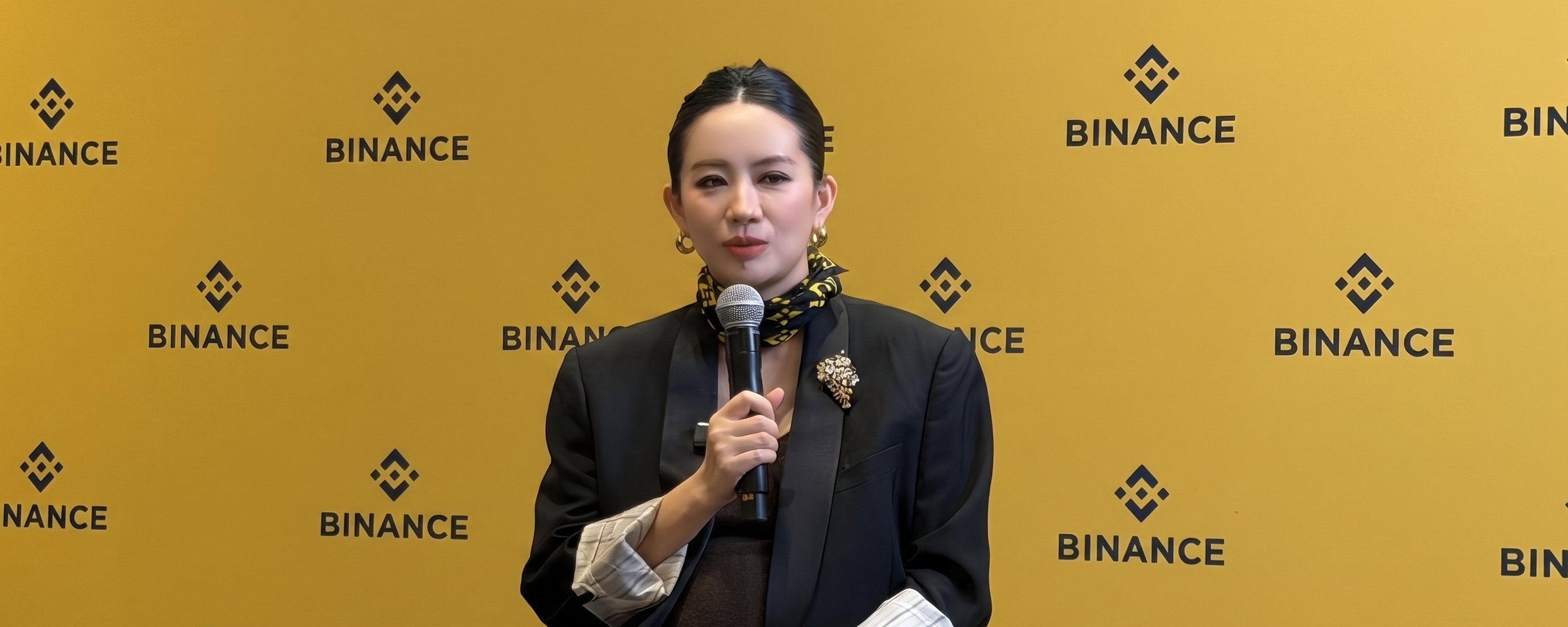
Fig: PANEWS
Security: Reclaiming Hope from 'Human Self-Discipline'
On October 29–30, Binance's hot wallet was compromised, resulting in the theft of approximately $6.34 billion in assets. The FBI attributed the attack to the North Korean hacking group TraderTraitor. Binance's investigation report revealed that the breach originated from a fake recruitment scam; after compromising employees' computers, attackers leveraged an internal AI tool to gain elevated permissions. Binance subsequently announced that the platform would fully cover the losses and completed the restitution of all assets by mid-November.
He Yi did not dodge the issue. She first laid out the background: following the 2019 theft, Binance rebuilt its security architecture based on a 'zero trust' principle, with strict isolation between departments, which is why major incidents haven't occurred in the years since. However, social engineering attacks occur daily, sometimes in ways that defy imagination: the person conducting the interview is one individual, but a completely different person shows up on the first day of onboarding; a new hire who passes all background checks has their IP address flagged interacting with suspicious addresses on day one, and when questioned, simply vanishes.
Regarding this incident, she stated bluntly: "We have been pushing AI adoption very aggressively across the board, and we granted AI systems overly permissive access." AI acts as both a weapon and a double-edged sword—it can serve as a spear and a shield.
Her proposed remediation plan consists of three layers.
The first is awareness. Security training used to be considered complete once employees passed a few quizzes. Now, Binance hires third-party firms to simulate social engineering attacks against staff. Even over the past month, seven employees still fell for it. These seven received a final warning: one more breach means immediate termination, regardless of seniority.
The second is environment. All company devices operate within a sandbox; any incoming attack hits the sandbox first and triggers an immediate alert. Her standard requires alarms to sound the exact moment an employee downloads a suspicious file, rather than waiting for post-incident forensics.
The third is using AI to monitor AI. Access rights for code-generating AI and auditing AI are separated, with a dedicated independent security audit AI operating 24/7 to monitor every line of code and piece of information uploaded daily. The overarching principle is minimum privilege and minimum data exposure.
A deeper layer of reflection centers on culture. Binance has operated remotely for years, consistently emphasizing giving employees freedom.
"The flip side of freedom is responsibility," she noted. While everyone possesses security awareness, execution lacks granularity, meaning "we cannot rely on human self-discipline; we must enforce strict controls." On the external front, Binance has already engaged three cybersecurity audit firms for comprehensive reviews.
Should Exchanges Advise You to Trade Less?
When asked whether Binance's AI would advise users to trade less or not at all—the best interest being user protection—He Yi grounded her answer in industry fundamentals: Every sector enjoys high margins during boom periods, but profitability inevitably narrows as it enters mature competition. The logic of platform businesses relies on scale; even if margins per user are slim, having enough users sustains the platform.
What she really wanted to correct was the public perception of Binance's user base. "Everyone assumes our users are purely traders running a giant casino. We apologize, but our users are incredibly diverse." In some countries, Binance functions as a national payment app akin to Alipay; in labor-exporting nations like the Philippines and Pakistan, many use it to send remittances home, competing directly on cost and efficiency with traditional cross-border money transfer services rather than other exchanges on trading fees. High-frequency trading users only concentrate among demographics with higher GDPs and disposable income.
Revenue and profit are certainly important because "you can't run a business at a loss," but the top priority is answering why users choose to use your platform.
When discussing AI agents, her assessment remains restrained: accounts can handle daily payments, wealth management, and investing, but not every user needs an agent continuously executing trades. Many retail investors suffer from flawed foundational cognitive frameworks—attributing price pumps solely to institutional manipulation and crashes to institutional dumping, treating the market as some 'divine hand.' Platforms should instead push financial literacy directly to users, empowering them to make better decisions.
She used a smartphone analogy: Everyone gets a phone and internet access. Some discover their path to self-improvement, leveling up and overcoming challenges; others simply scroll through short-form videos.
"Building the AI and placing it in front of users—if they don't use it, that's their problem. Not building it is our problem." To her, the greatest significance of AI for this industry is democratization.
AI Didn't Cause Layoffs at Binance, But Changed Talent Profiles
Binance's earliest large-scale AI deployment focused on customer service and compliance review (highly labor-intensive roles like KYC, KYB, and EDD). The team made several missteps: when conversational LLMs first went viral, the team hired specialists to build a customer service model, spent a year doing so, and saw minimal results—"it felt a bit like alchemy." The bottleneck was data. No matter how expensive the base model, dumping raw industry data into it yields nothing; humans must "clear the drainage ditches" to clean and structure the data properly. Only after open-source models emerged did the team leverage them for fine-tuning and data structuring, which finally produced tangible results.
The conclusion was clear: efficiency improved, but marginally. Headcount did not drop significantly. "I wouldn't dream of saying, 'Let's slash 30% of the staff right now.' What happens if you sever a major artery?"
What truly matters to her is the shift in talent standards. Traditional Chinese tech giants favor assembly-line, hierarchical structures. AI boosts coding efficiency and quality, but cannot lift the hierarchy itself. AI talent in the new era does not necessarily require a computer science background; a humanities graduate can orchestrate numerous tools using natural language to build their own products.
"The electricity has arrived. Knowing how to roll candles in a factory may no longer be a valuable skill." Initiative and learning ability outweigh formal degrees and backgrounds.
Listings on US Stocks Do Not Mean Abandoning Crypto
This year, Binance moved aggressively in traditional finance, launching over 8,000 US stocks and ETFs for non-US users in June, alongside TradFi perpetual contracts and tokenized equities, bStocks. He Yi revealed that stock-based derivatives now account for 40% to 50% of related business volume.
She does not view Binance as competing neck-and-neck with Robinhood.
Binance serves zero US users, catering to entirely different demand: buying US stocks starting at just $5 with the ability to trade at any hour. This shifts price discovery forward. When Nvidia drops major news before US markets open, prices on Binance move first. Weekend news is similarly reflected in pricing immediately.
Liquidity remains the most frequently questioned weak point.
He Yi openly admitted that when integrating 8,000 stocks, "we overlooked the underlying liquidity issues and simply aggregated pools." Restructuring is underway to directly tap traditional broker-dealer liquidity soon. bStocks operates under a dedicated market-making program where market-making fees are routed to external institutions and large holders, with Binance abstaining from direct participation. Under dual oversight from ADGM regulators and US monitoring, all projects report weekly, and even minor price spikes ('wicks') require detailed explanations.
Regarding asset selection, Binance prioritizes highly liquid and actively traded stocks. She also mentioned exploring a potential framework with several exchanges: healthy, promising companies that abandon traditional IPOs due to prohibitive costs could potentially launch as tokenized assets from day one while adhering to standard audit and disclosure procedures. As for mainland China A-shares, "it ultimately depends on regulatory acceptance."
Many crypto-native users worry that if capital floods into buying stocks, there will be no life left for the crypto sector.
He Yi disputes this concern, reiterating a stance she has maintained since 2017: strong tokens must be built upon solid business models. With real revenue, profits, and positive cash flow, thriving operations can then effectively empower the token ecosystem, completing the virtuous cycle.
Her criticism of the industry is equally unvarnished: The same script has played out repeatedly over the past decade—a group of polished founders raises billions, dumps their tokens, and declares, "House by the sea, retirement time. Bye. I'm heading to the AI space to become a guru." "If this industry is declining, who caused it? Every single practitioner takes money out but never reinvests back."
Thus, Binance began listing diverse global assets on its platform, guided by the principle of "do unto others as you would have them do unto you": everyday users want assets with long-term value that won't pump today and zero out tomorrow. For absolute beginners overwhelmed by complexity, her advice is simple: park funds in stablecoin yield products, study for a month, then proceed. "Don't go all-in immediately; if you lose everything, you'll just curse my name."
She also shared a past experience. Early on, she personally opposed margin and contract trading due to excessive risk and constant user complaints leading to rights-defense campaigns, so she refused to list them. The 2018 bear market taught her a lesson: opening your account daily meant watching balances shrink as all coins plummeted and users lamented. "In a strictly down-market, short-selling tools at least provide opportunities to generate profits."
Zooming out to a longer timeframe, she compares today's crypto market to the dot-com bubble and early bond markets. Every market experiences fireworks-like bull runs that make everyone feel like a god of investment. Beyond narratives, stablecoins have entered millions of households. In countries facing rampant 10% to 20% inflation, many use them for daily transfers and cross-border remittances. "For years I've insisted on building viable business models, constantly mocked and told 'He Yi, you don't get it.' Ultimately, common sense in commerce always prevails."
After the Disappearance of IEOs: Asset Hollowing Out
With IEOs and ICOs nearly extinct this year, He Yi reviewed Binance's evolving listing strategies.
Early on, Launchpad's logic was straightforward discount distribution: project teams offered discounts, and Binance passed them to users. Later, listings hit $1 billion valuations right off the bat, rendering discount mechanisms useless and exhausting that approach. Phase two introduced Alpha. It featured stricter spot listing standards but operated via on-chain trading, allowing slightly lower-quality projects that rewarded users with giveaways to participate. According to her calculations, Alpha distributed between $800 million and $1 billion in user rewards over roughly a year.
Alpha eventually ran out of steam due to a shortage of quality projects. "Forcing subpar launches makes sense less than listing memes," she noted. "At least at the startup phase, meme coins have low market caps, giving astute users a chance to profit."
After a decade in exchange operations, she realized the platform's paramount duty is maintaining ecological balance. Whales possess superior quantitative models and macro research, placing retail investors in a structurally disadvantaged position. "If the market only features whales, retail will be wiped out."
Whether IEOs or Alpha, these initiatives served as retail welfare programs. Now, projects claim zero budgets, and whales halted activities citing poor market conditions. The industry's core issue is asset hollowing out. "Without quality assets, does it even matter if we list them or not? We might as well help users find solid stocks."
Binance's primary revenue still stems from trading fees, directly tied to market heat rather than new listings. Users dubbed Alpha airdrops as a "basic living allowance," a term she finds highly revealing: "Claiming freebies qualifies as subsistence; losing a dollar immediately disqualifies it."
Regarding Alpha's future, her positioning is pragmatic: simply distribute benefits to retail users, not exclusively to bot farms or studios. Whenever incentives exist, opportunistic actors will naturally flock to them—it's a cat-and-mouse game. Alpha participants are not Binance's core revenue stream, so the platform won't engineer asset launches solely for Alpha. "It doesn't make sense to wrap whole dumplings just for a side dish of garlic."
She remains optimistic about the broader market.
She believes in cycles and value investing. Markets will forever oscillate between overbought and oversold extremes. Currently, most portfolios hold stablecoins and fiat simply because sentiment is too depressed to pull the trigger.
Recently, she publicly disclosed a personal portfolio drawdown of approximately $100 million in a single month, aiming to communicate: "I lose money too, but I maintain confidence." Knowledge is easy, action is hard. Most understand cycles and value, but when faced with actual volatility—seeing a 30% rally reverse—everyone thinks, "Forget it, just sell."
She also shared her personal preference: Properties in Lujiazui, Shenzhen Bay, and Manhattan retain long-term value but lack liquidity. "My profession dictates that liquidity comes first. Given sufficient liquidity, I evaluate optimal assets."
The Greatest Danger Lies Within
Looking ahead, He Yi believes institutionalization is gradually unfolding in subtle increments.
BlackRock and Fidelity are now Binance partners; Wall Street extending trading hours from 8 to 23 daily, in her view, was forced by exchanges. Numerous quantitative firms are increasingly using Binance perpetuals to hedge equity positions. A major Asian ETF provider proactively approached the exchange hoping to tokenize and list ETFs on-platform. Regulatory caution and entrenched interests will slow momentum, as "no one wants to transform comfortably earned passive income into a round-the-clock operational burden. But the tide of eras has come crashing in, and you have no choice but to engage."
With Asia housing over half of humanity, the goal of reaching 3 billion users cannot bypass the continent.
She revealed Binance is simultaneously engaging regulators in over a hundred countries, each with distinct focal points: some prioritize taxation, others inflation control. Some grant approval in principle, only for another department to block implementation; others cap foreign ownership. "Solutions always outnumber obstacles. We cannot treat exponential growth as business-as-usual."
The final group interview question asked: In the next decade, what is most likely to defeat Binance? AI, regulation, hackers, or something yet unseen?
She chose the latter, immediately adding: "The greatest danger always originates from within."
Humans fear subjectivity above all, and especially dread "the unknown unknowns." Over the past two years, she has repeatedly emphasized two concepts internally.
The first is objectivity, echoing the youthful classroom maxim of "seeking truth from facts." Though globally dominant, Binance isn't number one in every niche. Take Thailand, for instance: the local champion dominates through native language support, localized service, and deep offline presence, acting like a trusted neighborhood neighbor. "It mirrors the brutal clash between Uber and Didi back in the day."
The second is fairness. She admits disliking taking advantage of others and despises being taken advantage of herself. Projecting onto users: they don't need platforms guaranteeing profits, but demand fair and reasonable treatment. Projecting onto employees: they may never find perfect bosses, but insist on equitable leadership.
When does a team stop growing? She states it has nothing to do with headcount. Watch for specific signals: Is curiosity alive? Are they proactively learning? Do they demonstrate ownership? Or do they default to the classic corporate cliché: 'That's not in my scope'?
The Two Ends of the Scale
Returning to He Yi's recurring mantra: Ecological Balance.
On one end of the scale sit projects and whales, armed with capital, models, and insider information. On the other sits retail investors, holding only an account and desperate hope. Exchanges stand in the middle, tilting the scale toward retail via IEO discounts and Alpha airdrops. Yet after a decade of added counterweights, the scale remains tilted. The reason is brutally simple: No matter how exquisitely crafted the rules, they cannot outmatch human nature.
No one can resist the temptation of overnight wealth without accountability. Projects aim to raise capital and dump tokens to buy seaside villas; retail investors gamble everything hoping to finally break even. When losses mount, everyone collectively blames the system.
This exact script has played out in crypto for ten years, prompting He Yi to ask: "Who actually caused this industry's decline?"
She anchors the solution back to fundamental common sense: quality assets. Businesses generating revenue, profits, and cash flow; targets with long-term utility that won't vaporize overnight.
This path moves slowly and has no finish line. Today it's US stocks and tokenization; tomorrow it may be whatever new paradigm emerges. Exchanges can only keep searching, balancing the scales incrementally with each discovery.
The stolen $6.3 billion can be restored, rules can be rewritten, and inventories replaced. The industry's ultimate fate rests solely on those still willing to build here and take responsibility for their choices. Those who extract every last drop of sector dividends only to turn around and curse the platform never held the power to shape its destiny.
Join TechFlow official community to stay tuned
Telegram:https://t.me/TechFlowDaily
X (Twitter):https://x.com/TechFlowPost
X (Twitter) EN:https://x.com/BlockFlow_News
 深潮TechFlow