Revolution and Its Betrayal: Why People Miss SBF
Author: Zuo Ye, Zuo Ye Waiboshan
Fame brings trouble, and even SBF isn't allowed to have peace behind bars.
First was Anthropic's IPO, with onlookers speculating whether SBF's hefty $500 million investment back then, had it smoothly reached an IPO, would have paved the way for a more AI-driven future in crypto.
Then came the release of Netflix's documentary *The Altruist*. We don't know how SBF feels about it, but CZ and others running around wildly give off strong vibes reminiscent of Xia Luo at his wedding to Qiuya.
Some outside want him locked up; some inside want him released by the public.
Since Your Departure, Only Regret Remains
SBF is undoubtedly a sinner; misappropriating user funds is an atrocious crime. Even today, creditor settlements remain unfinished, yet whenever the market turns cold, there are always those who continuously pine for him.
If one must find a reason for this, it would likely be his spirit of innovation.
SBF viewed finance beyond mere "casino mentality," seriously contemplating how to propel the crypto sector simultaneously to the elite and the masses. Unlike Trump's co-optation of the crypto industry, FTX led by SBF took the initiative to seize leadership over financial development.
Rewind to 2022, when UST collapsed first. FTX did not panic-sell or manufacture FUD; instead, SBF attempted to emulate J.P. Morgan in 1907, playing the role of the lender of last resort amid panic.
Coincidentally, after a CoinDesk report detonated FTX, Binance also tried to salvage the industry. Besides establishing a $1 billion SAFU fund, it partnered with the industry to launch the Industry Recovery Initiative (IRI), planning to raise over $1 billion.
The outcome needs no elaboration; the industry has not recovered to this day.
Binance failed to save the industry, and FTX and SBF even destroyed it. Yet, some still dare widespread condemnation to hope Trump pardons SBF, which is deeply intriguing.
Ultimately, we feel a sense of humiliation over an industry overshadowed by AI, and resentment towards leaders who flatter regulators. We need some spiritual anchor just to survive in the reality of Fintech, payments, and Meme casinos.

Image: Briefly Arriving in the Future
Looking back at SBF's crypto journey from 2017 to 2022, FTX led industry trends across at least five dimensions: prediction markets, Perp DEXes, pre-market contracts, tokenized stocks, and globalization.
Arthur Hayes followed an empirical path of productizing financial engineering (perpetual contracts, hedging stablecoins), whereas SBF considered the future of crypto entirely through the lens of liquidity.
In a recent interview, when asked why he could constantly innovate, SBF replied, "liquidity breeds liquidity." Most users don't care about market costs like funding rates or option premiums; good user experience and wealth effects mutually reinforce each other.
This naturally stems from SBF's personal background as a trader and Alameda's origins in market making. However, there are many entry points into the market. Since SBF's fall, we've witnessed the collective credit collapse of 2024 VC-backed tokens, alongside the clumsy performances of numerous market makers like Web3Port.
Their obsession with liquidity is no less than Anthropic's blind faith and all-in bet on Scaling Laws. A priori reasoning always surpasses a posteriori evidence; only penetrating a single point thoroughly leads to market monopoly. FTX ultimately fell due to insufficient liquidity—profit and loss sharing the same origin.
For a while, the FTX app slogan was "Trader for Trader." I won't call Jeff an imitator, but FTX certainly possessed more originality than Hyperliquid. Once you capture users' interest in the Trump election, you naturally launch binary options and place them right on the main site (international version).
Forever missing the crypto industry where new mechanisms emerged daily—this is perhaps SBF's true spiritual legacy. At least it's more creative than $HellYeah or $BullComing.
Thousands of Miles Back, Old Friends Are Forever Lost
SBF was once a revolutionary, but ultimately betrayed the revolution.
Product innovation only captures market share; a revolution for financial leadership requires a sufficiently bold banner. FTX launched new mechanisms daily, SBF visited Congress to discuss regulation and bought naming rights worldwide. What held it all together wasn't decentralized slogans, but a value system capable of convincing both Wall Street and Washington: making money to do good, where crypto is a tool, not a casino.
Therefore, when SBF fell, it wasn't just an exchange that collapsed, but the crypto industry's only chance thus far to approach mainstream narratives.
Today's crypto industry, east or west, is mostly composed of lowly underdogs hiding in the shadows. Yet the turning point of all this precisely coincides with SBF's personal downfall.
While being questioned by Congress, SBF was the center of global attention. The moment FTX imploded, the industry's image plummeted. Since then, there has only been lengthy debt resolution and restructuring. You cannot expect Satoshi Nakamoto to show up, nor can you expect Vitalik's PoS roadmap to be perfectly correct.
Hard to resist saying it: a16z poured tens of billions following Vitalik's personal vision into LSTs, ZKs, and L2s, only for the Web3 vision to degrade into a crossroads between Fintech and payments—colloquially known as the urban-rural fringe.
It shouldn't have been this way. The metaverse turned Zuckerberg into an epic laughingstock, yet EA (Effective Altruism) nearly replaced Peter Thiel and Nick Land's dark enlightenment to become Silicon Valley's most dominant mainstream ideology.
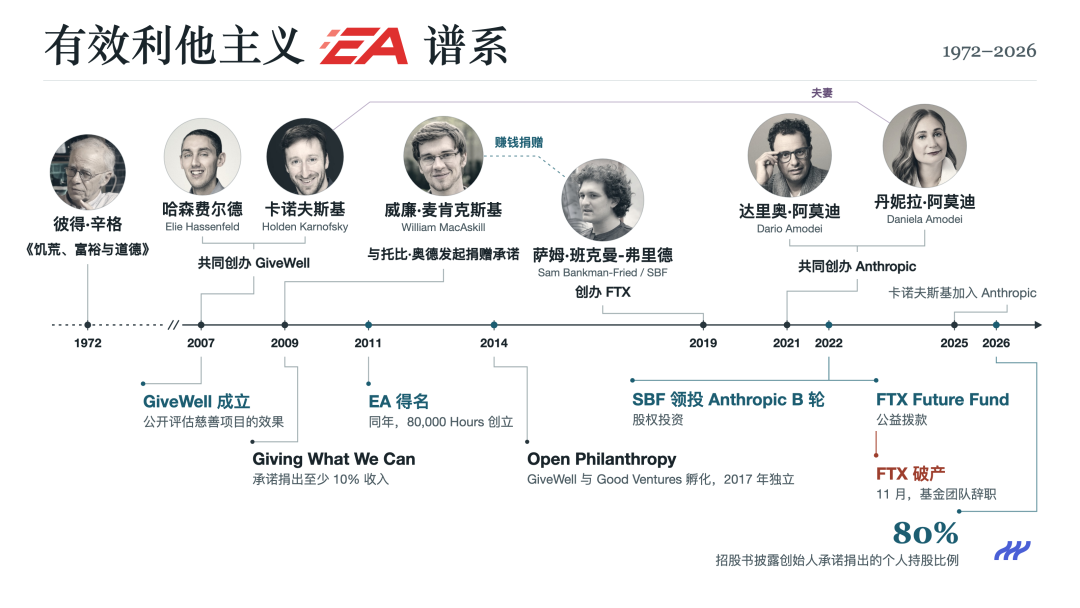
Image: Doing Finance for Charity
This is by no means a joke. SBF's mentor into finance was Mackenzie, who preached EA. Its core tenet is that to save lives, one must first make money, using capitalism to reform the world for good, empathizing with capitalists while relying on their wealth to aid others.
At that time, EAs to Silicon Valley billionaires were akin to Shaoxing clerks to dispatched imperial officials.
Altruism is the motive for doing good, effective altruism is precise calculation, and finance happens to be the most lucrative sector.
Anthropic co-founder Dario Amodei himself donated to the EA organization GiveWell as early as 2009, writing about his ideological journey, and his wife, Daniela Amodei, married GiveWell co-founder Kanosky.
Returning to Anthropic's Series B round, SBF invested not out of belief in AI, but recognition of the Amodeis' EA affiliation. This represents capital circulation within the EA circle. Had things proceeded normally, SBF would have played the role of Peter Thiel, leading the EA "mob" to rise in Silicon Valley.
Unfortunately, when the unexpected doesn't happen, there is no surprise. After SBF's collapse, EA's public image completely went bankrupt. Although Facebook co-founder Dustin Moskovitz clung desperately to it, the Amodeis gradually distanced themselves from it.
Mackenzie also briefly served as an advisor to the FTX Future Fund. After receiving SBF's donations, he too enjoyed a comfortable life. But all of this suddenly crumbled like a waking dream. With it vanished the crypto industry's dream of redemption.
One could say that the collapse of SBF and EA left the crypto industry in an extremely awkward position in the US. Crypto lacks no political power; in 2024, Fairshake spent heavily on elections, and stablecoin bills sailed through. But with money and votes lacking a soul, decentralization could unite humanity but failed to forge its own ideology from it. The inevitable conclusion is co-optation—an mission EA was supposed to fulfill.
Successors have tried as well. The Genius Act passed, finally giving stablecoins legal recognition. Armstrong led Coinbase at the forefront, campaigning for the Clear Act bill for over a year. Earlier this year, he grappled with banks over stablecoin yield clauses, only to withdraw support at the last minute. In September, a Senate procedural vote got only 50 votes, falling 10 short before collapsing, after which he pivoted to say they should just go after the SEC and CFTC.
The distinction lies here: SBF testified in Congress about what crypto could bring to the world, while Armstrong focused on what business Coinbase could conduct. The former wanted to be a rule-maker, the latter merely a lobbyist. Stablecoins entered the system, but crypto's narrative didn't follow, leaving stablecoins collateral damage in the process.
Co-opted industries deserve only assigned narratives.
You might think AI is obsessive, but bringing crypto to the world inherently required unconventional paths. Now crypto is no longer cool or viewed as a threat by the mainstream.
Watching cabals on BSC revolve around CZ, who then gets spun like a top by Americans, leaves us with only sighs. Will there be another SBF?
We aren't hailing or longing for any individual, but waiting for the next opportunity, the next wave. Revolutionaries are forever young.
Join TechFlow official community to stay tuned
Telegram:https://t.me/TechFlowDaily
X (Twitter):https://x.com/TechFlowPost
X (Twitter) EN:https://x.com/BlockFlow_News
 @zuoyeweb3