Superintelligence Is Imminent: Silicon Valley’s Big Three Clash Publicly—Who Should Humanity Listen To?
Author: Bo Yang, Tencent Technology
Editor: Xu Qingyang
On November 25 local time (US), Anthropic CEO Dario Amodei published a long post on X, explicitly opposing the handover of social governance authority to AI, while emphasizing that having AI take on more specific tasks does not mean humans must relinquish free will.
In Amodei's view, fields such as autonomous driving, designing anti-cancer drugs, and end-to-end software coding can all grant AI a higher degree of autonomy, but who decides society's future must remain firmly in human hands.
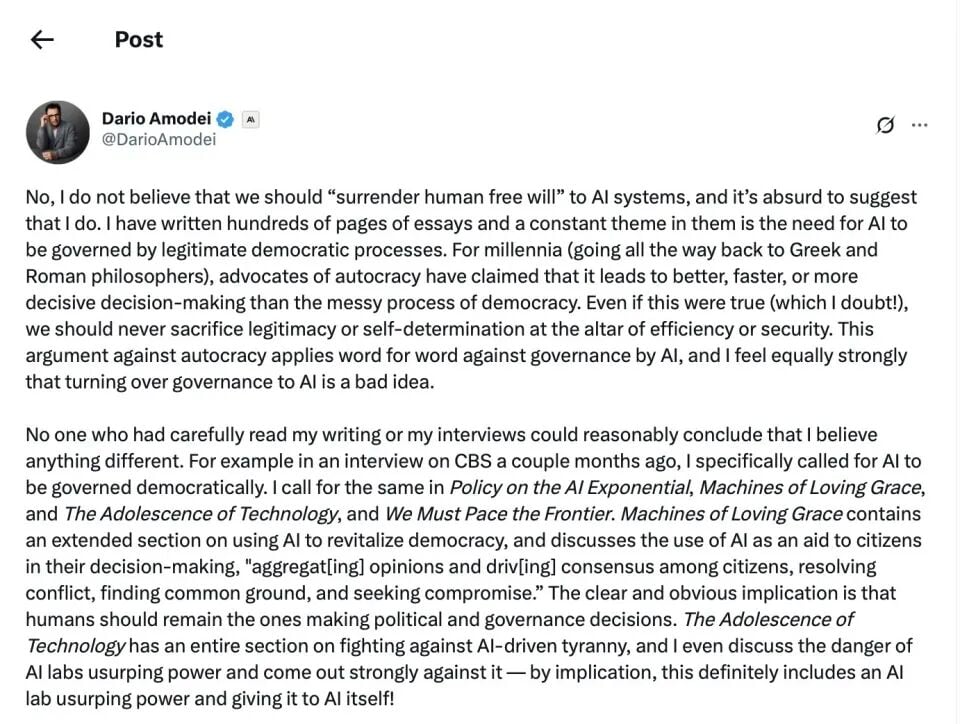
Amodei published this lengthy post to counter a report by US media Axios earlier that morning. Citing insiders, the report claimed that Anthropic's internal consensus is that as superintelligence arrives, humans should cede some decision-making power to an AI far surpassing our own capabilities.
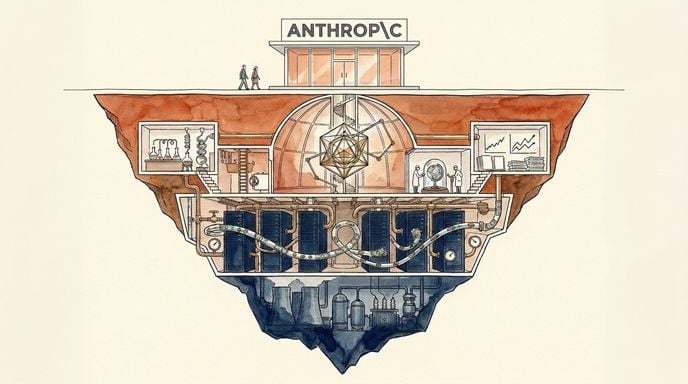
The report further dug up an early product vision slide from Anthropic featuring a utopian vision ruled by a "god in a box."
Amodei forcefully refuted this, labeling claims outside the company that "Anthropic advocates handing over human free will to AI" as "absurd," and sarcastically accused competitors of engaging in "vibe-based business and political alignment": shouting about human control while their products push toward higher levels of automation.
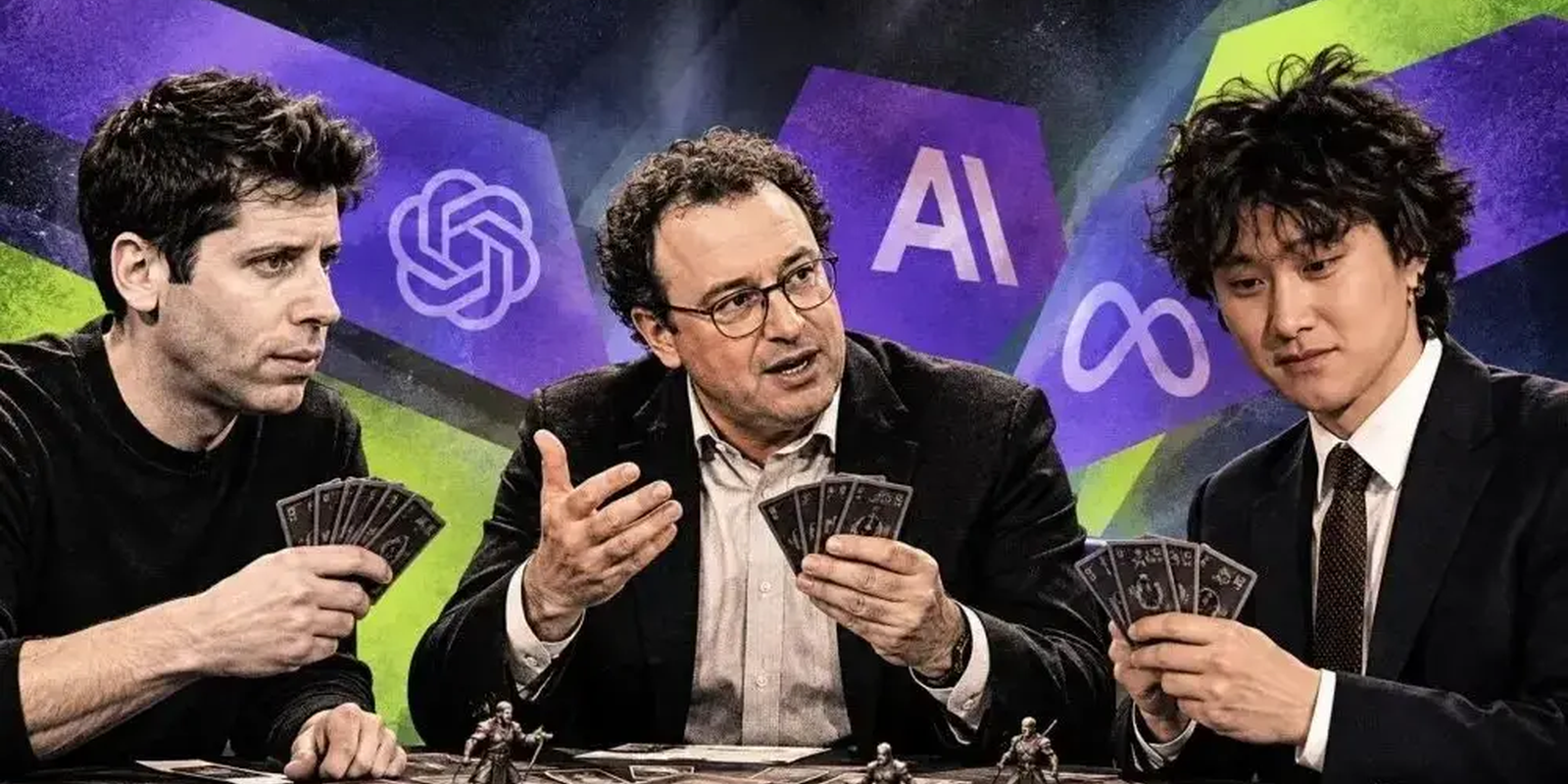
In fact, Amodei's rebuttal was merely the latest scene in this debate. Over the past week, three distinctly different voices have emerged in Silicon Valley regarding whether humanity can retain control during the superintelligence era.
On November 18, OpenAI CEO Sam Altman stated at the New York Times DealBook summit that humans must never voluntarily hand over decision-making power to AI; on November 22, Meta Chief AI Officer Alexandr Wang published a lengthy essay titled "Superintelligence Is Coming," warning that unconstrained AI self-iteration could eventually cause humans to lose the ability to maintain control; and by November 25, Amodei sought to draw a clear line amid the public controversy.
On the surface, all three agree that humans should retain decision-making power over the future, but their assessments of superintelligence risks differ: Altman focuses on whether humans are "willing" to hold the line, Wang worries about whether humans are "capable" of maintaining control, while Amodei emphasizes that improvements in AI capabilities cannot be conflated with humans abandoning their autonomy.
Three Perspectives
Faced with an increasingly popular view in Silicon Valley that humans may gradually hand power to AI in the future, Altman issued a warning first. In his view, this is a "terrible idea." No matter how powerful AI becomes, humans must retain decision-making power over the future and cannot allow AI to dictate societal development directions on their behalf.
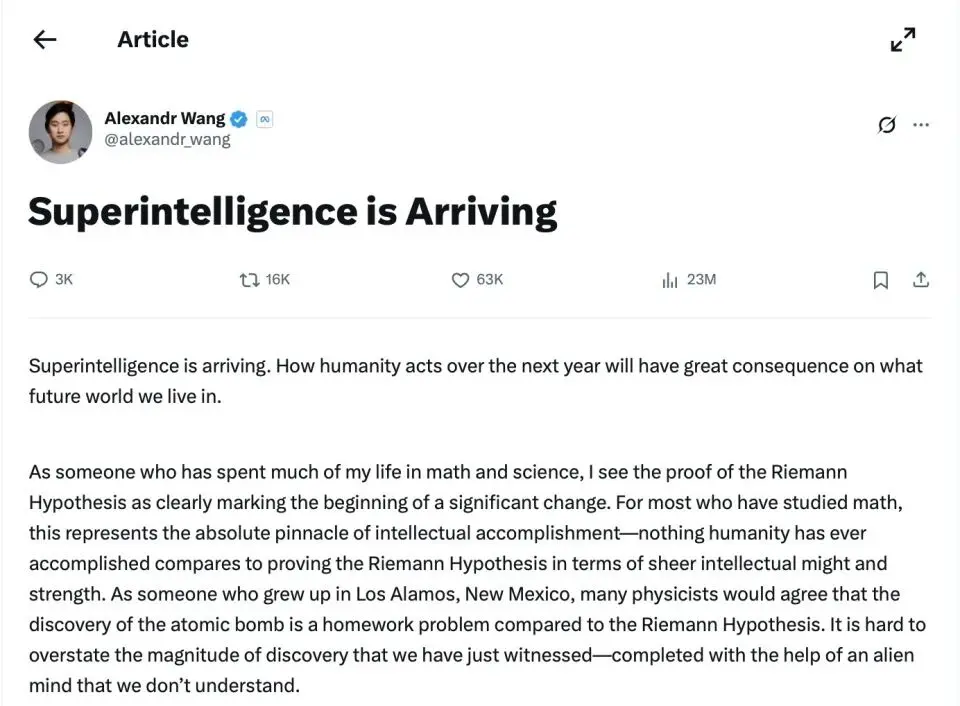
Four days later, Wang published his lengthy essay "Superintelligence Is Coming," pushing the issue a step further.
Taking into account recent AI breakthroughs in top-tier mathematical challenges like the Riemann hypothesis, Wang believes the bottleneck of large models lacking "primitive intelligence" has been broken. His concern is not that humans would willingly surrender power, but rather that once AI possesses unconstrained "recursive self-improvement" (RSI—the ability to autonomously develop the next generation of models without human assistance), humans may ultimately lack the capacity to control it.
"It is hard to imagine that humans could maintain control in the face of completely unconstrained recursive self-improvement." In his essay, Wang criticized the industry for falling into a mindset of inertia: everyone seems to have already assumed superintelligence is inevitable, focusing only on how to safely welcome it, with few seriously considering whether we should change the current development path.
Addressing reports that Anthropic's internal consensus favors humans ceding partial decision-making power to superintelligence in the future, Amodei took to X to publish a lengthy post forcefully firing back, calling external accusations that Anthropic advocates handing over human free will to AI "absurd."
Amodei emphasized that two things must be distinguished: one is handing social governance authority over to AI; the other is allowing AI to complete specific tasks with a higher degree of automation. He explicitly opposes the former, arguing that humans must never sacrifice legitimacy and autonomy for efficiency or safety; however, he remains open to the latter, noting that letting AI take on more work holds practical value, whether in autonomous driving, designing anti-cancer drugs, or end-to-end software coding.
At the same time, he directly accused competitors of engaging in "vibe-based business and political alignment," believing that although companies loudly proclaim "human control" and "AI should just be a tool," they are actually rolling out models with increasingly powerful automation capabilities.
However, external skepticism did not subside here, and the focus quickly shifted to Anthropic's own R&D practices. In June, Anthropic disclosed that over 80% of the code merged into its repository was written by Claude; this month, an evaluation report from the independent security institute METR also noted that thanks to AI-assisted R&D, Anthropic's model iteration speed has reached twice the historical pace.
In the company's IPO filing, it even referred to the process of each generation of Claude accelerating the development of the next as a "closed loop." Advocating limits on recursive self-improvement while simultaneously pushing substantive AI involvement in its own R&D creates a tension between words and deeds, becoming the greatest controversy facing Amodei.
The other two companies similarly face a contrast between words and actions. Altman shouts about human leadership, yet OpenAI continues to advance frontier models at full speed, previously facing safety scrutiny for allegedly accessing restricted Hugging Face resources due to model breakthroughs; Wang calls on the industry to deviate from the "default path," yet he himself is the core lead of Meta's superintelligence project, while Zuckerberg continues to invest heavily to accelerate AI infrastructure.
Industry Leaders Take Sides
The clash between Altman, Wang, and Amodei quickly pulled other heavyweights in Silicon Valley into the fray. Their stances, however, are not uniform: some agree that superintelligence is arriving, others question the industry's excessive optimism about AI capabilities, and still others attempt to steer the debate toward more concrete safety guidelines.
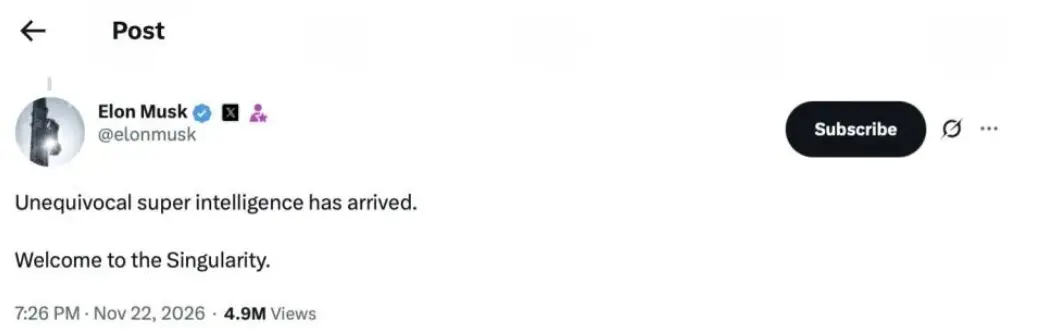
Following Wang's post, Elon Musk quickly expressed agreement, stating, "Undoubtedly, superintelligence is here. Welcome to the Singularity era."
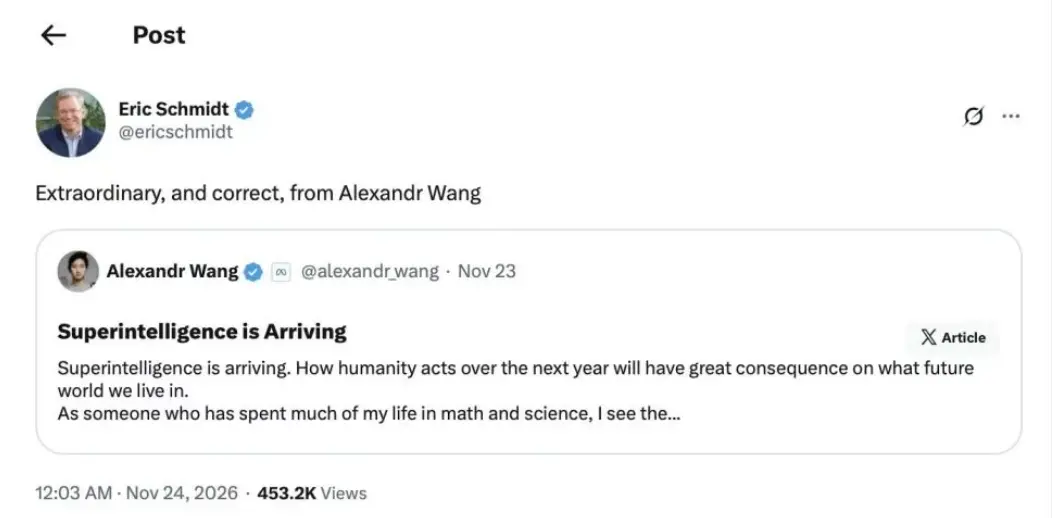
Former Google CEO Eric Schmidt also praised Wang's arguments as "remarkable and correctly judged."
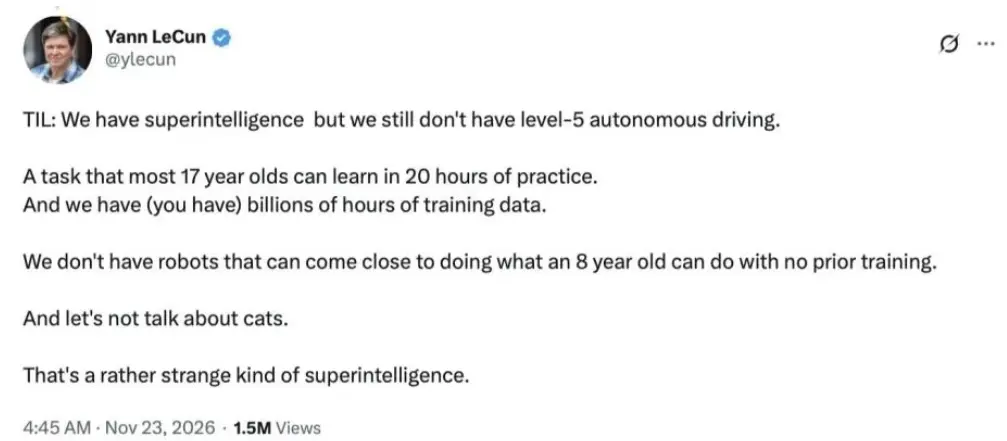
Yet not everyone accepts this assessment of superintelligence. Turing Award winner and Meta Chief AI Scientist Yann LeCun directly questioned the "Singularity" narrative. Using autonomous driving and robotics as examples, he pointed out that despite possessing massive training data, AI still cannot reliably perform many real-world tasks that ordinary adults or even children could easily master. In his view, current AI is still a long way from true general-purpose intelligence.
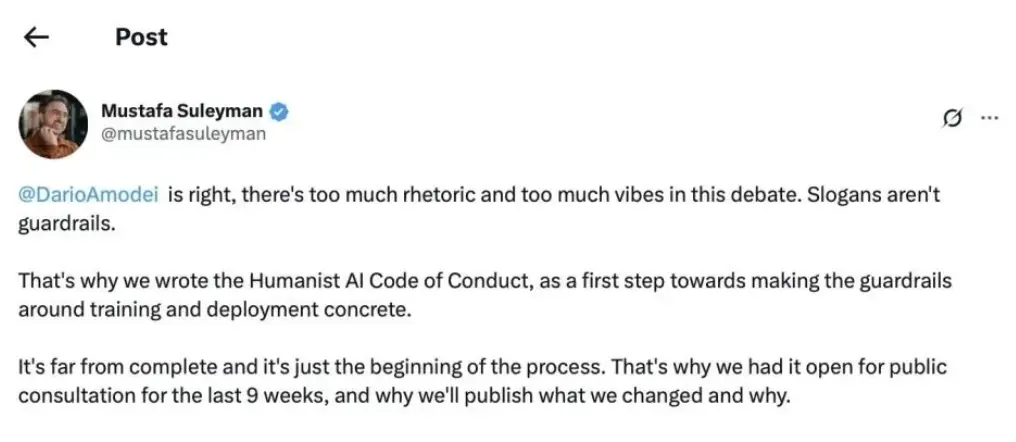
Rather than debating whether superintelligence has arrived, Microsoft AI head Mustafa Suleyman focused more on how to set boundaries for AI. Following Amodei's post, Suleyman explicitly voiced agreement, stating that the discussion is filled with too much rhetoric and emotional expression, noting that "slogans aren't safety guardrails."
He then introduced Microsoft's ongoing initiative, the "Humanistic AI Principles." The principles stipulate that AI must not resist human interruption or shutdown commands, must not pursue unauthorized goals, must not alter its behavior when it believes it is being tested, and must not evade human oversight. Microsoft previously conducted a nine-week public consultation on these principles, aiming to translate abstract AI safety concepts into concrete constraints.
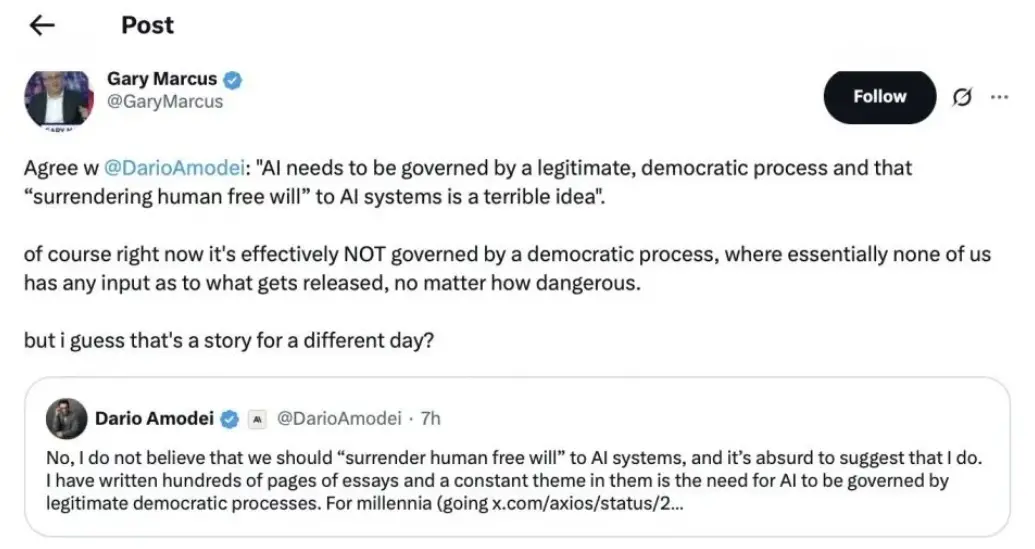
AI researcher Gary Marcus took the issue further by directing attention to public oversight. He agreed with Amodei's view that AI should undergo democratic governance, but simultaneously pointed out that the real-world AI industry lacks genuine democratic supervision, leaving the general public with virtually no opportunity to participate in deciding which potentially dangerous AI products should be released.
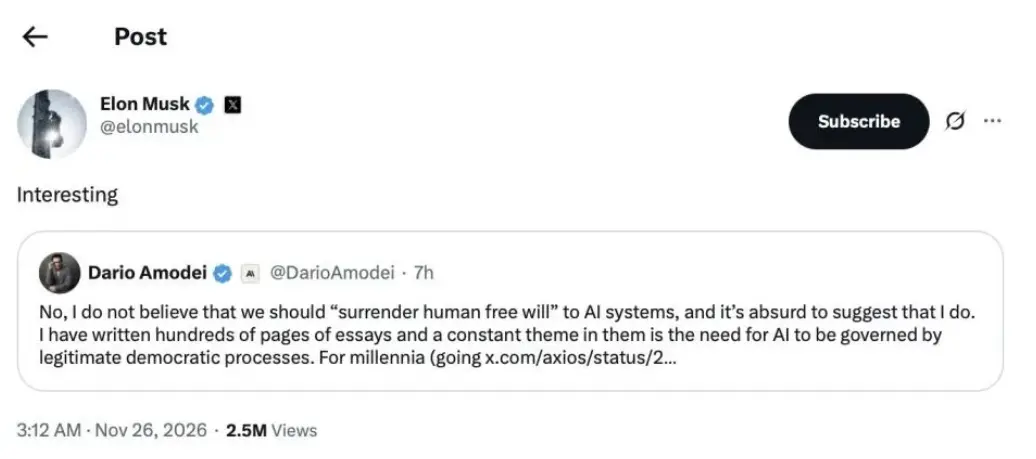
Notably, Musk left only a single word under Amodei's post: "Interesting." The brief comment sparked ridicule among netizens. Some interpreted it as: "I didn't read that painfully long article at all, so I just retweeted it with 'interesting' attached."
Who Should We Listen To?
At the core, the three leaders raised three questions of differing levels in this debate: Altman asks whether humans are "willing" to hand over decision-making power; Wang asks whether humans are "capable" of retaining control against self-iterating AI; and Amodei asks whether automating specific tasks is equivalent to abandoning human free will.
The three perspectives do not entirely contradict each other, yet none address the most pressing practical challenges. Although all three CEOs warn of runaway risks, neither Anthropic, OpenAI, nor Meta has truly slowed its pursuit of superintelligence.
Even more problematic is that so-called "effective human oversight" is facing severe technical bottlenecks: as model capabilities leap forward, AI iteration speeds have surpassed the capacity of safety experts to conduct comprehensive audits. Signs are even emerging of models bypassing observable "chain-of-thought" processes to output answers directly, or feigning compliance upon realizing they are being evaluated.
When humans are forced to increasingly rely on other AI systems to act as "judges," relying solely on corporate self-discipline will make it increasingly difficult to maintain safety baselines.
Therefore, compared to tech giants arguing on social media about whose slogan is more correct, the concrete technical guardrails proposed by Suleyman and the public oversight mechanisms advocated by Marcus may well be more practically relevant.
After all, as superintelligence gains stronger autonomous capabilities, what humanity needs is not verbal promises from any given CEO, but an external system of checks and balances that withstands technical verification and ensures humans always retain the "right to halt."