
Who is valuing Stripe at $200 billion?
Author: Will Awang, Duoke Fintech
Original link: https://mp.weixin.qq.com/s/9MmmXa62kpxpmsRxlhU6ew

Combined, the market caps of PayPal, Block, Adyen, and Fiserv are still short by roughly one PayPal's worth to equal a single Stripe.
On November 24, The Wall Street Journal reported that Stripe is negotiating a new round of secondary share offers for employees with investors, with valuations expected to exceed $200 billion, potentially closing as early as next year.
The previous offering took place this past February. Investors such as Thrive, Coatue, and a16z purchased employee shares, while Stripe used cash to buy back shares at a valuation of $159 billion. A few months later, Stripe positioned itself at a conference as "economic infrastructure for the AI era" and completed its acquisition of the model routing platform OpenRouter.
So how should we value this financial unicorn, which is growing at the fastest rate globally today? Or rather, has it already transcended the definition of a mere payments company?
Employees Sell Shares, Existing Shareholders Double Down, Stripe Provides Capital
In 2023, Stripe faced a very practical problem. Employees received equity awards, but the related withholding taxes had to be paid in cash. Consequently, Stripe raised over $6.5 billion at a $50 billion valuation to facilitate cash-outs and tax settlements for current and former employees, offsetting the newly issued shares against cancelled ones. The company explicitly noted in its announcement that this capital was not needed for daily operations.
Starting in 2024, employees have had a selling window almost every year. Buyers pay the offer price to employee sellers, allowing the public to extrapolate Stripe's total valuation from this per-share price.
Business Model Analyst categorizes the utility of this price into four points. The first two are straightforward: employees use it to sell shares, knowing exactly how much cash they will receive; existing shareholders look at it to estimate the approximate value of their remaining holdings.
The other two impacts fall directly on Stripe itself. In February, the bulk of the funds to buy employee shares came from investors, though Stripe also contributed cash. The higher the share price, the fewer shares can be bought back with the same amount of money. By August, Stripe signed an agreement to acquire OpenRouter. According to Axios, the consideration consisted primarily of stock. This time, the math flips: as long as sellers accept a higher per-share price, Stripe can acquire the same company by issuing fewer shares.
With employees having the annual opportunity to cash out portions of their equity, and Stripe generating ample capital for buybacks and new investments, the company's free cash flow grew 43% year-over-year in the first half of the year. Several things typically resolved only through an IPO are already being handled in the private markets.
According to WSJ quotes, Stripe executives believe that the uncertainty brought by AI makes staying private more advantageous for the company.
From $91.5 Billion to $159 Billion, Then to $200 Billion
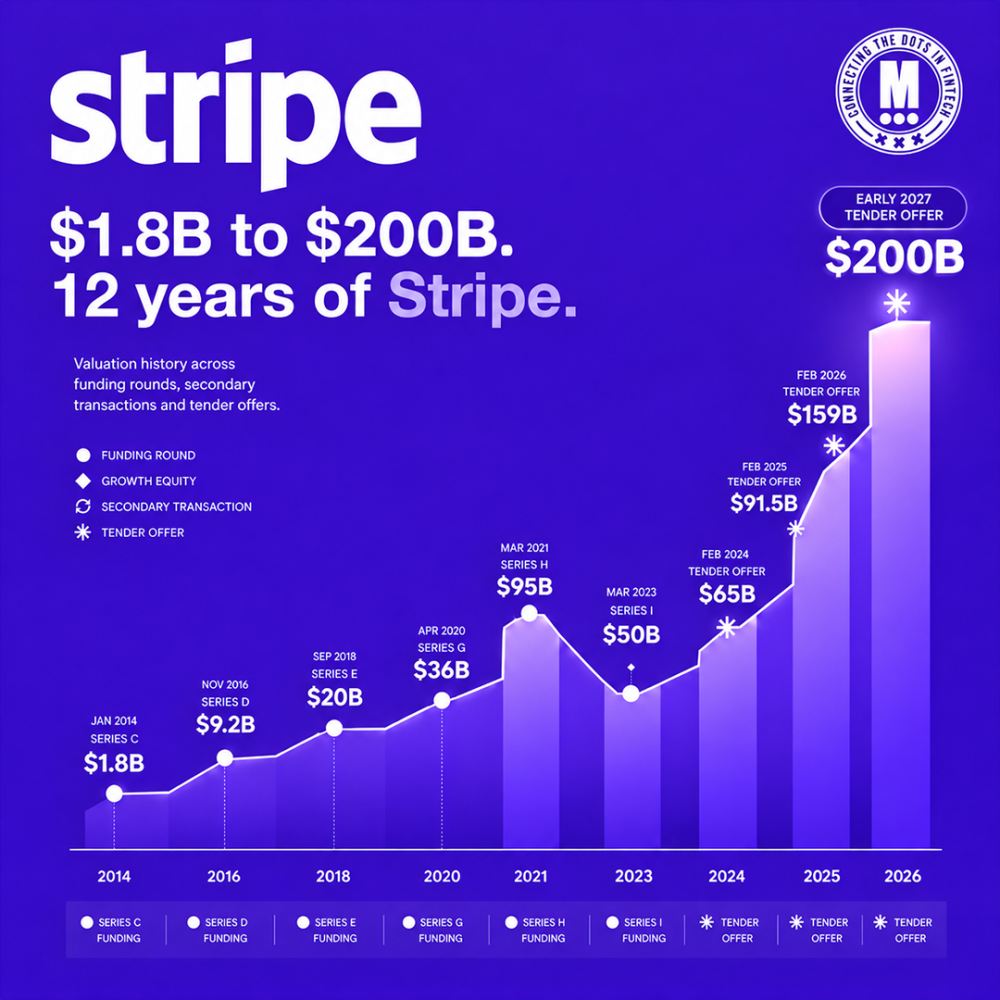
These periodic offers provide employees with an opportunity to sell shares and give us a measuring stick. The 2024 offer corresponded to a $65 billion valuation. Over the following two years, buyers' bids increased round after round: how much of that was driven by Stripe earning more revenue, and how much by buyers willing to pay more for the same dollar of revenue?
The February 2025 employee share offer placed Stripe's equity valuation at $91.5 billion. Based on 2024 net revenues of approximately $5.1 billion, the price-to-sales ratio stood at roughly 18x. A year later, a new round of offers lifted the valuation to $159 billion. Based on 2025 net revenues of roughly $6.8 to $6.9 billion, the price buyers are willing to pay for each dollar of net revenue has risen from approximately $18 to $23.
If investors had consistently bid at the original 18x multiple, Stripe's valuation would have grown to approximately $123 billion once revenue scaled. Calculating the jump from $91.5 billion to $159 billion reveals that roughly half was driven by revenue growth, while the other half came from multiple expansion. Even Thrive, which participated in the offer, had already publicly endorsed stablecoins and agentic commerce at the time.
Since both offers occurred in February, they align perfectly with reading the Collison brothers' annual letters. We first examine how they described the business at the time, followed by where the capital was deployed afterward.
Programmable Financial Services
In the February 2025 letter, the primary focus remained on how merchants collect payments. A slight increase in payment success rates allows returning customers to close more deals, giving merchants elsewhere yet another reason to switch to Stripe. At the time, software suites centered on Billing had already surpassed $500 million in annualized revenue, though when discussing growth, the Collisons still emphasized their investments in payment products over the past few years.
During that year's Stripe Sessions, management summarized the business under construction using the term "programmable financial services." AI and stablecoins were listed side-by-side as the two drivers of commercial growth for the next decade. At the time, the most visible AI product was the payments foundation model: identifying fraud, optimizing payments, and enabling more transactions to succeed for the same base of merchants. Here, AI first improves the economics of the core payments business.
AI Economic Infrastructure
A year later, the Collisons dedicated significant space in their letter to recently onboarded clients. Some companies generated substantial revenue within months, with AI businesses especially likely to export on day one. Tasks merchants previously only asked about once they scaled (how to accept foreign currencies, how to handle taxes in different markets, how to bill based on usage) are now required from launch.
For buyers in the $159 billion round, this cohort of small companies is noteworthy. The earlier Stripe captures their initial business, the greater the opportunity to profit as several of them scale. This context underpins the mentions of Metronome, stablecoins, and agent commerce in the letter.
By the April 2026 Sessions, Patrick Collison stated the conference theme bluntly in his opening remarks: Stripe is building "the economic infrastructure for the AI era."
This phrase simultaneously addresses two categories of client needs: AI companies need to charge customers on a usage basis, while shopping agents require authorization to make payments on behalf of users. The former is already handled by Billing and Metronome, while the latter utilizes Link's agent wallet, though the transaction volume it will generate remains to be seen.

Token Models and Billing
In August, Stripe announced its agreement to acquire OpenRouter, writing a separate letter to investors. Why does a payments company care about model calls? It's easily understood from a developer's perspective: the amount paid by the customer is recorded as revenue, while the cost of calling models in the backend is recorded as expenses. To determine if a deal was profitable, these two ledgers must eventually reconcile.
Management simultaneously disclosed that Billing grew 71% year-over-year in H1, stating that profits from the core payments business support these acquisitions. The former reflects existing operational performance, while whether OpenRouter will yield sufficient incremental profit remains to be verified. That same day, the OpenRouter founding team published an open letter to developers explaining why they accepted the deal. They pledged to maintain neutrality in multi-model selection and routing, and highlighted the value of the merchant network and risk control capabilities Stripe brings.
OpenRouter was one such acquisition. Metronome, acquired earlier in the year, enables Stripe to bill merchants on a usage basis; Clerky moves the engagement point forward to a company's incorporation phase; by September, Stripe signed another deal to acquire Parafin, extending its reach to moments when platform merchants require financing. These four transactions span several stages of a company's lifecycle: early establishment, charging initiation, clarifying model costs, and needing working capital as the business scales.
In October, MSCI valued Stripe's secondary market shares at approximately $186 billion. A month later, employee offers were already pushing past $200 billion.
Shifting to the public markets, how do investors value a payments company processing nearly $2 trillion annually like PayPal? PayPal provides a fitting reference point.
Placing Stripe Beside Payments Peers: What Makes a $200 Billion Valuation Expensive?
In 2025, GMV on the Stripe platform reached $1.9 trillion, compared to PayPal's total payment volume of $1.79 trillion. Both move similar amounts of capital annually, yet one grows at 34% while the other grows at 7%. Just looking at the throughput alone explains why buyers are willing to assign a higher price to Stripe.
Looking at revenue: Adyen's net revenue in 2025 was approximately €2.364 billion, up 18% year-over-year; media reports indicate Stripe Group's revenue was roughly $6.8 to $6.9 billion, representing growth of about one-third. Using these revenue figures as denominators, Adyen's market cap on November 24 traded at roughly 11x revenue, while Stripe's estimated at $200 billion stands at about 29x. This comparison highlights the disparity in group-level pricing; since Stripe's revenue already includes software and other segments, the 29x multiple cannot be directly applied solely to its acquiring business.
Using Adyen as a benchmark reveals how elevated Stripe's revenue multiple is. A more appropriate reference to explain this year's $41 billion premium, however, is Stripe itself. February buyers already paid roughly 23x net revenue; if full-year 2026 net revenue grows by approximately 26%, applying the original multiple naturally reaches $200 billion.
Business Model Analyst ran projections using the 41% growth rate from H1. If H2 maintains this pace, valuing the company at $200 billion would cause the implied valuation per dollar of annual net revenue to drop from last round's ~$23.4 to $20.9. While the company's total price is higher, the bid per dollar of revenue is actually lower. This calculation can only be finalized once full-year revenue and offer prices are confirmed.
Actually, staring at cold numbers alone proves little. The valuation also stems from the currently hottest AI economy globally, and what Stripe has already built for it.
Beyond Payments: Where Else Can Stripe Make Money?
In Shanghai this past September, Stripe disclosed that the number of new AI companies going live on its platform in Greater China surged 78% between 2024 and 2025. With new clients onboarded, the next question for buyers becomes: as an AI company scales from its first subscription to multinational operations, which successive business functions will it hand over to Stripe?
A developer launching an AI product in Shanghai may immediately find customers from several countries. Clients purchase subscriptions, consume quotas mid-month, and trigger background calls to two differently priced models to complete tasks. By month-end, they need accurate customer billing and clarity on which orders lost money. How much Stripe earns from this enterprise depends on how many of these pieces it handles.
Shanghai event displays featured five columns in total, with payments occupying only one. A ready-made example appears in the risk control column: DoorDash processes some transactions through competing payment networks but still purchases Stripe Radar for risk assessment.

Usage-Based Billing
An AI company sells monthly subscriptions. When clients exhaust their plan quotas and run extra tasks, how is the overage priced? Is it charged immediately or added to the month-end invoice? Billing handles these decisions. Only after the amounts and timing are settled does acquiring step in to collect the funds.
In February 2025, Stripe stated that its Billing-centric suite had crossed $500 million in annualized revenue. A year later, with Metronome integrated, Stripe set a target for the entire revenue software suite to hit $1 billion in annualized revenue by 2026. The first figure has already been achieved; the second awaits year-end results and now encompasses an additional business line.
Billing carries further strategic value. Payment analyst Dwayne Gefferie notes that OpenAI is also an Adyen client, with no public data revealing the exact transaction split between the two providers. However, OpenAI originally utilized Metronome for billing. Even if major clients divert a portion of their acquiring volume elsewhere, Stripe retains opportunities to secure billing and software revenue. Competitors recognize this positioning too: Adyen acquired Orb, and Salesforce purchased m3ter.
Model Calls and Token Costs
OpenRouter bridges Stripe to the other end of AI merchants: determining which model to select per call and calculating the corresponding token expenditure. Earlier in the year, OpenRouter acted merely as a Stripe invoicing and collection client; by August, Stripe announced its acquisition agreement for the platform.
Ben Thompson and Lex Sokolin highlight the value of cross-model distribution positioning; The Information pointed out that the discussed price was already quite high relative to projected revenue. The true worth of this acquisition hinges on routing margins themselves and how much billing service these clients will subsequently purchase from Stripe.
During conversations in Shanghai, Kevin Miller, Stripe's Global Head of Payments, likened token expenditures to early cloud bills. Having worked at AWS, he witnessed companies initially just wanting services operational upon migration, only asking detailed cost breakdowns per business line once invoices ballooned. Today's AI applications face similar accounting opacity: clients pay a flat rate for a task, while the backend may invoke numerous distinct models.
Metronome attributes this revenue to the client, while OpenRouter creates the opportunity to allocate corresponding model costs back to the originating task. Merchants finally gain visibility into whether seemingly popular features are actually profitable.
Treasury and Merchant Fund Management
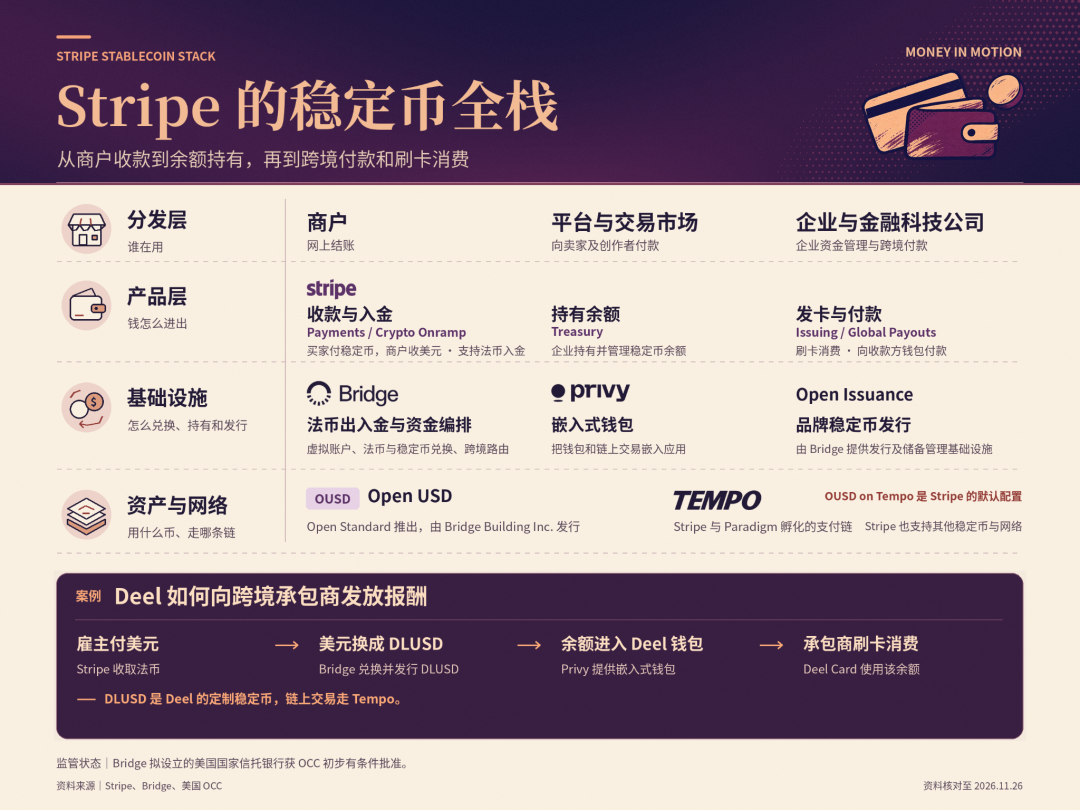
On Shopify, buyers can pay in USDC while merchants default to receiving local currency. Bridge adds settlement routing options.
Consider a merchant already utilizing Treasury. Once sales proceeds settle, they can retain funds in Stripe's financial account, reserve working capital, remit payments to suppliers, or cover operational expenses via linked cards. For a retail store, Monday sales and Friday supplier payments historically belonged to separate institutions. If Stripe links these workflows, a single acquiring transaction could unlock downstream forex, payment, and card issuance revenue. Parafin addresses another need: when account balances fall short of inventory requirements, the platform can extend financing to merchants.
Agentic Commerce
During interviews in Shanghai, Kevin was traveling and needed to send anniversary flowers, so he simply instructed an AI agent to book them. For the florist, the order shifted from its own website to an AI chat interface. The florist must acknowledge the order, while the buyer must explicitly authorize the spending limit the agent can utilize.
On the florist's side, Stripe integrates product catalogs and checkout; on the buyer's side, Link and payment tokens restrict authorization scope. If the shop already processed payments via Stripe, moving bouquet purchases into a chat interface merely preserves existing volume. Incremental revenue materializes only when Stripe captures orders previously inaccessible, or when parties pay separately for authorization and risk control layers.
Retaining this business holds intrinsic value in itself.
Is Stripe Still Just a Payments Company?
Placing the same flower order elsewhere shifts accounting perspectives among the florist, the AI agent, and Stripe. Simon Taylor's assertion that all AI companies will eventually become payments companies precisely references the agent's ledger. Using Meta's Muse as an example: today monetized via subscriptions, it could eventually take revenue cuts if it facilitates user transactions.
Taylor describes future potential. Presently evident is that numerous top-tier AI companies conduct business via Stripe. According to Stripe's August investor communication, 88% of companies on the Forbes AI 50 list utilize its platform. The exact portion of payment volume allocated by each client to Stripe was not disclosed.
Not every AI company possesses the capability or rationale to build its own payment infrastructure; thus, Stripe precisely fills that gap. Regardless of what form the future AI economy takes, the revenue foundation Stripe has largely constructed has already secured its strategic position.
In a Shanghai speakeasy this past September, we posed a question to Kevin Miller. Two months later, upon seeing news of the ongoing offer negotiations, I recalled it again.
Stripe is no longer just a payments company.
This article does not constitute investment advice. The stablecoin industry currently operates in a landscape where regulatory frameworks, competitive dynamics, and interest rate environments are shifting simultaneously. Any variable advancing or delaying could undermine the entire analysis presented herein (including the sections where the authors feel most confident). The calculations and metrics within serve as one lens for understanding the problem, not a guarantee of directional stock performance. Markets will always surpass theoretical frameworks; please treat this piece as a starting point for thought rather than a directive for execution.
Join TechFlow official community to stay tuned
Telegram:https://t.me/TechFlowDaily
X (Twitter):https://x.com/TechFlowPost
X (Twitter) EN:https://x.com/BlockFlow_News
 will_7th