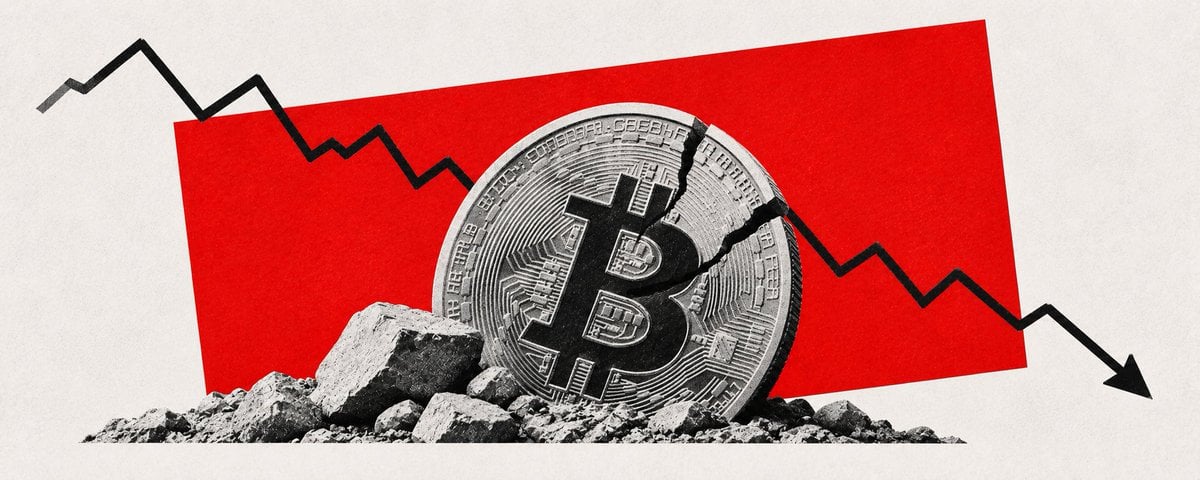
Why is it becoming harder to make money in the crypto industry?
Author: Paul Klay, Venture Partner at Begin Capital
Translated by: TechFlow
TechFlow Summary: The crypto market once thrived on endogenous liquidity and information asymmetry, fostering a multi-party win-win dynamic. However, over the past two years, this ecosystem has been systematically restructured. Interest groups are no longer satisfied with merely playing the game; they are vying to become the "casino bosses" that set the rules, constantly draining retail capital through closed-loop insider flows.
Begin Capital Venture Partner Paul Klay, drawing on numerous firsthand cases, deeply dissects four mainstream harvesting schemes ranging from politician insider trading and contract wick exploitation crimes to inflated valuation fraud and Meme coin harvesting. He warns that the industry must quickly shed its blind wealth-creation illusions and shift toward genuine value creation with closed commercial loops.
In recent years, we have repeatedly witnessed various harvesting schemes cycling through the crypto market. I believe these meticulously designed mechanisms have largely brought an end to the era when gold was scattered across the crypto industry and easy money could be made. Moreover, those simple paths to overnight wealth will most likely never return.
I will not here broadly discuss Bitcoin's price or trading volume, nor am I a market analyst. Therefore, please take everything I say next as my personal perspective based on industry observation.
The so-called "quick money" can only exist when others are willing to pay the bill and bear the losses. For a long time, the vast majority of participants in the crypto market have essentially been speculators. Of course, this industry does contain genuine innovative technologies and practical use cases, but anyone who stares at charts around the clock, chases every trending project, and treats cryptocurrencies as a full-time job is, regardless of how they dress it up, fundamentally a speculator.
During that phase, if you were slightly smarter than others, gained information earlier, and then sold your chips to the next wave of incoming investors—who would later sell them on the secondary market to ordinary retail traders—you could make money. Even if you weren't the first to enter and grab the spoils, you still had a significant probability of sharing in the profits.
More importantly, after this group made their profits, the vast majority did not cash out and leave. Instead, they chose to directly reinvest the funds back into the crypto ecosystem. Just like in traditional casinos, they would move their chips to the next gambling table where they believed they could make even more money.
But all of this previously occurred within a relatively organic and virtuous cycle. Everyone had the chance to make money, and everyone also faced losses. There was no single interest group in the market capable of continuously monopolizing all profits.
Yet in a traditional casino, the house always makes the most money.
Thus, several interest groups decided to completely change roles and become the "casino bosses" themselves. They figured out how to extract massive profits from the extreme volatility of the entire market and siphon this real money completely out of the crypto ecosystem.
The most brilliant aspect for them lies in the fact that inside the casino they built themselves, they face almost zero risk of losing money. All they do is precisely exploit humanity's insatiable greed.
Next, I will deeply dissect the four most common harvesting schemes that, in my view, have caused decisive damage.
Political Influence and Insider Trading
Trump realized he possesses tremendous influence capable of simultaneously swaying both the crypto market and US stock markets, and he has aggressively leveraged this influence. Here we primarily focus on the crypto sector because, compared to traditional stock markets, the crypto market is much smaller, less stable, and far easier to manipulate with just a few key phrases.
Once you become the person whose mere words can dictate the direction of the broader market, you and your closest circle gain an unmatched absolute information advantage.
The logic behind this maneuver is extremely straightforward: calculate in advance which direction to dump or pump to maximize profits, establish corresponding positions ahead of time, and then make public statements to exploit as much profit as possible within the limits of available liquidity.
This game can be played over and over again as long as the public hasn't completely desensitized to your rhetoric and still reacts violently to each of your public statements, or as long as there is still liquidity left to squeeze.
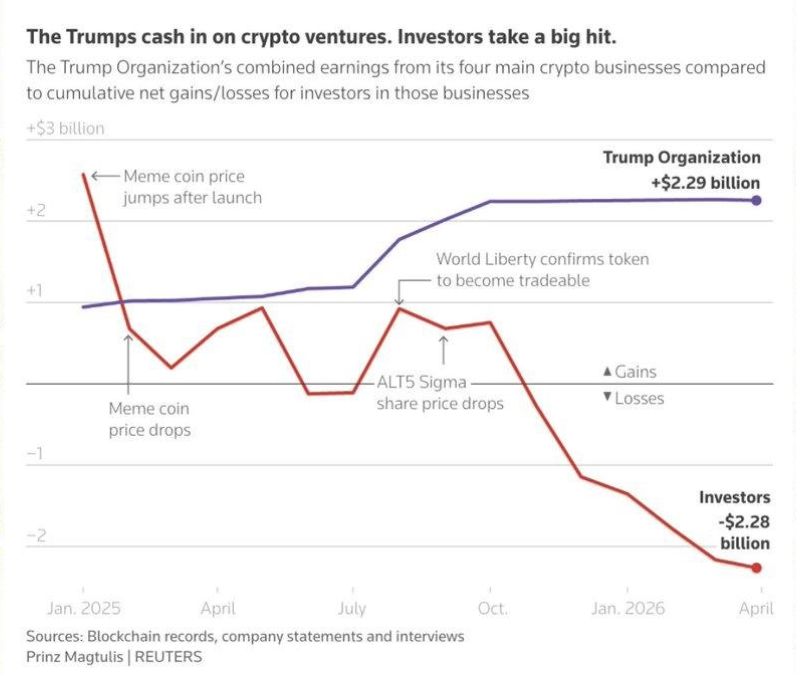
Figure: Impact of Public Statements and Insider Trading on Market Trends
The problem, however, is that market liquidity is not infinite. The number of traders participating in the game is limited, and the principal capital in their pockets is also finite.
When insiders wielding absolute control use their market manipulation capabilities to harvest recklessly, they drain massive amounts of capital, concentrating enormous wealth into the hands of very few. This drained liquidity simply never flows back into the crypto ecosystem.
Moreover, Trump and his family members personally stepped in to launch multiple token projects, representing yet another layer of direct monetization.
Thus, events that the crypto community cheered during the election period as a comprehensive industry victory may ultimately evolve into the most destructive nightmare for the entire sector.
Contract Manipulation and Precision Liquidation Crimes
The essential logic of this model is identical to insider trading. The only difference is that you don't need to become President to manipulate prices. You simply need absolute control over the majority of circulating supply of a specific token, and ensure that token supports contract trading on major top-tier exchanges.
This is a standardized assembly-line operation:
First, pitch a project concept and secure early-stage funding and backing from well-known venture capital firms. Then, funnel the raised capital into fabricating fake trading volumes and buying followers to manufacture hype. Next, forge non-existent real revenue data to raise another round at a higher valuation, using this as leverage to negotiate listing with top-tier exchanges.
If the exchange can list perpetual contracts alongside spot trading from day one, that's ideal. If not, keep pumping money to inflate spot trading volumes to astronomical figures until the exchange grants you contract trading access.
At this stage, a near-infinite money-printing harvesting machine is successfully built.
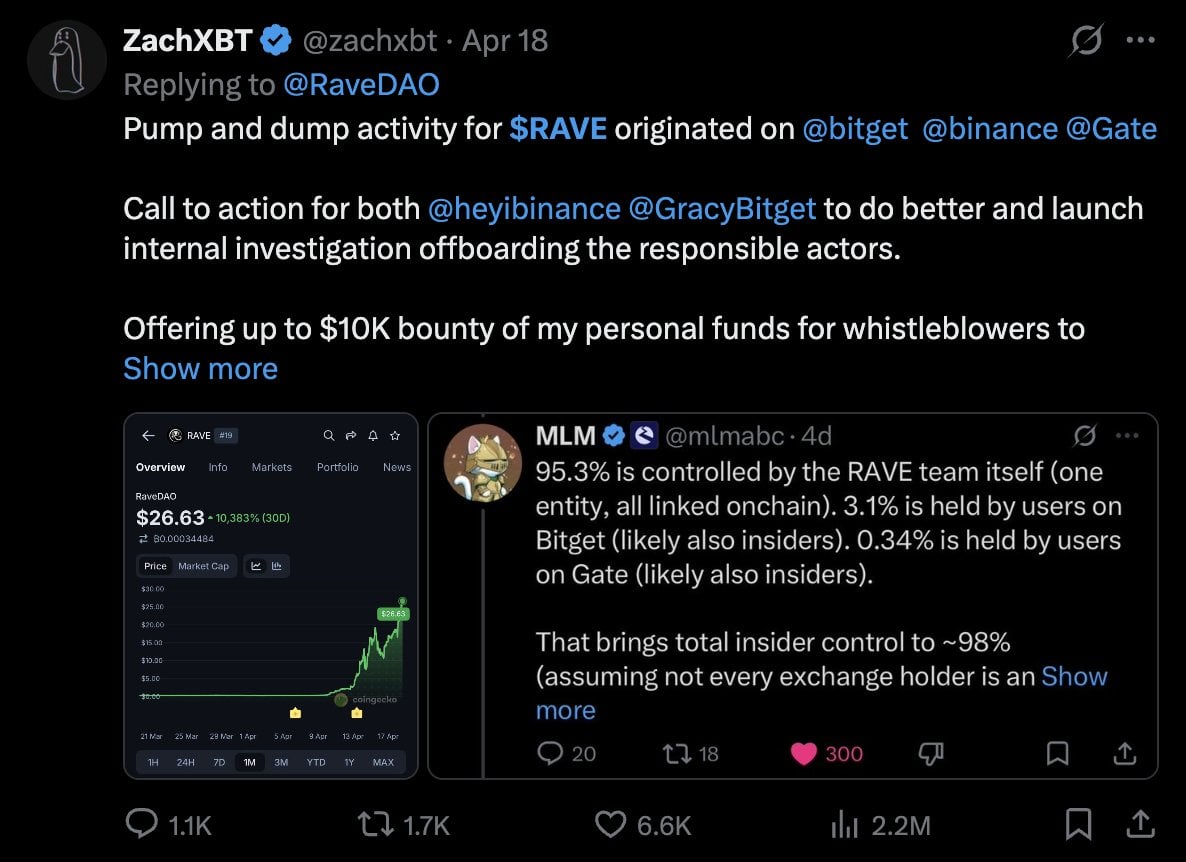
Figure: Typical Chart Pattern of Contract Long/Short Liquidations Orchestrated via Market Manipulation
Once contract trading goes live and you securely hold the vast majority of spot tokens, backend open interest data becomes completely transparent to you. You can precisely see exactly how many positions are short versus long at any given moment.
You simply position yourself against retail traders, then use your accumulated spot tokens to either aggressively dump the price or rapidly pump it, precisely triggering mass liquidations of opposing positions and effortlessly pocketing enormous profits.
As long as the token isn't forcibly delisted by the exchange, or as long as retail traders haven't fully seen through the trick, you can repeat this harvesting cycle indefinitely.
To generate scale effects, the core requirement is listing on the contract segments of top-tier mainstream exchanges, as only there lies sufficiently massive retail speculative liquidity. Regardless of how mediocre or even garbage your project is fundamentally, securing a contract pair on a top exchange easily attracts hundreds of millions of dollars in fervent gambling capital.
Inflated Valuations and the Self-Funding Trap of Fake Metrics via Airdrops
The crypto industry remains a relatively young sector, so many projects often secure exorbitant valuation premiums during their infancy. In traditional industries, business hypotheses proven false by market testing inevitably lead to bankruptcy liquidation. But in crypto, two fundamental fatal distortions exist:
First, the so-called revenue-generation mechanism.
Given the crypto market's inherently speculative nature, the vast majority of entrants come seeking quick profits. Thus, rather than solving real-world pain points, many projects are specifically designed to solve the question of "how to distribute money to speculators."
Founders promise substantial returns via airdrop expectations to incentivize frequent product interaction. Users indeed flood in droves, not because the technology solves their actual business challenges, but purely because they anticipate profiting from it.
Founders subsequently package these bloated active addresses and engagement metrics into polished pitch decks for VCs, securing larger rounds of funding before eventually launching the token.
Once the token launch and airdrop materialize, on-chain interaction activity often plummets hundreds or even thousands of times overnight, because all users gathered previously were exclusively driven by financial incentives.
Second, the distorted exit channel via token issuance.
In traditional physical and internet startups, failure typically means closing the company entirely. Investors take their losses, and founders exhaust their time.
But in the crypto world, even if your underlying premise has been thoroughly disproven by the market, weak regulatory oversight and a lack of accountability allow you to continue whitewashing reality. You can craft a highly provocative new grand narrative and issue tokens at an artificially inflated Fully Diluted Valuation (FDV) in the billions, entirely devoid of fundamental support.
Puzzlingly, there is always a steady stream of buyers willingly jumping on board.
Founders cash out handsomely, while early investors either break even or strike it rich. A zombie project that should have faced bankruptcy liquidation months prior instead executes a victorious escape on the secondary market.
This is essentially a "fake IPO" conducted without rigorous compliance reviews or substantive due diligence. As long as you're willing to pay to bypass listing requirements, you can freely issue tokens and cash out, with virtually no external scrutiny or accountability.
A colleague once developed an exceptional analytical tool called Valueverse AI, which identifies truly undervalued assets by directly comparing a project's actual on-chain revenue against its market valuation.
This tool clearly explains why the vast majority of tokens on the market exhibit a unidirectional, endless downward bleed post-launch. Only a tiny fraction manage exception performance, which usually relies on heavy manipulation rather than genuine terminal demand. Meanwhile, many companies with solid profitability utterly disdain issuing tokens.

Figure: Tokens Lacking Genuine Demand Support Typically Exhibit One-Side Downward Trajectories Post-Listing
Returning to the most basic laws of supply and demand: this castle-in-the-air model can only persist as long as a continuous influx of new external buyer capital enters the market. Theoretically, however, any business model that fails to create substantive value cannot be sustained long-term.
Everyone wants to make money, but in a zero-sum game, someone must absorb the losses. Consequently, founders began mass-producing projects like factory assembly lines, treating token issuance as their sole tool for cashing out and exiting.
I know numerous startup teams that used to, and some still do, churn out new projects weekly by repackaging old ones. Imagine this scenario: launching a new token project every week. They simply wrap legacy code in a fresh presentation, fabricate seemingly impressive metrics, spend money hiring Twitter KOLs to blast promotional shills everywhere, and then effortlessly harvest and depart.
Mass Meme Launches and Asymmetric Harvesting with Zero Chance of Loss
In the previous category, we discussed projects with valuations artificially inflated by multiples: a project genuinely worth $10 million on real metrics gets fictitiously packaged into a $1 billion market cap.
In this category, the model has completely devolved into a pure assembly line spawning massive volumes of Meme coins. The market is flooded with specialized workshops dedicated to batch token issuance and harvesting.
The probability of loss for this group is virtually zero because from day one, they firmly control the vast majority of early token supply and can dump for cash at any moment without hesitation. Out of hundreds of Meme coins they launch, if even one or two get lucky enough to ride an emotional hype cycle, they reap unimaginable windfalls.
The reality is that brutally simple.
No substantive commercial value is created here. It merely provides a venue satisfying pure speculative urges, indistinguishable from slot machines in a casino.
The only distinction lies in this: even in legitimate traditional casinos, the house faces a non-zero risk of short-term bad luck and occasional losses. In these operator-controlled Meme launchpads, however, the house designs rules with absolutely no downside risk. The actual winning probability for ordinary traders is significantly lower than sitting at a physical casino roulette table.
Conclusion: Return to Real Value Following the Growing Pains
Precisely because of the rampant proliferation of the aforementioned harvesting schemes, the entire crypto market is undergoing irreversible acceleration of differentiation. Liquidity is increasingly and decisively flowing toward products with genuine institutional-grade capacity and tangible use cases. The era when you could conjure nothing from thin air by merely spinning a compelling story and drawing conceptual pie charts is completely gone forever. The easy path to overnight wealth that once accompanied such narrative bubbles has vanished into thin air.
You might call this an inevitable growing pain for the crypto industry's maturation, and I wholeheartedly agree. Yet during this transition, a small clique of interest groups has already siphoned out extraordinarily massive liquidity. Today's crypto market bears little resemblance to the early days of wild growth and multi-party win-win dynamics. This disillusionment was unavoidable, as that unsustainable hot-potato model was doomed to fail from day one.
Despite these growing pains, I remain convinced that the crypto industry holds immeasurable potential. I firmly believe that over the long term, the entire sector will continue to expand and develop, though it will absolutely never revert to those primitive forms of the past.
The past crypto ecosystem was teeming with speculators lacking basic business acumen yet desperately building pseudo-ecosystems everywhere. Amidst frantic liquidity bubbles, the market actually kept pouring endless capital toward these individuals. They took fundraising sums and hired what I've seen as the least professionally competent so-called experts, paying them the most absurdly exorbitant salaries in the market.
Today, the vast majority of these speculators and freeloaders have been ruthlessly flushed out of the market, which is undoubtedly a tremendous blessing for the long-term health of the entire industry. The era of blindly sending money to teams devoid of any business logic has completely ended.
This shakeup forces everyone remaining at the table to focus intently on building real commercial entities capable of genuinely solving practical problems and possessing robust self-sustaining capabilities. And this, ultimately, will bring about a truly profound positive restructuring for the next decade of the entire crypto industry.
Join TechFlow official community to stay tuned
Telegram:https://t.me/TechFlowDaily
X (Twitter):https://x.com/TechFlowPost
X (Twitter) EN:https://x.com/BlockFlow_News
 @PaulKlayVC