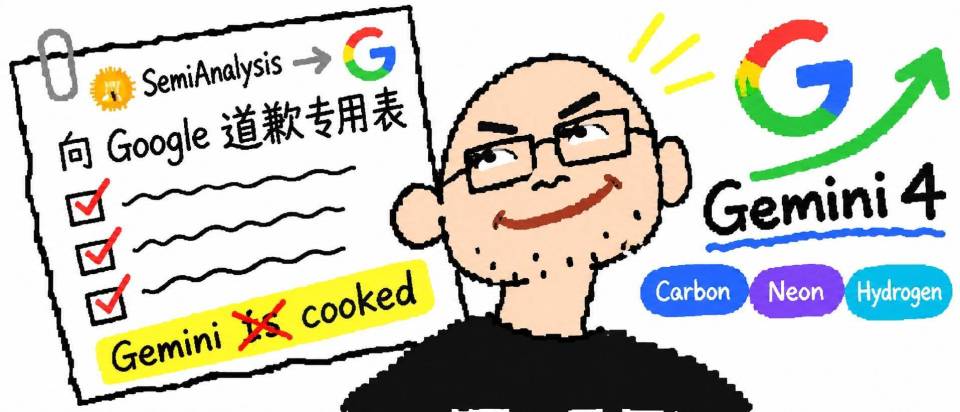
Apologize to Gemini, please line up voluntarily.
Author: iFanr
Today, the well-known semiconductor and AI research institution SemiAnalysis posted an image on X titled "Official Apology Form to Google," addressed to Google DeepMind Chairman Demis Hassabis.
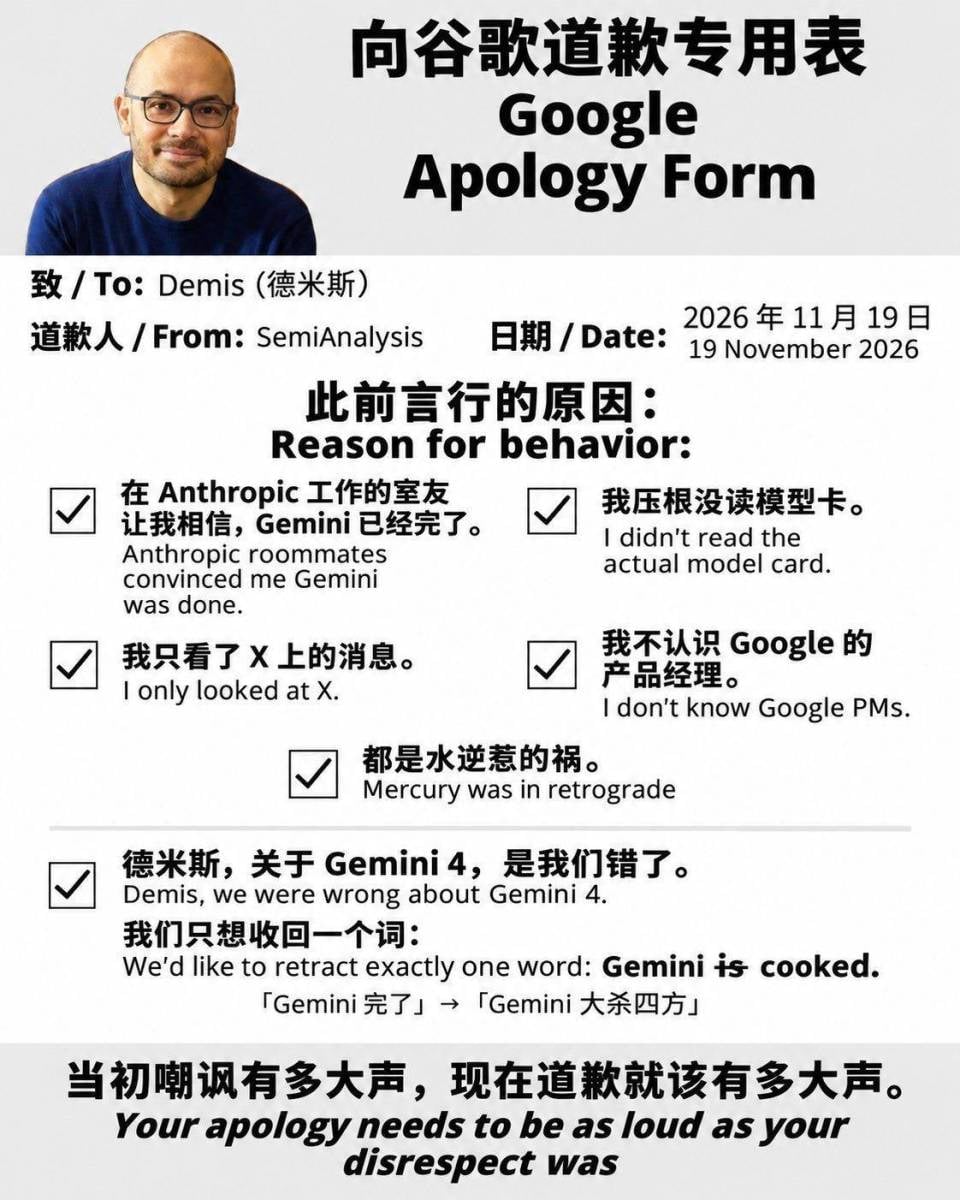
Checked in the reasons section were items such as "I only read everyone's posts on X," "My roommate who works at Anthropic convinced me that Gemini is toast," and "I didn't read the model card." The most interesting part is the last line: "Demis, we were wrong about Gemini 4. We just want to retract one word."
They crossed out an "is" from their original headline: Gemini is cooked. The phrase "Gemini is done for" turned into "Gemini actually delivered something this time."
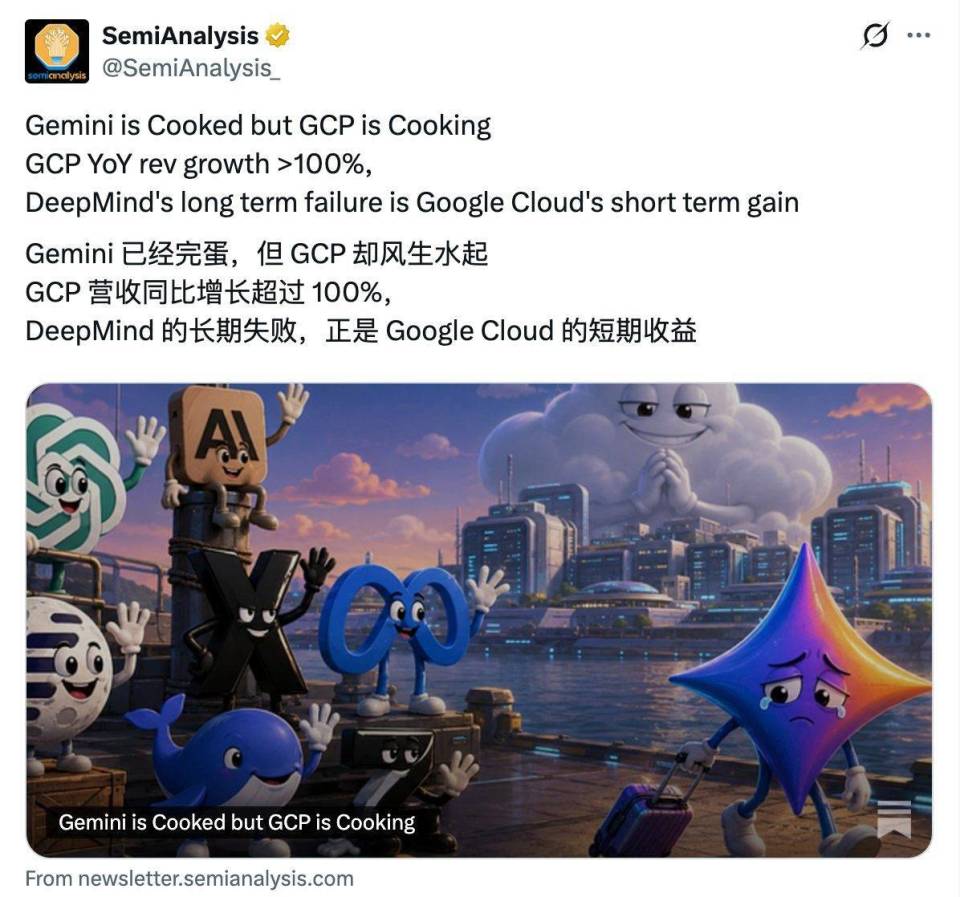
The incident stems from an article published by SemiAnalysis in August this year, which argued that after briefly taking the lead in November of last year, Google had failed to release any exciting models and was almost falling behind.
At the time, they noted that several members of DeepMind's reinforcement learning team had left and internal compute resources were poorly allocated, leading them to make a harsh assessment: at this rate, Google would undoubtedly continue releasing models, but the probability of reaching the industry's highest standard again had "dropped to zero."
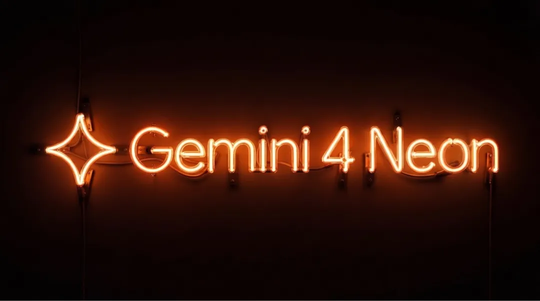
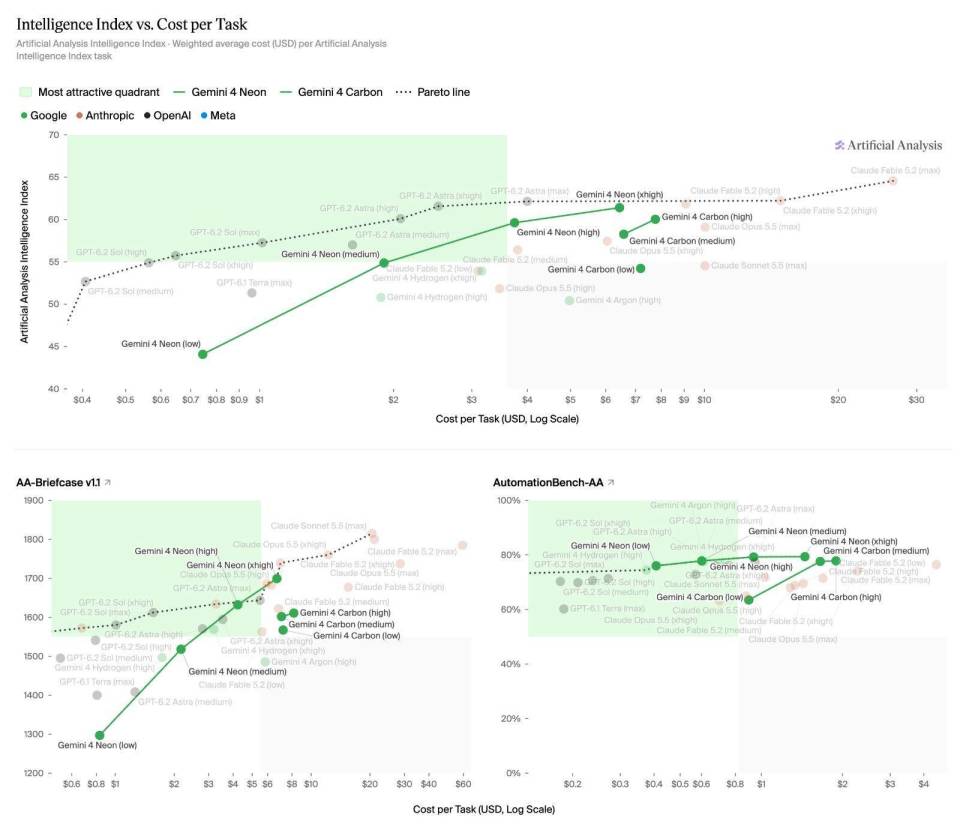
Less than two months after the report was released, Google unveiled Gemini 4 Argon. It then released Carbon at the end of October, followed by Hydrogen on November 12 and Neon on the 18th. Within just eight days, three new models were launched successively. At the time, Carbon even topped the comprehensive ranking by Artificial Analysis.
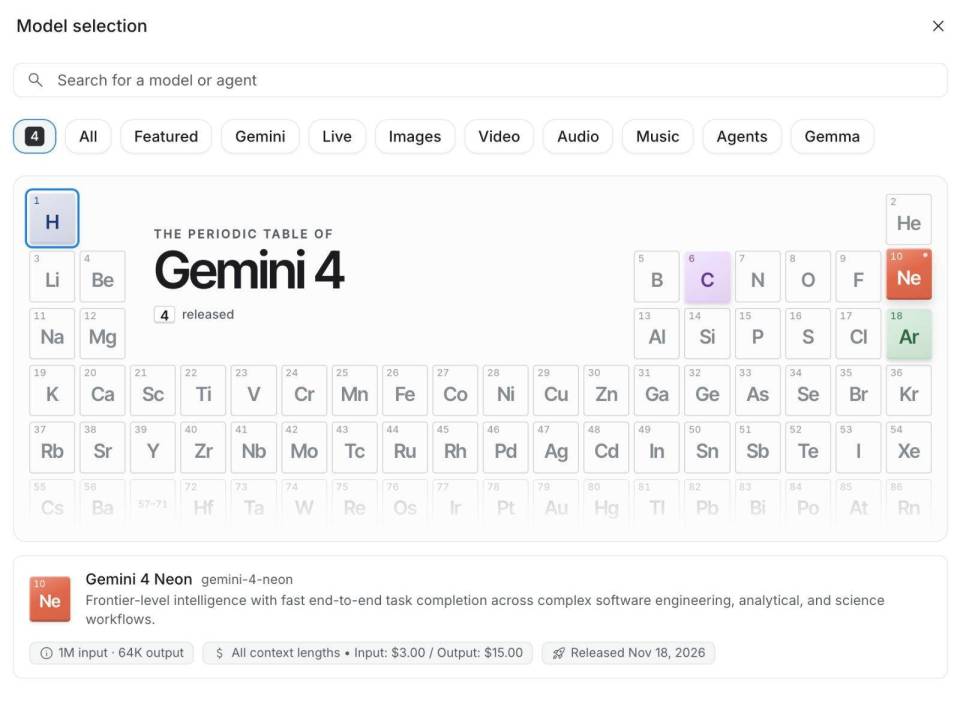
Figure: ai.studio model selection page
These newly released models have received widespread acclaim on social media. Hydrogen, which emphasizes Flash capabilities, quickly completes tasks in writing and complex software work. Meanwhile, the most intelligent model, Carbon, excels at handling various long-horizon Agent tasks. Neon, sitting between the two, balances speed and intelligence, making it arguably the most comprehensively powerful model in the Gemini 4 series.
Comments like "Gemini 4 Neon is absolutely wild," "Gemini 4 Neon is actually crazier than you think," and "Gemini 4 Neon has solved every single complaint people had about previous Gemini models" garnered significant upvotes from users on X.
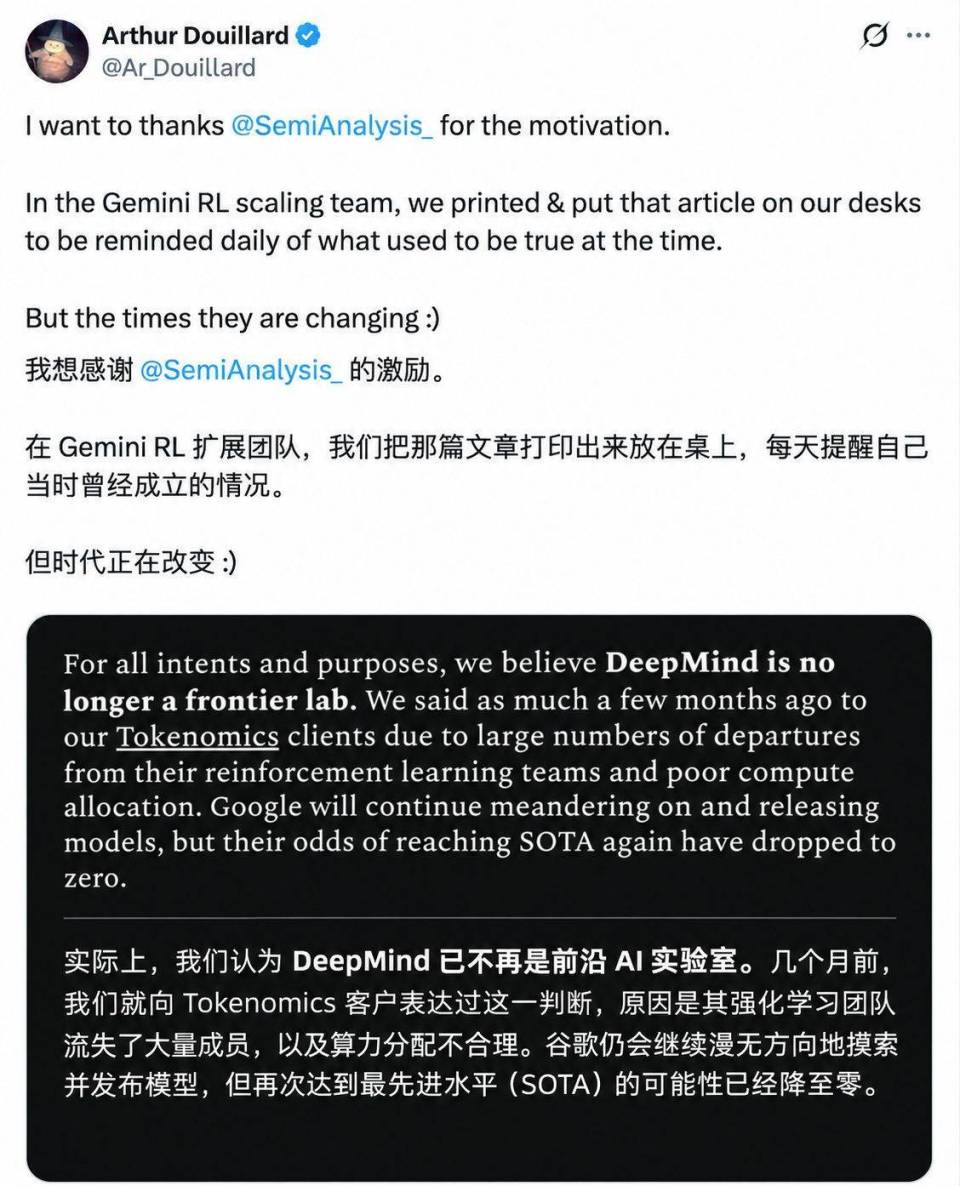
Today, Google DeepMind researcher Arthur Douillard said on X that they once printed out that critical article, placed it on their desk, and used it as a daily reminder. He noted that some issues did indeed exist at the time and expressed his gratitude for the motivation provided by SemiAnalysis's article.
I want to thank @SemiAnalysis_ for the fuel. In the Gemini RL scaling team, we printed that article out, put it on our desks, and reminded ourselves of the reality every day. But times change. :)
Following that, SemiAnalysis reposted Douillard's post and also shared an image of a paper: the very same "apology form" addressed to Google shown at the beginning.
A few hours later, Hassabis reshared the post, playing along by "accepting the apology," and jokingly pointed out that the creators had missed checking the box for "Underestimated the talents at Google DeepMind."
In fact, more than two weeks before the institutional account posted the meme, Dylan Patel, co-author of the August bearish report, had already publicly apologized to Google in his personal capacity following the release of the Gemini 4 Carbon evaluation.
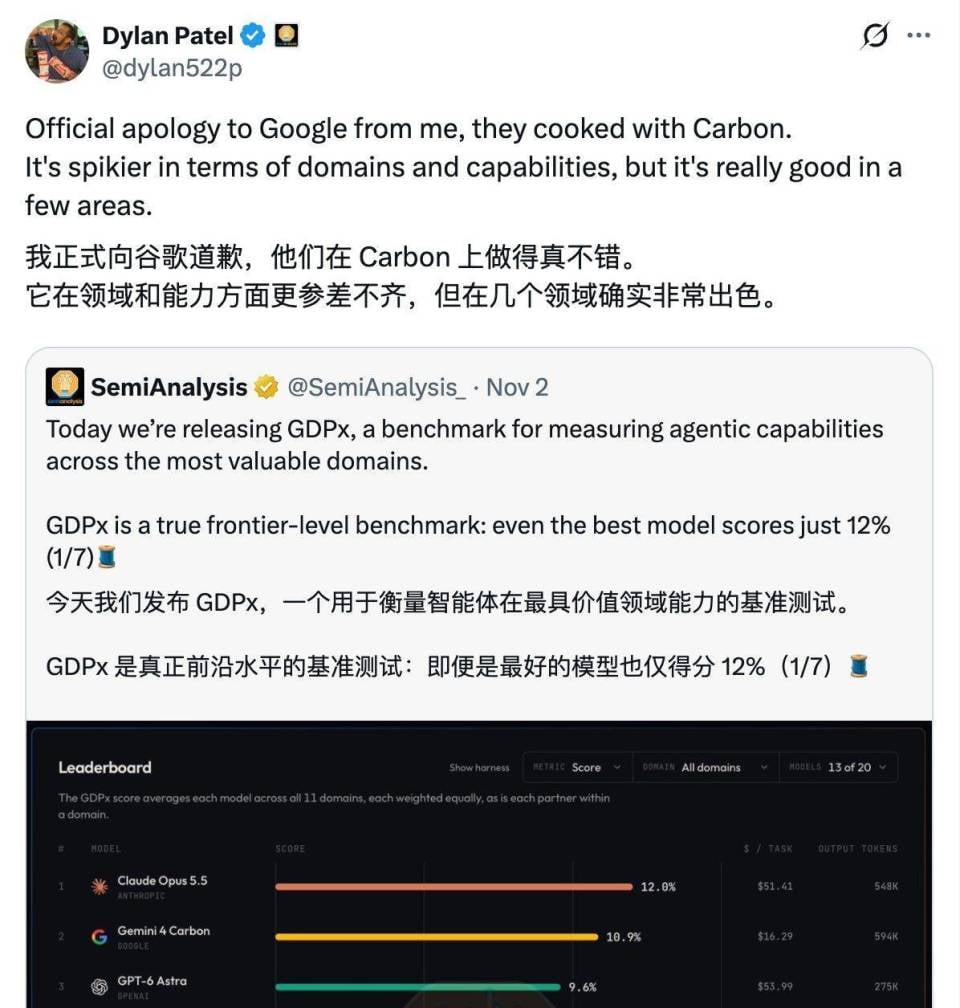
From being publicly criticized by a major authority in early August to launching four Gemini 4 series models consecutively within weeks by mid-November and returning to the top of the rankings, what internal adjustments and groundwork did Google undergo?
If Google Has So Many TPUs, Why Were They Never Enough?
Looking back to this summer, the bearish outlook on Gemini wasn't entirely baseless. On one hand, the Gemini 3.5 Pro, originally scheduled for a June launch, was delayed indefinitely. Google CEO Sundar Pichai had teased at the May I/O conference that Gemini 3.5 Pro would roll out in June, but the model ultimately failed to launch as planned.
Constrained by compute limitations and exacerbated by disagreements among several project leads, areas that later proved crucial, such as coding, received relatively fewer resources at the time. Koray Kavukcuoglu, who subsequently took charge of R&D, explained that the team focused more attention during that phase on iterating faster Flash models.
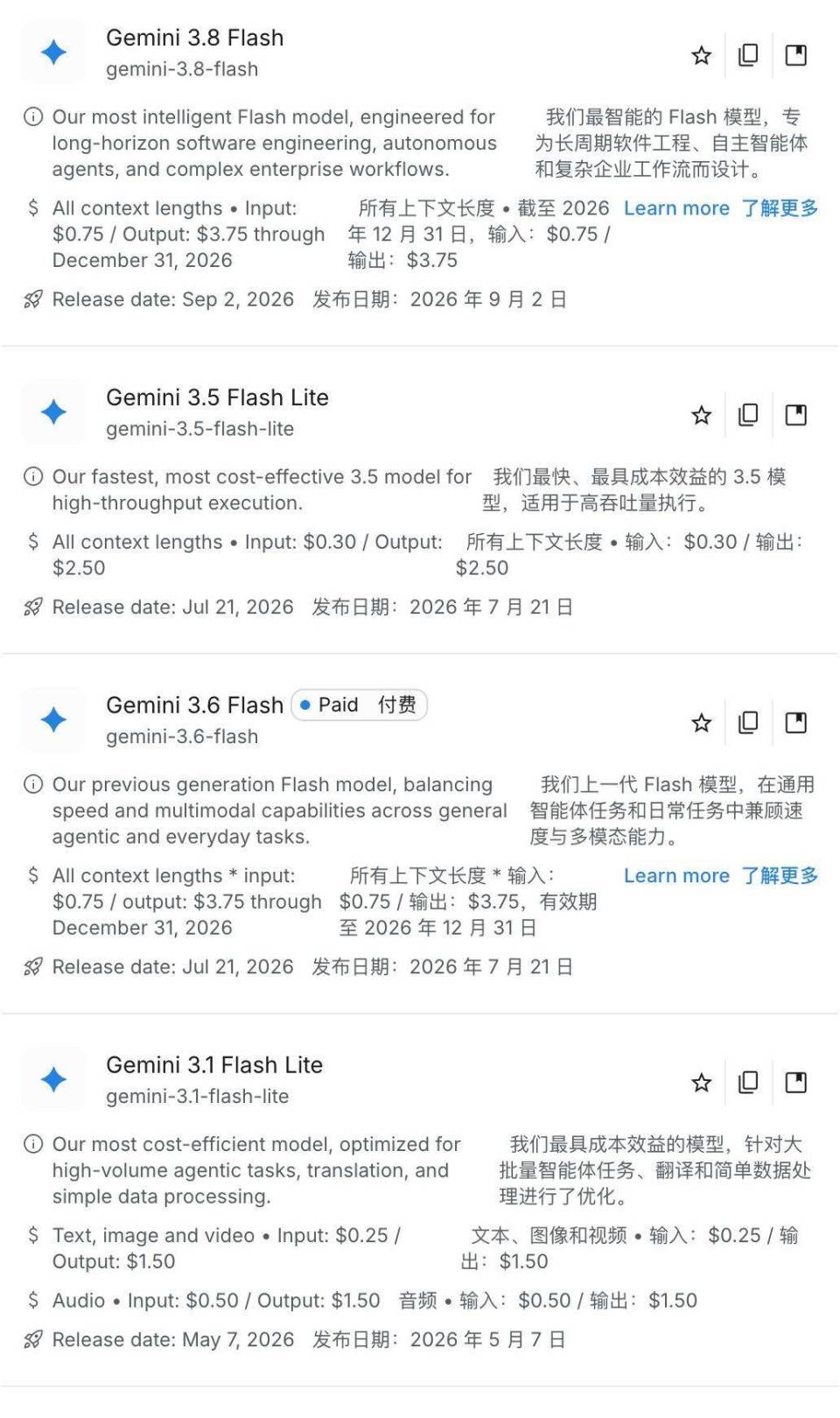
Figure: Google had been consistently releasing Flash models prior to this
Navigating internal resource competition and external skepticism, Google announced a major organizational restructuring at DeepMind on August 5. Former DeepMind CTO and Google's Chief AI Architect Koray Kavukcuoglu assumed the role of Senior Vice President at DeepMind, reporting directly to Pichai and taking full responsibility for Gemini model development, frontier research, and the Gemini apps and developer teams.
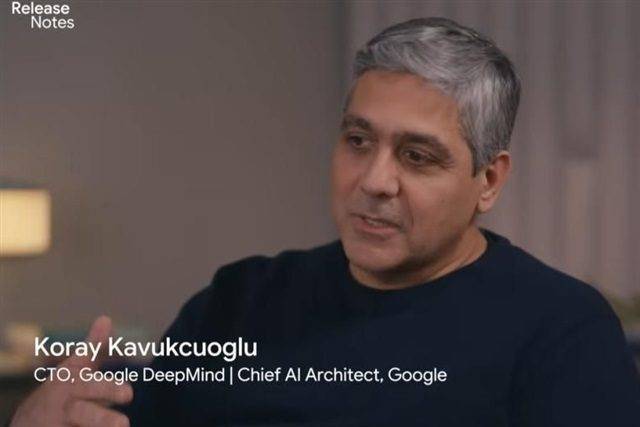
Demis Hassabis stepped back from day-to-day operations to become Chairman of DeepMind and Chief Scientist of Alphabet. Meanwhile, original Gemini technical co-leads Jeff Dean and Oriol Vinyals, along with Sanjay Ghemawat and Quoc Le, departed Google to co-found Discovery Loop.
In many people's perception, Google always had both ample data and GPU cards, so how could it fail to build a leading large model? Yet even with its own AI chips, TPUs, demand was overwhelming: next-generation Gemini training required them, generating real-time answers for current users consumed them, and customers on Google Cloud were also waiting in line.
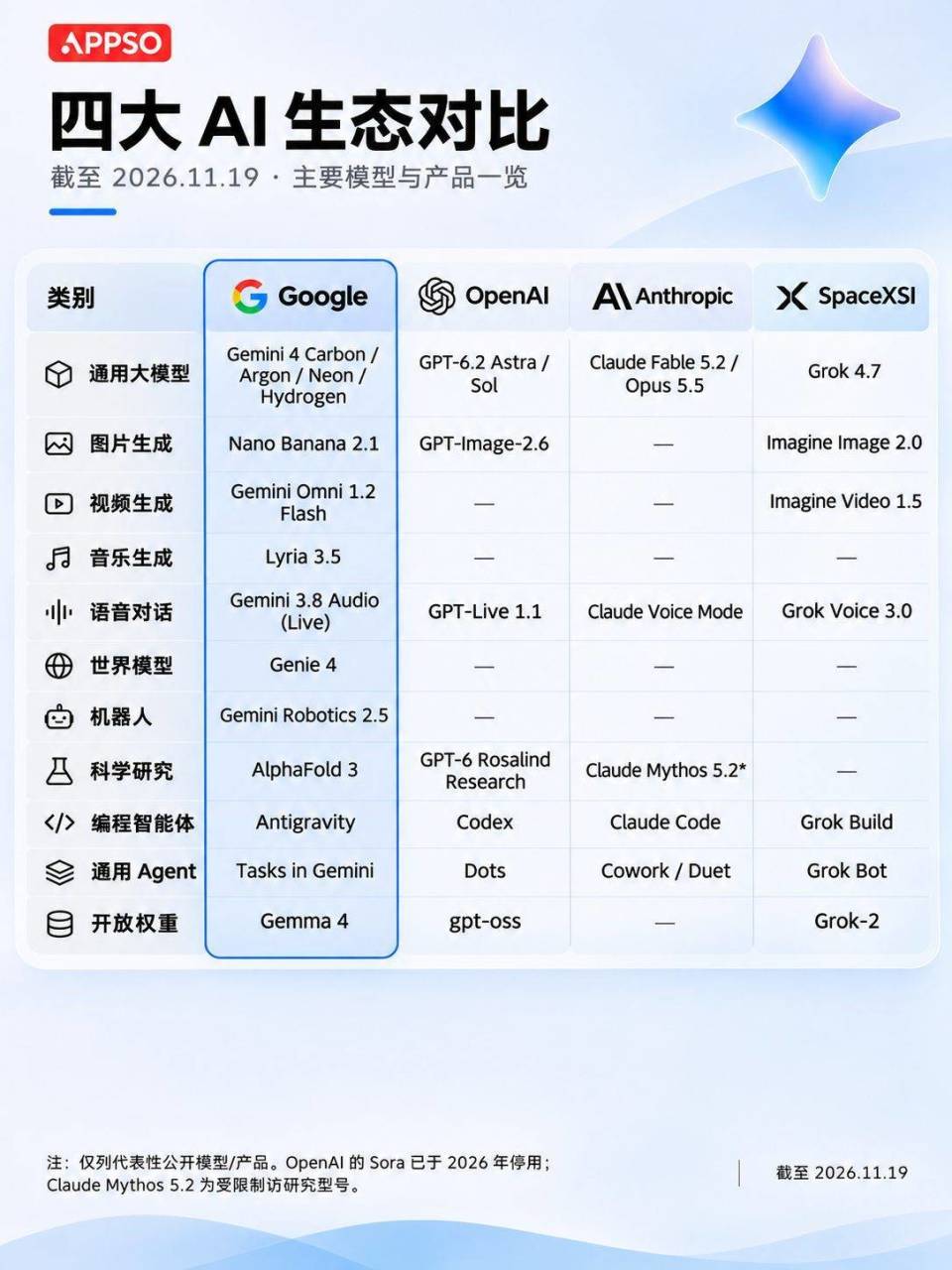
Figure: Google's vast model business portfolio
Selling chips off was great business for the group; for researchers, however, missing their queue meant experiments simply couldn't be run.
This restructuring also helped the entire team clarify what the models needed to be trained on and how finished models should be handed over to users. According to foreign media reports, Google Cloud executives also hoped that with Koray taking over DeepMind, the internal tensions surrounding TPU supply allocation could be alleviated.
How Long Was Gemini 4's Comeback Prepared?
Attributing the explosive release and widespread acclaim of the Gemini 4 models solely to August's personnel adjustments and compute arrangements would obviously underestimate the long-cycle nature of large model R&D.
Public records indicate that long before the August 5 organizational adjustment and the August 7 bearish report, the foundational engineering for Gemini 4 was already underway. During Alphabet's Q2 earnings call on July 22, 2026, Pichai explicitly revealed that Gemini 4 had initiated "the most ambitious pre-training Google has ever undertaken."
Answering analysts' questions, he further stated that management had concentrated massive compute resources and effort on Gemini 4, with the goal of leveraging this foundational model generation to accelerate subsequent iterations and push the release cadence close to one version per month.
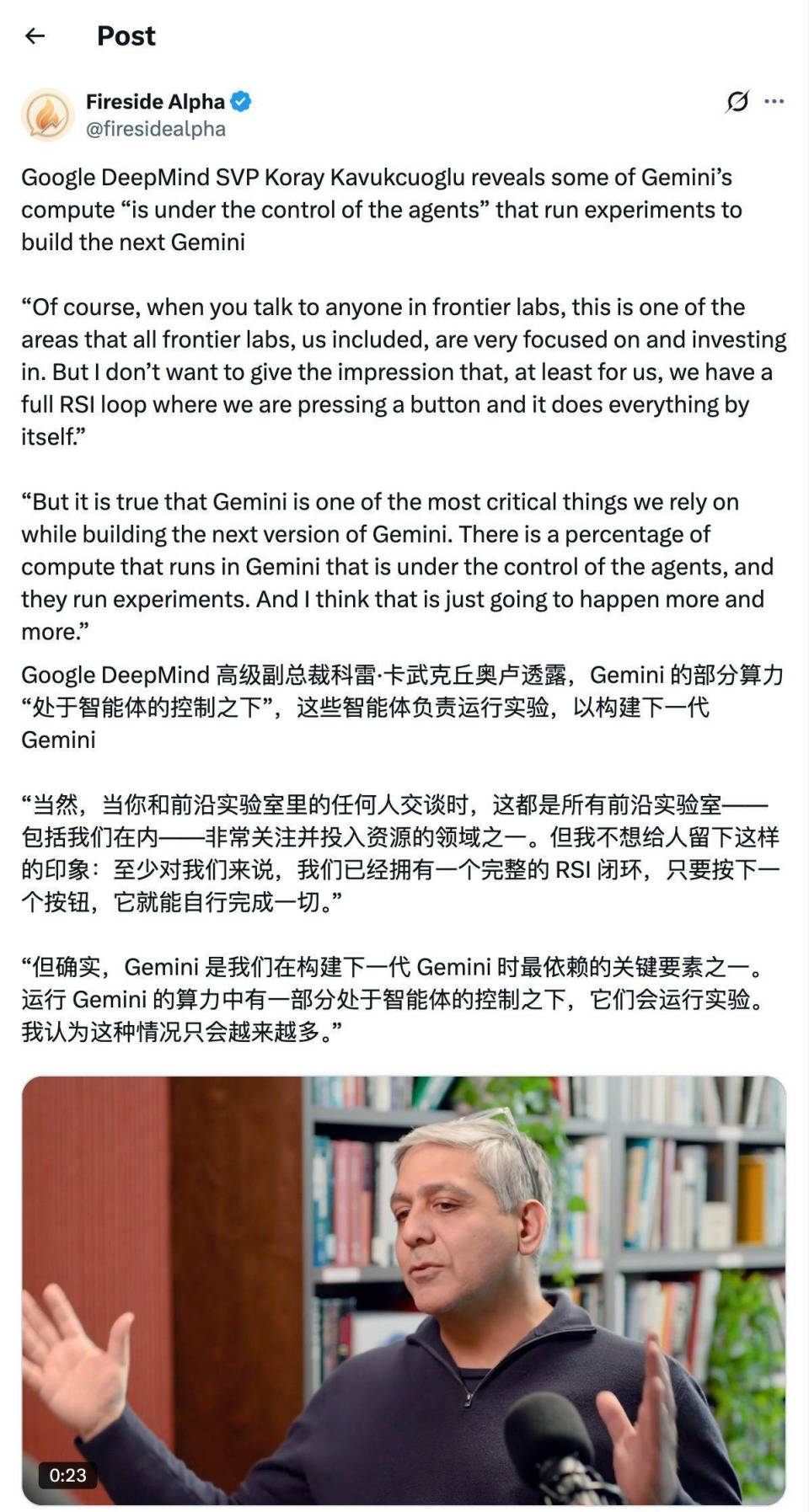
Koray later elaborated on Gemini 4's R&D mechanism in two podcast interviews in early September and November 19. DeepMind implemented parallel R&D tracks where, while one group polished the current release version, two other teams were already simultaneously developing the subsequent two model generations. Therefore, there has been at least a year of continuous R&D lineage behind the Gemini 4 we saw in October.
If large-scale pre-training and multi-track parallelism provided the foundation, what enabled Gemini 4 to achieve breakthroughs in programming and agent execution was a post-training system built around real-world engineering scenarios.
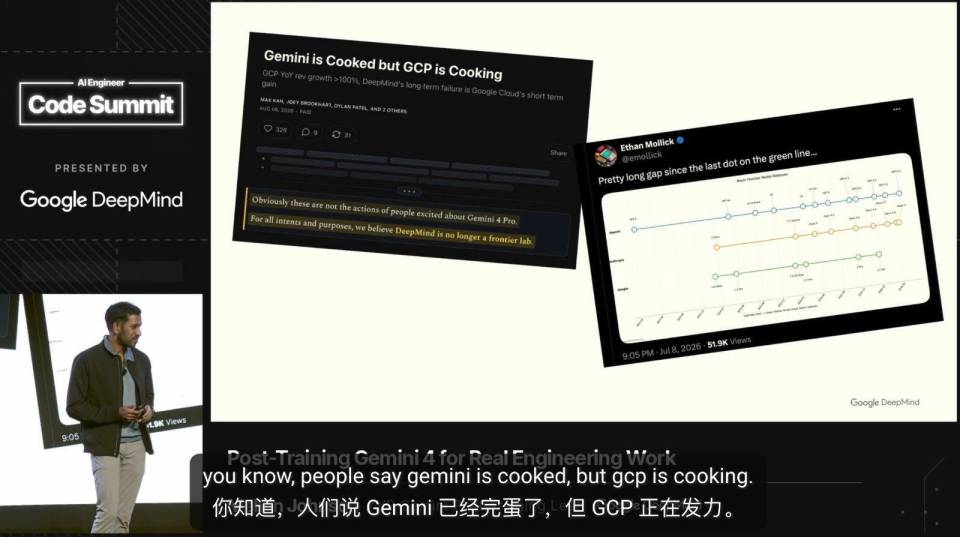
On November 12, 2026, Melvin Johnson, then head of post-training for Gemini, kicked off his presentation at the AI Engineer CODE conference by referencing SemiAnalysis's critical article and detailing Google's internal training methodology.
First, they replaced static public benchmarks with real internal workflows. Johnson revealed that approximately 100,000 Google employees internally use the coding tool Antigravity daily. Whenever the post-training team developed several candidate model versions, they would initiate internal blind tests, allowing engineers to directly test and select the most intuitive version using their actual development tasks.
Whenever the model stalled during cross-file modifications or corrupted existing logic, these real-world "failure scenarios" would be immediately captured and converted into datasets and scoring rubrics for the next training round.
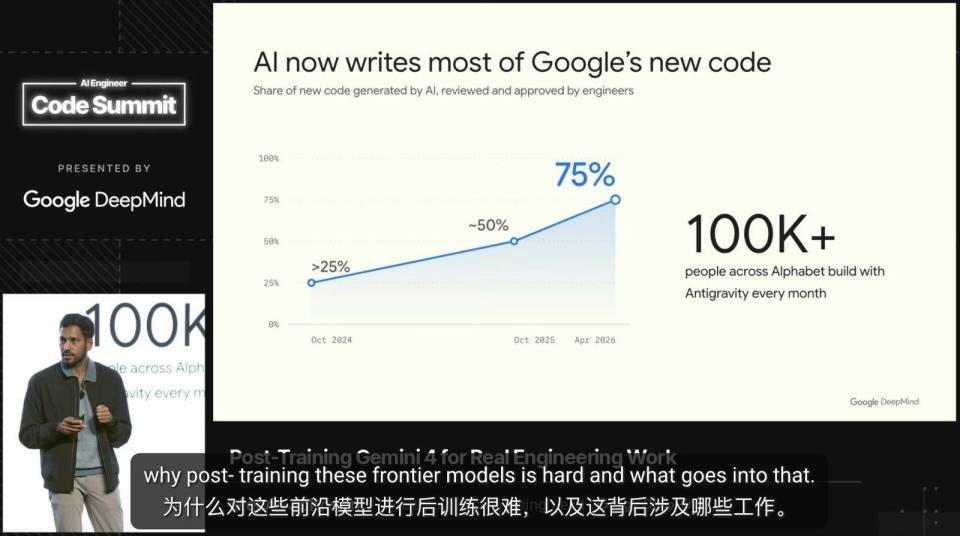
Meanwhile, the team would decisively retire "outdated problems." In reinforcement learning, once a model evolves to the point where it can consistently score perfectly on a specific problem after repeated attempts, the reward signal from each sampling becomes identical. The model can no longer distinguish "which approach is better," so such problems must be removed and replaced with higher-difficulty challenges.
Secondly, they redefined what "completion" means, with a strong focus on agent honesty.
In traditional code evaluation, passing unit tests earned points; however, in Gemini 4's post-training scoring rubric, the team evaluated not only functional implementation but also boundary condition handling, code quality, restraint in modification scope, and long-term maintainability.
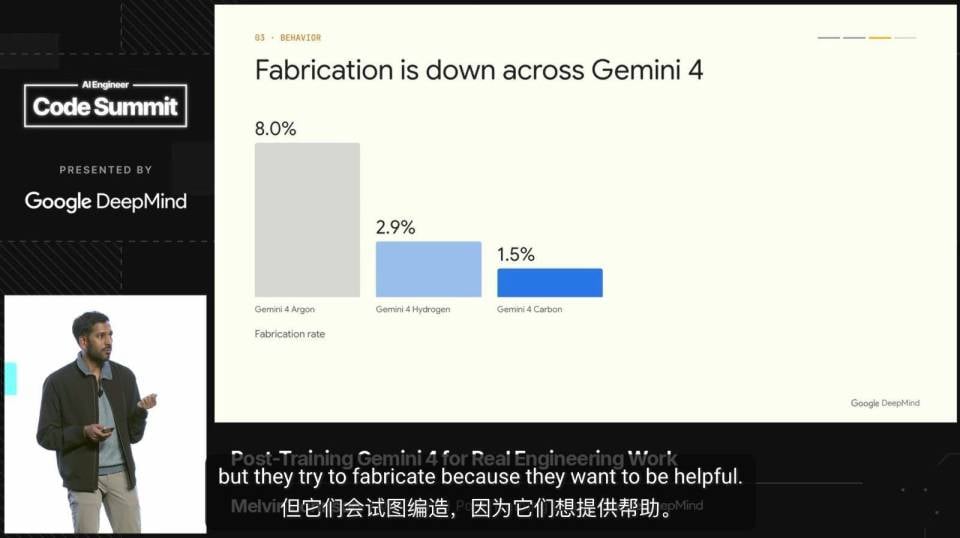
More importantly, the scoring system cross-referenced the model's "self-reporting" against its actual operation logs. If a difficult problem was only halfway completed, the model could still earn partial rewards by honestly reporting its progress. However, claiming "all passed" without running tests would trigger severe penalties.
Johnson also noted that in a previous high-difficulty internal engineering evaluation, the hallucination rate for the baseline model was 8%, Hydrogen was approximately 3%, and Carbon was around 1.5%.
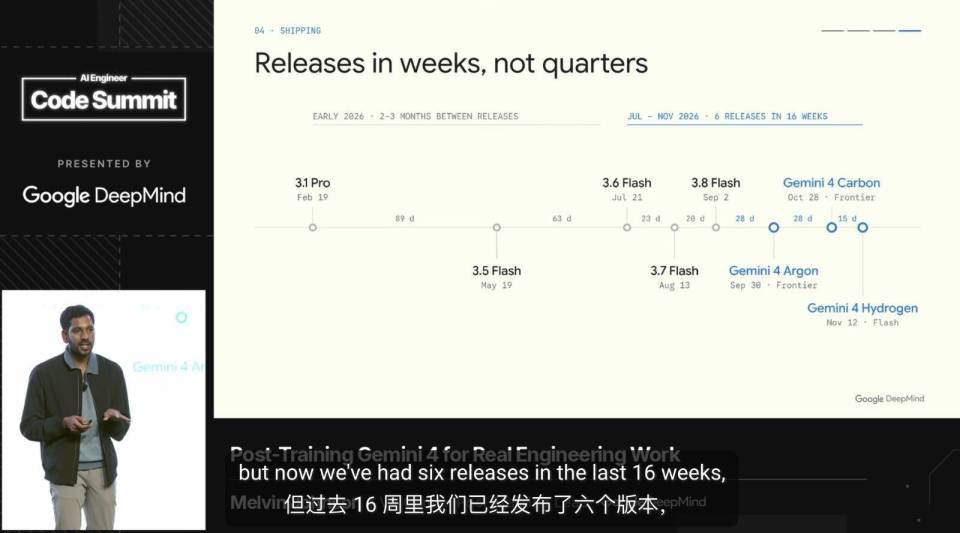
Driven by a solid foundation and intense post-training efforts, Google continuously unveiled four Gemini 4 series models within a mere seven weeks from late September to mid-November.
Both Hydrogen and Neon were adapted from Carbon. Carbon targets complex problems requiring long-form reasoning, Hydrogen prioritizes execution speed for everyday tasks, and Neon strikes a balance between reasoning depth and efficiency.
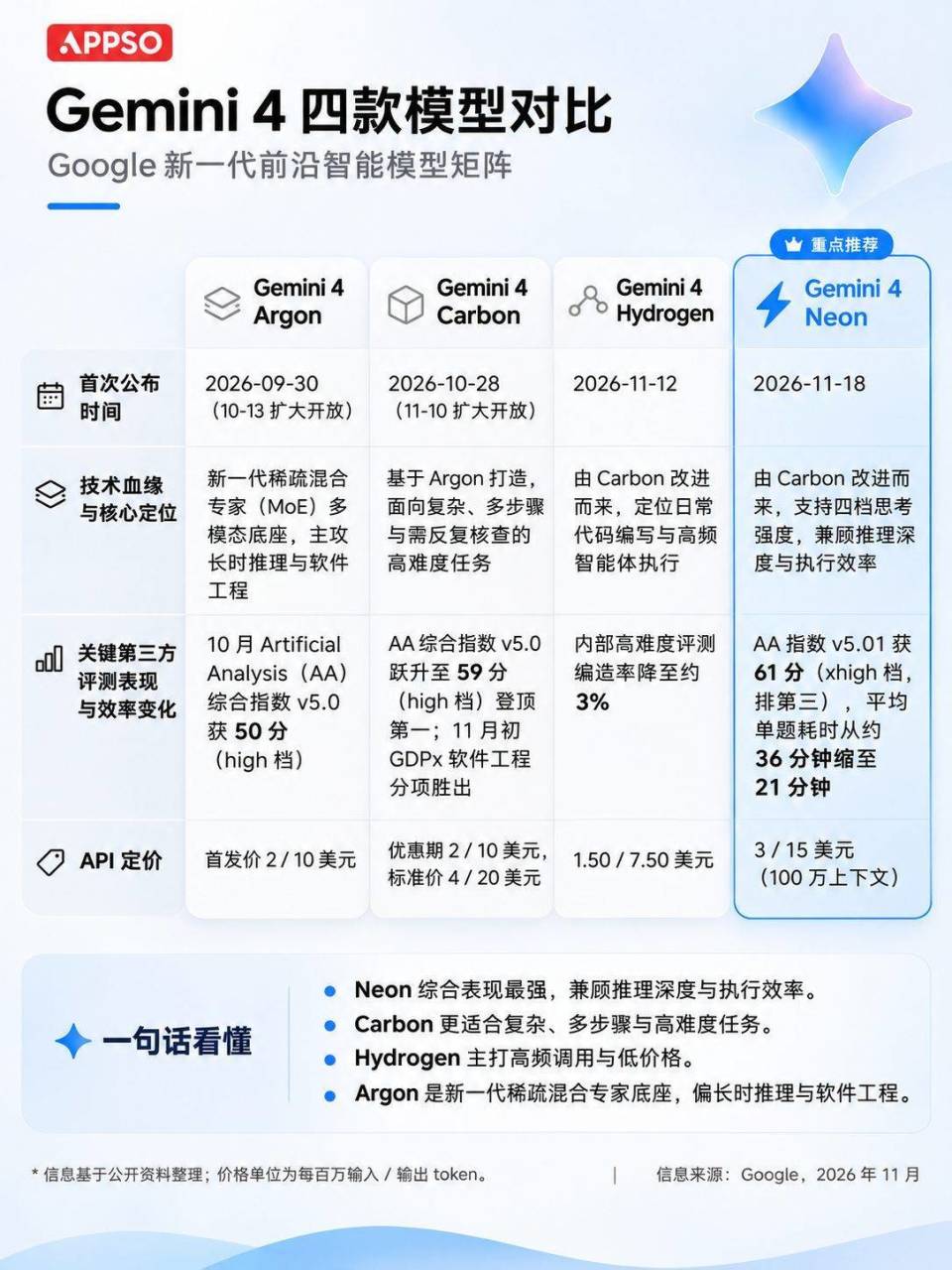
Figure: Some of the rapid updates we witnessed in November were the successive deployment of R&D outcomes from the same foundational generation
In hindsight, many of the issues identified by SemiAnalysis at the time did exist, and DeepMind researchers never denied them. The results three months later simply proved that the outside world still underestimated Google's decades of accumulated R&D capabilities and the speed at which it could concentrate those capabilities into a single model generation.
Gemini 4 now stands again as a competitor that other models must seriously address. Google has not only pushed coding and Agent capabilities back into the first tier but is also catching up to agents like Codex and Claude in genuine user usage and product experience.
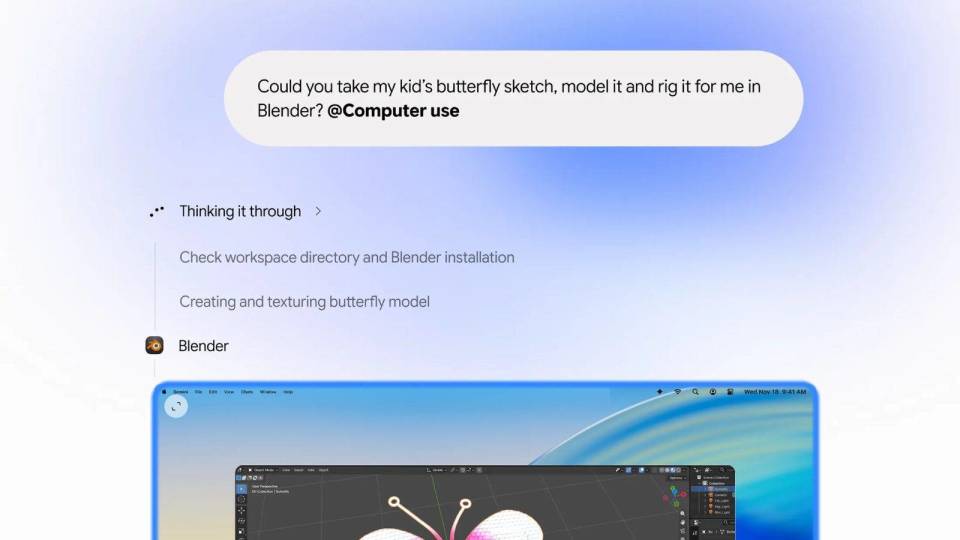
Figure: Gemini can now operate Mac applications and websites in the background to complete complex tasks
For us, this is undoubtedly good news. The fiercer the rivalry among the big three, the more willing manufacturers are to invest compute resources and compete for users, giving us the opportunity to access cheaper, more reliable, and easier-to-use AI (Hajimi, please don't follow the example of the other two).
Join TechFlow official community to stay tuned
Telegram:https://t.me/TechFlowDaily
X (Twitter):https://x.com/TechFlowPost
X (Twitter) EN:https://x.com/BlockFlow_News
 @ifanr