Behind the 1.8 Trillion Market Cap Surge, Anthropic Owes Compute Landlords 900 Billion
Author: Curry, TechFlow
TechFlow Summary:
On its first day of trading, Anthropic’s ($ANT) market capitalization surpassed $1.8 trillion, setting a new record for the largest tech IPO globally and marking what many view as a peak moment for the AI industry. However, upon opening its prospectus spanning over four hundred pages, one can see that behind this milestone lies a closed-loop strategy orchestrated by the entire technology supply chain.
While securing a total fundraising amount of $107.3 billion, Anthropic signed rigid compute procurement commitments worth up to $900.9 billion, with over $200 billion directly locked into major shareholders Amazon and Google. This means that cloud giants and chipmakers inject funds via equity stakes, only to instantly capture guaranteed profits through irreversible cloud bills and channel commissions, while the heavy burdens of hardware depreciation, idle compute capacity, and underwhelming commercialization are entirely pushed onto Anthropic, which has just entered the secondary market.
The US stock market witnessed a historically significant scene.
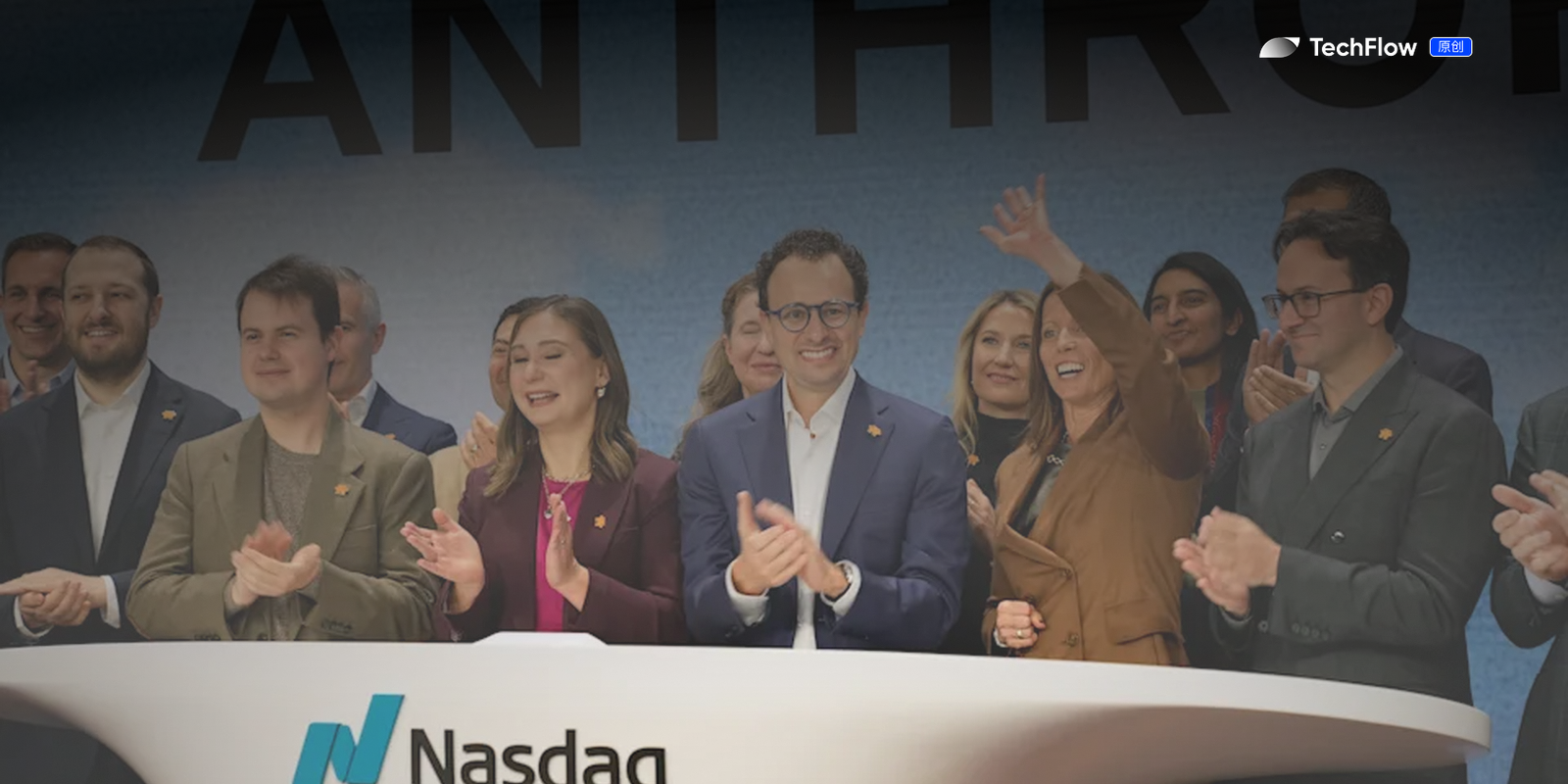
Anthropic, trading under the ticker ANT, saw its shares surge on its first day of listing on NASDAQ, with its intraday market capitalization briefly crossing the $1.8 trillion threshold, directly matching Broadcom and TSMC to become a super heavyweight second only to a handful of trillion-dollar tech giants. Five years ago, a group of idealistic scientists who left OpenAI single-handedly orchestrated the largest initial public offering in global capital markets.
If looking solely at the fundraising figures reported in the public press, this appears to be nearly a flawless victory.
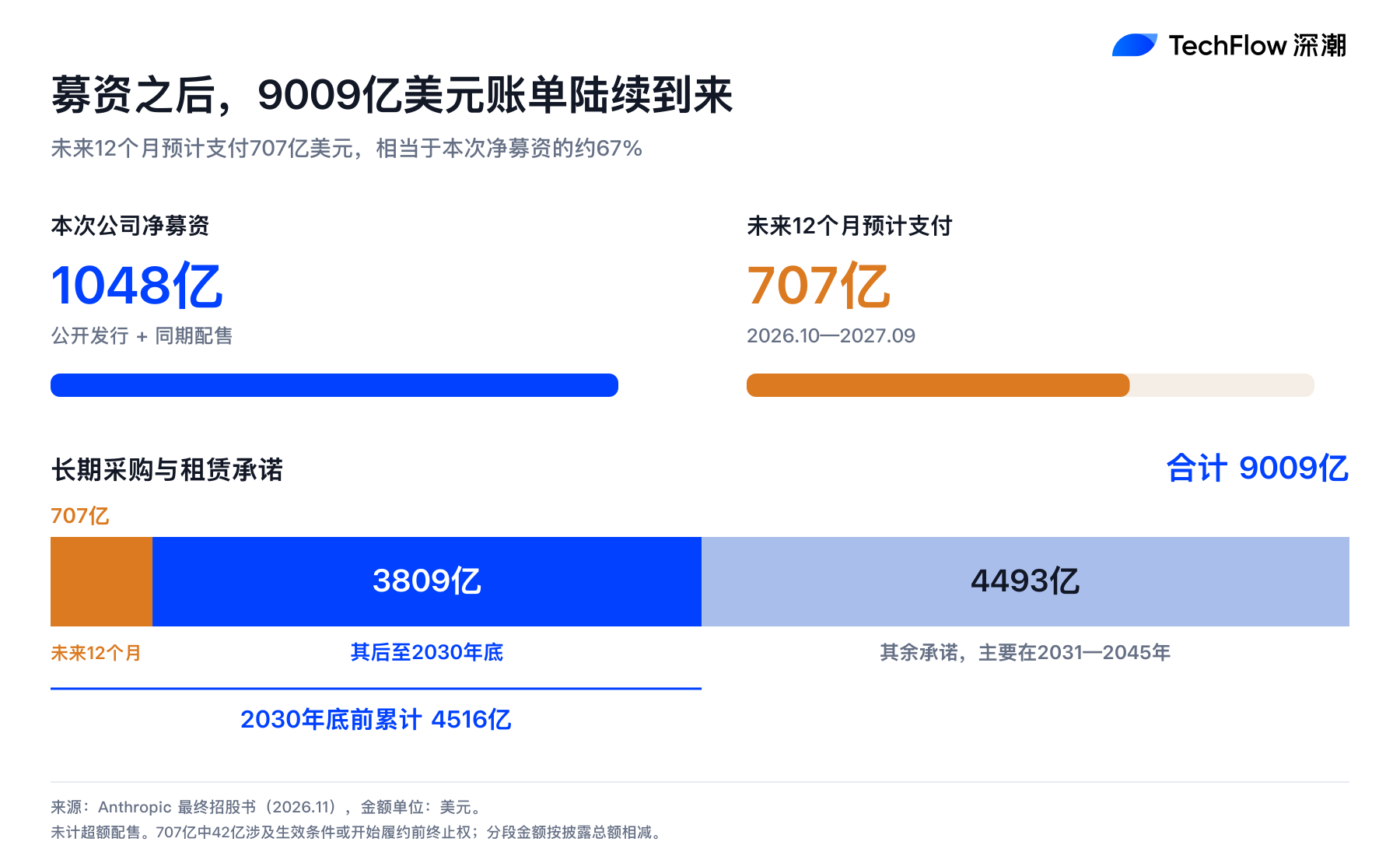
Anthropic raised $81.3 billion through the public offering and simultaneously completed a directed private placement of up to $26 billion, bringing the total financing per deal to over $107.3 billion.
But as everyone raises a glass to this AI wealth-creation myth, very few pause to look through the hundreds-of-pages-long S-1 prospectus. In those densely packed schedules of equity holdings and contracts lies the most ruthless underlying reality of this boom: the shareholders lifting you up, the suppliers selling you tools, and the channel partners taking your commissions are all the exact same people.
Shareholders Lifting Your Carriage Are Also Landlords Collecting Rent
In the history of Silicon Valley tech, it is almost impossible to find another company whose shareholder register overlaps with its suppliers and channel partners to such an extent.
In the list of subscribers for that $26 billion directed placement, the buyers constitute a complete portrait of the global compute industry: Nvidia contributed $10 billion, Google handed over $10 billion, and the remaining $6 billion was neatly split among Microsoft, Broadcom, AMD, TSMC, and Micron. Adding up the pre-IPO old shares, Amazon and Google together firmly hold a combined 28.4% stake in Anthropic.
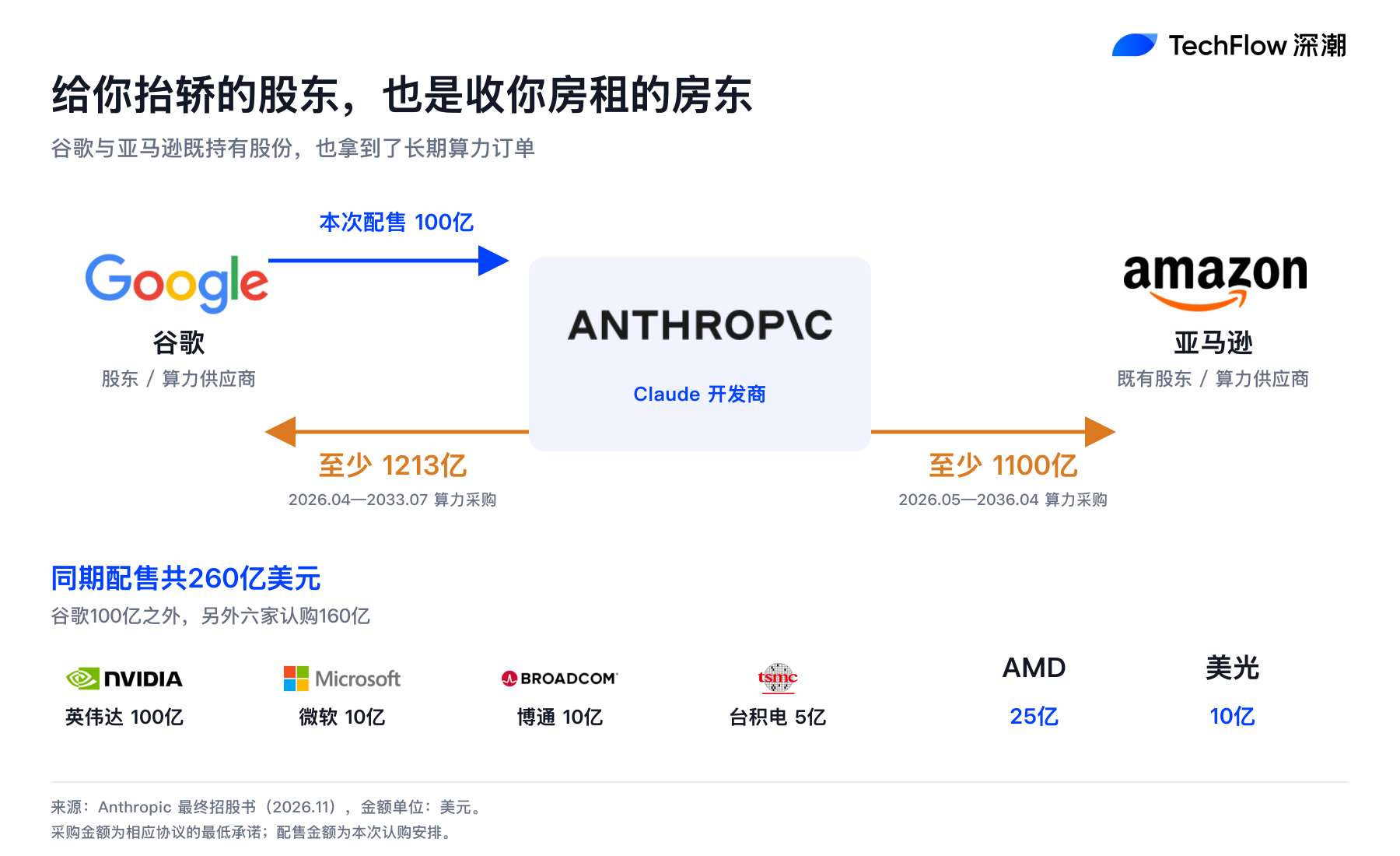
Beneath the surface appearance of giants injecting real cash to boost valuations does not flow a simple financial investment logic, but rather a meticulously designed industrial capital recirculation mechanism.
These chip hegemons and cloud behemoths package their capital as equity and flood it into Anthropic’s accounts. To the capital markets, this represents endorsement by top-tier industrial capital; but within the giants' own financial models, this money merely takes a quick trip outside before swiftly returning to their balance sheets in greater multiples and with more predictable cash flows.
Because the moment they secured these funds, Anthropic personally signed a colossal IOU.
Upstream Take-or-Pay, Downstream Flexible Exit
The most staggering figure disclosed in the prospectus is the $900.9 billion in long-term procurement and leasing commitments.
This massive expenditure, almost entirely tied to compute power and data center infrastructure, spans nearly two decades into the future. Of this, $451.6 billion must be fulfilled by the end of 2030; and within the next 12 months leading up to September 2027, Anthropic faces rigid cash outlays totaling $70.7 billion.
The truly critical issue lies in the unforgiving nature of the contractual terms.
Among these astronomical procurement volumes, baseline contracts alone allocate over $110 billion to Amazon and $121.3 billion to Google. The vast majority of these agreements fall under the industry-standard Take-or-Pay provisions.
The meaning of Take-or-Pay is straightforward: regardless of how much inference costs for large models drop in the future, regardless of whether frontier research hits a compute ceiling, and even if tens of thousands of rented GPU racks run idle for months, this sky-high rental fee must still be paid in full to the cloud giants on a quarterly basis.
In stark contrast to this rigidly locked-down "death pact" with upstream suppliers lies Anthropic’s highly fragile downstream commercial defense line.
Financial data shows that approximately 48% of Anthropic’s software sales rely heavily on the cloud marketplace distribution channels of AWS and Google Cloud. For every enterprise customer bill generated through cloud-based API calls to Claude, the two cloud giants extract a toll fee, and moreover, the vast majority of downstream enterprise customers sign short-term, flexible agreements that can be adjusted or canceled on demand.
Upstream sits non-revocable, rigid ground rents in the hundreds of billions, while downstream features compute budgets that customers can slash at a moment's notice. Anthropic is ruthlessly squeezed in the middle of this asymmetrical risk scale.
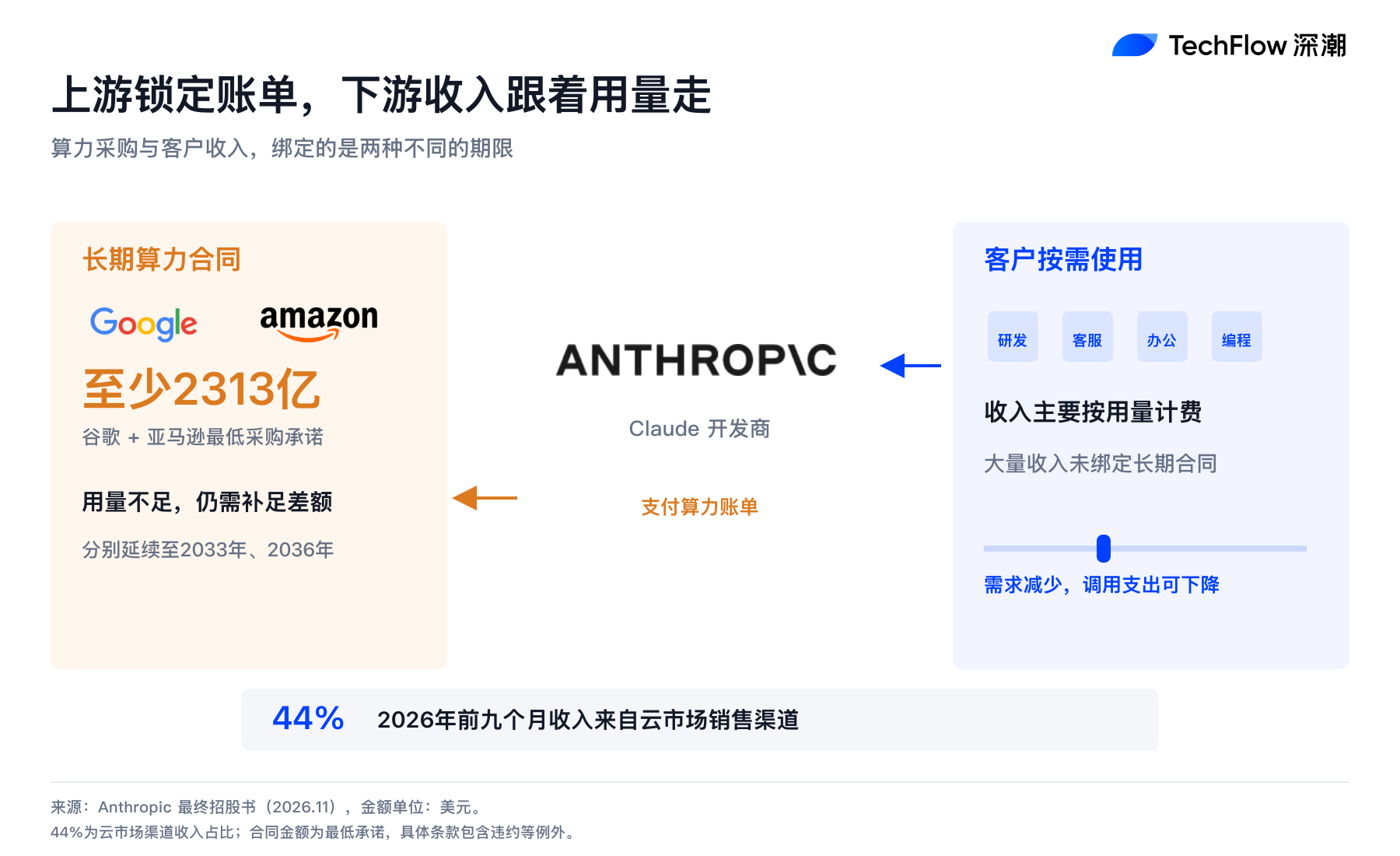
When straightening out the interest chain of the entire industry, the profit distribution across this compute frenzy becomes completely clear.
Cloud giants use a small amount of equity capital as leverage to unlock hundreds of billions in guaranteed cloud service orders that Anthropic must fulfill in the coming years. These orders are securely recorded as high-margin Remaining Performance Obligations (RPO) in the giants’ financial reports, directly fueling the stock price expansion of the tech titans themselves.
Subsequently, armed with these certain future compute demands, the cloud giants place massive upstream orders for Nvidia accelerators, Broadcom custom networking chips, TSMC advanced process nodes, and Micron memory chips. The semiconductor giants involved in the placement simultaneously secure top-tier chip shipment quotas.
In this closed loop, only Anthropic bears the ultimate cost.
The hardware industry operates on an irreversible natural law: chips depreciate rapidly every day, and process technologies update a generation roughly every eighteen months to two years. Customers who purchase or lease hardware long-term must run ultra-high-load real-world operations just to outpace depreciation.
Now, the giants have offloaded the hottest potato—the depreciation poison pill—onto this star tenant. The risk of machine idleness and value depreciation belongs to Anthropic, the risk of losing model competition belongs to Anthropic, while the upstream giants reaping windfall profits have already fully banked several years’ worth of software revenue sharing, data center rent, and hardware margins.
The Tamed Behemoth and the Countdown Hanging Over Its Head
Beneath the glow of a 17% first-day gain and a trillion-dollar market valuation, Anthropic appears to be an artificial general intelligence hegemon that has already won the future.
But as the spotlights fade, this backstopped unicorn must immediately confront a countdown list measured in days. With rigid payments of $70 billion due within a year, it must open its eyes each morning to pay nearly $200 million in compute rent to its shareholders and landlords alike.
The giants successfully executed a textbook-level risk transfer: using a grandiose IPO, they effectively offloaded the massive capital expenditures and depreciation risks that once weighed on their own balance sheets onto retail investors and mutual funds in the public market.
Incumbent firms took the guaranteed cash and orders, leaving Anthropic with a gamble that requires true profits growing several times over to plug a $900 billion compute deficit.
Join TechFlow official community to stay tuned
Telegram:https://t.me/TechFlowDaily
X (Twitter):https://x.com/TechFlowPost
X (Twitter) EN:https://x.com/BlockFlow_News
 深潮TechFlow