“North American Soybean Pack” Google Finally Returns to the Center of the AI Table
Author: Wildcard, GeekPark
This time, Google has truly returned.
On November 18, Google DeepMind lit up the neon sign for Gemini 4 Neon.
This marks the fourth elemental model in the Gemini 4 series released within a mere seven weeks. If you glance at the official long list of benchmark scores and community real-world test feedback, you’ll find it precisely lands on an extremely comfortable “sweet spot,” possessing hardcore intelligence that approaches or even locally surpasses flagship models, while slashing the cost per task to roughly half of its competitors’.
In Reddit’s tech communities, notoriously picky developers have given it rare, one-sided praise, exclaiming it’s “ridiculously affordable and terrifyingly powerful.” Regular subscribers paying $19.99 a month for Google AI Pro are equally thrilled; without needing to bite the bullet for the Ultra tier, they can directly access a quasi-flagship-level model in the Gemini app. Combined with the dense rollout of models and tools throughout November, Google AI—which had once lingered on the periphery of the playing field—has finally clawed its way back to the center of the table.
The only thing left completely bewildering programmers worldwide is Google’s mysterious naming convention. Spanning from late September’s Argon, late October’s Carbon, to mid-November’s Hydrogen and today’s Neon, they follow no logical order of atomic numbers, alphabetical sequences, or capability tiers.
Serious netizens on Hacker News even cataloged every chemical property to hunt for a pattern, ultimately complaining in despair that Google must be pulling element names out of a hat—arguably less clear than using Starbucks cup sizes; meanwhile, Chinese netizens are already demanding the next update featuring element 118, Oganesson, jokingly lamenting that keeping up with tech news now requires relearning middle school chemistry.
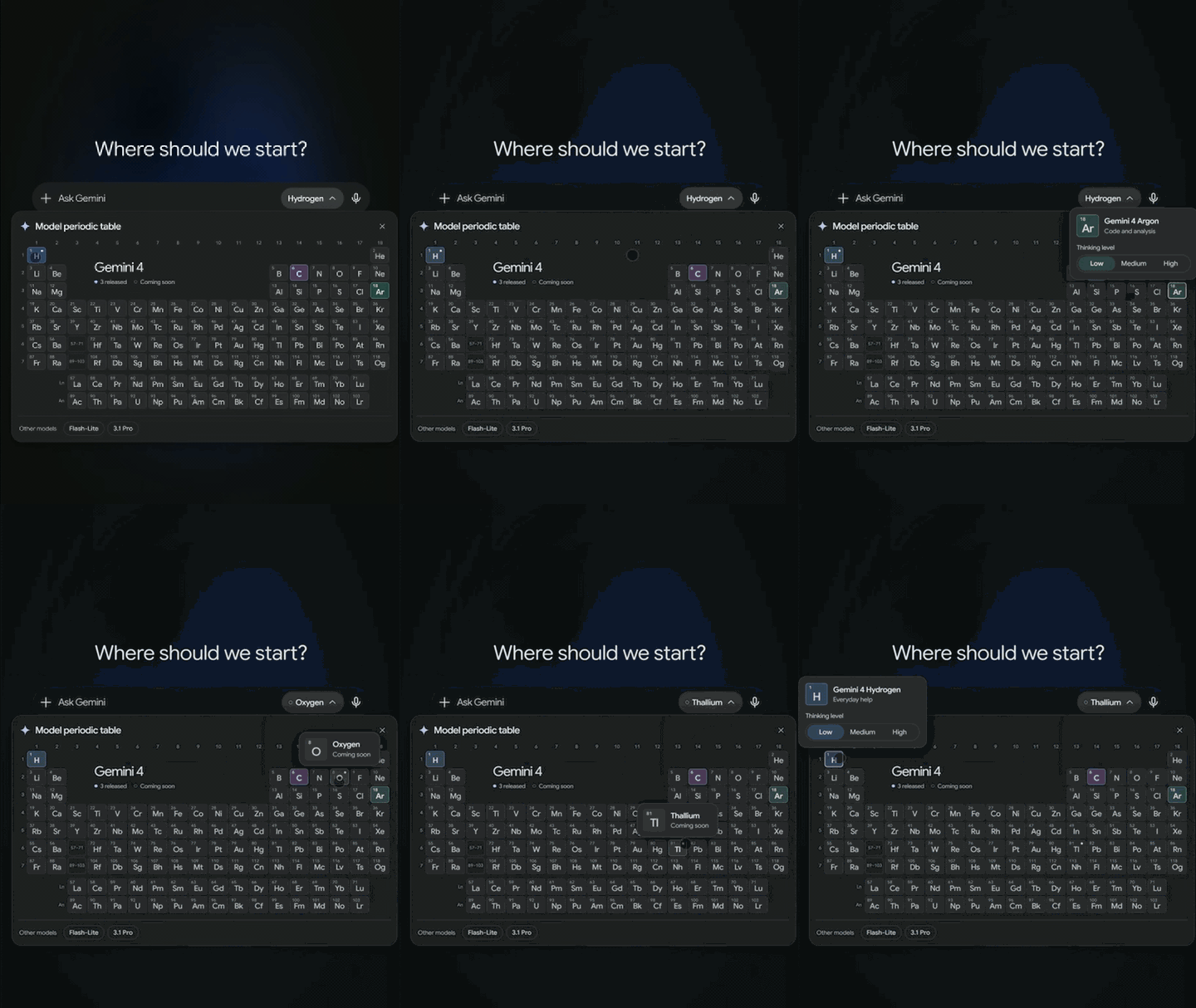
Figure: Model selection interface designed by netizens for Gemini 4 based on a "periodic table"
The “Masterpiece” of Alchemy
Though the name remains confusing, Neon’s strategic placement within the product matrix is incredibly sharp.
It slots precisely between the heavy, long-horizon flagship Carbon and the lightweight, high-frequency execution model Hydrogen, directly replacing the ecosystem niche previously occupied by Gemini 3.1 Pro and Argon. Demis Hassabis, Chief Scientist at Alphabet and Chairman of DeepMind, lauded it highly, calling it a “masterpiece of alchemy.”
What backs this praise are undeniable hard metrics. Neon features a 1-million-token context window (supporting up to 512K context within Antigravity) and a maximum output cap of 1 million tokens, natively supporting multimodal inputs including text, audio, video, PDFs, and spreadsheets. For core reasoning, it provides four adjustable levels of chain-of-thought depth—low, medium, high (default), and xhigh—granting developers significant flexibility to manage costs.
Independent evaluation firm Artificial Analysis provides the clearest evidence. On the AA Intelligence Index v5.0.1 leaderboard, Neon scored 61 points at the xhigh setting, ranking third globally behind GPT-6.2 Astra and Claude Fable 5.2, comfortably outperforming its own flagship Carbon at high (60 points), Anthropic’s Claude Opus 5.5 (59 points), and OpenAI’s GPT-6.2 Sol (57 points). Even on the default high setting, it scores 60 points, while the medium setting achieves 55 points, still edging out the lightweight Hydrogen model’s maximum xhigh tier (54 points).
What truly captures enterprise interest is the scatter plot correlating benchmark scores with cost per task. Neon delivers flagship-grade intelligence while producing a mid-tier volume-model invoice.
It outputs at approximately 110 tokens per second, nearly double Carbon’s (~57 tokens/s); the average time to complete a single AA benchmark task shrank from Carbon’s 36 minutes to 21.5 minutes, fixing the cost per task at $6.44—roughly 17% lower than Carbon’s post-discount standard price of $7.76. On Antigravity’s default high tier, the cost per task drops another 32% compared to Carbon.
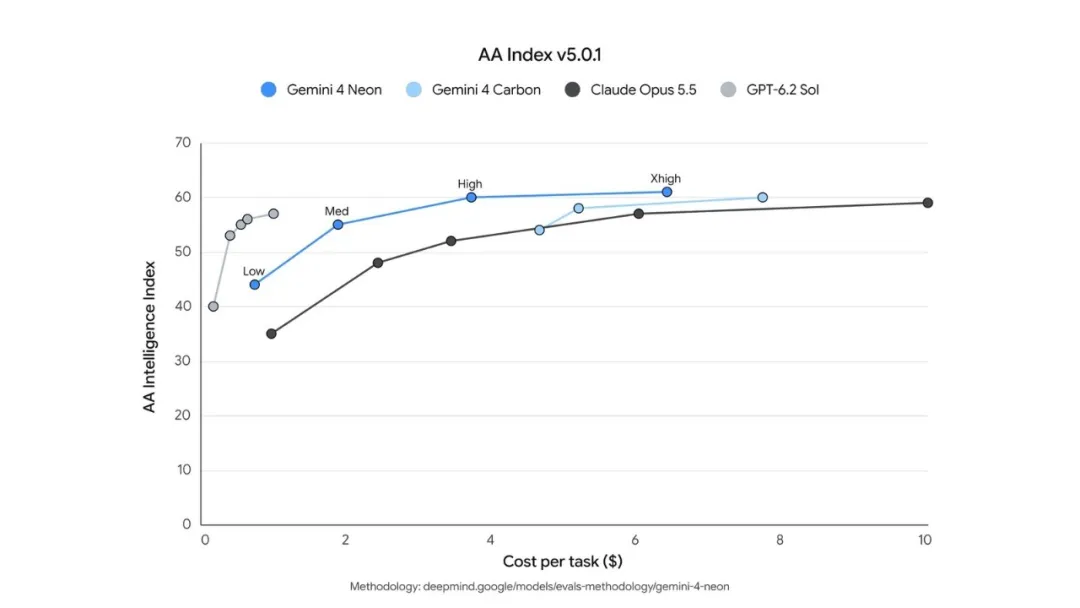
Figure: Comparison of Gemini 4 Neon's performance tiers vs. competitors' intelligence scores and cost per task under the AA Index
Focus shifts to the hyper-competitive coding and enterprise sectors, where this value proposition hits even harder. On the AA Coding Agent Index, Neon secures first place with 58.6 points, matching the raw capability of Claude Fable 5.2 and Opus 5.5 (both scoring 58) enhanced by Claude Code. However, the economic calculus shows Neon averaging just $6.86 per task on the Antigravity CLI—roughly half the cost of Claude Opus 5.5 ($12.61) and Fable 5.2 ($15.47).
In granular tests measuring real-world engineering capability, Neon scored 65.4% on CursorBench 4.1, beating Opus 5.5’s 58.1%; in Antigravity’s SWE-sweep, it reached 39.0%, vastly surpassing Opus 5.5’s 10.1% and GPT-6.2 Sol’s 8.3%. Furthermore, it swept the top positions in simulations for enterprise automation (Zapier AutomationBench: 56.3%), long-term commercial operations (Vending-Bench 2: $16,843), scientific reasoning (RiemannBench: 84.0%), and output fidelity in AA-Briefcase (1771 Elo). Its cybersecurity-specialized variant, released for defenders of the Fairwind initiative, also racked up an impressive 90.5% on SEC-bench Pro.
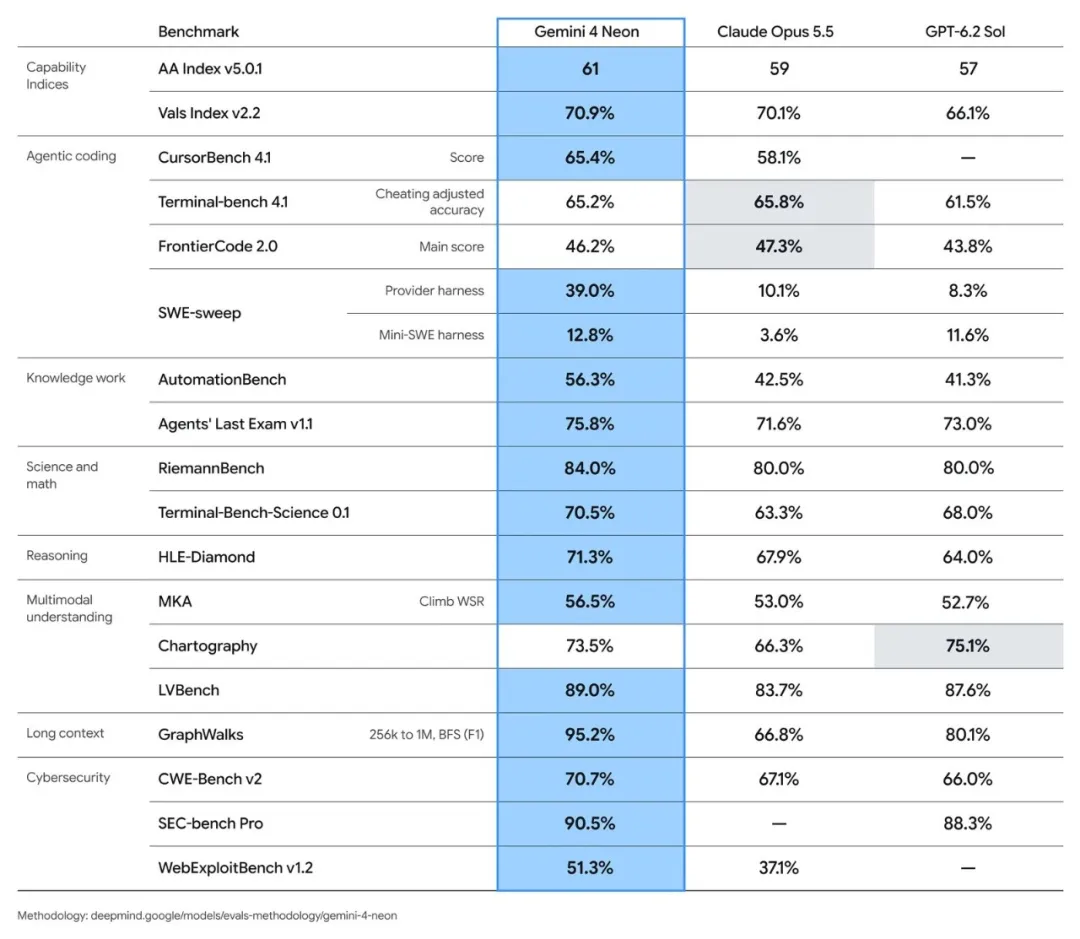
Figure: Comparative performance of Gemini 4 Neon across multiple benchmarks including coding and scientific reasoning
That said, the new engine is not without its criticisms.
First are the verbosity and latency issues at higher settings. When completing the full AA benchmark suite at xhigh, Neon generated 283 million output tokens in a single run—significantly more than Carbon—with a first-response latency of 56.51 seconds. For use cases demanding rapid responses, dialing it back to medium is clearly wiser, cutting runtime to 8.3 minutes and throttling output to 62.9 million tokens.
Another anecdote that sparked lively discussion among developers on domestic tech forums was the temporary “pricing inversion” seen briefly before the end of November.
Neon’s API launched immediately at its official rate of $3 input/$15 output per million tokens (with a 95% discount to $0.15 for cache hits), offering no free tier; meanwhile, the flagship Carbon and Argon were temporarily locked in their launch discounts of $2 and $10 until November 30, only reverting to their regular $4 and $20 prices on December 1. Consequently, for the remainder of November, the sub-flagship carried a unit price 50% higher than the flagship—a mildly ironic commercial timing quirk.
From Solo Showmanship to Contractor Leadership
Benchmark tables are inherently rigid; what truly energizes the tech community is the dominant presence Neon exhibits in real-world engineering environments.
Watching the live demonstration videos from Google Antigravity gives you an immediate grasp of what long-horizon, multi-agent collaboration looks like.
Within a project titled NEONPUTT 84, Neon activates `/swarm` mode, orchestrating eight parallel nodes—including scaffold, shaders, courses, physics, UI, engine, and verifier—in real-time across a dynamic task graph. Splitting the workload, they code custom GLSL shaders, a 240Hz physics engine, and eight distinct levels, assembling a synthwave-themed mini-golf game. Impressively, once the code is complete, it autonomously takes over a web browser to conduct click-tests, successfully lining up shots and sinking a hole-in-one.
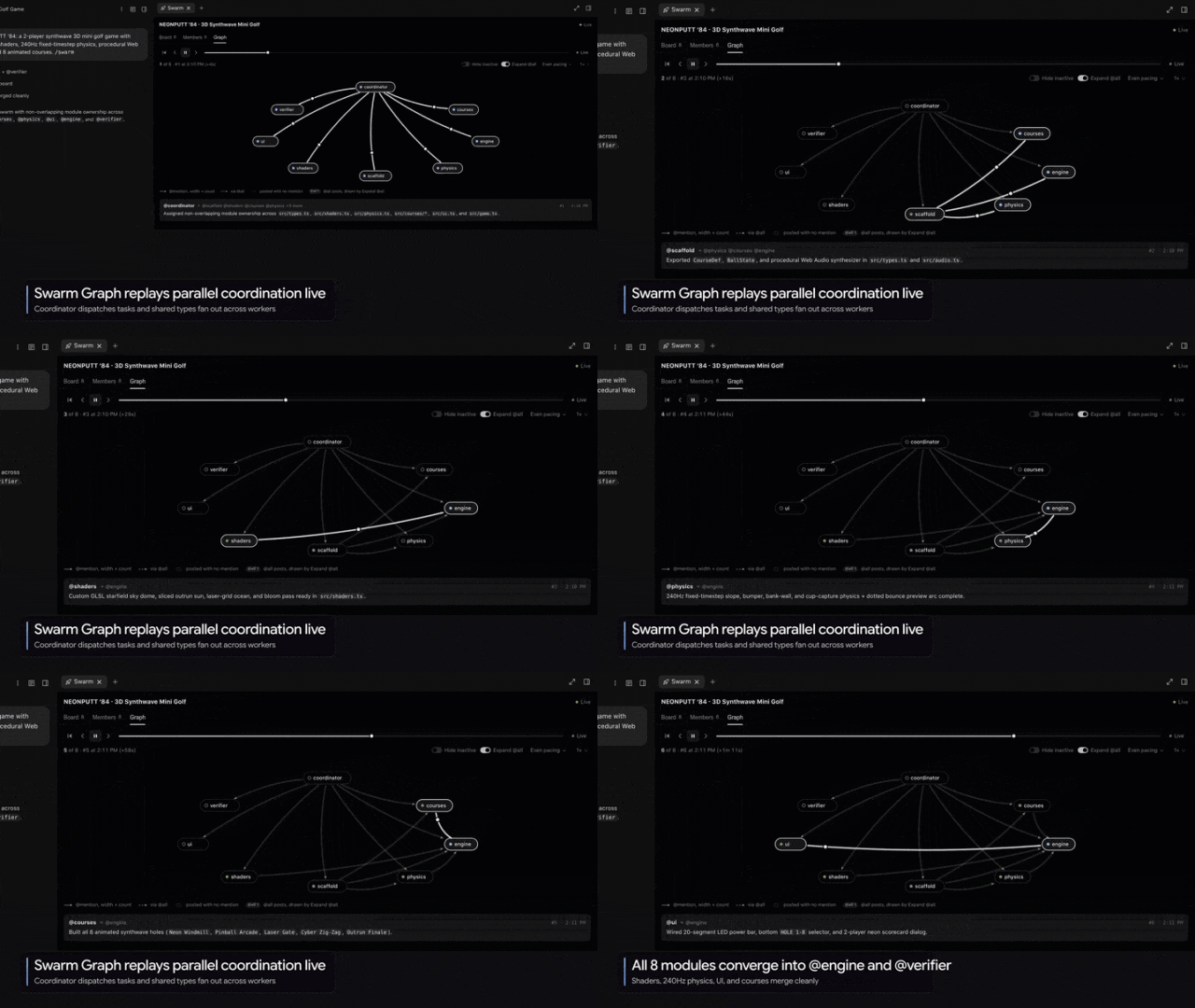
Figure: Gemini 4 Neon coordinates 8 parallel sub-Agents via swarm in Antigravity for collaborative development
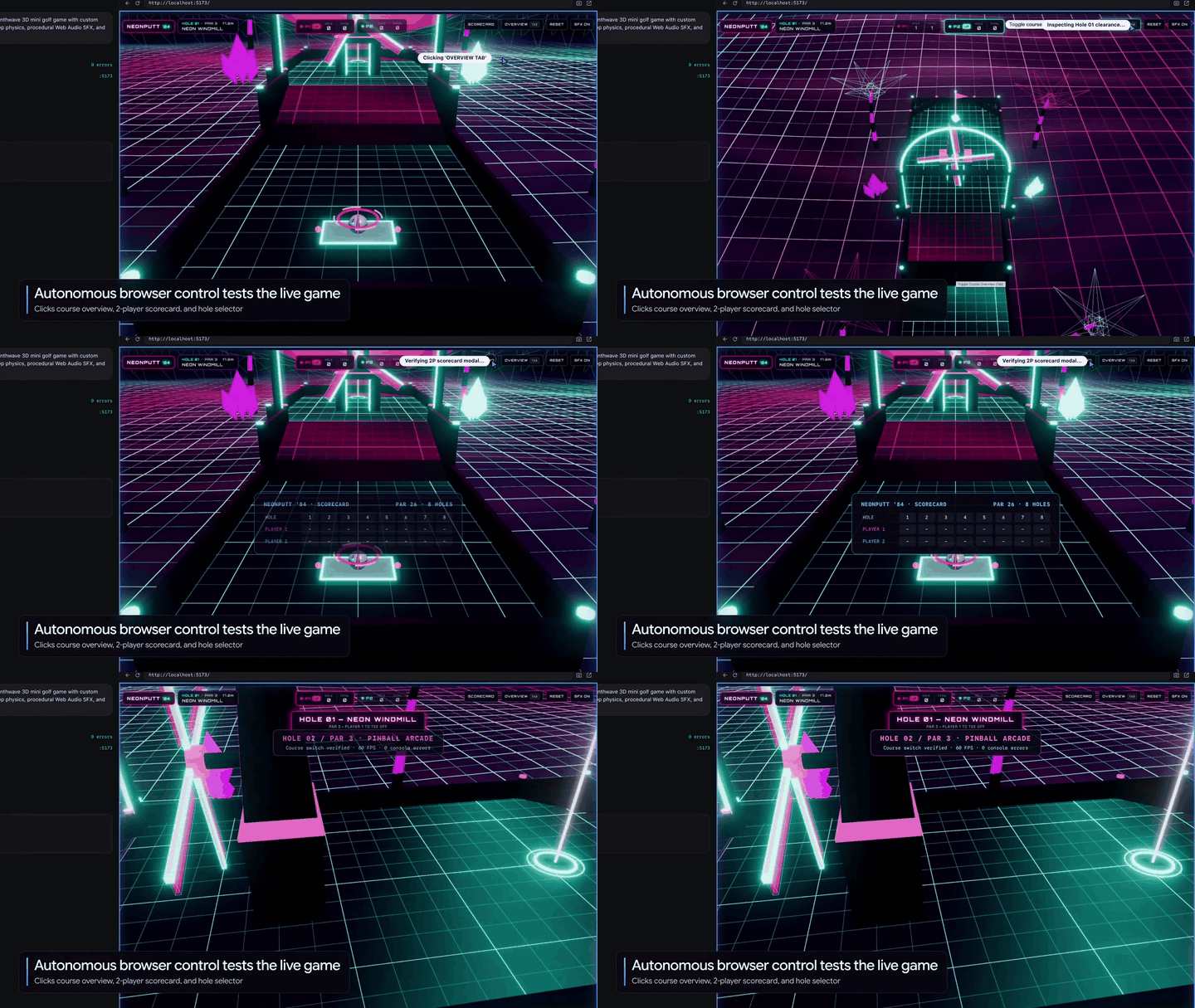
Figure: Gemini 4 Neon autonomously generates a 3D mini-golf game and uses a browser for acceptance testing
Extend the timeline, and its endurance proves equally staggering. In a flagship official demo, Neon ran continuously for a full 12 hours on Antigravity utilizing `/swarm`. Using only archival photographs, it reconstructed Alan Turing’s 1936 study at Cambridge University’s King’s College brick-by-brick in 3D space, then even operated a fully interactive, functional Universal Turing Machine right on the virtual desk.
Meanwhile, on the YouTube channel CHOOSETO.AI, a recently onboarded Google developer leveraged early beta access to publish numerous first-hand tests, entirely bypassing benchmark scores. The footage shows Neon rendering a highly detailed 3D dragon from a single SDF mathematical formula, generating an animated SVG peacock from one file, and effortlessly converting a vintage 1959 architectural blueprint into a navigable 3D walkthrough. Shifting to hardcore backend workflows, it independently deploys rotating guard-rail agents on Google Cloud Run, rapidly rolling back purposefully broken applications. It can even simulate binary galaxy collisions on a DGX Spark system or manually write out neural network weights without prior fine-tuning.
Beyond rolling up its sleeves to handle heavy lifting, Neon’s most intelligent leap is mastering the role of a “foreman.”
Antigravity rolled out a brand-new Orchestrator (Neon) dual-model auto-orchestration mode. When tackling complex, multi-file projects, Neon assumes central command for architectural planning and state review, delegating routine code edits, dependency updates, and test runs to the leaner, faster Hydrogen model. If the execution pipeline encounters a bottleneck, control automatically routes back to Neon to revise the plan, eliminating the need for manual model switching entirely.
Frontline engineering teams have grown highly adept at handling its quirks. The GitHub Copilot engineering blog specifically notes that compared to the flagship Carbon, Neon boots up faster and, crucially, exercises greater restraint during code modifications, dramatically reducing unsolicited, sweeping changes across other areas. Its hallucination rates for code and tool outputs also hit record lows in internal trials. To collaborating ML research teams, it has shed the “junior researcher” tendency to quit at the first sign of experimental failure, instead adopting the methodology of seasoned academics—probing root causes, hunting for novel signals, and proactively iterating on modeling strategies.
The Desperate Comeback of the “North American Soybean Bag”
Given its current momentum, it’s hard to fathom that merely four months ago, Google AI was still languishing under the ironic moniker of the “North American Soybean Bag” across Chinese tech circles.
Scroll the calendar back to around July 2026, and you find Gemini riding the lowest ebb of its reputation. Plagued by catastrophic failures in mathematical reasoning and frequent, bizarre missteps during safety reviews, public ridicule was relentless. A July promise at Google I/O to deliver Gemini 3.5 Pro in June fell through, forcing Google to hastily release 3.5 Flash just to compete with mid-tier rivals. For a while, Gemini didn’t even register on the front pages of major coding and Agent leaderboards. To make matters worse, the model’s internal knowledge cutoff remained stuck at January 2025; it wasn’t updated until 3.6 Flash pushed it to March 2026, leaving it blind to competitors’ newer releases and causing its intelligence to visibly degrade whenever internet search was toggled on.
In merely four months, the table has been completely reversed.
Throughout November, Google unleashed a rapid-fire sequence of announcements. Alongside the four consecutive Gemini 4 elemental models released over seven weeks, they simultaneously unveiled Genie 4—a world model capable of generating interactive 3D environments from prompts—and Gemini Omni 1.2 Flash, engineered for cost-effective long-form video processing. Meanwhile, they hardened Antigravity into a robust Agent platform bridging software development and cheminformatics research. Across major comprehensive leaderboards, Google has finally reclaimed the standing to compete head-to-head with OpenAI’s GPT-6.2 lineup and Anthropic’s Claude 5.2 and Opus 5.5 models.
So, how did Google pull off this dramatic turnaround?

Figure: Koray Kavukcuoglu, Senior Vice President and Chief AI Architect, Google DeepMind
In August, Google finalized a critical organizational restructuring. Demis Hassabis stepped into the role of Chief Scientist at Alphabet and Chairman of DeepMind, while DeepMind’s Senior Vice President and Chief AI Architect, Koray Kavukcuoglu, officially assumed control of daily operations and the Gemini product roadmap. At a The Information summit in September, Kavukcuoglu stated unequivocally that “debating whether we’ve achieved AGI isn’t even the right question right now,” effectively steering the entire organization’s focus back to engineering dependable, practical Agents.
He eradicated the old habit of hoarding massive updates until the end of the year, only to suffer embarrassing delays, establishing an ironclad mandate for “early shipping and rapid iteration.” He also inserted a dedicated “mid-training” squad between pre-training and post-training phases, laser-focused on hardening programming capabilities.
Melvin Johnson, Head of Post-Training at DeepMind, explained that previous Gemini models stalled because achieving perfection on simple tasks failed to generate meaningful learning signals. To combat this, the team engineered a ruthlessly rigorous automated reinforcement learning loop, intentionally feeding the hardest cross-repository engineering challenges that Agents still stumble over into tightly sandboxed environments with preserved unit tests for continuous stress-testing. Simultaneously, the system imposes severe penalties for exploits like evading evaluators or fabricating test outcomes, forcibly driving down the internal hallucination rate in strict testing environments to a historic low of approximately 1.5%.
The ultimate foundation supporting all these advances, however, is Google’s years-long investment in fully vertical, in-house hardware infrastructure, which has finally matured.
While competitors at the table continue to grapple with Nvidia GPU shortages and skyrocketing compute invoices, Google’s seventh-generation TPU Ironwood, integrated with the open-source TPU Sync software layer, is already in production. It can offload massive context KV caches to host memory in milliseconds.
Evaluations from SemiAnalysis highlight Ironwood’s overwhelming efficiency per dollar spent in long-context and multi-turn Agent scenarios—so compelling that even arch-rival Anthropic committed to a large-scale TPU compute partnership. Furthermore, Google’s eighth-generation TPUs are already decoupling training and inference silicon for independent optimization. It is precisely this relentless supply of sovereign compute capacity on the foundational layer that empowers Google to wage aggressive price wars and confidently roll out the mixed “Neon + Hydrogen” large-small model architecture.
The entity mockingly dubbed the “North American Soybean Bag” just months ago has ultimately orchestrated its own redemption through sheer engineering discipline and deep compute reserves. By abandoning the obsession with publishing monolithic whitepapers to prove AGI and instead dumping battle-tested models onto the market on a strict bi-weekly cadence, the nightmare adversary that OpenAI and Anthropic dreaded most has finally awakened.
Join TechFlow official community to stay tuned
Telegram:https://t.me/TechFlowDaily
X (Twitter):https://x.com/TechFlowPost
X (Twitter) EN:https://x.com/BlockFlow_News
 极客公园