Deutsche Bank warns markets face "triple downside risks": negatives may offset each other, but a rebound could spur Fed hawkishness.
Author: Xiao Yanyan, Jinshi Data
Deutsche Bank analyzed three major market threats: the Middle East energy shock, the cooling of the AI investment cycle, and European debt risks, pointing out that they do not necessarily reinforce each other and may even offset one another. However, each market rebound driven by risk easing could loosen financial conditions and reawaken the Federal Reserve's hawkish stance.
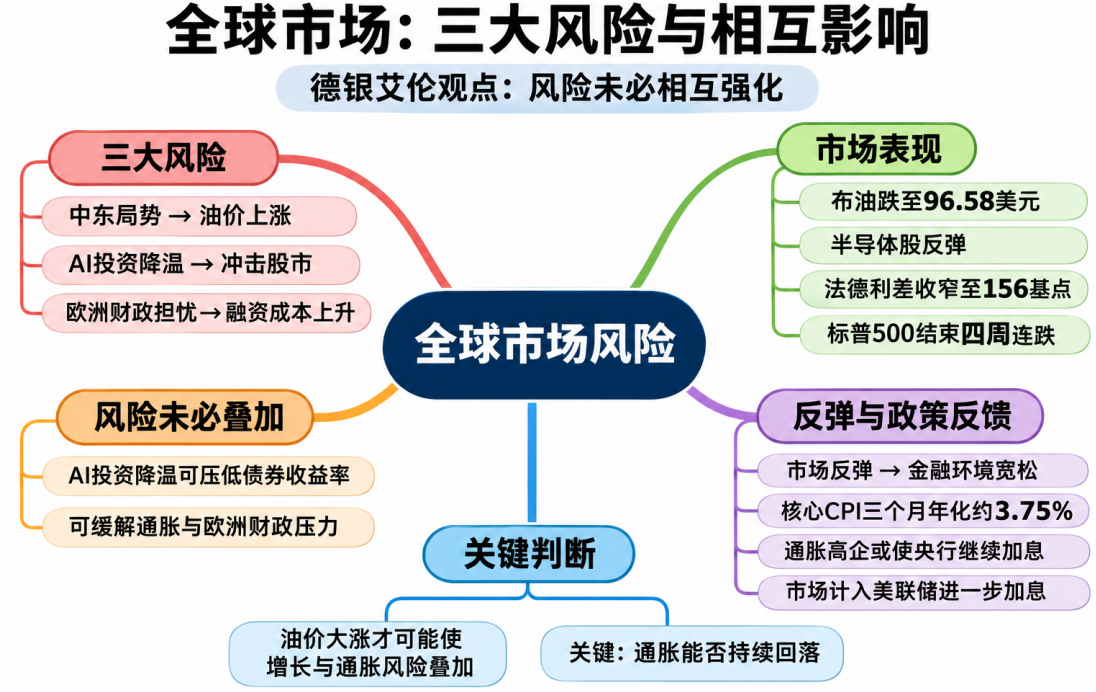
Global markets are facing three major risks: an escalation in the Middle East driving up oil prices, a cooling AI investment cycle impacting stock markets, and fiscal concerns in Europe pushing up government financing costs.
In his latest report, "How the Bearish Risks Can Offset Each Other," Deutsche Bank macro strategist Henry Allen pointed out that investors tend to assume these three risks will reinforce each other, which is not the case. The negative impact brought by one risk may be partially offset by the market effects of another.
Cooling AI Investment May Instead Ease Debt and Inflation Pressures
Allen believes that among the three risks, there is a special relationship between the slowdown in AI investment and the other two.
If AI investment cools significantly, tech stocks will be hit first. Demand for semiconductors, data centers, and related infrastructure may decline, affecting corporate earnings and expectations for future productivity growth.
On the other hand, reduced AI investment may also bring two positive market effects.
First, a slowdown in AI investment would weaken economic growth expectations, prompting investors to shift to safe-haven assets like U.S. Treasuries, driving bond prices up and yields down. Lower bond yields can ease financing pressures for highly indebted European countries and alleviate market concerns over sovereign debt.
Second, AI infrastructure construction consumes substantial energy and drives demand for products such as high-end memory chips. Slowing investment could reduce demand in these areas, thereby easing some inflationary pressures.
Therefore, although cooling AI investment is unfavorable for the stock market, it may simultaneously lower bond yields, ease inflation, and alleviate some fiscal pressures. The three risks do not necessarily move in the same direction.
Market Rebound Brings New Problems: Central Banks May Continue to Raise Rates
Recent market trends have already shown signs of these risks offsetting each other.
Since late October, tensions in the Middle East have eased somewhat, with Brent crude oil prices falling from $113.43 per barrel to $96.58, causing short-term inflation expectations in Europe and the U.S. to recede accordingly.
Meanwhile, semiconductor stocks rebounded from their November 5 low, with the Philadelphia Semiconductor Index gaining more than 12% by the following Friday. Credit spreads in both the U.S. and Europe also narrowed, indicating that market concerns about AI investment risks spilling into financing markets have diminished.
Pressure on European debt has also eased. The spread between French 10-year government bonds and German Bunds narrowed from around 174 basis points on October 22 to 156 basis points.
These developments pushed the S&P 500 index to end its four-week losing streak, recording its first weekly gain in over a month.
The problem lies in the fact that rebounds in stock and credit markets imply financial conditions are loosening. If inflation remains elevated, central banks need not ease monetary policy due to previous market pressures; they might even raise rates further.
The annualized three-month increase in the U.S. core consumer price index through October reached approximately 3.75%, marking the highest level since April 2024. Inflationary pressures are rising again, and the market is beginning to price in the possibility of further Fed rate hikes, even considering a 50-basis-point hike in December.
Allen believes that investors tend to associate falling stock markets and slowing economic growth with central bank rate cuts, while overlooking the alternative scenario: a stock market rebound and narrowing credit spreads could similarly give central banks more room to hike rates.
This is precisely the most contradictory aspect of current markets: the more confidence the market regains, the harder it becomes for monetary policy to shift toward easing.
Rising Oil Prices Are What Would Actually Cause the Triple Risks to Compound
Unlike a slowdown in AI investment, an escalation in Middle East tensions and a sharp rise in oil prices could simultaneously dampen economic growth and push up inflation.
Rising energy prices would increase household consumption, corporate production, and transportation costs, dampening economic activity while pushing up inflation expectations and interest rates. Government financing costs could also rise, further intensifying pressure on European debt.
This situation stands in stark contrast to cooling AI investment. While the latter may suppress economic growth expectations and bond yields, an energy shock could cause slowing growth and rising inflation to occur simultaneously, making decisions even more difficult for central banks.
Allen also cited the rate-hiking cycle from 2022 to 2023, noting that markets frequently anticipated central banks were about to halt hikes, but stubborn inflation and resilient economic activity repeatedly debunked this view. The collapse of Silicon Valley Bank and regional banking turmoil in 2023 did not stop the Fed and the ECB from continuing to tighten policy.
Currently, the market expects cumulative Fed rate hikes of approximately 113 basis points by September 2027, higher than the 95 basis points initially priced in before the start of this tightening cycle.
This indicates that the market is gradually raising its expectations for future interest rates.
The core of Deutsche Bank's analysis is that the Middle East energy shock, cooling AI investment, and European debt risks are not simply additive. A slowdown in AI investment may ease inflation and fiscal pressures, but if oil prices surge again or if stock market rebounds lead to excessively loose financial conditions, the market could still face stricter monetary policy.
Ultimately, the key determining market direction remains whether inflation can continue to fall. Only when inflationary pressures truly ease can stock market rebounds and central bank monetary policy easing occur simultaneously.