Bernstein Research Report Breakdown: Excluding AI Business, Oracle Still Worth $133; Market Significantly Undervalues Stock
Author: Chaoxiang Research
Oracle (ORCL) shares have fallen cumulatively by 41.0% year-to-date, with the market assigning a negative valuation to its massive AI data center business.
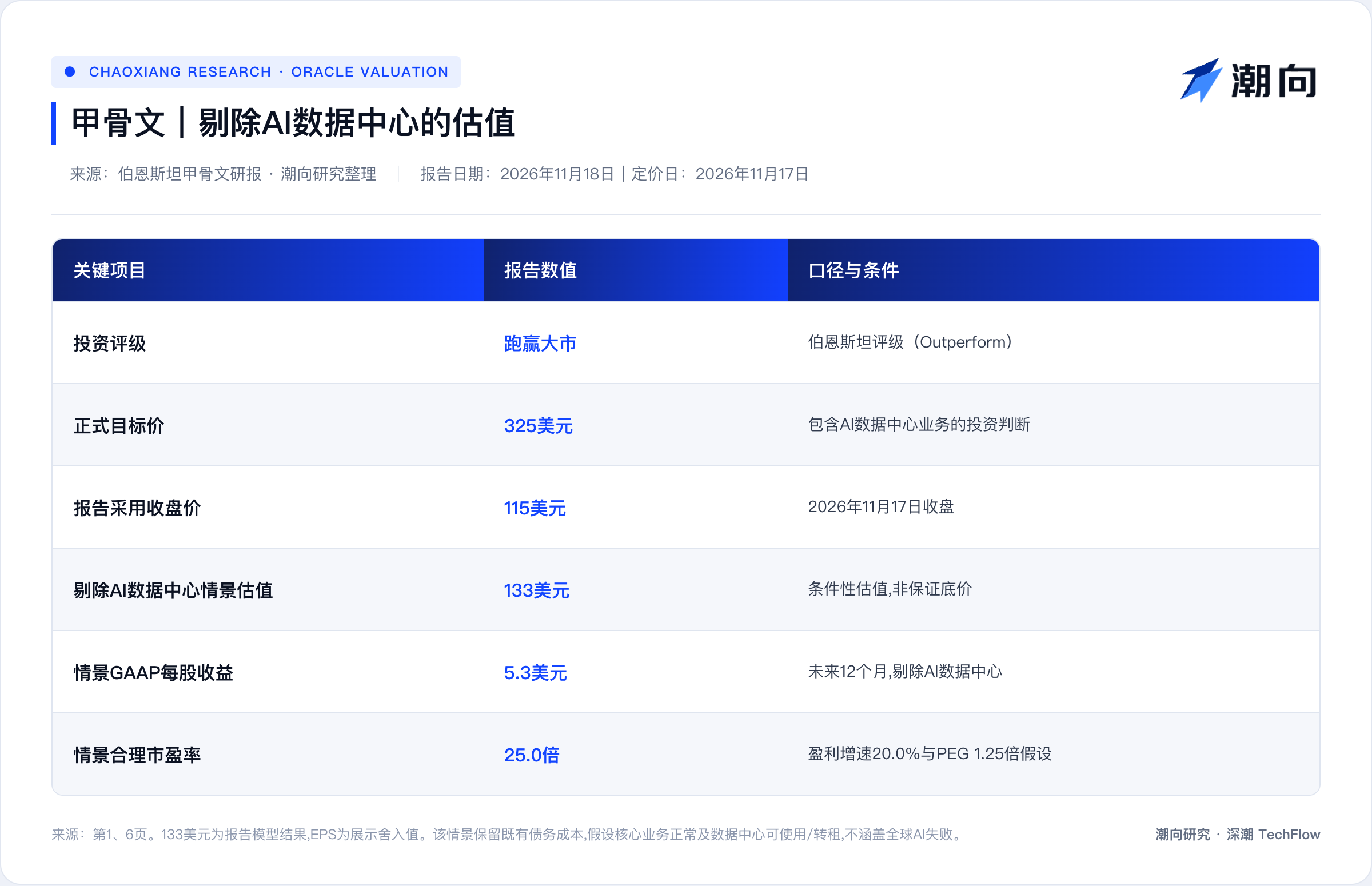
In a deep-dive report published on November 18, 2026, Mark L. Moerdler of Bernstein's Global Software Team noted that even if all AI data center contracts were breached, purchased hardware became worthless, and the company continued to carry all related debt, Oracle would still be valued at $133 based solely on its traditional core business, approximately 16% higher than the current closing price of $115.00.
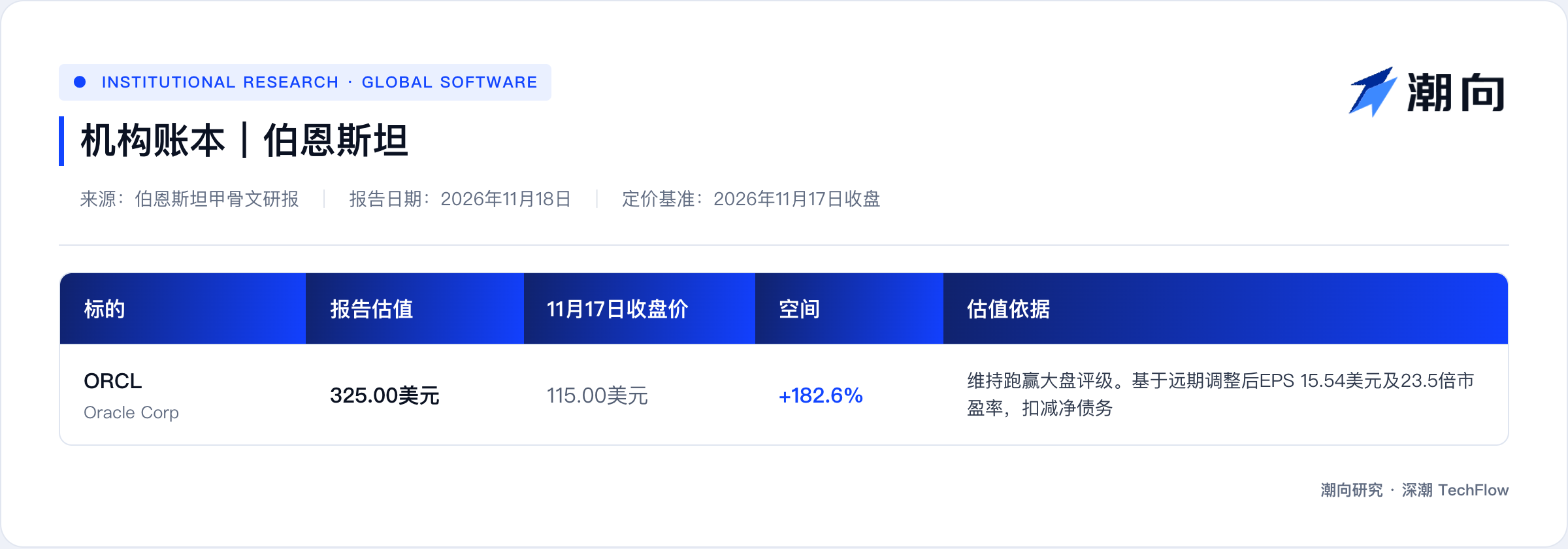
The firm maintains an Outperform rating on Oracle with a $325.00 price target, believing that current odds are heavily skewed to the upside.
Extreme Stress Test: Core Valuation at $133 Even After Excluding AI
Market concerns over Oracle's AI capital expenditures and clients' ability to fulfill contracts have already suppressed the stock price below its fundamental floor.
To address investor questions regarding the "worst-case scenario," Bernstein built a nearly stringent bottom-line valuation model. This model assumes that all AI data center clients, including OpenAI, Meta, Nvidia, AMD, and ByteDance, immediately breach their contracts without paying any penalties, and that Oracle's recognized AI revenue for Q1 FY2027 is wiped out to zero.
Simultaneously, the model assumes Oracle cannot monetize its ~$40 billion in work-in-progress hardware inventory (including servers, networking, power, and cooling systems), and continues to fully bear the interest costs of new debt issued and equity dilution costs associated with building AI data centers.
Even under such extreme conditions, Oracle's non-AI core business (databases, SaaS enterprise applications, and traditional CPU cloud business) continues to expand robustly. Bernstein expects its non-AI revenue to grow steadily from $61 billion in FY2026 to $98 billion in FY2030, with a 20.0% CAGR in GAAP EPS over the next 24 months.
Referencing the historical low valuation multiples of software peers like Microsoft, SAP, Salesforce, and ServiceNow, Bernstein applies a 25.0x P/E multiple to Oracle's forward 12-month non-AI EPS of $5.3, yielding a conservative bottom-line valuation of $133 per share. This figure remains ~16% above the November 17, 2026 closing price of $115.00 (slightly lower than the $137 estimated in February 2026, primarily reflecting recent additional bond issuances and hardware investments).
$288 Billion in Leases and $40 Billion in Hardware Risks Are Controllable
The core argument for shorting Oracle centers on massive data center lease commitments and hardware procurement risks.
After locking in approximately $317 billion in non-cancelable remaining performance obligations (RPO) with clients like OpenAI, Oracle signed total data center lease agreements worth about $288 billion. The market worries that if major clients cancel orders, these non-cancelable leases will completely drain the company's free cash flow.
Bernstein points out that this concern overlooks the lease maturity structure and industry supply-demand realities. First, these data centers will be delivered in batches over the next 3 years until the end of FY2029, rather than all at once; second, each lease runs 15 to 19 years, translating to a maximum annual cash expenditure exposure of only $15 billion to $19 billion (expected to peak in FY2030).
More importantly, as long as there is no global "AI winter" where generative AI fails completely, power-ready data centers remain a scarce resource. Bernstein calculates that global spending on AI inference compute will eventually reach at least 5 times that of training compute. Coupled with the fact that the non-AI cloud infrastructure market (IaaS/PaaS) currently has a penetration rate of less than 50%, Oracle can easily repurpose excess capacity for its own cloud business expansion or sublease to other hyperscale cloud providers.
Hardware inventory risks are equally manageable. Oracle requires approximately $2.5 to $3 in compute assets for every $1 of annual AI revenue generated, and typically procures hardware only 3 to 6 months before deployment. This means any hardware exposed to risk at any given time represents at most 1 to 2 years of capex volume. Given the use of industry-standard GPUs and common networking/storage components, even in the event of localized breaches, the equipment can be quickly reallocated to existing cloud operations or liquidated.
Cash Flow Turns Positive in 2028, Price Target Set at $325
Once the pessimism suppressing the stock price subsides, Oracle will welcome a significant simultaneous upgrade in both valuation and earnings.
In the base case scenario inclusive of AI data center operations, Bernstein expects Oracle's total revenue to surge from $67.358 billion in FY2026 to $234 billion in FY2030, representing a 33% CAGR (FY2025-FY2030 basis). Although the AI business drags down overall gross margins (projected to decline from 66% in FY2026 to 47% in FY2030), scale effects will drive operating profit to $80 billion in FY2030.
The cash flow inflection point is now clearly visible. Following its recent completion of $20 billion in additional financing ($10 billion equity and $10 billion debt), Oracle no longer requires external funding. Bernstein projects the company's free cash flow will officially turn positive in the second half of FY2028 (approximately 15 to 18 months from now), reaching ~$30 billion in FY2029, and further jumping to $81 billion in FY2030.
Based on adjusted EPS of $15.54 over the next 12 months, applied to a 23.5x P/E multiple, and deducting net debt of $40.7 per share, Bernstein reiterates a $325.00 price target and Outperform rating for Oracle. The report cautions that changing investor perception may take time, but the stock is poised for a strong rebound within the next 18 months. Key downside risks include excessive customer concentration, a global generative AI "winter", pressure on traditional databases from cloud alternatives, and underperformance in sovereign cloud expansion.
This article is a compilation and interpretation by Chaoxiang Research of third-party brokerage research reports. The ratings, price targets, earnings forecasts, and related assessments cited herein reflect the views of the respective broker's analysts, represent only the stance of their affiliated institutions, do not represent the views of Chaoxiang Research, and do not constitute any investment advice.
Markets involve risk, and decisions must be independent. This article should not serve as a basis for buying or selling any securities.
Join TechFlow official community to stay tuned
Telegram:https://t.me/TechFlowDaily
X (Twitter):https://x.com/TechFlowPost
X (Twitter) EN:https://x.com/BlockFlow_News
 @chaoxiangooo