Cloud Capex Isn't Slowing Down, But the Timeline Has Changed | Morgan Stanley Latest Research Report Analysis
On November 15, Morgan Stanley downgraded a batch of ratings. The targets are cloud-side semiconductors and legacy storage. The report opens by acknowledging that these downgrades have faced investor pushback.
Its response is direct. Demand remains strong. But waiting until "cloud capex deceleration" becomes visible before acting means prices will have already adjusted.
This is a Q&A-style report addressing the four most concentrated investor concerns. The sector view remains "attractive." Bullish on the industry, but trimming individual stock exposure first—that is the report's overarching stance.
The report is signed by four analysts.
Daniel Yen and Charlie Chan.
Daisy Dai and Ethan Jia.
What Investors Are Actually Asking
Four questions, each sharper than the last.
The first asks whether the downward revision to Montage's earnings forecast holds water. The second asks what drives the multiple compression and where the catalysts lie.
The third asks whether shipment forecasts for servers and CPUs have been revised, and why act now given such strong demand. The fourth asks why positions in CXMT and Nanya remain.
The report answers each point individually. Linked together, the four responses form the core thesis: demand is correct, but the timing is off.
A Preemptive Downgrade
Two prior reports preceded this one. One discussed cloud-side semiconductor growth peaking. Another covered pricing power in legacy storage reaching its peak. This serves as a follow-up Q&A.
The downgraded names fall into two categories: those with concentrated cloud-side exposure and legacy storage players. The former's revenue tracks server deployments, while the latter follows storage prices.
Within the cloud-side category, Aspeed makes server management chips. Montage produces memory interface chips. The report has adjusted its 2027 RCD shipment assumption more conservatively.
RCD refers to registered clock drivers mounted on memory modules. It constitutes the "content" within a single server, i.e., the per-unit value proposition. The report states that this opportunity remains intact.
In the legacy storage category, Phison was downgraded to Underweight. Winbond and Macronix were adjusted in the same batch. The changes were concentrated around November 10 and 11.
The report does not frame the downgrade as bearish toward the industry. It repeatedly emphasizes that end-demand remains robust, with Q3 earnings confirming current spending. What has changed is the judgment of timing.
To summarize its stance in one sentence: wait until deceleration is confirmed by data, and valuation adjustments will have already occurred. Therefore, trim exposure before it becomes visible, not after.
Demand Unchanged; Delivery Timing Has Shifted
The two hardest figures on the page both relate to timing.
The first is 5GW. The U.S. team shifted approximately 5GW of new capacity additions from 2028 to 2029. According to the report's metrics, this equals roughly 20% of the originally projected 2028 capacity additions.
The second relates to capital expenditure forecasts. Projections for hyperscaler spending remain unchanged: $1.6 trillion in 2027 and $1.8 trillion in 2028.
Read together, the message is clear. Intentions to deploy capacity remain, but the timing for equipment procurement and deployment is harder to pin down. Orders may arrive late, but they will not disappear.
The report attributes the downward revisions to three uncertainties: procurement timing, platform transitions, and supply chain execution. It also concedes that the 2027 RCD shipment assumption may be conservative.
This point warrants separate attention. A conservative assumption implies upside room. If customer orders and deployments proceed more smoothly than currently modeled, this component will revert.
The Q3 earnings season has just wrapped up. The report suggests this moment is suitable for baking in additional risk, citing post-midterm-election execution uncertainties.
It also flags a key distinction. Capex intent and capex realization are two separate things. The former depends on guidance, while the latter hinges on equipment and deployment.
Pricing Power in Legacy Storage Is Eroding
The issue for legacy storage is not demand, but whether pricing and returns can be sustained.
During upcycle phases, long-term agreements at fixed prices allow manufacturers to raise rates quickly. Once demand weakens, the protection afforded by these agreements diminishes.
The report explicitly states that as shortages narrow, the sustainability of pricing and returns must be reexamined. Its updated supply-demand model points to normalization in 2028.
The conclusion rests on valuation multiples. Lower multiples should be applied ahead of normalization, rather than waiting for peak earnings to roll over before adjusting.
Another observation supports this view. The breadth of earnings revisions is peaking. Visibility into 2028 server production is weakening.
Together, these factors undermine confidence in extrapolating growth rates. This explains why the report adjusts valuations before touching earnings.
Two Holdings Remain; For Different Reasons
The report maintains Add ratings for CXMT and Nanya. Their rationales for remaining on the watchlist differ.
CXMT benefits from three additional drivers: capacity expansion, localization, and process migration. Management notes that clients have already booked 2027 capacity for relevant enterprise-grade products.
DDR5 supply remains tight. This forms the second rationale for retaining CXMT.
Nanya relies on process upgrades and DDR5 migration. DDR5 already accounts for roughly 10% of its revenue. This trajectory differentiates it from other DDR4 suppliers.
The report offers a structural assessment of niche storage: smaller supply bases, greater price sensitivity to minor supply-demand shifts, and lower direct exposure to AI-driven demand.
This carries dual implications. Both resilience and fragility stem from these characteristics.
Both must still navigate memory cycles. The difference lies in CXMT's additional growth drivers versus Nanya's clearer migration pathway.
Who Remains on the Add List
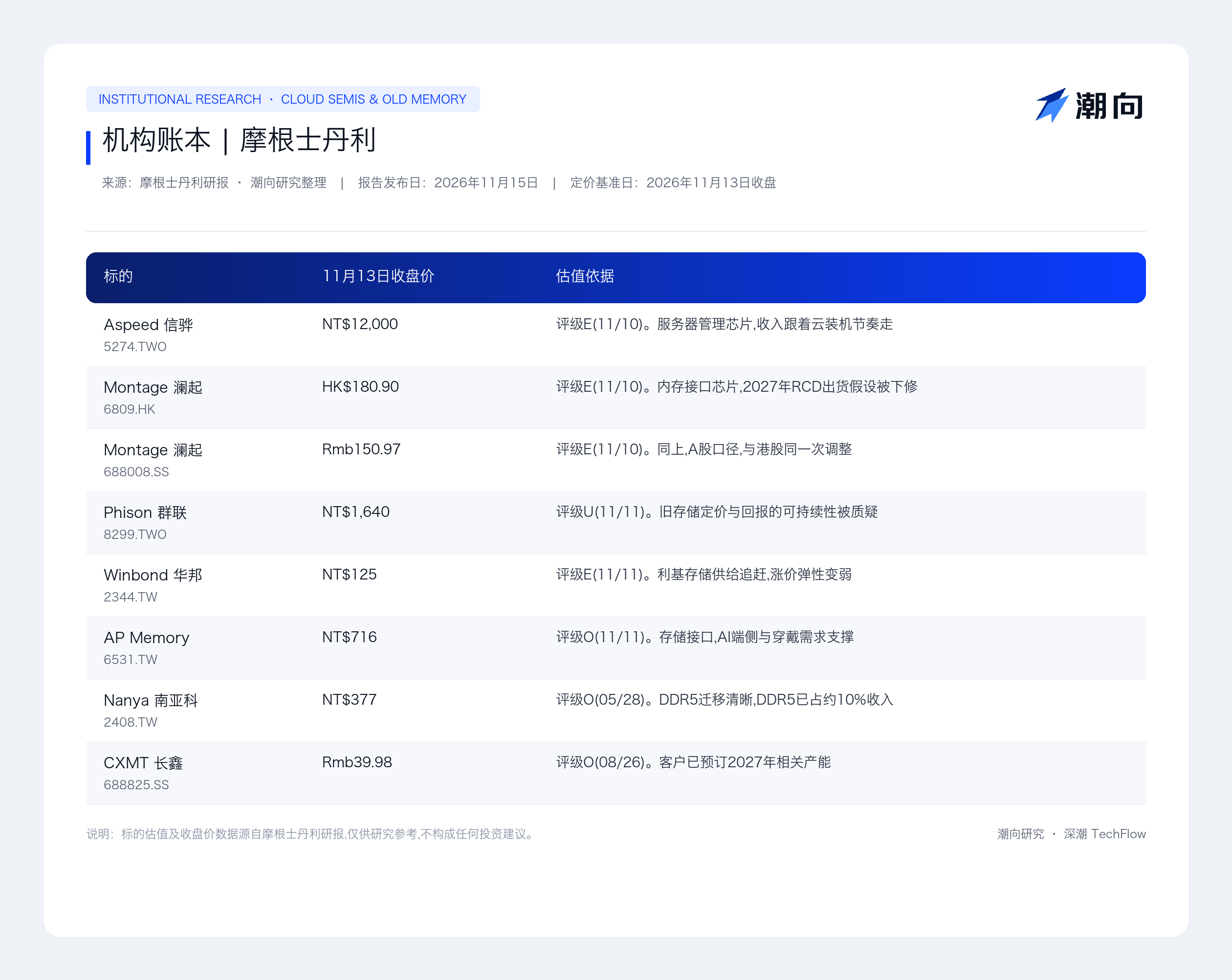
The report concludes with a coverage list, providing ratings and closing prices as of November 13. Target prices are absent.
Names retaining the Add rating include TSMC, MediaTek, and Alchip.
Others include SMIC, ASMPT, and Global Unichip.
Names downgraded to Underweight include MetaX, Vanguard, Silergy, and Phison.
Additionally, power semiconductor manufacturer AWSC.
These companies sit closer to legacy storage and mature nodes.
Cross-referencing the list with the main text clarifies the downgrade distribution. Cloud-side exposure and legacy storage pricing form the two diverging lines of this adjustment. All others remain unchanged.
Conditions That Would Invalidate This Caution
Bulls can monitor three signals: faster deployments, upward revisions to earnings forecasts, and renewed capex acceleration after Q1 2027.
If any materialize, this caution loses footing. The report itself lists faster deployment as a factor that would challenge its prudent stance.
Conversely, weakening order momentum and slowing price hikes are recognized catalysts by the report. It acknowledges that the timing for such scenarios remains uncertain.
The entire thesis hinges on one assumption: that the 5GW delay will genuinely translate into delayed equipment orders. Should this assumption fail, the downgrade proved premature.
The report leaves two concluding caveats. First, niche storage prices are highly elastic—rising fast and falling equally fast. Second, direct exposure to AI demand is low. When the AI narrative cools, the downside impact is actually limited.
These two points explain why the same report trims some exposures while adding others. They are navigating different cycles.
One final monitoring window deserves mention. Q1 2027 capex guidance will serve as the first stress test for this judgment. Upward guidance revisions would necessitate yielding to optimism.
How to Interpret the Rating Scale
Ratings correspond to risk-adjusted total returns over the next 12 to 18 months. Target prices share the same timeframe. Thus, this is a cross-year assessment, not a quarterly viewpoint.
The three tiers must be clearly defined. Add corresponds to outperforming the average return of the covered universe, Neutral matches market performance, and Underweight indicates underperformance.
Ratings describe relative performance, not absolute price movements. An "attractive" sector view does not guarantee holding every single name.
Prices listed are closing values from November 13. They serve as pricing benchmarks, not target levels. The report notes that historical prices are unadjusted for stock splits.
A final reminder: the value of this report lies not in its conclusions, but in its timing. It simultaneously asserts strong demand and the need to exit now. Readers must judge which premise materializes first.
Institutional Ledger | Morgan Stanley
Source: Morgan Stanley Research Report · Compiled by TechFlow|Report Publish Date: November 15, 2026|Pricing Benchmark Date: Close on November 13, 2026
Standard Disclaimer Regarding Research Report Content (Broker Views, Not TechFlow Views)
This article is a compilation and interpretation of third-party brokerage research reports by TechFlow. All ratings, target prices, earnings forecasts, and related judgments cited herein reflect the views of the respective broker's analysts, representing only their affiliated institution's position. They do not represent TechFlow's views and do not constitute any investment advice.
Markets carry risks, and decisions require independent judgment. This article should not be used as a basis for buying or selling any securities.
Join TechFlow official community to stay tuned
Telegram:https://t.me/TechFlowDaily
X (Twitter):https://x.com/TechFlowPost
X (Twitter) EN:https://x.com/BlockFlow_News
 @chaoxiangooo