Starship Second Stage Successfully Recovered by Tower for the First Time, Bernstein Sees Nearly Double Upside for SpaceX | Analysis of Bernstein's Latest Research Report
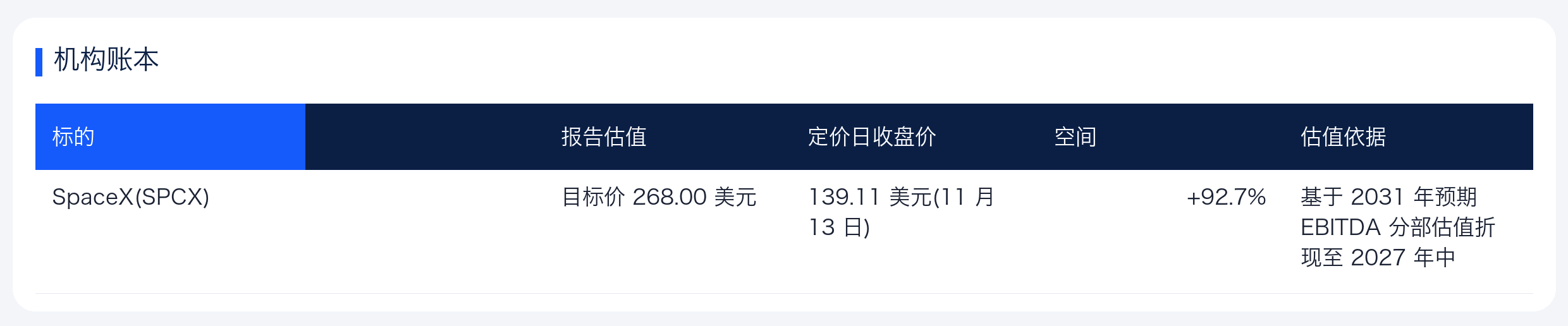
SpaceX successfully completed its first second-stage tower catch recovery. Bernstein has maintained an Outperform rating with a $268 price target. Compared to the closing price of $139.11 on November 13, this price target implies a 93% upside. The firm believes this success validates the fully reusable trajectory, directly determining whether the space data center constellation can generate hundred-billion-dollar-level cash flow before 2031.
Second-Stage Recovery Breaks the One-Time Rocket Curse
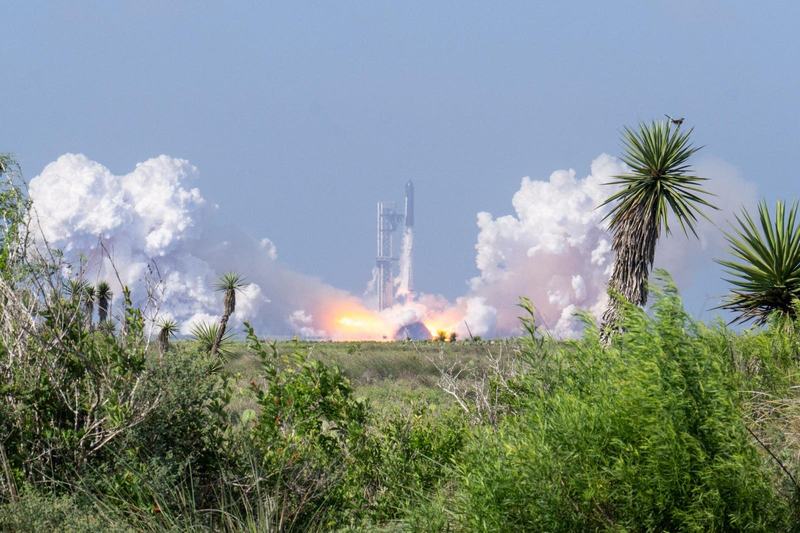
On the evening of November 13, SpaceX launched the fifteenth test flight of Starship (Flight 15). The spacecraft orbited Earth 14 times within 22 hours and deployed 26 Starlink V3 satellites into their designated orbits.
Unlike Flight 14, this mission successfully executed the complete orbital sequence. The most critical breakthrough occurred during the return phase, when the Starship second stage was successfully captured and recovered by the launch tower at Starbase.
This marks the first time in human aerospace history that a rocket's second stage has been landed and recovered. Bernstein analysts led by Douglas Harned noted that the capture was executed precisely according to plan.
Currently, the thermal protection tiles appear to be in good condition visually, but final conclusions must await teardown analysis by SpaceX engineering teams. Once confirmed that the thermal tiles can be reused without major refurbishment, this Starship is expected to directly proceed to Flight 16.
If traditional rockets are compared to commercial airliners scrapped after each flight, second-stage recovery equals bringing back the most expensive airframe and avionics systems intact to the ground. Bernstein estimates that SpaceX revenue will surge from $18.674 billion in 2025 to $241.887 billion in 2027.
First-Stage Booster Sea Landing Was a Proactive Risk Mitigation
Flight 15 was not without flaws, as the Super Heavy first-stage booster failed to return to the launch site as planned.
During ascent, all 33 Raptor engines on the booster ignited normally. However, during the home-burn ignition phase, one engine failed to start.
Bernstein analysis suggests that a single engine failure alone would not necessarily cause a landing failure. What actually triggered the abort command was a low propellant alert, prompting the autonomous system to guide the booster for a splashdown in the Gulf of Mexico.
Although the exact trigger for the alert has not been disclosed, the firm speculates that SpaceX intentionally sought to avoid any risk of damaging the launch tower. Ensuring the launch pad remained intact safeguarded the historic tower capture of subsequent Starship second stages.
Given that SpaceX had previously succeeded in recovering boosters, this setback is viewed as a temporary fluctuation. Bernstein expects booster recovery to soon become routine, similar to how Falcon 9 operations normalized after 2016.
Valuation Anchor Bets on 2031 Space Computing Power
On the surface, SpaceX's current $1.91 trillion market capitalization corresponds to a staggering forward P/E ratio of 96.4x based on 2027 earnings estimates. Focusing solely on launch and Starlink businesses over the next three years, this valuation would be hard to justify.
Bernstein employed a rare approach in its valuation model, directly using Adjusted EBITDA for 2031 as the valuation anchor. The firm first calculated the segment enterprise value for 2030, then discounted it back to mid-2027 to arrive at the $268 price target.
Skipping 2028 is because business at that time would still be limited to rocket launches, ground computing power, and early-stage Starlink. Bernstein emphasizes that the true foundation supporting SpaceX's trillion-dollar valuation lies in its orbital data center constellation.
Deploying massive constellations of computing satellites into orbit and maintaining network connectivity requires Starship to achieve full reusability. Only by driving launch costs per flight to extremely low levels does space computing become commercially viable.
Financial projections clearly illustrate this performance explosion curve:
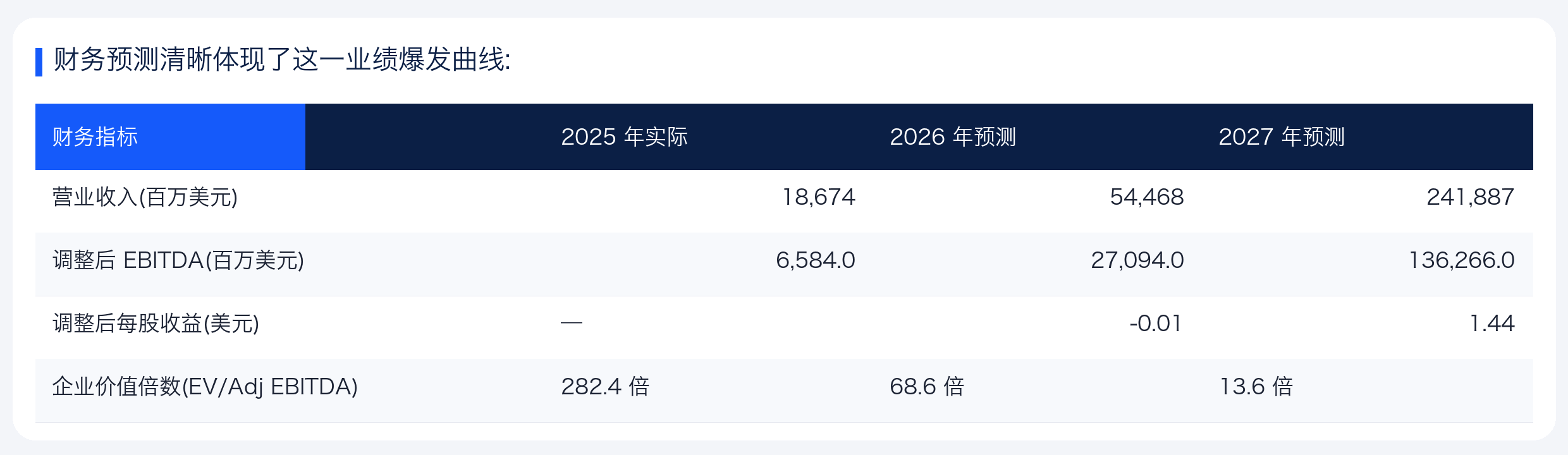
As profits scale up in 2027, SpaceX's enterprise value multiples will plummet from 282.4x in 2025 to 13.6x.
Decade-Long Technological Gap and Four Implementation Risks
Bernstein assesses that SpaceX leads all competitors in reusable rocket technology by approximately a decade. Since initiating coverage on July 7, 2026 with a $239 price target, the firm raised it to $248 on August 6, and further increased it to $268 on October 26.
However, high odds come with stringent engineering and commercial prerequisites. Bernstein highlighted four core downside risks:
First, whether Starship launch capacity can significantly expand entirely depends on the reuse verification results of the thermal protection system. If the thermal tiles require costly refurbishment, launch frequency will be severely impacted.
Second, orbital data centers represent a completely new commercial model, requiring SpaceX to prove its ability to execute engineering operations smoothly.
Third, semiconductor chip supply constraints or aerospace supply chain bottlenecks could slow down the deployment of satellites and computing nodes.
Fourth, regulatory grounding following launch accidents, as well as actual market demand for space computing falling short of expectations, will directly impact long-term valuations.
Additionally, disclosure documents indicate that Bernstein and its affiliates have provided investment banking and IPO underwriting services to SpaceX, as well as acted as its stock market maker, within the past 12 months.
Institutional Ledger
Standard Disclaimer Regarding Research Report Content (Brokerage Views, Not TechFlow Research Views)
This article compiles and interprets third-party brokerage research reports by TechFlow.
The ratings, price targets, earnings forecasts, and related judgments cited herein reflect only the opinions of that brokerage's analysts, represent solely the stance of their respective institutions, do not represent the views of TechFlow, and do not constitute any investment advice.
Markets involve risks, and decisions must be independent. This article should not be used as a basis for buying or selling any securities.
Join TechFlow official community to stay tuned
Telegram:https://t.me/TechFlowDaily
X (Twitter):https://x.com/TechFlowPost
X (Twitter) EN:https://x.com/BlockFlow_News
 @chaoxiangooo