Stripe Acquires OpenRouter for $7 Billion: Valuation Surges 5x in Three Months, How Long Can the Most Neutral AI Gateway Remain Neutral?
Author: Claude, TechFlow
TechFlow Editor's Note: On August 16, Bloomberg and TechCrunch confirmed from dual sources that Stripe acquired AI model routing platform OpenRouter for over $7 billion. Three months ago, the company's Series B valuation was only $1.3 billion. OpenRouter is the intermediary layer most commonly used by developers for 'one interface connecting all models', and is also recognized in the AI circle as a synonym for 'neutrality'. Now it belongs to a payment company that makes money from transaction fees, and the neutrality that developers value most has a clear price tag for the first time.

On August 16, Bloomberg cited informed sources reporting that Stripe has reached an agreement to acquire OpenRouter, with a transaction amount exceeding $7 billion. TechCrunch followed up to confirm, and Stripe spokesperson's response was 'no comment on rumors or speculation'. If this transaction is completed, it will be one of the largest acquisitions in the AI infrastructure field, and it took only one quarter for both parties to go from 'service provider and client' to 'acquirer and acquiree'.
Valuation Flips 5 Times in Three Months: $1.3 Billion Series B, $7 Billion Transaction Price
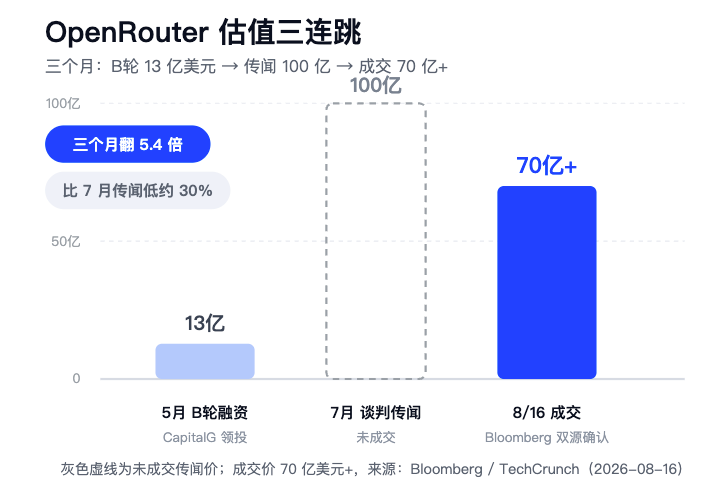
On May 28 this year, OpenRouter announced the completion of a $113 million Series B financing round, with a post-money valuation of approximately $1.3 billion, led by Alphabet's growth fund CapitalG, with existing shareholders such as Sequoia, a16z, and Menlo Ventures continuing to add investment. Three months later today, the transaction price exceeded $7 billion, flipping the book value more than 5 times.
What is more interesting is the direction of the price change.
In late July, The Wall Street Journal and Axios reported the negotiation price between the two parties was around $10 billion, three weeks later it settled at a bit over $7 billion, about 30% lower than the rumors.
Analysts attribute the price cut to a fact: throughout the summer, model prices have been falling all the way, and the bargaining chips in the buyers' hands are becoming harder.
Claiming to be 'The Stripe of the AI World', This Time Really Acquired by Stripe
OpenRouter started operations in early 2023, Founder and CEO Alex Atallah comes from Stanford and Palantir, co-founded NFT trading platform OpenSea with Devin Finzer in 2017 and served as CTO, and is one of the people in Silicon Valley most familiar with the business of 'market aggregation'.
What OpenRouter does is essentially aggregate the fragmented model market into a unified entry point: developers only need to access an API key compatible with the OpenAI interface to call hundreds of models, routing, failover, usage statistics, and billing are all handled by it, and switching models does not require rewriting code.
According to its own statements, currently has over 10 million global users, can call over 500 models from more than 80 providers, processing over 200 trillion tokens per month (the above are self-reported numbers).
Its fee model is simple and rough: charging a 5.5% platform fee in pay-as-you-go scenarios, model inference prices are passed through as is. Atallah has repeatedly claimed to be 'The Stripe of the AI Field': giving developers a single access point to avoid being locked in by any model vendor.
Now this analogy has the most straightforward ending, the company that said it was Stripe was bought by Stripe.
Stripe Has Been Keeping Books for OpenRouter for a Long Time, From Service Provider to Boss
The groundwork for this transaction runs deeper than outsiders see. Stripe was originally OpenRouter's payment service provider, in Stripe's official customer case studies, OpenRouter uses it for invoicing, tax calculation, connecting local payment methods, and anti-fraud, and even linked model cost changes with usage billing.
In other words, Stripe has always been able to see every transaction on OpenRouter's books. From vendor to acquirer, it knows what the cash flow of this intermediary layer looks like better than any external buyer.
More critical is the strategic position. At the Stripe Developers Conference in April this year, the company intensively released a set of AI payment products: streaming payments billed by token, wallets for agents, micropayment rails between machines, the official quote was 'tokens are becoming interchangeable with currency'. After acquiring OpenRouter, Stripe simultaneously holds two core assets: OpenRouter decides which model an inference request is sent to and records how much it is worth, Stripe is responsible for collecting money, settling, and recording it on the account. Metering and collection are housed in the same company for the first time.
Neutrality is the Entire Selling Point, Now Belongs to the Fee Collector
For developers, the most subtle change is here. OpenRouter's foundation is one sentence: Neutrality. It does not sell its own models, only does scheduling and billing, so developers are willing to hand over traffic to it, betting that it will not favor any model vendor.
Now the guarantor of this 'neutrality' has become a payment company that collects fees. Some developers pointed out directly: 'OpenRouter originally used Stripe for collection, this acquisition can help Stripe reduce costs and increase revenue.'
Others cited a more striking data point: 'All companies achieving commercialization in Forbes AI 50 are using Stripe for collection, this is a bit unsettling.' Intermediary business naturally consolidates, one API key facing a fragmented ecosystem, collecting a convenience fee, the acquirer of this business model this time is the one collecting the largest toll.
Another layer of risk is technical. The routing layer is a typical single point of failure: once it fails, all model providers behind it suffer together. In February this year OpenRouter went down twice, in one instance 80% to 90% of API requests failed. Developers handing the freedom of 'who to choose' to a neutral scheduler, and handing the freedom of 'who to choose' to a payment giant, are two completely different kinds of trust.
Clearing House for Dollars and Tokens, Stripe Wants to Take Both Away
Zooming out, OpenRouter may just be one piece on Stripe's chessboard. In the same week, on August 14 The Wall Street Journal reported, Stripe and private equity giant Advent are negotiating to purchase PayPal, the offer of $60.5 per share proposed in July corresponds to a valuation of approximately $53 billion, negotiations are continuing after being rejected by PayPal, if completed, the transaction volume processed by Stripe annually will reach the level of $3.7 trillion.
On one side is the incumbent giant of dollar payments, on the other side is the incremental entry point of token payments. What Stripe wants is not a routing layer, but the thing itself of 'money passing through me when it flows', whether it is fiat currency or tokens, whether the collector is humans or agents. OpenRouter once claimed to keep the model market fully competitive, now the meter and toll gate of this market are installed in the hands of the same company. For developers who call models on it every day, the interface hasn't changed, what has changed is the ownership of every toll on this road.
Join TechFlow official community to stay tuned
Telegram:https://t.me/TechFlowDaily
X (Twitter):https://x.com/TechFlowPost
X (Twitter) EN:https://x.com/BlockFlow_News
 深潮TechFlow