Large Quantities of Idle GPUs, Yet AI Companies Cannot Rent Computing Power: Why Can't Computing Power Be Traded Freely Like Oil?
Author: Jonah Burian, Investor at Blockchain Capital
Translated by: TechFlow
TechFlow Summary:In the current AI boom, computing power is widely viewed as the "oil of the digital age," with the industry persistently envisioning a global spot and futures trading market akin to crude oil or electricity. Yet reality stands in stark contrast: leading labs face massive idle compute capacity that cannot be transferred, while small-to-mid enterprises and startups find it impossible to secure chips. A liquidity-matching market remains elusive.
The deep-seated barriers extend beyond chip heterogeneity and physical interconnectivity to an obscure "credit structure." Modern large-scale GPU clusters depend on billions of dollars in debt financing, where backers underwrite the tenant's balance sheet and repayment credibility, not the hardware's residual value. Rigid take-or-pay long-term contracts lock computing power into a labyrinth of credit guarantee networks.
This author represents the renowned venture capital firm Blockchain Capital, offering a hard-core perspective rooted in energy trading and structured finance. Peeling back the layers, they analyze the default chain reactions and liquidity dilemmas behind secondary compute subleasing. Only when financiers truly trust the asset itself rather than specific clients can a deep compute spot market potentially break through.
The Core Dilemma: The Illusion of Compute Shortage and Idle Capacity
Imagine you are a top-tier AI lab planning to deploy 100,000 GPUs to train the next generation of large language models. If you attempt to procure them today, you'll find almost no available capacity. Scanning major cloud providers globally, compute quotas for the coming years are already nearly fully booked.
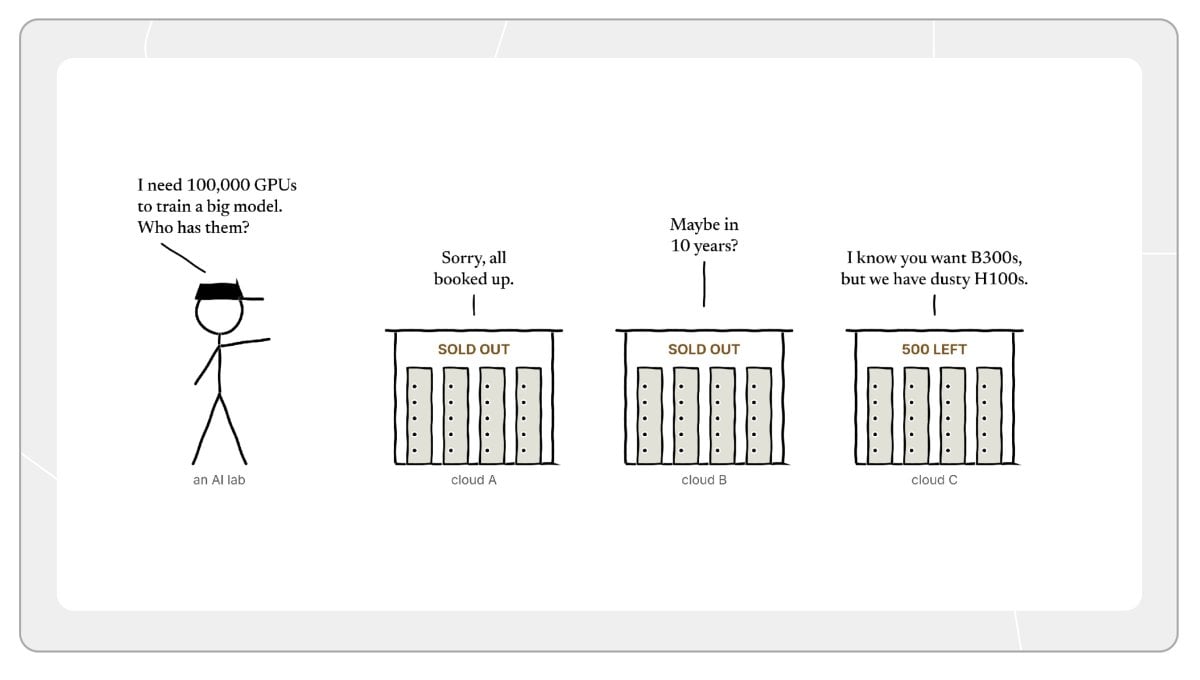
The most common industry explanation is "demand far outstrips supply." Everyone rushes to buy advanced chips, while new wafer fabrication capacity and data center infrastructure require years to deliver and commission.
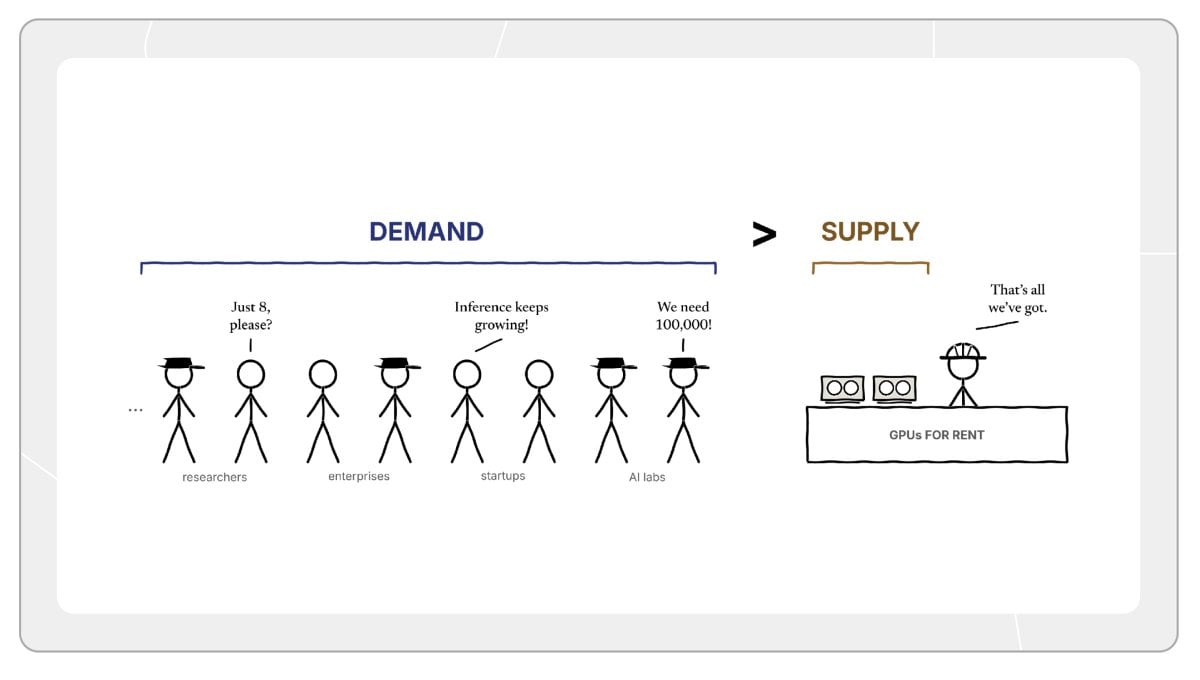
However, "demand exceeds supply" tells only half the story. A counterintuitive phenomenon shatters conventional wisdom: there is actually a vast amount of idle compute capacity in the current market.
If you visit existing buyers with robust balance sheets and massive compute fleets, you'll find they are rarely running at full load continuously. Model training exhibits distinct pulse-like bursts: during large-scale pre-training cluster tests, all hardware is instantly maxed out; yet between two training iterations, gaps of weeks or even months may occur, leaving tens of thousands of expensive chips operating at minimal utilization.
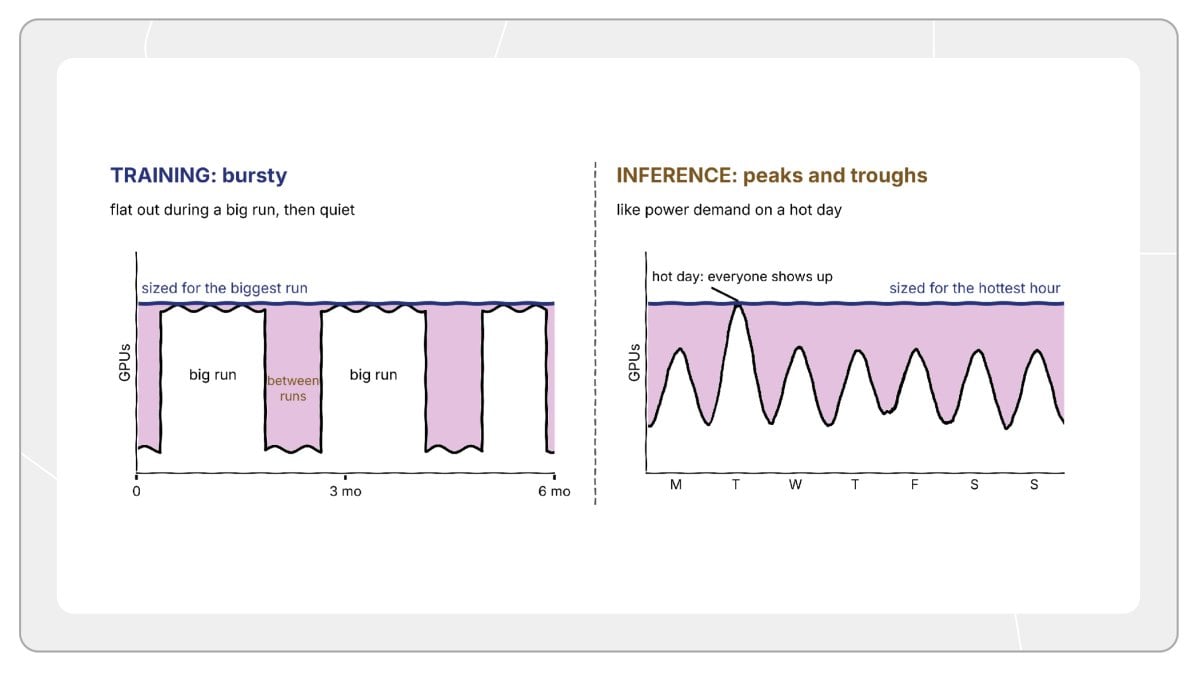
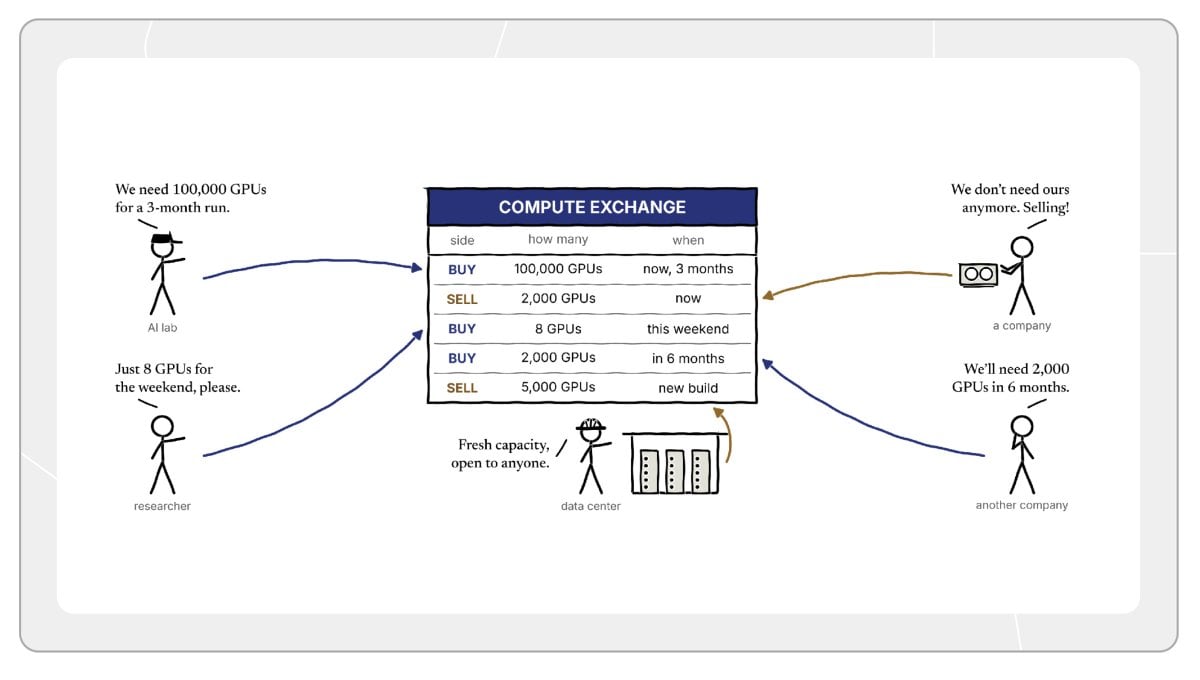
This massive valley of idle compute naturally sparks a highly attractive vision: building a spot exchange specifically dedicated to matching GPU hours. Free markets excel at efficient resource allocation and true price discovery; compute should be no different. Yet it begs the question: why hasn't such an exchange taken shape?
Blame is often placed on non-standardization in the technical dimension: compute isn't a single commodity. The market features Nvidia H100s, B200s, and B300s, alongside different generations of networking protocols (e.g., InfiniBand vs. Ethernet RoCE), plus variations in liquid cooling and geographic latency, making it difficult to mold into standardized contracts.
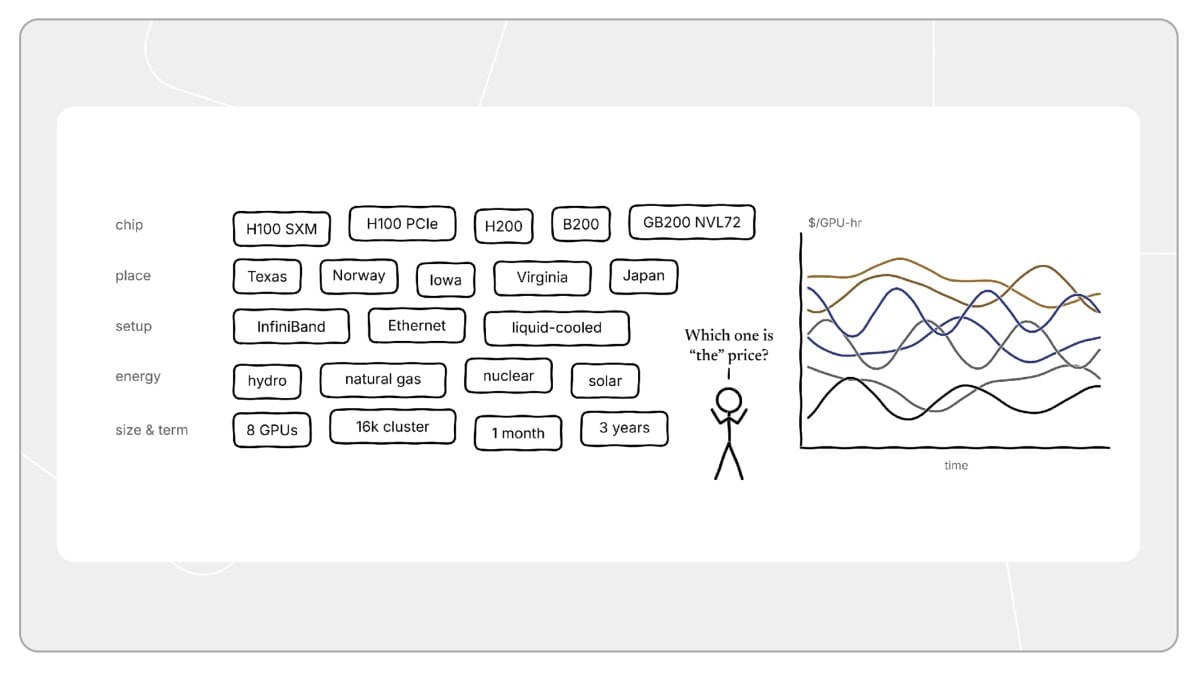
Yet this is hardly the core bottleneck. Looking at the commodities market, crude oil itself encompasses hundreds of grades and origins. The market ultimately established baseline pricing via WTI and Brent, with other varieties simply traded at premium/discount spreads. Compute inherently possesses the foundation for standardized conversion.
The deeply overlooked structural hindrance actually lies in the financing architecture behind the GPUs. The vast majority of hyperscale compute clusters are not purchased outright with proprietary capital but rely on massive borrowing. And the constraints embedded in loan terms directly dictate who can sell compute and who can acquire it.
Underlying GPU Financing Operations: Take-or-Pay Contracts
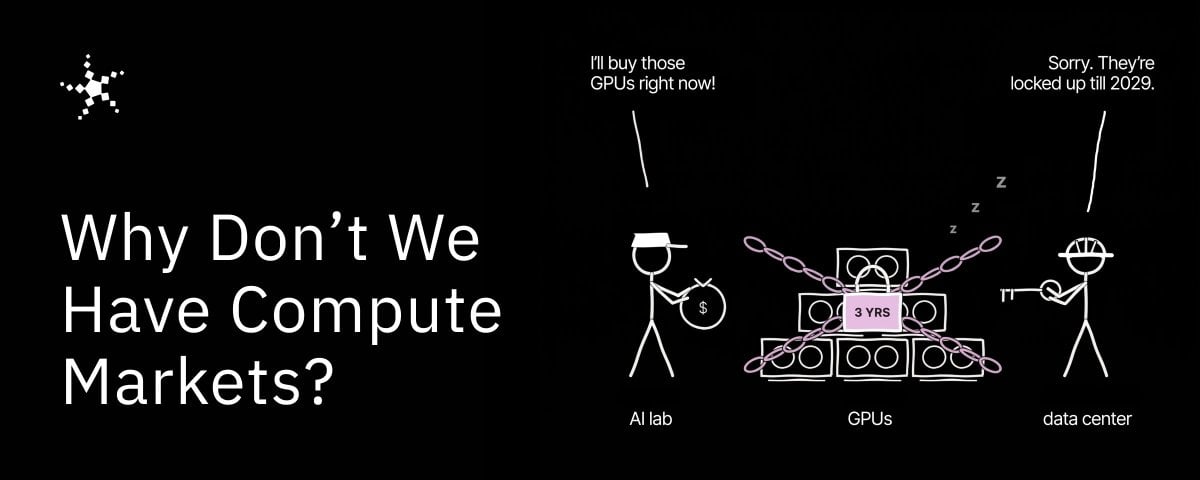
In the current business landscape, large-scale GPU deployments universally rely on take-or-pay agreements: exclusive long-term contracts spanning three to six years, obligating clients to pay full rent on schedule regardless of actual usage. This means all capacity is locked down before facilities even break ground or chips finish packaging.
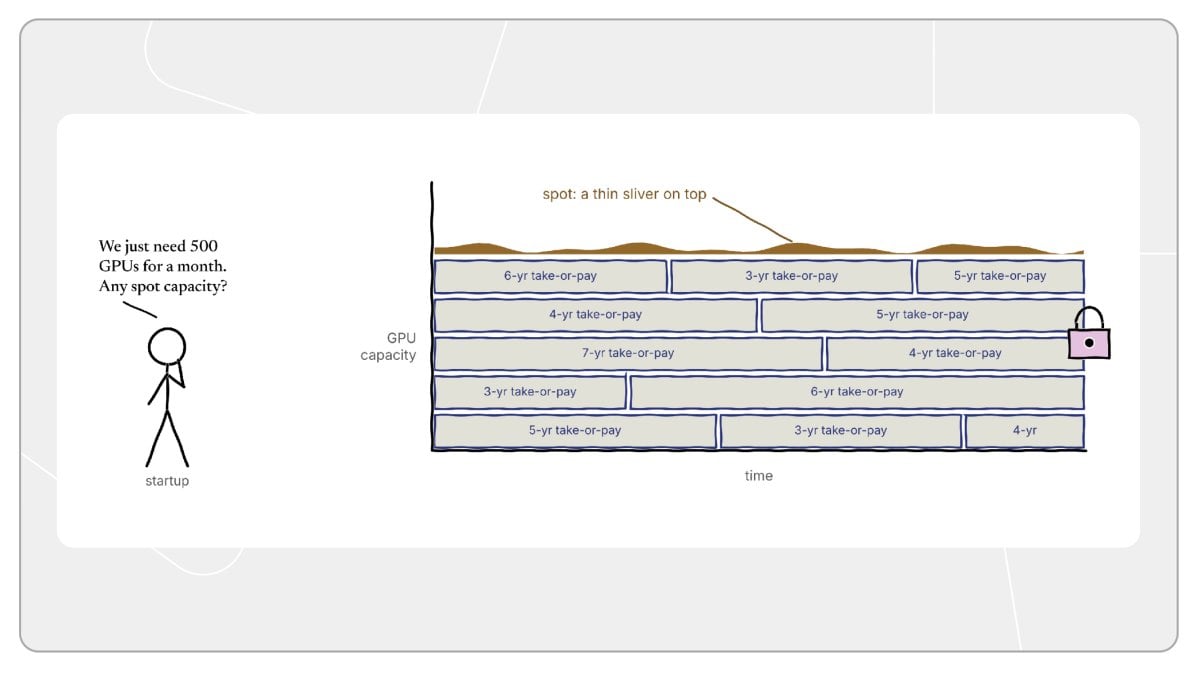
The Underlying Closed-Loop Logic of Take-or-Pay
Let's reconstruct the foundational logic of this business model. Suppose an AI lab urgently needs 100,000 GPUs, but all mainstream public clouds lack available inventory. An emerging specialized compute cloud (Neocloud) or facility operator is willing to build a custom cluster, but lacks hundreds of millions in spare working capital, necessitating a large project loan from financial lenders.
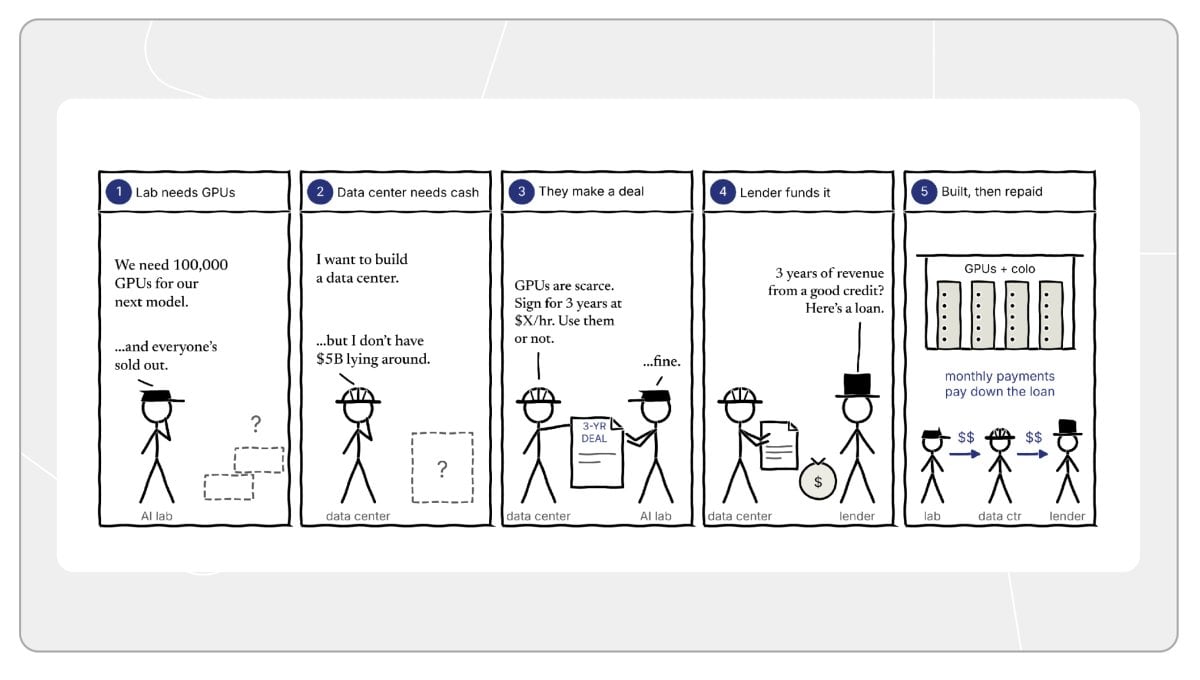
From the lender's standpoint: financiers are asked to inject billions into an emerging, volatile sector, with collateral being rapidly depreciating hardware that is hard to accurately value. How much will these chips be worth in three years? If the fledgling AI lab suddenly faces operational distress or bankruptcy, how does the financier protect itself?
Take-or-pay contracts perfectly resolve the financier's concerns. Backers need not worry about forecasting the hardware's secondary residual value, because the contract locks in predictable cash flows and a definitive payer. Essentially, the basis for lending is the irrevocable cash flow from end clients, not the liquidation value of the chips themselves.
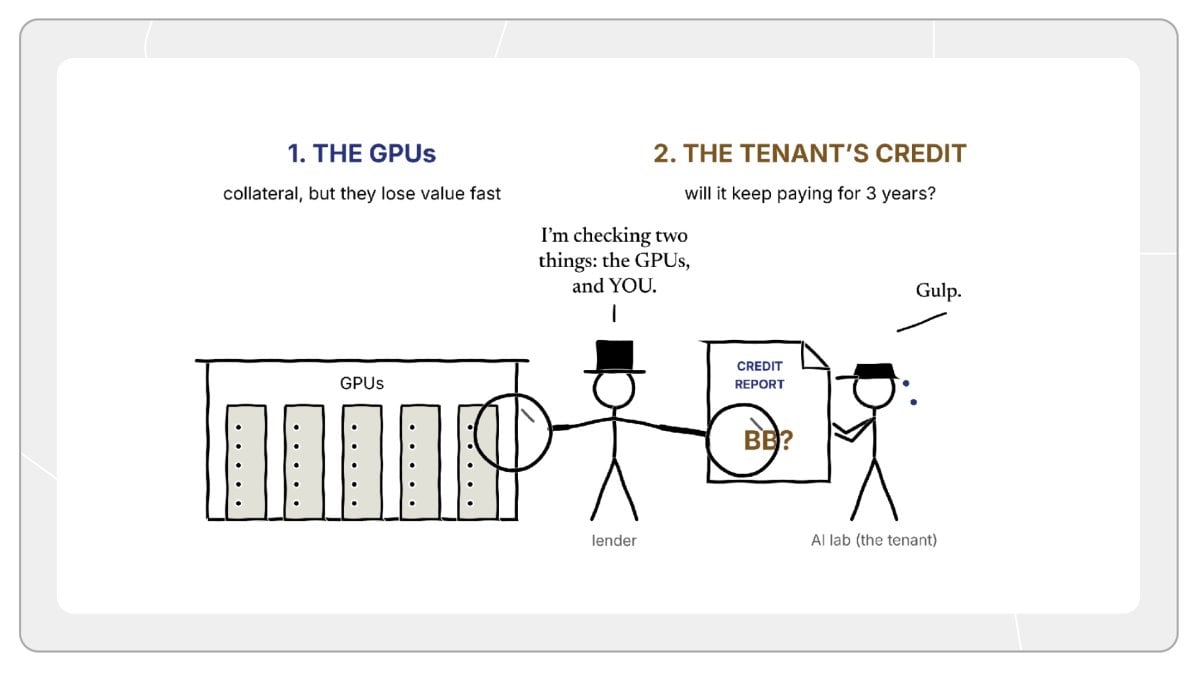
The key here is: the credit profile of the leasing client directly dictates the financing cost for the compute data center.
Weighing Pros and Cons from the Customer Perspective
From the end-tenant's perspective, long-term price locking effectively hedges against surging costs. If external compute lease indices skyrocket, the customer's unit price remains rock-solid, which holds immense strategic value in highly constrained supply chains.
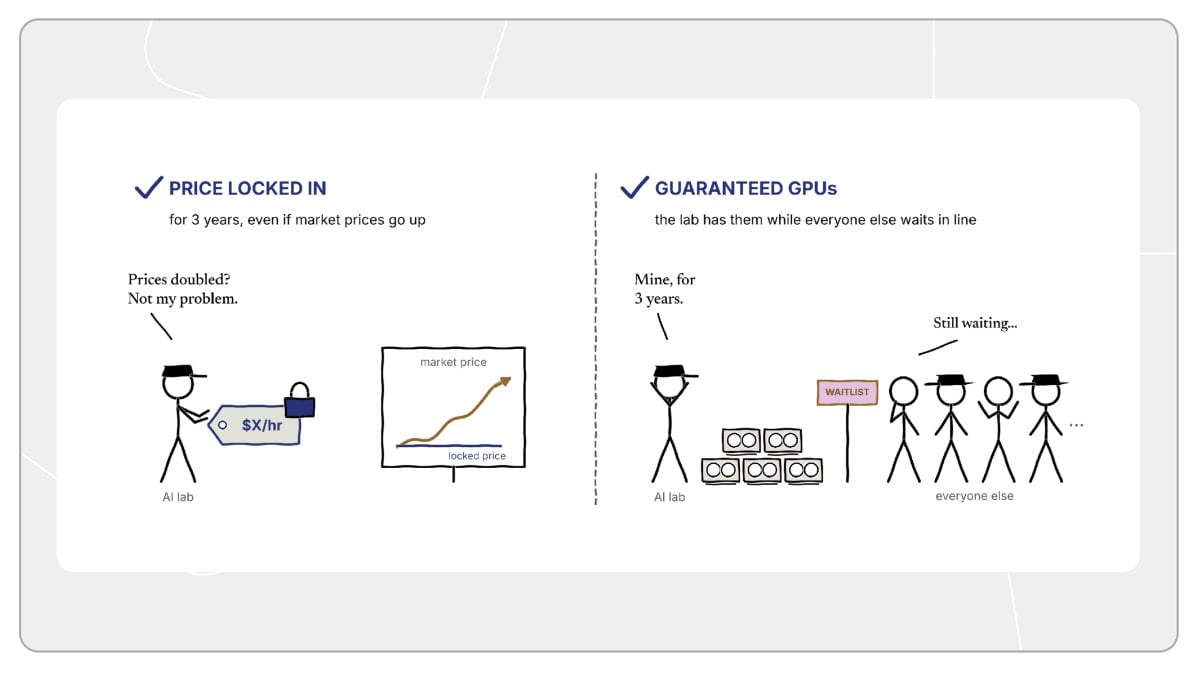
On the flip side, customers shoulder significant latent risks. First, if corporate operations deteriorate, funding dries up, or business strategy pivots, they must still fulfill every installment of massive payments. Second, customers must pay in full for substantial idle capacity. Procurement scales are typically configured for peak compute demands, but during windows between major training iterations, idled machines equate to burning cash.
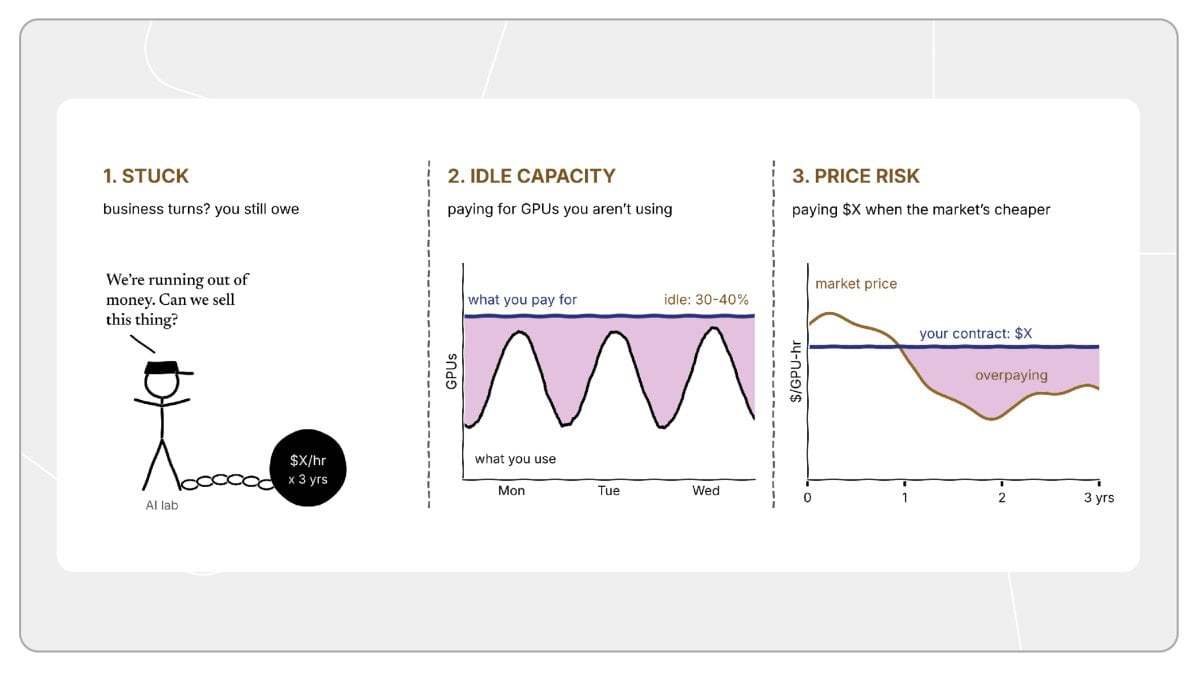
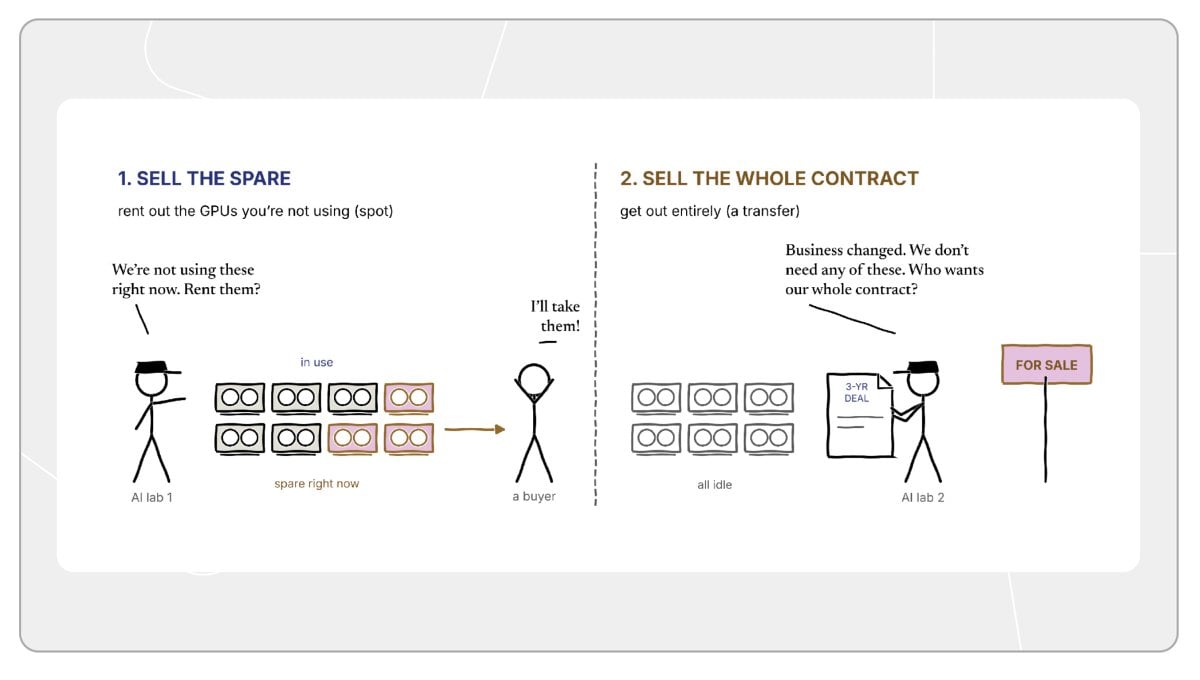
Intuitively, this seems like the perfect breeding ground for a secondary liquidity market: some clients hold unused quota during specific windows hoping to monetize it, while others desperately need short-cycle, plug-and-play compute.
Why a Compute Spot Exchange Remains Extremely Elusive
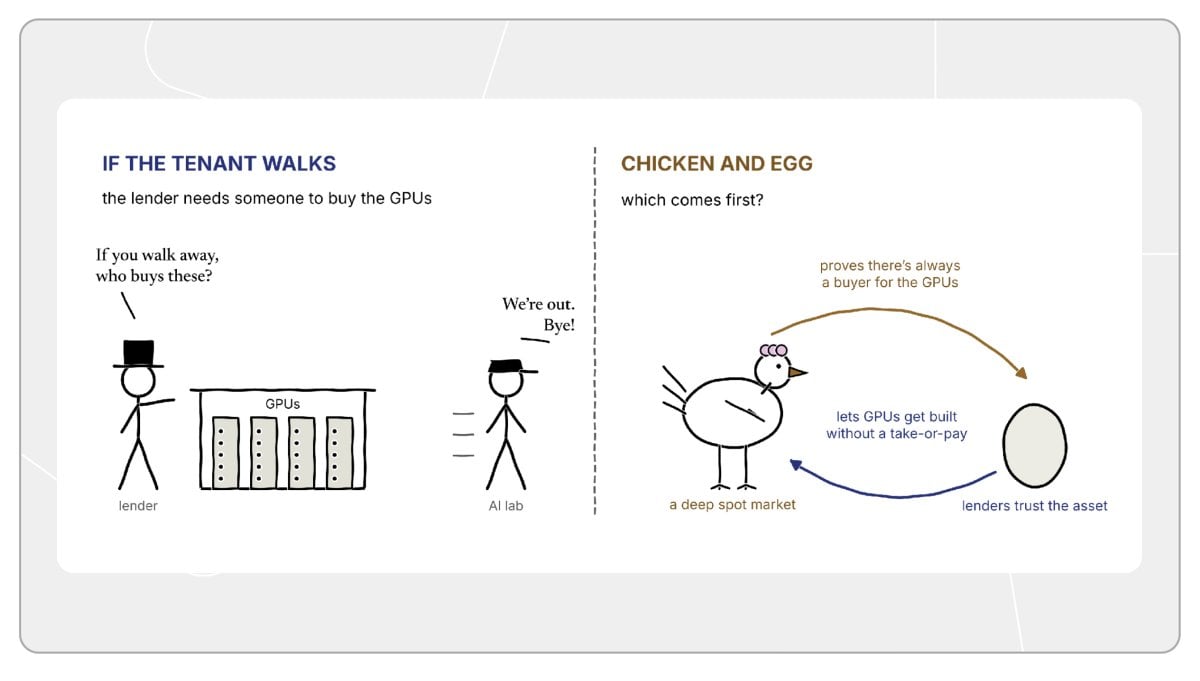
Picture a large lab finishing a phased task and no longer needing its GPUs, wanting to sell the remaining contract term to another party. Lenders will inevitably intervene harshly, since the core premise of the initial massive loan was betting on the original lab's premier credit strength.
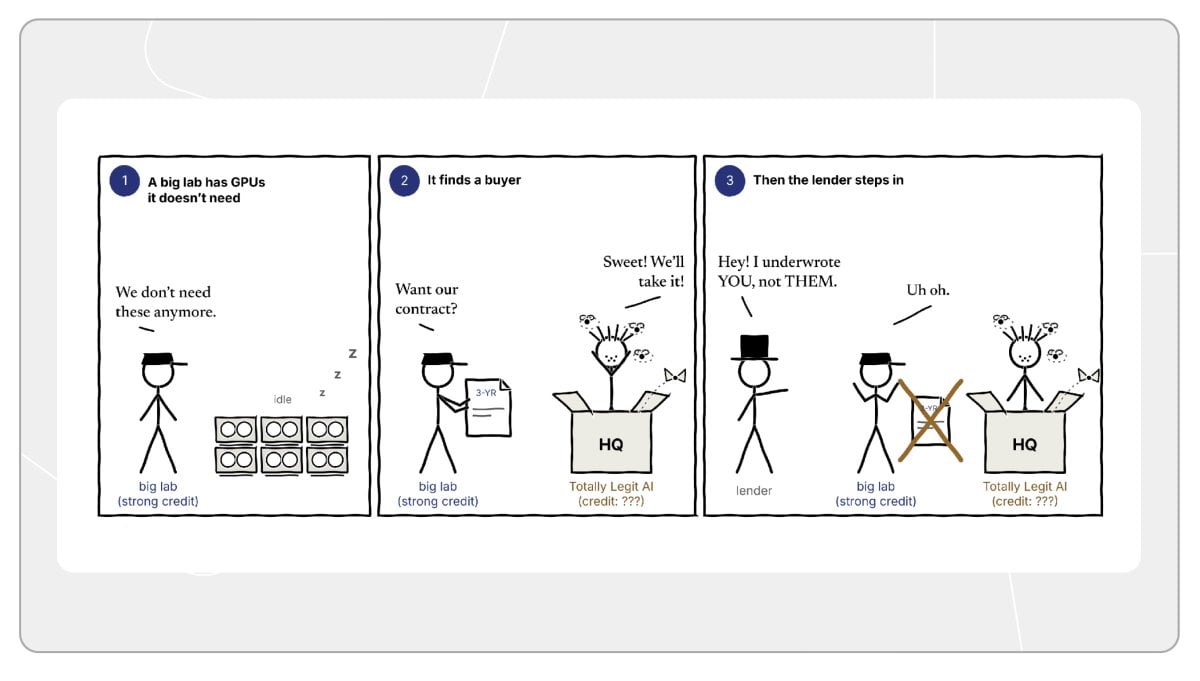
If the lessee is a well-capitalized, high-rated tech giant, the data center secures extremely low borrowing rates; but if the acquirer is a high-risk early-stage startup, the risk premium for borrowing on the same chip cluster will multiply exponentially. Tenant creditworthiness determines the true cost of capital. Transferring leases to lower-rated entities completely spirals financier exposure out of control.
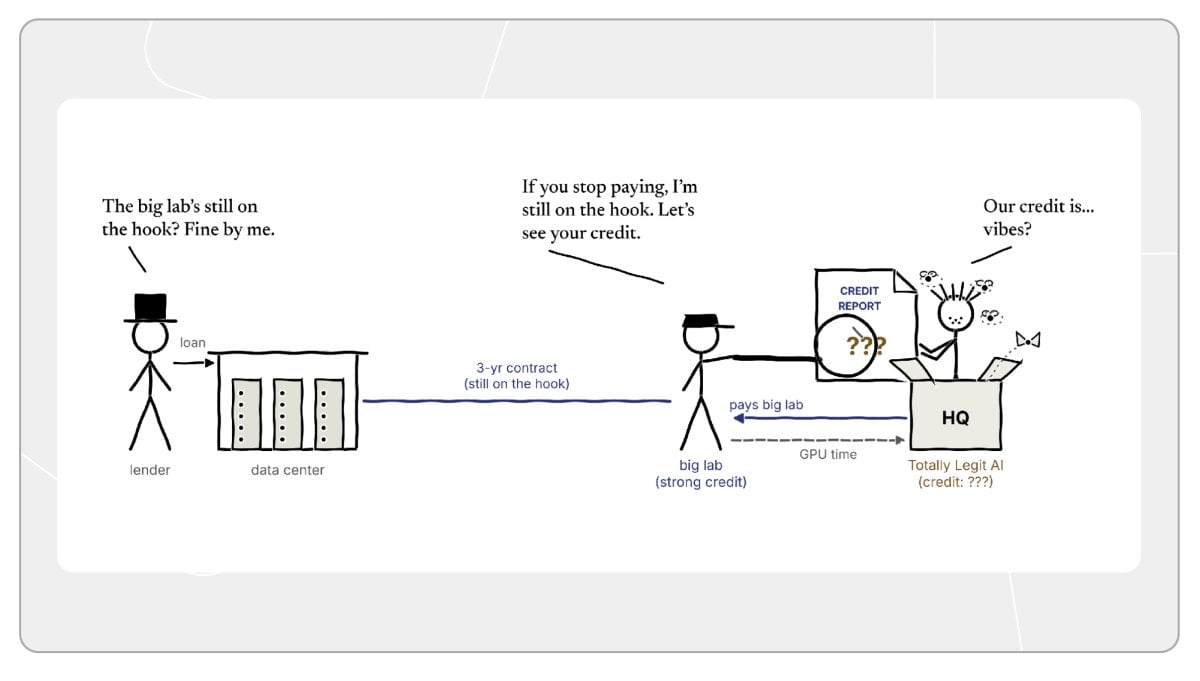
More critically, if the secondary tenant defaults, the original AI lab that initiated the sublease remains jointly liable to the data center operator. This heavy recourse chain makes compute transfers entirely incompatible with traditional financial matching mechanisms.
If you sell Apple stock on an exchange, your rights and obligations are fully settled the moment the trade executes; you don't even need to know who bought it. But in compute transactions, after resale you remain trapped in joint debt guarantees, effectively forced to act as the buyer's credit underwriter.
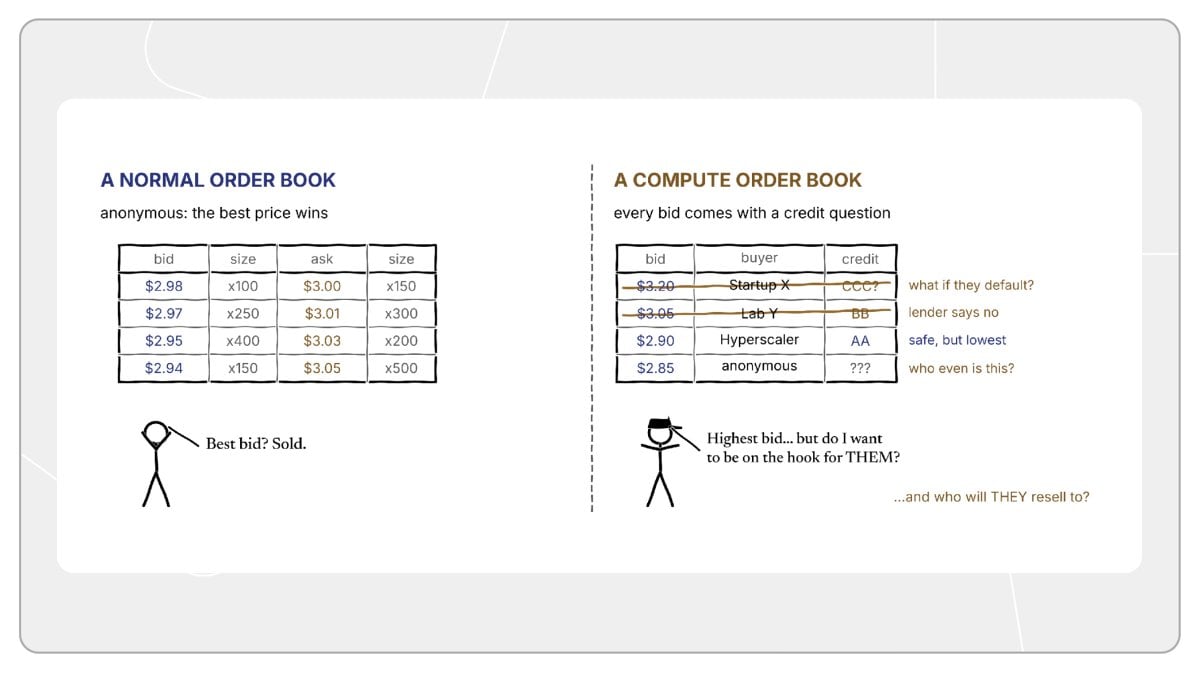
Subsequent cascading complexities arise: Can the secondary buyer resell to a tertiary buyer? Does the original lab at the bottom of the debt chain have the right to know the ultimate user's identity and business compliance? An intricate web of cross-linked credit makes compute spot trading fundamentally incapable of achieving large-scale, free-floating turnover like standardized commodities.
The Path Forward: Shifting from Client Trust to Asset Trust
Piercing through the surface reveals a singular root cause for all matching obstacles: in financier risk control logic, GPU hardware and its end user are bound as a single entity. Mature commodity markets operate differently. A barrel of crude oil doesn't care who ultimately buys it, because the market always hosts thousands of genuine buyers ready to absorb it at fair prices.
To truly land a compute spot market, lenders must shift to "trusting the asset itself" rather than "trusting specific clients." In other words, financiers must firmly believe that even if a major client defaults and vacates, they can swiftly find alternative tenants in the open market to seamlessly step in. Only by genuinely trusting the asset's liquidation mobility can the financial architecture fully decouple chip financing from actual end-users.
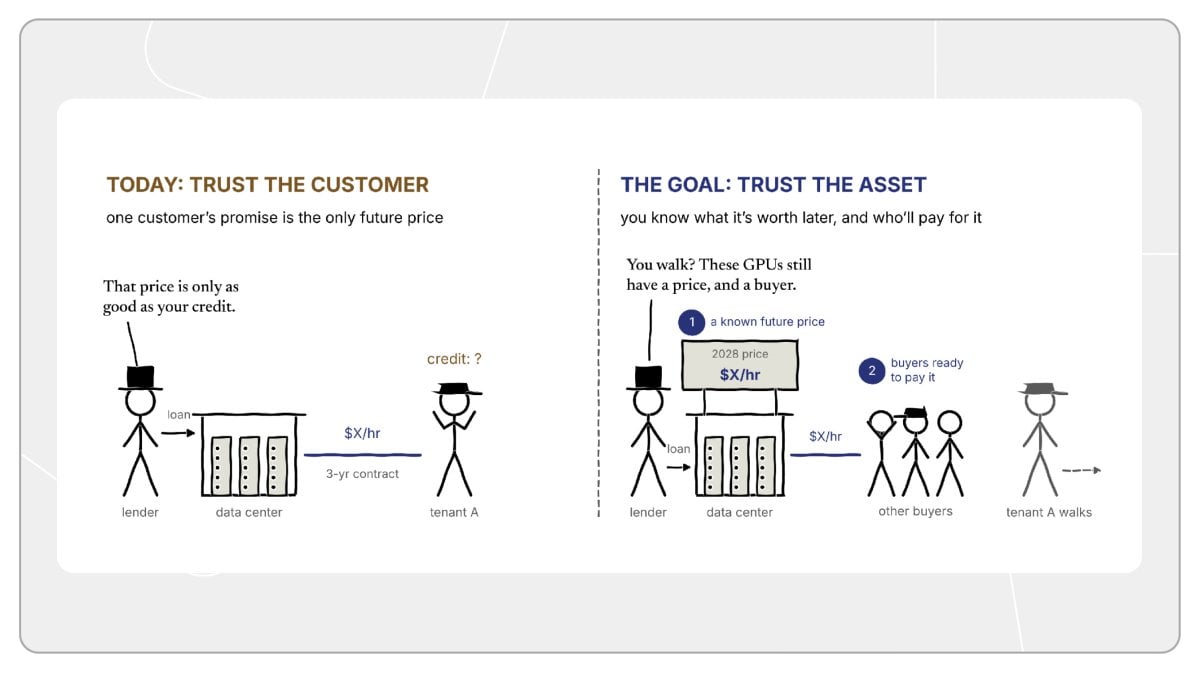
However, this decoupling faces a classic "chicken-or-egg" dilemma in practice. Financiers need a deep, liquid spot market as a safety net to ensure smooth liquidation upon tenant default. Yet a truly liquid spot market depends on financiers first dropping their attachment to rigid take-or-pay long-term contracts, willingly lending to clusters without investment-grade client backing.
Furthermore, even overcoming the initial liquidity cycle won't immunize deep spot markets from systemic risk. In the LLM sector, industry volatility is highly correlated. If a leading client suffers mass defaults, it likely signals deeper growth bottlenecks across the entire track, meaning spot rents would equally suffer cliff-like crashes.
Despite the formidable obstacles, transformation still breeds astonishing opportunities. GPU compute has become one of the world's most critical core productivity factors, with downstream demand exceptionally strong.
By contrast, the misallocation of global compute resources is staggering: one side sees institutions sitting on long-term contracts burning cash in idleness, while the other side consists of innovation teams desperate for chips but finding none. This inefficient allocation cannot persist indefinitely. Those who crack this underlying financial matching mechanism will unleash immeasurable economic value.
Appendix and In-Depth Background Analysis
First, top-tier labs represent composite exceptions. Large-model giants wielding massive compute typically combine model training with large-scale online inference services, capable of dynamically balancing workloads internally. As autonomous agents execute background batch processing tasks around the clock, the utilization efficiency of nighttime idle compute is seeing further optimization.
Second, credit constraints are not the sole origin of the missing spot market. Hardware generational heterogeneity, network topology, and physical migration costs present undeniable objective resistance. This article's core aim is to reveal the financial credit deadlock long ignored by the market.
Third, multi-tier asset and credit stacking. Giant clusters under actual construction often involve more complex capital structuring dynamics:
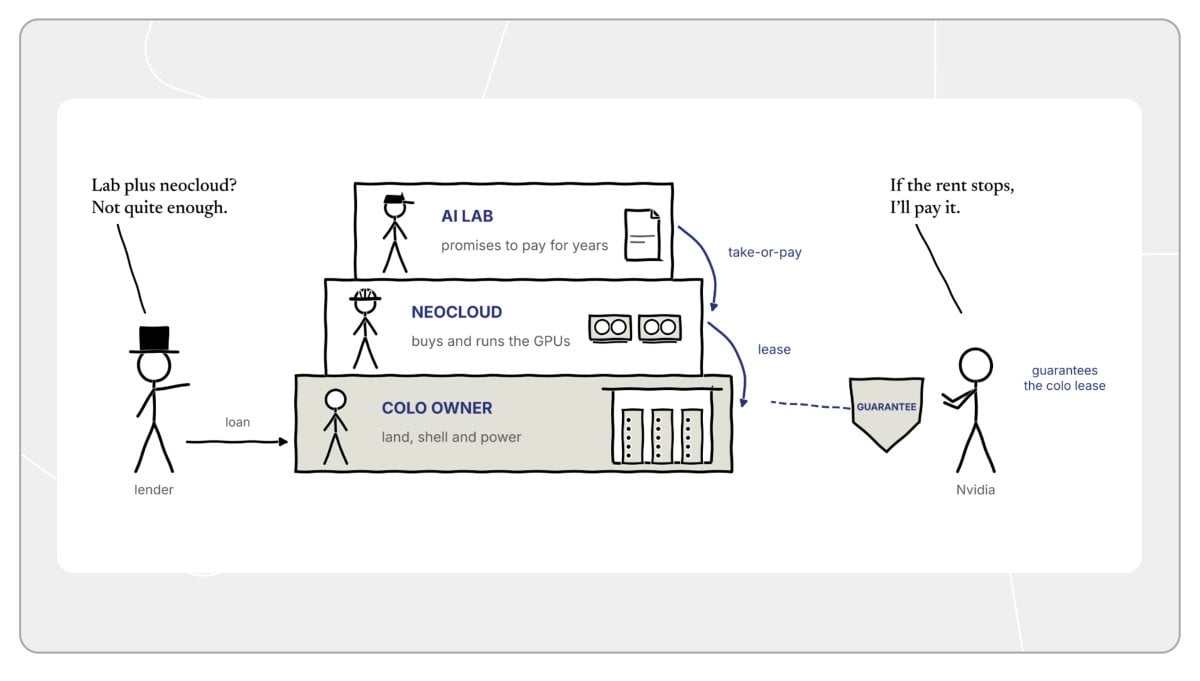
Data Center Facility Owners (Base-layer Assets): Typically heavy-real estate investors, holding land, civil engineering for data halls, power distribution, and cooling systems. They borrow from banks for construction based on long-term lease agreements.
Emerging Compute Cloud Providers (Middle-layer Operations): Responsible for procuring and deploying server clusters, paying space and power rent to facility owners. They obtain chip mortgage loans backed by their long-term lock-in obligations with downstream AI labs.
AI Labs (Top-layer Takers): Sign rigid multi-year take-or-pay contracts, regularly paying service fees to compute cloud providers.
Lenders to facility owners bet that emerging cloud providers will pay rent on schedule. Meanwhile, emerging cloud providers often have thin capital reserves, and their service contracts with labs typically span only three to five years, whereas the facility's underlying leases often exceed ten years. The load-bearing cornerstone of this financial edifice remains entirely tethered to the lab's credit fulfillment capability.
Fourth, limitations of contract assignment mechanisms. Certain advanced agreements permit transferring compute lease rights to third-party new tenants, but execution strictly mandates that new tenants possess equivalent asset credit profiles. As long as financiers waive joint liability for the original contracting party, sublessors remain trapped in long-term recourse risks.
Join TechFlow official community to stay tuned
Telegram:https://t.me/TechFlowDaily
X (Twitter):https://x.com/TechFlowPost
X (Twitter) EN:https://x.com/BlockFlow_News
 @jonah_b