
Bitcoin 66,000 Rebound Hits Warsh Moment: This Week's FOMC Is the Crypto Market's True Baton
TechFlow Selected TechFlow Selected
Bitcoin 66,000 Rebound Hits Warsh Moment: This Week's FOMC Is the Crypto Market's True Baton
The FOMC statement will be released on July 29 at 2:00 PM ET, followed by Warsh holding a press conference at 2:30.
 Navigating Web3 tides with focused insights
Author: Coinstack
Compiled by: TechFlow
TechFlow Editor's Note: Bitcoin briefly broke above 66,000 last week before falling back to the 63,000 range, coinciding with the key FOMC window for new Fed Chair Warsh. As the market trades the Fed first and itself second, the cross-market linkage between macro and crypto is becoming the strongest signal for short-term direction, precisely hitting the main thread of "cross-market linkage."
Weekly Overview
- After closing above $64,300 on July 26 (touching a high of $66,910 intraday on Tuesday), Bitcoin entered Fed interest rate week.
- Spot Bitcoin ETFs recorded a net inflow of $33.79 million for the week, while Ethereum ETFs recorded a net inflow of $103.9 million (July 24); Bitcoin's seven-day consecutive inflow ended on Friday with a net outflow of $240.08 million (SoSoValue).
- Tesla held 11,509 BTC unchanged in Q2, recording a tax-adjusted unrealized loss of $112 million under fair value measurement.
- Morgan Stanley submitted final documents for MSSE and MSOL spot staking ETFs on July 22, proposed for listing on NYSE Arca, with a management fee of 0.14%.
- CME FedWatch shows a probability of about 64% for holding rates steady in July, and a 35.5% probability for a 25 basis point rate hike.
- Focus this week: The FOMC statement will be released on July 29 at 2:00 PM ET, followed by a press conference by Warsh at 2:30.
Weekly Market Dashboard
Ethereum closed near $1,953 on Sunday, with spot Ethereum ETFs seeing net inflows for the third consecutive week, and outperforming Bitcoin funds in capital attraction for the second consecutive week. The Sunday evening rebound touched an intraday high of $1,960, boosted by news of a US-Iran ceasefire, lifting risk assets broadly.
All major large-cap coins closed higher this week. XRP had the smallest gain, closing near $1.10, consolidating near support levels; Bitcoin (+1.0%) and Solana (+0.3%) also recorded slight increases.
Institutional demand dominated early in the week and receded as Treasury yields climbed ahead of the FOMC. Bitcoin ETFs recorded the longest consecutive inflows since May before Thursday, subsequently erasing about $465 million on Thursday and Friday. Ethereum performed stronger mid-week, then fell back with Bitcoin. Tesla's earnings and Morgan Stanley's staking ETF application ran through Wednesday's main narrative thread.
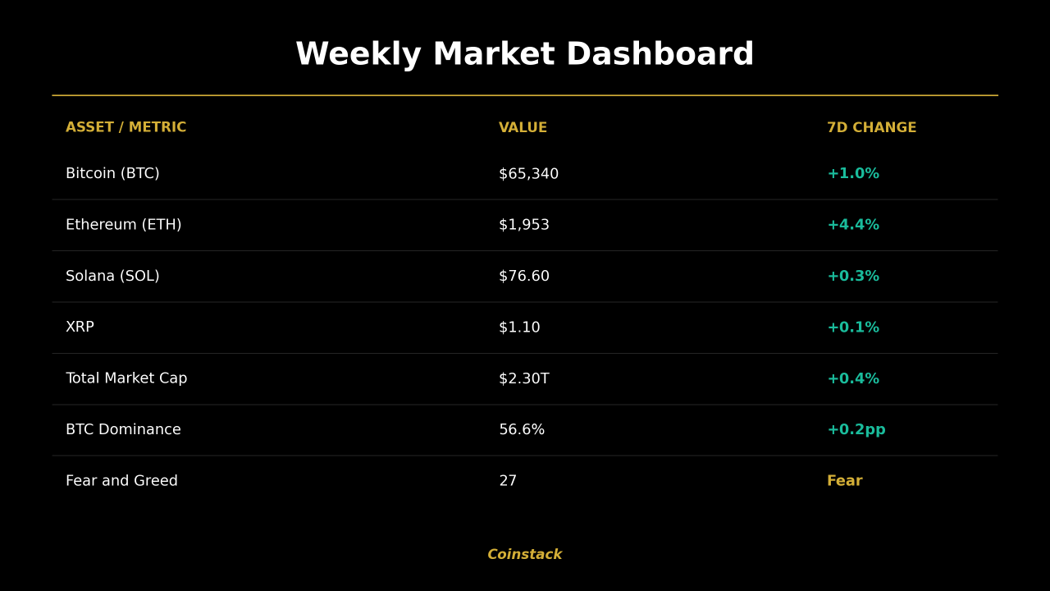
Figure: Crypto Market Weekly Dashboard (as of July 26, 2026). Sources: CoinMarketCap, CoinGecko, SoSoValue, Yahoo Finance, Alternative.me.
Bitcoin: Pullback After Surge to 66,000
Bitcoin surged on Tuesday driven by five consecutive days of ETF net inflows (totaling about $727.25 million from July 14 to 20, the strongest institutional pulse since May), breaking above $66,500; by Friday, as Treasury yields climbed ahead of the FOMC, spot Bitcoin ETFs saw outflows of $465.26 million over two trading days (SoSoValue). Ethereum maintained structural buying, continuing net inflows for the third week, while Tesla did not move its 11,509 BTC reserve. Attention now turns to Chair Warsh, whose press conference on Wednesday will set the tone for the September path.
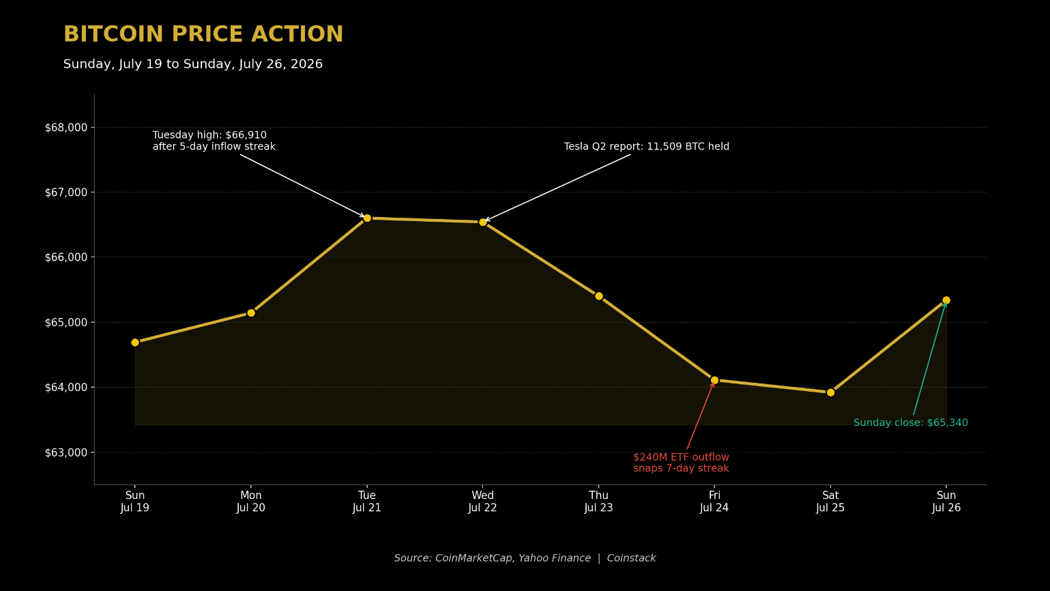
Figure: Bitcoin Price Trend (July 19 to 26, 2026).
Focus Shifts to FOMC: Warsh's Second Meeting
The FOMC meeting on July 28-29 is Warsh's second in office, with the federal funds rate held at 3.50%–3.75% for four consecutive times.
CME FedWatch as of Friday shows a probability of about 64% for holding steady, and a 35.5% probability for a 25 basis point rate hike. This meeting will not release the Summary of Economic Projections (SEP), so the statement wording and press conference will bear all the repricing.
Bitcoin's rebound to $66,910 on Tuesday, and the pullback on Friday, both stemmed from changes in Fed expectations, rather than crypto-native capital flows. If a hawkish hold moves September rate cut expectations forward, it could reignite ETF demand; if Warsh's press conference reinforces September rate hike expectations, the tightness trade will continue.
Position for the path rather than the level. Focus on September and December federal funds contracts, as well as the 10-year Treasury yield, until Wednesday afternoon.
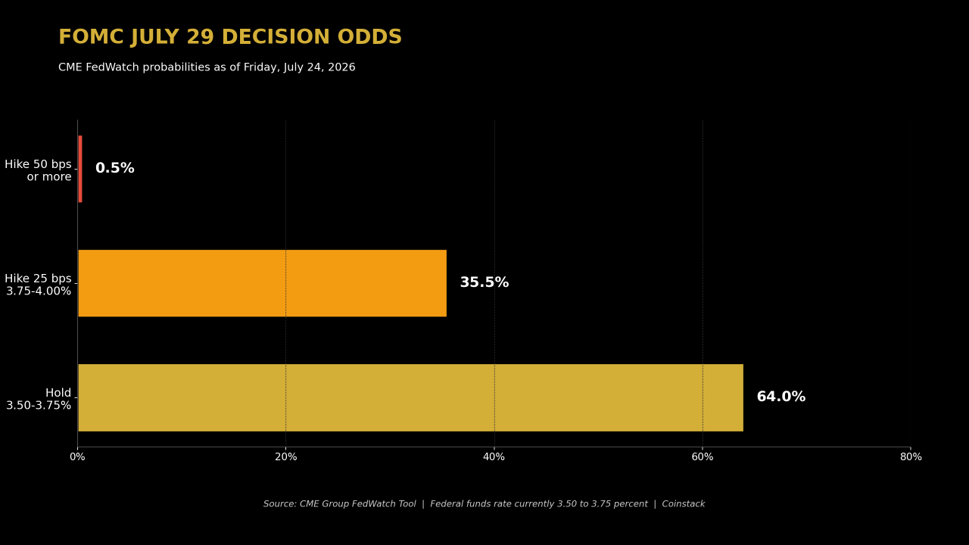
Figure: July Interest Rate Probabilities Shown by CME FedWatch Tool (as of July 24, 2026). Source: CME FedWatch Tool.
Tesla: Holdings Untouched for Four Years, Yet Records Book Loss
Tesla held 11,509 BTC unchanged in Q2, recording a tax-adjusted unrealized loss of $112 million under 2024 FASB fair value rules. Adjusted EPS was $0.33, below market expectations.
In this quarter where MSTR shifted to cash reserves, this four-year span of holding through drawdowns is the clearest institutional endorsement.
As long as the price is below cost, fair value measurement will continue to generate quarterly noise; while Tesla's HODL did not add marginal demand.
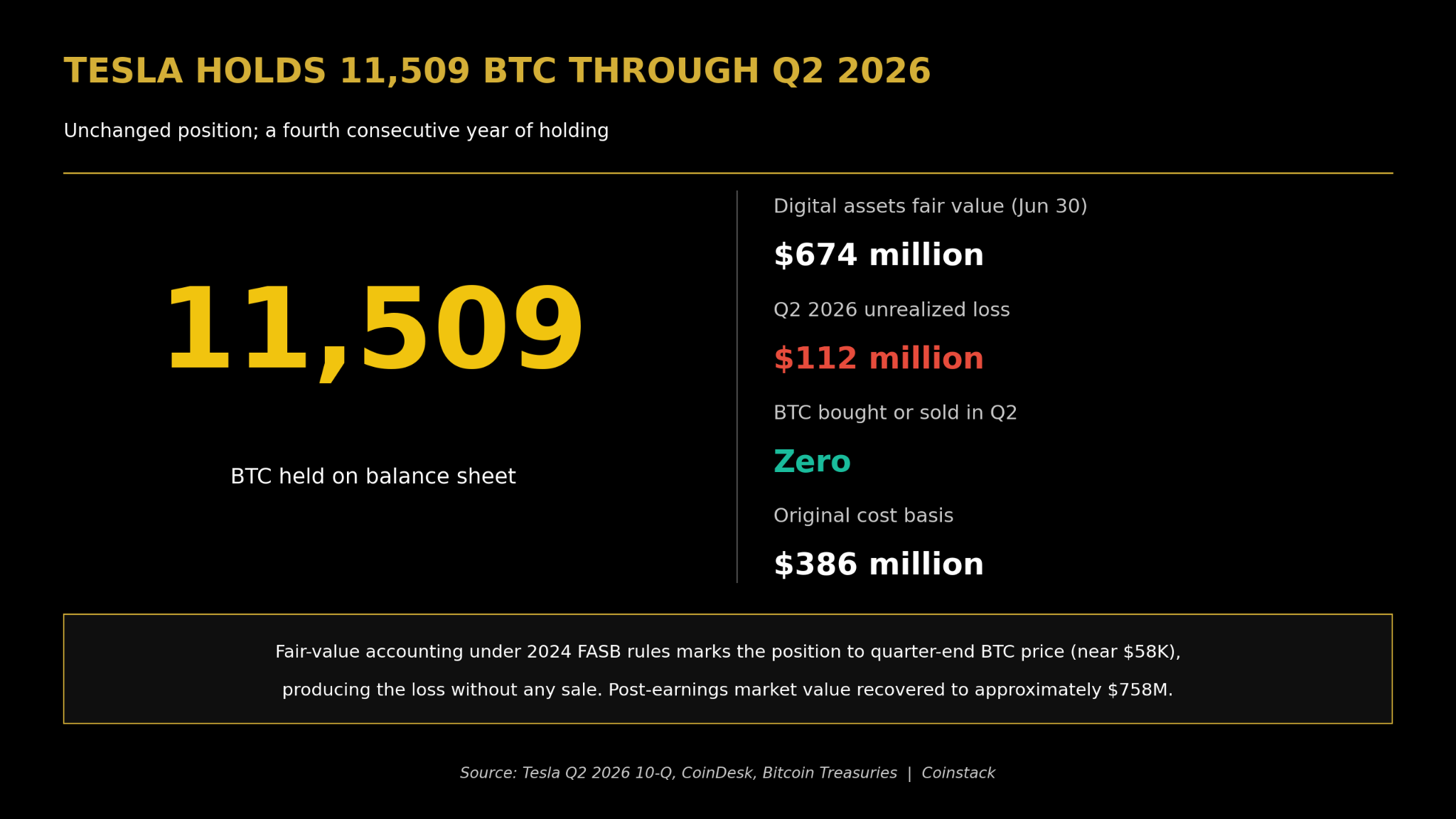
Figure: Bitcoin Holdings and Fair Value Changes in Tesla Q2 2026 Earnings. Source: Tesla Q2 2026 Update.
Morgan Stanley Rushes Staking ETF
Morgan Stanley submitted final documents for spot Ethereum (MSSE) and Solana (MSOL) staking ETFs on July 22, proposed for listing on NYSE Arca, with a fee structure of 0.14%. Custodied by Coinbase Prime and BNY Mellon; MSSE plans to stake 50%–80% of ETH, MSOL up to 100% of SOL.
The 0.14% fee rate is lower than most Bitcoin ETFs, and packages staking yields into a vehicle accessible to advisors and retirement accounts.
Staking design and tax treatment remain pending at the SEC. If final approval is delayed, this fee compression selling point will lose shelf appeal over time.
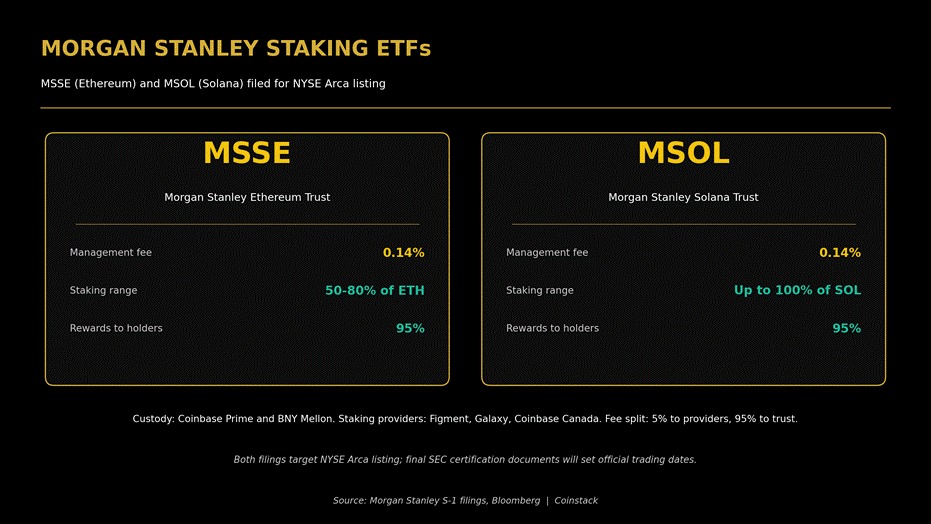
Figure: Morgan Stanley Spot Ethereum (MSSE) and Solana (MSOL) Staking ETF Structure. Source: SEC Filing Documents.
Strategy: Zero Increase for Two Consecutive Weeks, Cash Reserves Rise to 3.2 Billion
Strategy (formerly MicroStrategy) disclosed selling $263.5 million of MSTR stock from July 13 to 19, pushing its USD reserves to $3.225 billion. No BTC was bought or sold, the company holds 843,775 BTC (July 20 Form 8-K).
A larger cash buffer enhances Strategy's ability to pay Digital Credit dividends without being forced to sell BTC.
Strategy did not make any Bitcoin purchases for the second consecutive week, its Bitcoin accumulation flywheel temporarily stalled.
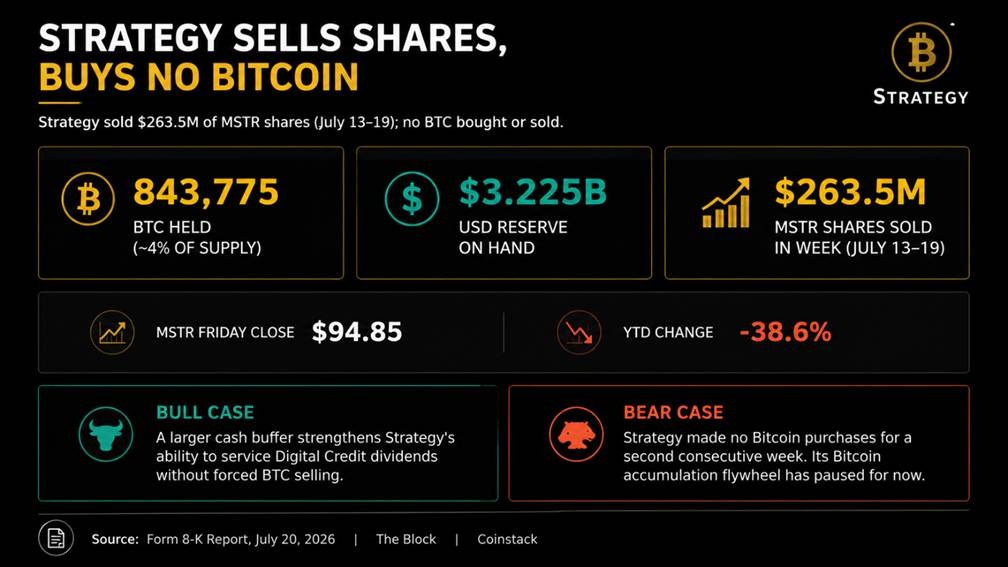
Figure: Strategy (formerly MicroStrategy) Cash Reserves and BTC Holdings Changes (as of July 20, 2026). Source: Form 8-K.
Ethereum Staking Queue: 2.52 Million Queuing to Enter
Over 2.52 million ETH are in the validator entry queue, accounting for about 2% of circulation, with an activation wait time of 43 days 22 hours (as of 10:30 AM ET on July 27), and exit demand near zero.
New ETH is queuing to be locked, rather than sold off. Similar backlogs have appeared synchronously with ETH accumulation phases and rising staking ratios.
Institutional demand for yield-bearing ETH is accelerating, coinciding with Grayscale preparing to pay Ethereum staking ETF rewards in cash quarterly starting around August 7 (pending SEC approval). Both point to a mature structural buy side that does not require price momentum.
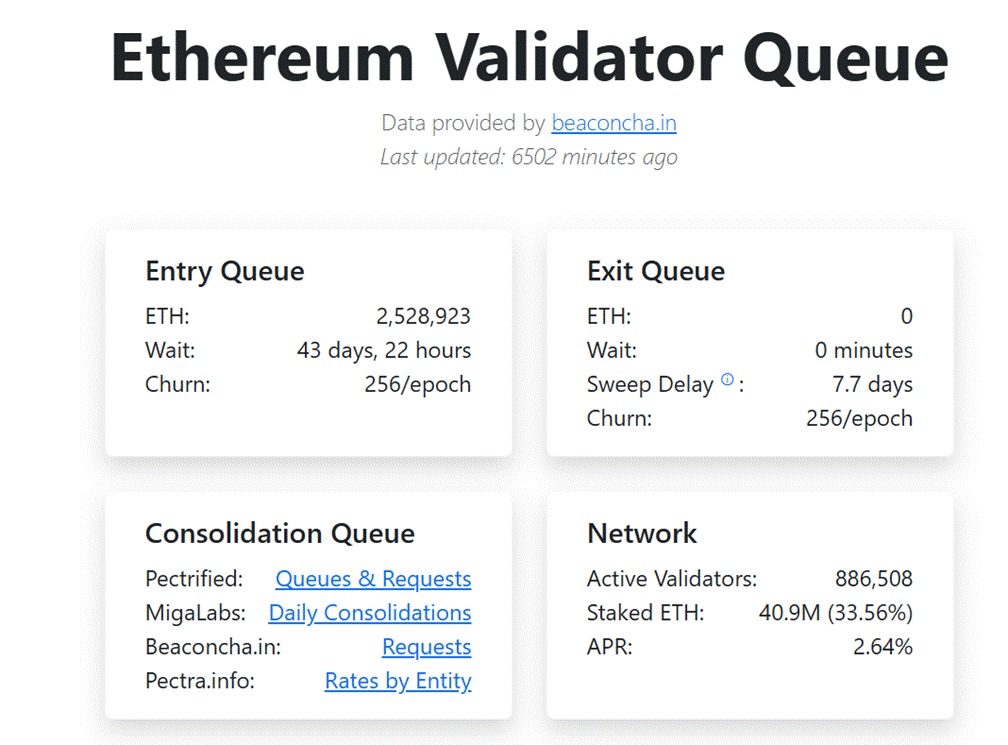
Figure: Ethereum Validator Entry Queue Size and Activation Wait Time (as of July 27, 2026). Source: Validator Queue.
Staking Yields Become New Battlefield for ETFs
Grayscale is about to pay ETH staking rewards in cash, Morgan Stanley plans to stake 50%–80% of its ETH and up to 100% of SOL, and Bitwise's BSOL has already adopted a staking design. Yields are becoming a differentiating factor among US crypto ETFs.
Staking yields turn crypto ETFs into income products that advisors can embed alongside REITs and dividend stocks. The nearly 44-day ETH entry queue signals real institutional demand.
The SEC has not yet finalized staking treatment under the Investment Company Act, and any variables in tax or custody will weaken this selling point.
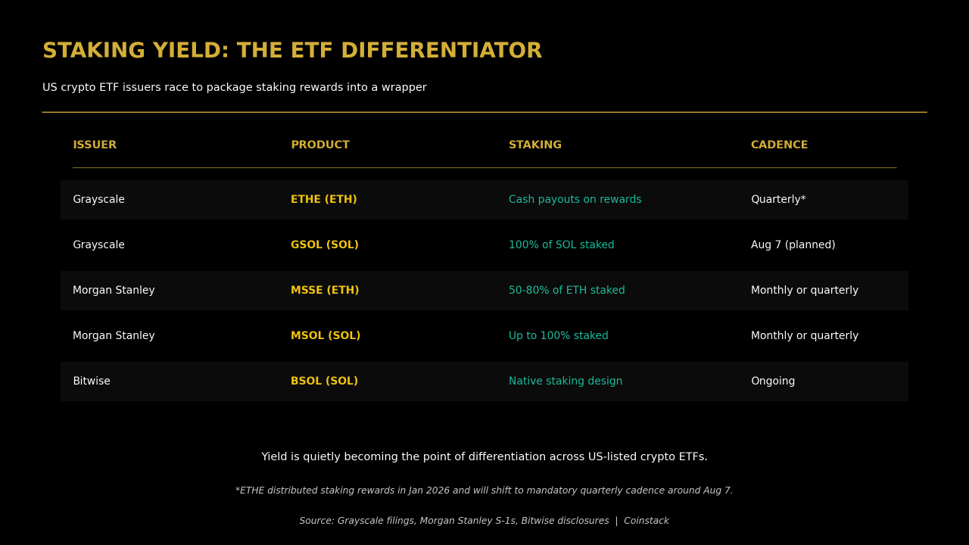
Figure: Overview of US Listed Crypto Staking ETFs.
Overview of US Listed Staking ETFs
US listed staking ETFs turn ETH and SOL into packaged yield instruments with regulated custody and cash distribution, opening channels for capital that will never directly touch validators.
Key nodes to watch: Grayscale's August 7 Ethereum staking distribution launch, SEC final action on MSSE and MSOL, and more fee filings ≤0.14%.
A hawkish Warsh press conference may compress risk appetite for high Beta Layer-1 networks, and any staking rules limiting fee aggregation will reprice this vehicle.
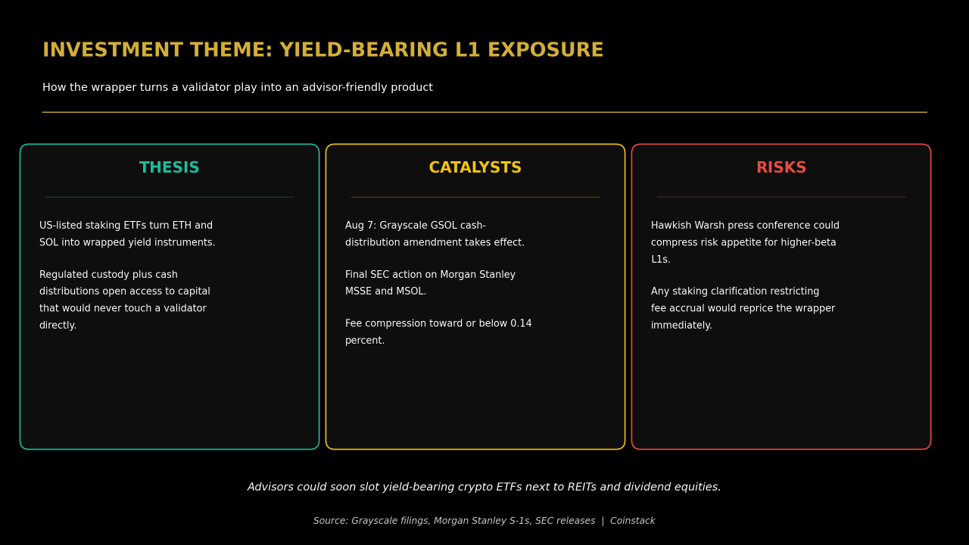
Figure: Comparison of Ethereum Staking Entry Queue and Exit Queue.
Entry Queue: Locked Supply is a Leading Indicator
Ethereum's staking design limits the rate of new validator activation, so when demand surges, ETH piles up in the entry queue. A long queue means holders are willing to lock capital for weeks in exchange for base layer yields.
The queue is a leading indicator of committed supply. Coins in queue are unlikely to enter exchanges soon, and when the exit queue is empty, the sellable share of ETH contracts accordingly. A surge in the exit queue will reverse the signal.
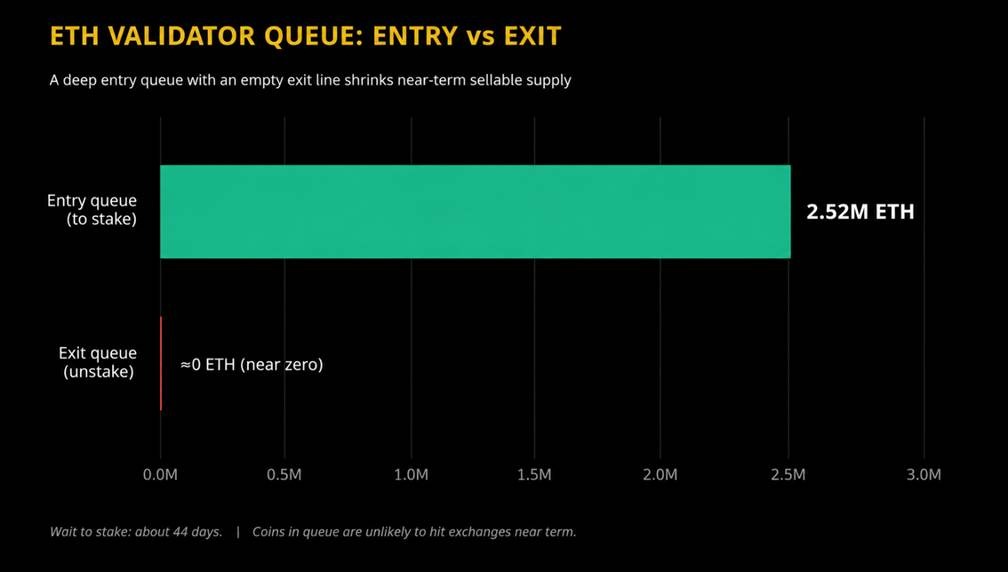
Figure: Schematic of Ethereum Validator Activation Rate and Entry Queue Mechanism.
Join TechFlow official community to stay tuned
Telegram:https://t.me/TechFlowDaily
X (Twitter):https://x.com/TechFlowPost
X (Twitter) EN:https://x.com/BlockFlow_News
 @coinstackcrypto