Virtuals Launches Hyperboost: 14-Day Reward Extension for Every Graduated Token to Combat the "First-Day Peak" Curse
TechFlow Selected TechFlow Selected
Virtuals Launches Hyperboost: 14-Day Reward Extension for Every Graduated Token to Combat the "First-Day Peak" Curse
Will AI tokens that peaked at launch make a comeback?
 Navigating Web3 tides with focused insights
Author: Claude, TechFlow
TechFlow Insight:Virtuals Protocol launched the "Hyperboost" mechanism on July 27, converting a portion of idle supply at token graduation into trading and content rewards released daily over 14 days, automatically covering all newly graduated tokens.
Official data shows that over 75% of tokens on the platform reach peak trading volume within 24 hours after graduation launch, followed by a rapid decline. Hyperboost attempts to extend this price discovery window, but with the mechanism live for only two days, early graduated projects still show a typical "post-graduation plunge" trend, and the effectiveness remains to be seen.
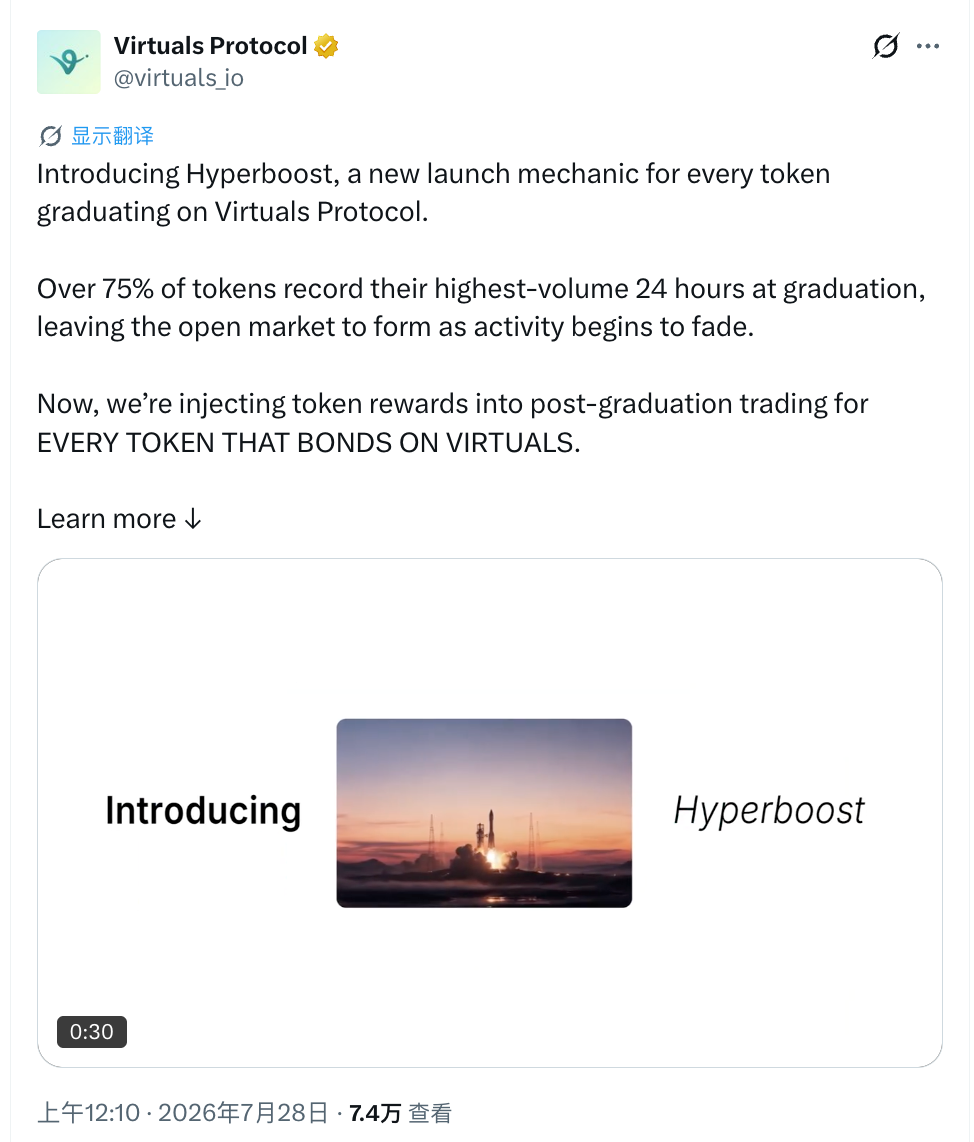
AI Agent token launch platform Virtuals Protocol has long had an old problem:
On the day a token "graduates" and launches on the bonding curve, trading volume usually peaks, followed by a continuous decline. Platform data shows that over 75% of tokens record highest trading volume within 24 hours after graduation, and public market activity fades rapidly thereafter.
On July 27, Virtuals launched the Hyperboost mechanism, attempting to extend the market heat after graduation using economic incentives.
Mechanism Breakdown: Idle Supply Becomes Trading Rewards, Released Daily for 14 Days
The core logic of Hyperboost is to activate a portion of token supply that was originally idle.
In the past, when tokens graduated from the bonding curve and entered public trading on Uniswap, a portion of the supply was set aside for a smooth transition, actually remaining in an idle state.
Hyperboost reallocates this portion of supply, converting it into a reward pool released daily over 14 days after graduation.
Rewards are distributed in two lines: trading rewards are allocated based on the wallet's trading volume proportion for the day; content rewards are for creators publishing content around the token on platforms like X. 1/14 of the total rewards are released daily, with no lock-up or vesting restrictions for claiming; they can be claimed upon arrival.
The mechanism takes effect automatically, requiring no configuration or manual activation by founders. All tokens that complete graduation after 16:00 UTC on July 27 will automatically enter the Hyperboost window.
The official whitepaper does not disclose the specific idle supply ratio or reward allocation percentage, only stating it as "a fraction of token supply".
Details on the evaluation criteria for content rewards are also limited, and the community has raised certain questions regarding the transparency of anti-farming mechanisms and content scoring rules.
Current State of Virtuals Ecosystem: 18,000+ Agents, Market Cap Around $400 Million
Hyperboost is not an isolated product; it is embedded within Virtuals' entire AI Agent tokenization ecosystem.
As of the first half of 2026, the Virtuals Protocol platform has cumulatively launched over 18,000 AI Agent tokens, with cumulative protocol revenue exceeding $75 million.
Along with changes in the overall crypto market and the development of AI Agents, Virtuals has been very intensive in ecosystem and product expansion since the first half of the year. In March, it launched the ERC-8183 standard (in collaboration with the Ethereum Foundation) for AI Agent on-chain identity;
In early July, it completed the cross-chain infrastructure migration from LayerZero to Chainlink CCIP, involving over $700 million in VIRTUAL liquidity; Robinhood Chain also announced it will integrate Virtuals' AI Agent infrastructure on its new chain.
These are more like long-term considerations and underlying product updates, while Hyperboost is more like an innovation in gameplay regarding token trading and rules.
Two Days After Launch, Some Graduated Projects Still "Plunging as Usual"
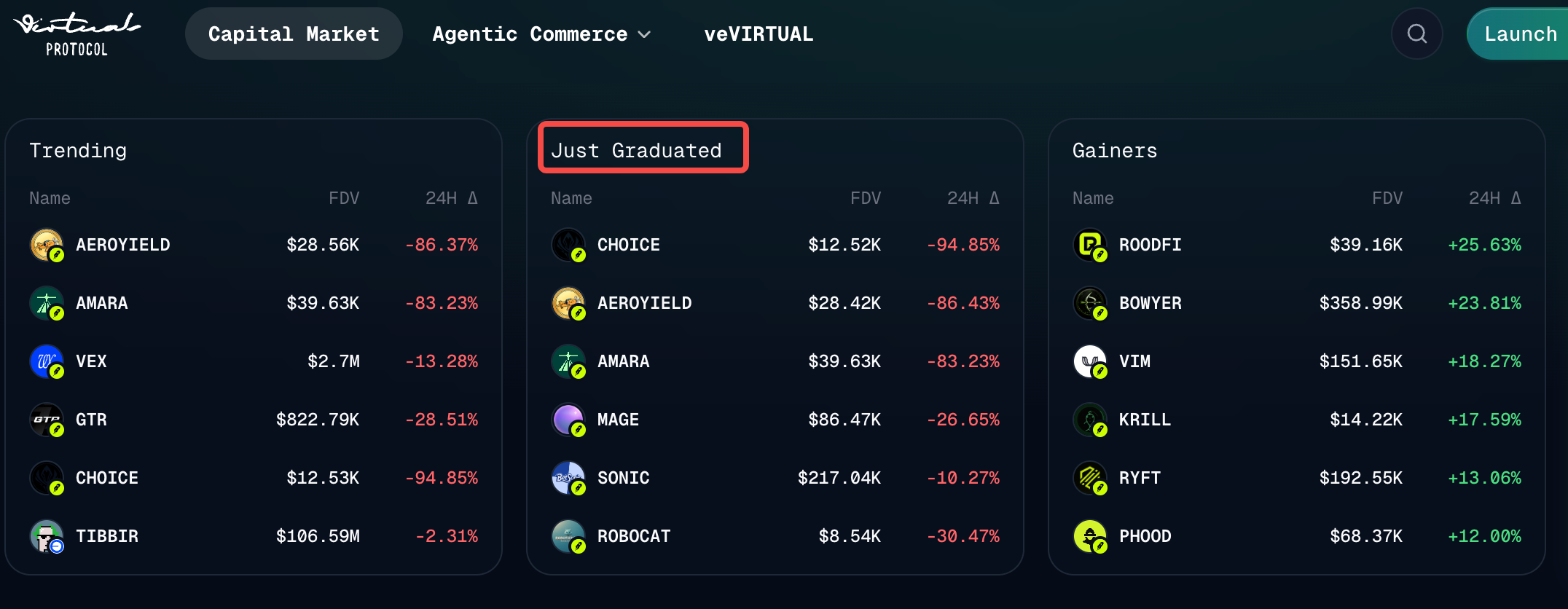
Hyperboost has been live for only about two days, and some early samples can be seen in the Just Graduated section of app.virtuals.io.
AMARA (Amara Exchange) graduated about 9 hours ago, with an FDV of around $51,000, a 24-hour decline of about 78%, trading volume of around $358,000, and about 185 holders.
MAGE is related to Mage Trading AI Agent, with a 24-hour decline of about 55%. GTR (gtr.trade) has been live for about 4 days, with an FDV of around $700,000, a 24-hour decline of about 44%, about 1,700 holders, and liquidity of around $110,000.
These data still present a typical "post-graduation peak decline" pattern, which is exactly the phenomenon Hyperboost attempts to alleviate. However, considering the mechanism has been effective for less than 48 hours and the 14-day reward cycle has not completed the first round, the current sample size and time span are insufficient to judge the effectiveness.
Core Question: Will Trading Volume Rewards Become a Cash Machine for Farmers?
Currently, comprehensively speaking, the community's discussion focus on this new product centers on several aspects.
First, if trading rewards are allocated based on trading volume proportion, this design naturally attracts wash trading. If a wallet contributes 50% of the trading volume on a certain day, it takes away 50% of the trading rewards for that day. For tokens with an FDV of only tens of thousands of dollars, the cost of wash trading may be lower than the reward yield, making the arbitrage space obvious.
The official response is that the total daily reward pool is fixed; even if someone wash trades, they are just sharing a larger piece of the fixed pool, not amplifying it infinitely. However, the premise for this argument to hold is that the reward pool itself is not large (officially undisclosed); if the reward scale is considerable, the wash trading incentive still exists.
Second, the evaluation criteria for content rewards are equally vague. Current rules only state "parameters are set by the protocol and can be adjusted to maintain distribution integrity," but do not disclose details such as specific content scoring mechanisms, whether account verification is required, or how to prevent bulk spam posting.
For a mechanism that publicly claims to incentivize content creation on the X platform, the absence of these rules casts doubt on the actual effectiveness.
Limited Impact on VIRTUAL Token
Hyperboost gives VIRTUAL a new growth story at the narrative level. If the mechanism can indeed extend the trading active period of graduated tokens, it means more trading volume passes through liquidity pools paired with VIRTUAL, indirectly increasing demand for VIRTUAL.
According to TronWeekly, the VIRTUAL price showed technical bullish signals shortly after Hyperboost went live, with some analysts giving a short-term target price of $0.70.
But at the same time, VIRTUAL has fallen about 7.4% in the past 7 days and overall remains dragged down by the broader market decline. BTC has recently turned negative, and the overall crypto market sentiment is weak.
Perhaps launching a phenomenal token would be more conducive to reversing this decline. Subsequently, we can closely monitor the trading volume retention rate of graduated tokens within the 14-day window, whether the number of newly graduated tokens increases due to incentives, and the actual consumption volume of VIRTUAL as a paired asset.
These data will require at least 2 to 4 weeks to accumulate sufficient samples, but in the current situation where crypto projects are gradually shutting down or changing tracks, Virtuals continues to constantly seek changes and update gameplay, which is actually a welcome development.
Join TechFlow official community to stay tuned
Telegram:https://t.me/TechFlowDaily
X (Twitter):https://x.com/TechFlowPost
X (Twitter) EN:https://x.com/BlockFlow_News
 深潮TechFlow