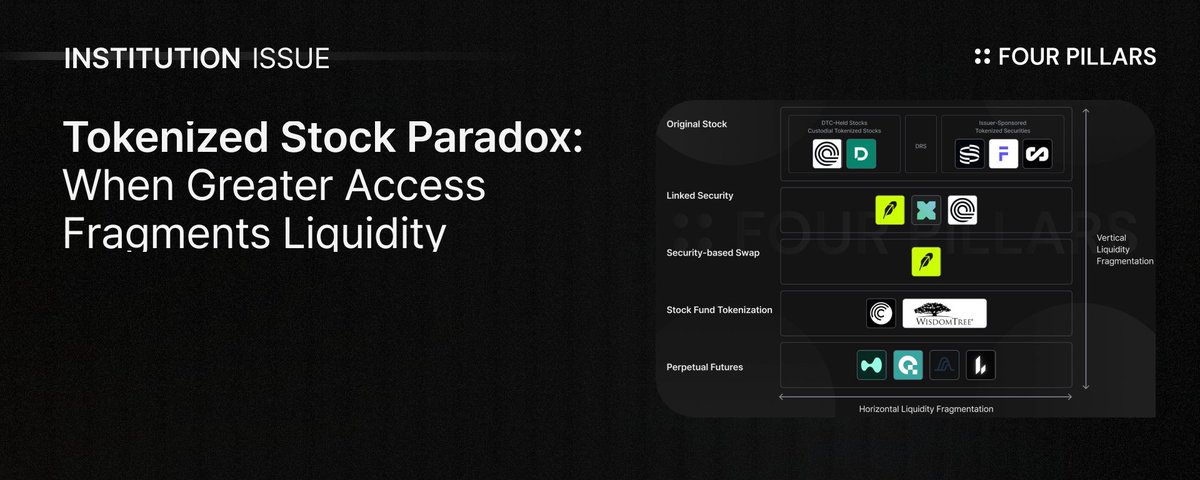
Tokenized Stock Scale Increases by 56% in Three Months, How Can Crypto Solve the Liquidity Fragmentation Dilemma?
TechFlow Selected TechFlow Selected
Tokenized Stock Scale Increases by 56% in Three Months, How Can Crypto Solve the Liquidity Fragmentation Dilemma?
Tokenized stocks are advancing on three fronts, but liquidity is being torn apart by both vertical and horizontal forces.
 Navigating Web3 tides with focused insights
Written by: @100y_eth
Compiled by: AididiaoJP, Foresight News
Key Points
Although the overall growth of the RWA sector has slowed down in the past few months, tokenized stocks are still expanding at an unusually rapid pace. Currently, the tokenized stock sector is mainly expanding through three channels:
- Linked Security tokenized stocks provided by Ondo, xStocks, Robinhood, etc.;
- Issuer-Sponsored tokenized securities provided by Securitize, Figure, Superstate, etc.;
- Growth of perpetual contract exchanges (strictly speaking, this does not belong to tokenization).
Although the tokenized stock sector is growing overall, liquidity fragmentation has begun to become a side effect. Even if the underlying stocks are the same, liquidity is fragmented in two dimensions:
- Vertically, between different tokenization structures;
- Horizontally, between different tokenization providers adopting the same structure.
From a more positive perspective, especially in terms of improving accessibility, this phenomenon does not necessarily represent fragmentation of existing liquidity. Instead, tokenized stocks may have attracted investors who previously could not access U.S. stock market liquidity, and fragmentation is just a byproduct that comes with it.
In any case, liquidity fragmentation of tokenized stocks is a real existing problem. Potential solutions may include:
- The emergence of orchestration or clearing platforms similar to those in the stablecoin sector;
- Industry consolidation into oligopoly or monopoly structures driven by economies of scale.
Tokenized Treasuries Stalled, Tokenized Stocks Are Sprinting
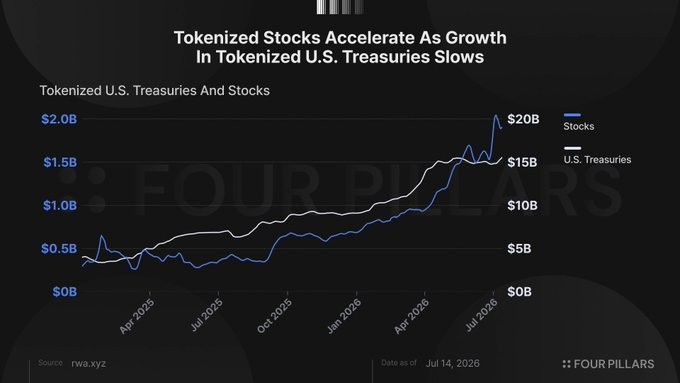
Market interest in RWA remains strong. It is no exaggeration to say that tokenized U.S. Treasuries have been the main engine of RWA growth so far. From January 1, 2024 to present, the total crypto market cap has only grown from $1.65 trillion to $2.19 trillion, an increase of about 1.33 times; while during the same period, the tokenized U.S. Treasuries market expanded from $695 million to $16.1 billion, growing 23 times.
However, the previously explosive growth of tokenized U.S. Treasuries has recently begun to slow down. This trend is not limited to Treasuries. Other RWA categories such as stablecoins, private credit, and commodities have recently shown signs of stagnation or even contraction. Within the RWA sector, however, there is one asset class that has recently demonstrated rapid growth: tokenized stocks.
In the past three months, the tokenized stock market grew from $1.2 billion to $1.88 billion, an increase of 56%. During the same period, tokenized U.S. Treasuries grew only 7.3%, private credit grew 16%, and commodities declined 13%. These figures fully illustrate the steepness of the recent growth of tokenized stocks.
There are several reasons why tokenized stocks can grow so rapidly. Fundamentally, stocks as an asset class have attracted more attention due to the recent rise in AI and semiconductor-related stocks. In addition, as the RWA market matures, the paths and structures for stock tokenization have become quite clear. As a result, numerous tokenization platforms have begun to offer tokenized stock services, and the market has also begun to see scale growth.
Current growth in tokenized stocks is mainly achieved through three main channels:
The first is the growth of platforms adopting offshore structures to tokenize debt instruments into Linked Securities, including Ondo Global Markets, Backed Finance xStocks, and Robinhood Stock Tokens. These stock tokens do not represent direct rights to the underlying shares. However, due to fewer compliance restrictions faced in secondary distribution, they can be actively used in on-chain DeFi protocols, thereby achieving rapid growth.
The second is the growth of platforms such as Securitize, Superstate, and Figure. They tokenize existing shares directly through transfer agents. Since these platforms tokenize the shares themselves under the premise of full compliance with securities laws, they face strict compliance restrictions in both issuance and secondary trading. This results in fewer available stocks and more limited utility. However, when these platforms cooperate with companies to tokenize their shares, the number of stocks may be limited, but the tokenization scale of each stock can be very large. Therefore, they have made significant contributions to the growth of the tokenized stock market recently.
The last channel is perpetual contract exchanges such as Hyperliquid, Variational Omni, and QFEX. Strictly speaking, stock products traded on perpetual contract exchanges are not tokenized stocks. Nevertheless, a large number of users can already trade products tracking stock prices through perpetual contract exchanges, and the scale is huge.
But from the perspective of financial market development, the emergence and growth of tokenized stocks cannot be entirely viewed as positive. Just as growth always has a dark side, several problems have emerged alongside the expansion of tokenized stocks. This research report focuses on one of these problems: liquidity fragmentation.
Liquidity Fragmentation of Tokenized Stocks
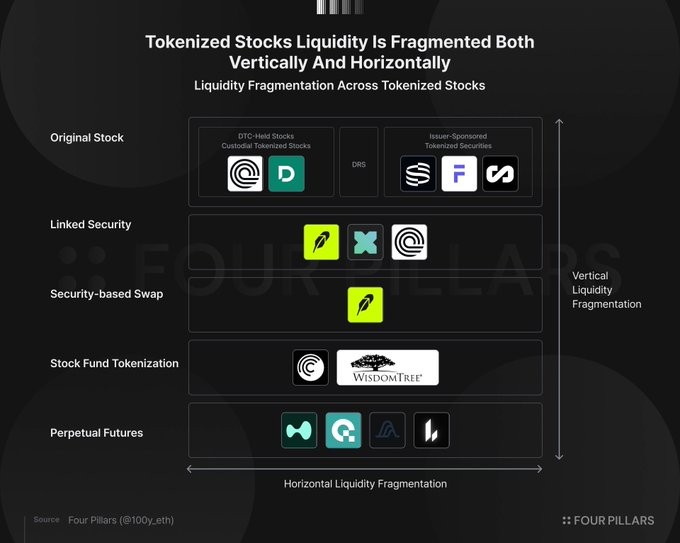
Even if the underlying stocks are the same, liquidity will be fragmented in both vertical and horizontal directions due to differences in tokenization structures and platforms.
Vertical Liquidity Fragmentation Between Different Tokenization Methods
There are many ways to tokenize stocks:
- Custodial Tokenized Stocks: A third party tokenizes share rights deposited within the DTC custodial system. Representative examples include DTCC, Ondo, Dinari.
- Issuer-Sponsored Tokenized Stocks: The issuer or transfer agent directly tokenizes share ownership. Representative examples include Securitize, Figure, Superstate.
- Linked Security: A third party issues and tokenizes a separate security, providing economic exposure to the underlying stock. Representative examples include Robinhood Stock Tokens, Backed Finance xStocks, Ondo Global Markets.
- Security-Based Swap: A third party tokenizes a derivative contract providing economic exposure to the underlying stock. A representative example is Robinhood Classic Stock Tokens.
- Stock Fund Tokenization: Tokenizing fund shares composed of stocks. Representative examples include Centrifuge, WisdomTree.
- Perpetual Futures: These platforms do not tokenize stocks, but operate exchanges providing perpetual contract markets tracking stocks. Representative examples include Hyperliquid, QFEX, Variational Omni, Lighter.
Even if the underlying stocks are the same, liquidity fragmentation also exists between different tokenization methods. Custodial Tokenized Stocks and Issuer-Sponsored Tokenized Stocks are based on original shares; while Linked Securities tokenize debt securities, Security-Based Swaps tokenize derivatives, and Stock Fund Tokenization involves fund shares. These instruments are therefore not interoperable. Perpetual Futures fundamentally do not tokenize stocks, so they trade in separate markets with independent liquidity.
Horizontal Liquidity Fragmentation Within the Same Tokenization Method
Even if the tokenization method is the same, liquidity will be fragmented due to different entities conducting the tokenization.
- Original Stocks: Even if tokens are based on original shares, they are not necessarily interoperable. Shares deposited within the DTC custodial system and tokenized as Custodial Tokenized Stocks are different from shares where ownership is directly registered with the transfer agent and tokenized as Issuer-Sponsored Tokenized Stocks. Therefore, liquidity is fragmented among the following three categories: 1) Shares deposited in DTC custody and Custodial Tokenized Stocks; 2) Shares with ownership directly registered through DRS; 3) Issuer-Sponsored Tokenized Stocks. Because these three categories are not interoperable.
- Linked Securities: Under this tokenization method, liquidity is fragmented between different tokenization platforms. Even if the underlying stock and tokenization structure are the same, the finally generated tokens will differ due to different tokenization entities, such as Robinhood, xStocks, or Ondo Global Markets.
- Stock Fund Tokenization: Under this method, liquidity is also highly fragmented, depending on the fund type and managing entity. However, it is difficult to say that tokenization itself caused this fragmentation. Funds and ETFs composed of stocks have long existed in various forms in traditional financial markets, and their liquidity itself is also fragmented.
- Perpetual Futures: Following the success of Hyperliquid, numerous perpetual contract exchanges have emerged. Even if they list the same stock, the stock will trade separately on different exchanges, each having fragmented liquidity.
A Hypothetical Scenario
Imagine a hypothetical scenario: TSLA shares are tokenized through each of the above methods and platforms. Then TSLA can be traded in the following forms:
- Original TSLA: TSLA shares traded on Nasdaq. Even in the traditional stock market, TSLA is not only traded on U.S. Nasdaq, but also on multiple public electronic exchanges, alternative trading systems, and over-the-counter markets. It is also traded on various overseas exchanges and in the form of depository receipts. Its liquidity is therefore already fragmented to some extent.
- Multiple Custodial Tokenized TSLA Products: These are products that tokenize TSLA share rights already deposited within existing DTC and brokerage account systems. DTCC can tokenize TSLA, and different securities companies can also tokenize their respective rights to TSLA shares. However, since these tokens only represent rights within the traditional stock market system in the form of tokenized receipts, it is difficult to view their liquidity as severed from the original shares.
- DRS TSLA: TSLA shares held through DRS, where ownership is directly registered with Tesla or Tesla's transfer agent. This asset is already fragmented from the original TSLA shares.
- Issuer-Sponsored Tokenized TSLA: Tokenized TSLA shares where ownership is directly registered with Tesla or Tesla's transfer agent in token form. To trade in the same liquidity pool as original TSLA shares, ownership needs to be transferred back from direct registration to the DTC custodial system.
- Multiple Linked Security TSLA Products: Under this structure, tokenization platforms tokenize debt securities backed one-to-one by TSLA shares. Because platforms such as Robinhood, Ondo, xStocks can each tokenize TSLA into different tokens, liquidity fragmentation occurs accordingly.
- Multiple Security-Based Swap TSLA Products: Under this structure, tokenization platforms tokenize derivative contracts with TSLA stock as the underlying asset.
- Multiple Tokenized Stock Fund Shares Containing TSLA: Under this structure, fund shares containing TSLA in the investment portfolio are tokenized.
- TSLA Traded on Multiple Perpetual Contract Exchanges: TSLA trades separately on various perpetual contract exchanges, each having independent liquidity.
In summary, even though TSLA liquidity is already fragmented within the traditional securities system, this fragmentation has historically been mainly limited to alternative trading systems, DRS, and overseas exchanges. However, in the tokenized stock ecosystem, there may exist numerous forms of tokenized TSLA under different legal structures, including derivative contracts, debt securities, and fund shares. These products may also target completely different investor groups, such as U.S. vs. non-U.S. investors, or retail vs. institutional investors.
None of these products are interoperable, each trading in markets with independent liquidity. As a result, tokenization may cause the degree of TSLA liquidity fragmentation to far exceed today's levels.
The Paradox of Tokenized Stocks: How to Solve Liquidity Fragmentation?
The value proposition of tokenized stocks is clear. They offer benefits such as higher accessibility, 7x24 hour trading, faster settlement, and integration with smart contracts. Tokenization aims to provide better financial services for people around the world. But in the case of tokenized stocks, it seems to have produced the paradoxical side effect of liquidity fragmentation.
Personally, I think this view is partially correct and partially incorrect. How to interpret this problem depends on how one views the tokenized stock ecosystem.
If viewed from the current status quo, the tokenized stock ecosystem undoubtedly has a liquidity fragmentation problem. A stock may simultaneously experience vertical liquidity fragmentation between different tokenization structures, as well as horizontal liquidity fragmentation between different platforms adopting the same tokenization structure.
However, if viewed from the perspective of improving accessibility, the situation is different. Rather than saying tokenization fragmented the liquidity of existing stock markets, it is better to say that newly created platforms improved access to these markets, ultimately leading to liquidity fragmentation. Linked Security tokenization, Security-Based Swap tokenization, and perpetual contracts have opened access paths for investors who previously had difficulty accessing U.S. stocks, thereby bringing new liquidity into the market.
Whether liquidity fragmentation is an inherent problem of tokenized stocks or an ultimate byproduct of their growth process, if the tokenized stock market scale far exceeds current levels, this problem will become more serious. Therefore, solving it will become important.
In the stablecoin sector, enterprises have attempted to solve liquidity fragmentation through stablecoin orchestration platforms and services similar to clearing houses. So, how to solve the liquidity fragmentation of tokenized stocks? Two potential scenarios can be considered.
The first scenario is the emergence of a platform playing a role similar to stablecoin orchestration or clearing in the tokenized stock sector. However, unlike stablecoins which usually adopt consistent tokenization methods and have relatively simple rights structures, tokenized stocks use a wide variety of tokenization structures, involve complex rights, and cover individual securities far exceeding the number of stablecoins. Therefore, it is difficult to imagine a single entity handling all of this at scale.
The second scenario is market consolidation into oligopoly. In the early stage of any industry, numerous participants often emerge. However, factors such as liquidity and network effects are very likely to cause the industry to eventually reorganize around a few dominant or monopoly platforms. Tokenized stocks are unlikely to be an exception. As regulatory conditions become increasingly clear and restrictions are gradually lifted, a certain specific stock tokenization structure or platform may grow significantly, causing liquidity to tend towards concentration.
Tokenized stocks are just getting started. Following stablecoins and tokenized Treasuries, how the tokenized stock market will evolve, and whether it can provide value consistent with the fundamental purpose of tokenized equity for investors, remains to be seen.
Join TechFlow official community to stay tuned
Telegram:https://t.me/TechFlowDaily
X (Twitter):https://x.com/TechFlowPost
X (Twitter) EN:https://x.com/BlockFlow_News
 Four Pillars