Tokenized Stocks Poised to Take Off, Yet Traditional Market Infrastructure Faces Severe Challenges
TechFlow Selected TechFlow Selected
Tokenized Stocks Poised to Take Off, Yet Traditional Market Infrastructure Faces Severe Challenges
Tokenized Stocks Enter Live Trading Era: Infrastructure Lags Behind, Fragmentation Risk Quietly Approaches
 Navigating Web3 tides with focused insights
Written by: Mike Cahill, CEO of Douro Labs
Compiled by: AididiaoJP, Foresight News
Tokenized stocks are accelerating from laboratory pilots to real trading stages, but the core infrastructure supporting the orderly operation of traditional stock markets—corporate action processing, rights distribution, reference data maintenance, and settlement mechanisms—is not yet ready for this new type of asset that trades continuously across multiple venues. Earlier this year, Nasdaq and the New York Stock Exchange sequentially received approval from the U.S. Securities and Exchange Commission (SEC) to list tokenized versions of Russell 1000 Index components and mainstream index ETFs. Meanwhile, the Depository Trust & Clearing Corporation (DTCC) has also launched limited-scale production trading, planning for a full commercial launch in October this year. More than 50 institutions participated in this trial, fully indicating that the underlying technology is basically mature—however, whether the traditional systems that have long served public markets can keep up remains a huge question mark.
The Same Stock, Two Different Products May Share the Same Code
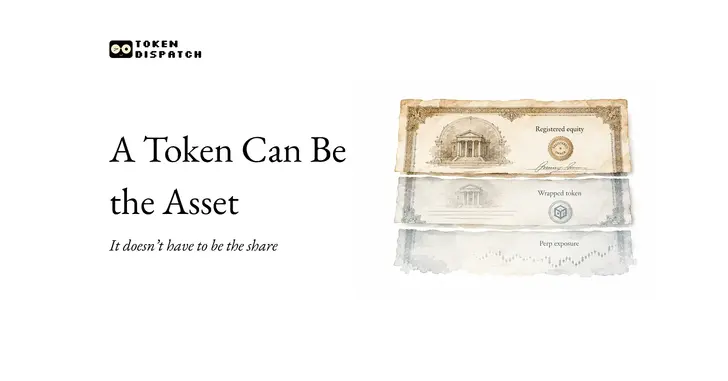
The main path currently approved by the SEC still firmly anchors tokenized assets to the original ownership structure. Tokenized shares will use the exact same Committee on Uniform Securities Identification Procedures (CUSIP codes) as traditional shares, trade on the same order books, and strictly follow the T+1 settlement cycle. The DTCC's pilot project also adopts a similar model: the underlying real shares continue to be custodied at the Depository Trust Company, while tokens become a new form of recording ownership. There is no substantive change in the legal rights and status of shareholders.
However, another path under review by the SEC is completely different. According to media reports, a so-called "innovative exemption" may allow crypto-native trading platforms to directly list tokens linked to stock prices without obtaining approval from the listed company itself. Guidance issued by SEC staff in January this year clearly distinguished two major categories: tokenized securities issued by the issuer or on behalf of the issuer, and tokens issued by unaffiliated third parties—the rights attached to the latter may be consistent with the underlying shares, or there may be differences. This exemption was close to a release window in May, but regulators ultimately chose to postpone it. However, the core issue it raised has not disappeared: from a legal perspective, a token that simply tracks a company's stock price and equity that truly represents ownership of the company's shares may essentially be two different things.
This distinction seems technical, but it directly relates to investor protection and market fairness. If third-party tokens cannot fully replicate all rights of native shares, potential disputes and opacity risks will increase significantly.
What Truly Defines a Stock Goes Far Beyond Price
Minting a token that can mirror stock prices in real time is no longer a technical challenge, but fully replicating all the complex attributes carried by real stocks—far beyond the scope covered by simple price data feeds—is of incomparable difficulty and importance.
Take dividends as an example: they must be calculated precisely, taxes withheld correctly, and paid timely to the ultimate rights holders; shareholder voting must be accurately delivered to the actual registered owners, not just anyone holding tokens at the snapshot moment; major events such as stock splits, distributions, or corporate spin-offs must be executed synchronously and accurately across all trading venues, otherwise the same company will appear with completely different capital structures on different ledgers. These sophisticated mechanisms have kept global public markets highly consistent and predictable for decades, and their design basis is centralized systems built around fixed opening and closing times. However, tokenized assets may achieve 24/7, cross-timezone continuous trading on dozens of blockchains, posing unprecedented challenges to existing infrastructure.
Fragmentation: The Most Realistic Systemic Risk of Tokenized Markets
Multiple industry organizations, including the Securities Industry and Financial Markets Association (SIFMA), have publicly expressed concerns: if there is a lack of unified interoperability standards and price transparency mechanisms, tokenized markets are highly prone to fragmentation. And if multiple unaffiliated third parties issue stock token versions of the same listed company simultaneously, this risk will be multiplied.
Imagine multiple independent platforms each launching tokenized products tracking the same stock, but adopting different settlement rules, rights arrangements, and trade reporting systems. Then, the company's price discovery process will quietly fragment into several incompatible silos. Investors may face issues such as information asymmetry, distorted arbitrage opportunities, and even liquidity fragmentation, ultimately damaging the efficiency and confidence of the entire market.
This Transformation Goes Far Beyond a Single Asset Class
Tokenized stocks are just a microcosm of the comprehensive infrastructure transformation triggered by the financial system embracing blockchain technology. Nasdaq is already separately pushing regulators to relax trading hour restrictions, moving towards near 24/7 trading; the New York Stock Exchange is also building dedicated infrastructure designed for 24/7 operation. However, no matter how trading hours are extended, the market still needs a set of reference data layers and settlement layers that can keep up with the pace. Without a "closing bell" in the traditional sense, core processes such as Net Asset Value (NAV) calculation, margin requirements, and index rebalancing will lose the benchmark points they have long relied on.
The institutions and enterprises that can truly lead the development of the next stage will be those pioneers capable of integrating fragmented tokenized trading venues into a single, coherent market system—ensuring that regardless of which "track" the trade settles through, investors can obtain consistent rights protection, reliable corporate action processing, and a trustworthy settlement experience.
In this wave, technology providers, traditional market participants, and regulators need to collaborate closely to jointly create a new market architecture that can both release the efficiency dividends of blockchain and uphold the bottom line of investor protection. The implementation of tokenized stocks tests not only the maturity of technology but also the ability of the entire financial system to adapt to the future.
Join TechFlow official community to stay tuned
Telegram:https://t.me/TechFlowDaily
X (Twitter):https://x.com/TechFlowPost
X (Twitter) EN:https://x.com/BlockFlow_News
 Forbes