800x Big Golden Dog, "Gacha" Saves NFT Trading
TechFlow Selected TechFlow Selected
800x Big Golden Dog, "Gacha" Saves NFT Trading
The wind of "card drawing" has finally reached ETH, but why can it rise even more than TCG projects?
 Navigating Web3 tides with focused insights
Written by: Cookie, BlockBeats
Last month, we detailed the narrative of on-chain TCG cards. "Card drawing" is almost the current crypto-native "money printing machine" second only to Hyperliquid and pump.fun:
"CARDS Up 5x in 2 Months, Are On-Chain TCG Cards the Next Big Narrative After HYPE?"
And last week, the wind of "card drawing" finally blew onto the ETH mainnet. A new protocol named Fake World Assets, launched just over a week ago, reached revenue of about $1.3 million, ranking 15th on the crypto app revenue leaderboard for the past 7 days:
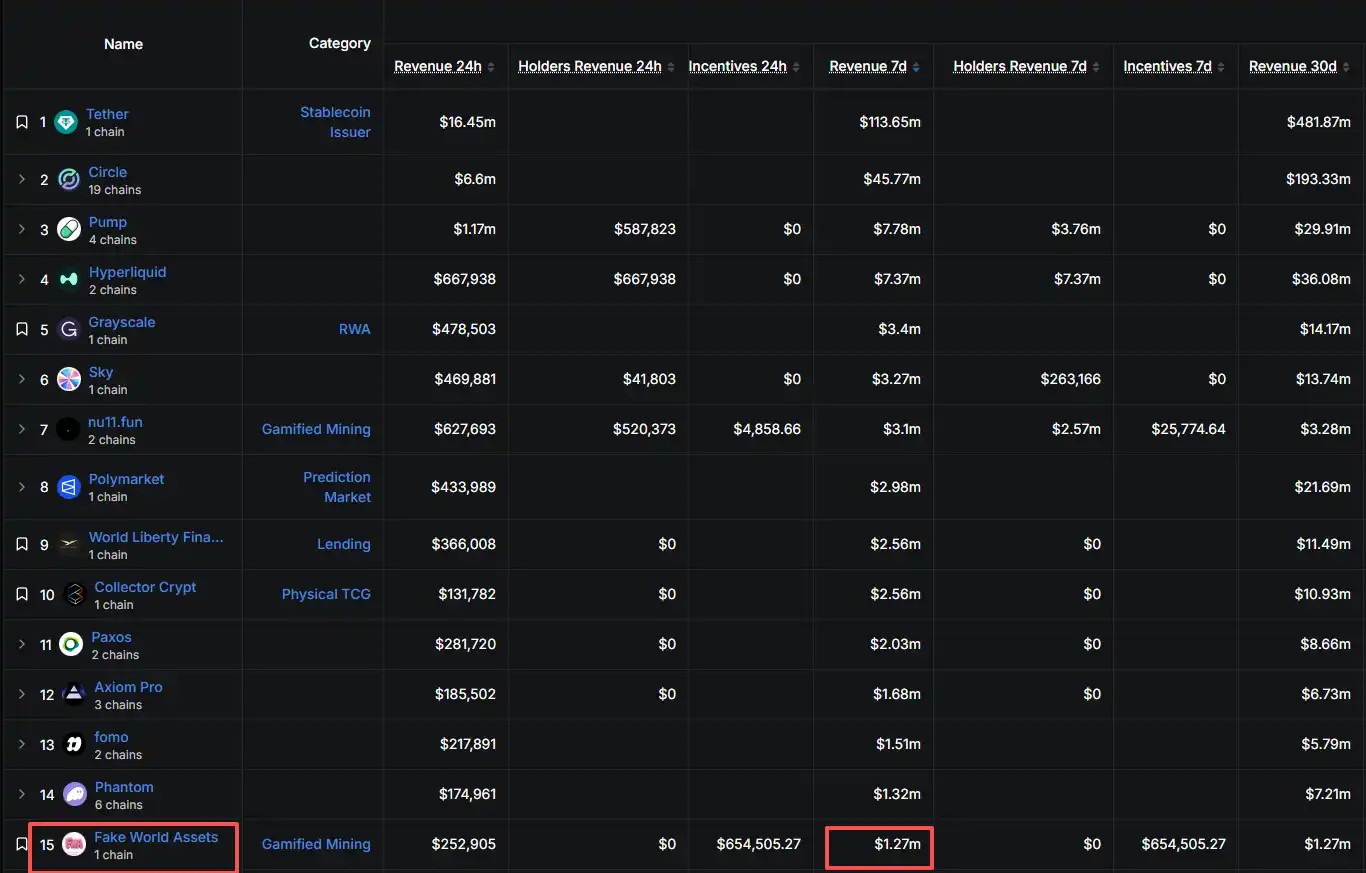
At the same time, the protocol token $FWA went from an initial opening market cap of about $47,550 to a peak of about $38.8 million, an 800x big dog. Meanwhile, while Collector Cards maintained strong revenue momentum, its token $CARDS fell from a high of nearly $90 million market cap a month ago to only about $28.87 million market cap.
Why?
FWA Gameplay
The team behind FWA, TokenWorks, should not be too unfamiliar to everyone. This team's previous hit project was "PunkStrategy," which ran to a peak market cap of $300 million in one month.
But TokenWorks doesn't release a hit project every time. The previous project TTT (Ten Thousand Tokens) was launched roughly in the mid-to-late stage of the Uniswap v4 hook hype wave. The gameplay was roughly a Launchpad where you needed an NFT to launch tokens on it. There were 10,000 NFTs in total, corresponding to only 10,000 tokens that could be launched on this platform. Fees were distributed among the token launcher, all NFT holders, and the protocol.
Because it failed to produce hot projects, the NFTs plummeted shortly after the platform launched.
I missed this FWA at the beginning too, thinking it was just a simple "NFT card drawing" gameplay. But it designed a token flywheel that allows $FWA to become Ponzi-like.
The token $FWA cannot be bought directly externally. To get this token, you must go "draw cards".
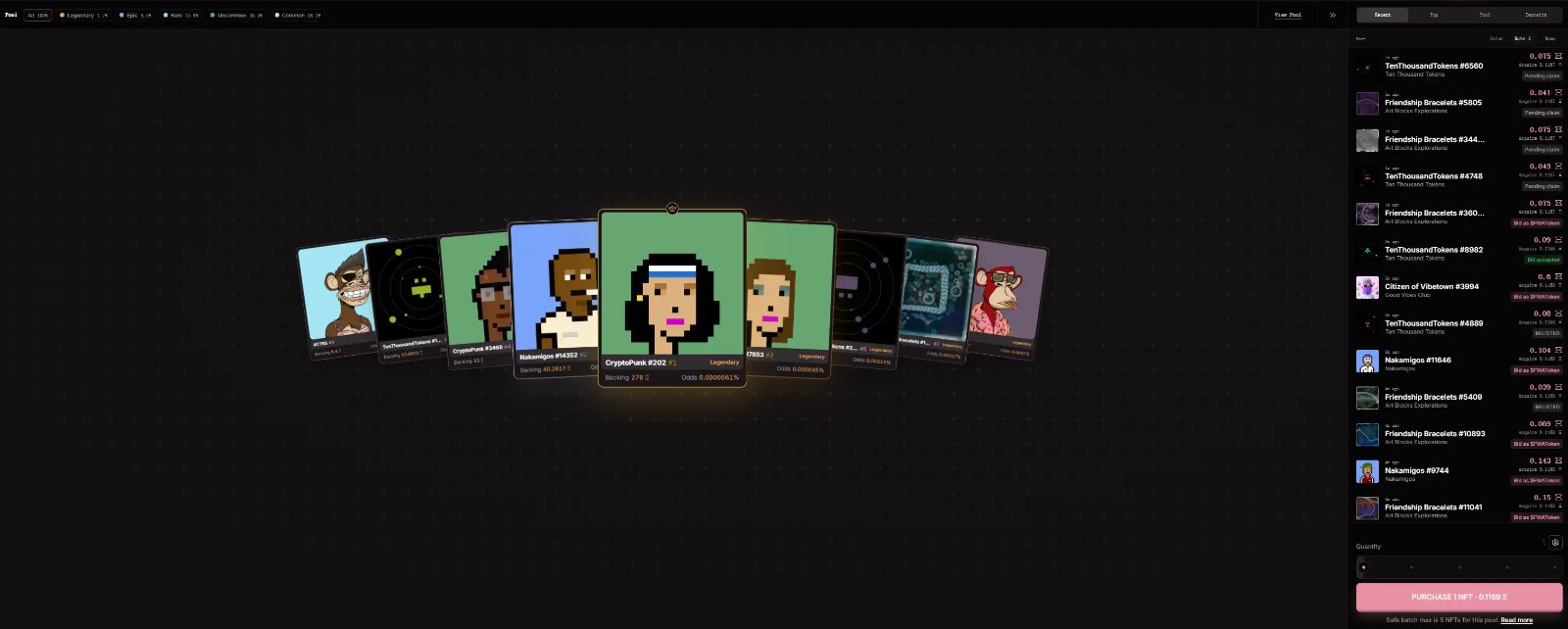
The NFTs in this pool are deposited by players voluntarily. When depositing NFTs, players also need to deposit ETH simultaneously as bilateral liquidity. That is to say, every player depositing assets actually opens their own pool.
The more ETH deposited, the lower the probability of the corresponding NFT being drawn. Taking this CryptoPunks as an example, there are 276 ETH paired with it, corresponding to a probability of being drawn of only 0.0000061%, meaning it would take over 10 million draws to possibly be drawn away. The protocol has only had 73,884 draws in total since running from July 3 to now, averaging over 3,000 times per day.
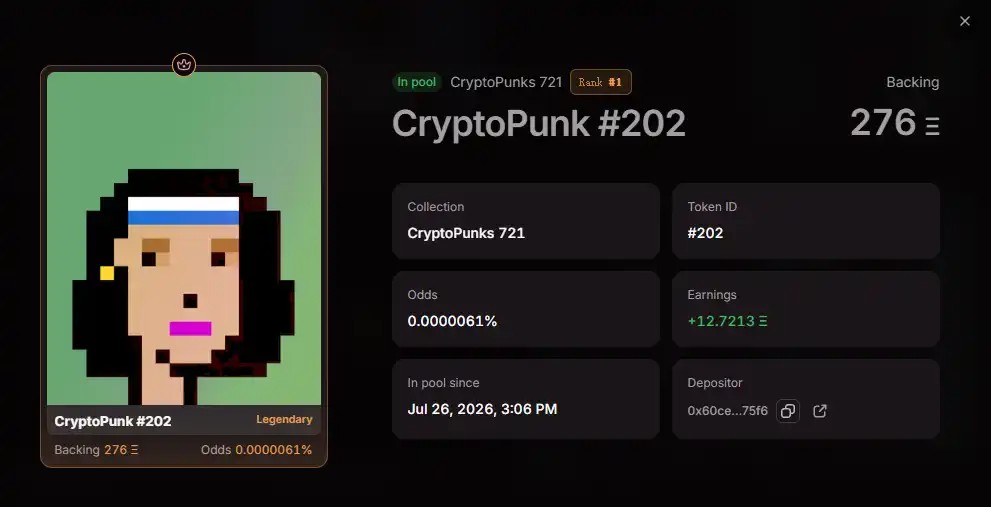
At the same time, it can be seen that the depositor of this CryptoPunks has harvested income of 12.7213 ETH in just over a day. This income comes from:
- Each time someone draws, a fixed 1% fee is deducted
- If someone draws a satisfactory NFT and chooses to keep the NFT, 1% of the income generated will be deducted from the earnings of the player who deposited that NFT
- Most players draw ordinary NFTs and will immediately sell this NFT back to the corresponding depositor at an 85% discount. This price difference forms income
As for how much each player who deposits NFTs and ETH into the protocol can share, it does not depend on the amount of assets deposited, but on how long the deposited NFT can survive in the pool. That is, if the deposited NFT is not drawn, profits can be shared continuously. If it is drawn, dividends terminate, and a new NFT needs to be deposited.
To ensure they can survive long enough in the pool, correspondingly they need to deposit more ETH, which incentivizes the pool to become deeper.
Here we can give a clear summary, which is that this thing is very much like an NFT AMM superimposed with a card drawing mechanism.
FWA Flywheel
The most interesting thing about this protocol token $FWA is that it cannot be bought directly from outside. To get this token, you must practically play this NFT gacha machine.
50% of the total token supply is used to add initial liquidity, 30% is for emissions in the first half month after launch (issuing 1% daily to asset depositors and card drawing players each), and another 20% is for early snapshot airdrops.
The most widespread way to obtain $FWA is to draw cards, and as we mentioned earlier, when you draw an NFT you don't want, you can sell it back to the NFT depositor at an 85% discount. At this point, you can choose to get back ETH, or choose to get $FWA (the protocol automatically buys $FWA with this portion of ETH received).
Most players choose the operation of taking $FWA after selling back unwanted NFTs. Data statistics show that in the past 7 days, at most 82.3% of operations chose to sell back immediately after drawing to obtain $FWA, especially in the earliest stage when the token price had not yet launched. In recent days, as the $FWA token price rose to high levels and entered adjustment, the choice to obtain ETH after immediate sell-back is gradually rising, but the choice to obtain $FWA still occupies over 60% on a single day.
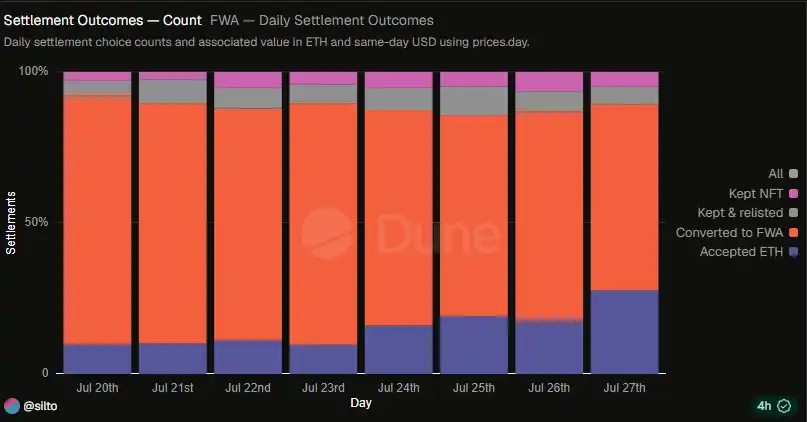
If we directly convert the acquisition cost of $FWA, we will find that actually every draw is negative expectation, and the cost of obtaining $FWA through drawing each time is actually higher than the $FWA price of the day, which is a premium purchase.
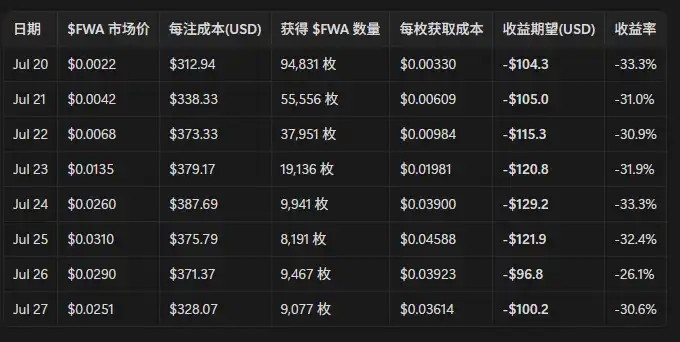
But if after getting $FWA you don't sell directly but choose to hold, then during the period from July 20 to 23, every operation of drawing for $FWA was printing money like crazy. Actually, this is not much different from grinding for Blur airdrops risking Offer wear back in the day; both are betting on the subsequent token taking off, trading time for potential upside. But there is also a certain difference, because this is actually a game with a much shorter game theory cycle and mainly gaming for attention—if this mechanism can be discovered quickly and become the focus of attention, as long as incremental users come in to draw cards, there will be a large amount of $FWA buy pressure conversion. People coming in later will continuously push up the holding value of those who held $FWA earlier.
This is also the reason why FWA was able to surpass Collector Cards token market cap in an extremely short time. The core gameplay of both is card drawing, and the core revenue is the discount price difference from immediate buybacks. Even though Collector Cards' drawing content (Pokemon cards) theme can attract a wider audience than NFTs, and profit performance is also better, Collector Cards' token utility is widely criticized by the community. Except for project party buybacks (and specific details were delayed in disclosure due to the Clarity Act not passing), Collector Cards' token is almost 0 utility.
Even pump.fun's previous large daily buybacks were not recognized by the market, let alone Collector Cards whose buyback strength is much worse.
Conclusion
This kind of flywheel of FWA is probably difficult to sustain long-term. When the token price is rising, everyone will run in to draw cards, praising this great innovation that saved NFTs. But once the token price falls back, when the losses from drawing cards themselves cannot be covered by the continuous rise of $FWA or even create excess returns, this protocol will gradually be forgotten by everyone, and the "great revival" of NFTs will also come to an abrupt end.
But the more valuable experience we can gain from this is that profitability is a narrative that is very easily forgotten in the crypto market. If we understand it in terms of the relationship between attention and buy pressure conversion, perhaps we can avoid many situations of being stuck at the top.
Join TechFlow official community to stay tuned
Telegram:https://t.me/TechFlowDaily
X (Twitter):https://x.com/TechFlowPost
X (Twitter) EN:https://x.com/BlockFlow_News
 BlockBeats