Crypto Morning Brief: South Korean police launch first investigation into Polymarket users; HKMA establishes expert task force on tokenized bonds
TechFlow Selected TechFlow Selected
Crypto Morning Brief: South Korean police launch first investigation into Polymarket users; HKMA establishes expert task force on tokenized bonds
The U.S. House of Representatives proposes a 20-year holding period for the national strategic Bitcoin reserve.
 Navigating Web3 tides with focused insights
Author: TechFlow
Yesterday’s Market Highlights
Hong Kong Monetary Authority Establishes Tokenized Bond Expert Panel
The Hong Kong Monetary Authority (HKMA) announced today the formation of a Tokenized Bond Expert Panel, bringing together industry representatives with relevant experience and a strong interest in advancing Hong Kong’s tokenized bond market. The panel aims to further promote the application and expansion potential of tokenized bonds in Hong Kong. Its members include representatives from industry associations, financial institutions, law firms, as well as financial infrastructure and technology providers. Building upon the progress achieved by the HKMA in its various tokenized bond initiatives to date, the panel will jointly explore policy measures, market practices, and innovative solutions.
JPMorgan, Citi, and Other Major Banks Plan Joint Launch of Tokenized Deposit Network Next Year to Counter Stablecoin Competition
According to the Wall Street Journal, several major U.S. banks plan to launch a tokenized deposit network next year to counter the growing threat posed by stablecoins and crypto firms rapidly encroaching on traditional banking services—accelerated under the Trump administration. The network will bridge traditional payment rails with digital asset infrastructure and will be operated by The Clearing House, a real-time payments network company jointly owned by multiple major banks. Participating banks include JPMorgan Chase, Bank of America, Citigroup, and Wells Fargo.
U.S. House Proposes 20-Year Holding Period for National Strategic Bitcoin Reserve
The U.S. House of Representatives introduced H.R. 8957, the “U.S. Reserve Modernization Act of 2026,” which proposes that the U.S. Department of the Treasury establish a “Strategic Bitcoin Reserve” and a “Digital Asset Vault” within 180 days of the bill’s enactment to centrally hold federal government-owned Bitcoin and other digital assets.
The bill stipulates that Bitcoin included in the Strategic Bitcoin Reserve must be held for at least 20 years, during which time it may not be sold, exchanged, or otherwise disposed of. It also mandates the establishment of a proof-of-reserves system, requiring quarterly disclosures of holdings, transactions, and private key control evidence, subject to independent third-party audits. Additionally, the bill directs a study into the feasibility of increasing Bitcoin holdings over the next five years via budget-neutral mechanisms.
U.S. House Ways and Means Committee Circulating Seven Digital Asset Tax Discussion Drafts
According to cryptocurrency journalist Eleanor Terrett, the U.S. House Ways and Means Committee is circulating a package of seven digital asset tax discussion drafts aimed at comprehensively revising U.S. tax rules for cryptocurrencies.
The drafts cover topics including stablecoin transactions, mining and staking, crypto lending, wash-sale rules, charitable donations, and a voluntary disclosure program for taxpayers with prior noncompliant digital asset reporting.
This initiative effectively splits the Miller-Horsford Digital Asset PARITY Act and Senator Lummis’s similar bill introduced last year into multiple standalone proposals. These drafts are expected to form the core agenda for Tuesday’s cryptocurrency tax hearing.
U.S. SEC: Advancing Framework for Security Token Trading and Coordinating Regulatory Policy with CFTC
According to an official SEC announcement, Jamie Selway, Director of the Division of Trading and Markets, stated at Piper Sandler’s Global Exchanges & Fintech Conference that SEC Chair Paul Atkins has directed the division to advance the development of a framework for security token listing and trading, guided by the principle of “fostering innovation without creating regulatory arbitrage.”
In addition, the SEC is collaborating with the Commodity Futures Trading Commission (CFTC) to align policies and concurrently evaluating areas of ambiguity or incompatibility across multiple new product proposals and rule frameworks.
Securitize’s SPAC Merger Cleared by SEC
According to a Securitize announcement, the S-4 registration statement related to Securitize’s business combination with special purpose acquisition company Cantor Equity Partners II (Nasdaq: CEPT) has been declared effective by the U.S. Securities and Exchange Commission (SEC), advancing Securitize’s transition to a publicly listed company. The proposal will be submitted for shareholder approval at a special meeting of CEPT shareholders scheduled for June 29, 2026. If approved, the transaction is expected to close shortly thereafter, subject to customary closing conditions. Upon completion, the combined company expects to operate as Securitize Corp. and list on the New York Stock Exchange under the ticker symbol SECZ.
Additionally, Securitize noted that it continues to advance its strategy in tokenized securities, trading infrastructure, and institutional partnerships—including with BlackRock.
HK SFC and HKMA Issue Joint Consultation Summary on Proposed Amendments to OTC Derivatives Clearing Rules
According to an official announcement, the Securities and Futures Commission (SFC) of Hong Kong and the HKMA have jointly published a consultation summary regarding proposed amendments to the clearing rules governing over-the-counter (OTC) derivatives transactions. Given broad market support, the SFC and HKMA will proceed with the legislative process to incorporate these proposed amendments into the Clearing Rules, targeting implementation on March 1, 2027—the start date of the proposed new calculation period.
South Korean Police Launch First-Ever Criminal Investigation into Polymarket Users for Alleged Illegal Gambling
According to Chosun Business, South Korean police are investigating domestic users of Polymarket—the world’s largest prediction market platform—for alleged violations of Article 246 of the Criminal Code (Gambling Offense), punishable by fines of up to KRW 10 million. This investigation, led by the Gangwon Provincial Police Agency at the direction of the National Police Agency, marks South Korea’s first criminal probe targeting Polymarket users. Subjects span users nationwide. Reports indicate that South Korean users place bets on the platform using USD-pegged stablecoins, with no restrictions imposed by Polymarket; for example, the June 3 local elections alone attracted billions of KRW in betting volume.
Greece Plans 15% Tax on Cryptocurrency Capital Gains
According to Reuters, Greece is preparing legislation to impose a 15% tax on cryptocurrency capital gains, with the bill expected to be submitted to parliament in the coming months. Two government officials familiar with the matter said the move aims to formally integrate cryptocurrencies into the country’s tax framework.
Under the plan, capital gains up to EUR 500 would be exempt from tax; individual cryptocurrency mining would not be subject to this tax, but mining conducted by registered companies would be taxable. Due to most investors’ use of offshore platforms, Greece’s cryptocurrency market size remains difficult to estimate, and authorities currently lack projections for additional tax revenue.
Kraken Launches IPO Access Portal for SpaceX
According to an official announcement, Kraken has launched SPCXx—a SpaceX-related instrument—via xStocks and opened an IPO Access subscription portal within the Kraken App. Users can view the price range, review details, and submit subscription indications before the subscription window closes.
Kraken described this offering as corresponding to “one of the largest IPOs in history.”
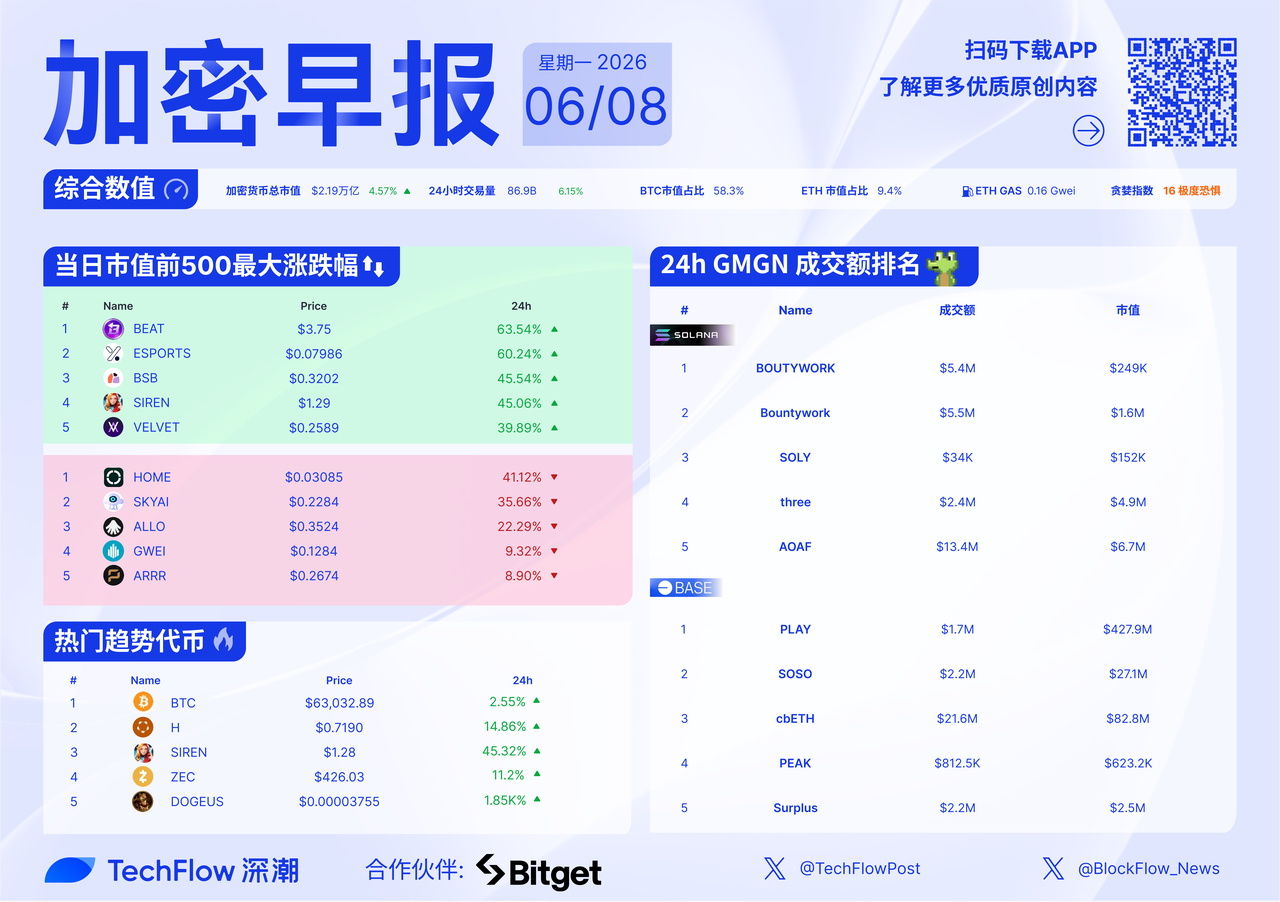
Market Data
Recommended Reading
Nasdaq Plunges 4% in One Night, Wiping Out $1.3 Trillion—U.S. Equities Hit by Triple Blow
https://www.techflowpost.com/article/31936
On June 5, U.S. equities suffered one of their largest declines this year: the Nasdaq fell 4.18%, while the semiconductor sector plunged over 10%, wiping out approximately $1.3 trillion in market value in a single day.
Three factors drove the plunge: Broadcom’s earnings signaled slowing AI growth; stronger-than-expected U.S. nonfarm payroll data heightened rate hike expectations; and ongoing Middle East tensions pushed oil prices—and inflation—higher.
Markets grew concerned that both core narratives—“AI-driven high growth” and “Fed rate cuts”—were simultaneously weakening, triggering a revaluation of tech stock valuations. However, fundamentals remain robust: AI demand remains strong, suggesting this is more of a correction in overvalued sectors—not the end of the AI narrative.
Going forward, market direction will hinge on Fed policy, earnings reports from AI leaders, and oil price developments.
The Flip Side of the Money Printer: 84% of Polymarket’s 2.5 Million Accounts Are Losing Money
https://www.techflowpost.com/article/31934
With the World Cup approaching, prediction market platform Polymarket is experiencing another surge in traffic. Data shows the platform now hosts over 1.29 million active wallets, with monthly trading volume reaching $25.7 billion—sports and crypto-related events being the most popular betting categories.
Yet beneath the surface of this boom, few users profit. Multiple independent studies show that roughly 70%–84% of Polymarket accounts are unprofitable, with the vast majority of profits captured by a small group of professional traders, arbitrage bots, and quant teams. Less than 0.1% of accounts earned over two-thirds of all profits, while average retail users lost anywhere from several dollars to hundreds of dollars.
The article notes that prediction markets are evolving from “information markets” into highly specialized trading venues. Though Polymarket demonstrates high accuracy in forecasting event outcomes, forecasting correctly does not guarantee profitable trading. Facing competition from bots, market makers, and professional players, most retail participants remain at a structural disadvantage.
As large-scale events like the World Cup drive new user growth, the scale of prediction markets continues to expand—but so too does the stark reality of “few winners, many losers.”
From Fragmented Entry Points to One Account: Gate TradFi Makes Global Asset Allocation Accessible
https://www.techflowpost.com/article/31933
As more traders turn attention to U.S. equities, gold, forex, and other traditional financial assets, crypto exchanges are accelerating their expansion into the TradFi (Traditional Finance) space. This article examines Gate’s newly launched Gate TradFi service, exploring how its unified account system bridges crypto and traditional financial markets.
Currently, Gate supports trading in over 10,000 assets—including stocks, ETFs, forex, gold, crude oil, and indices. Users can directly deploy USDT to allocate across U.S. equities and traditional financial markets without opening multiple accounts or transferring funds across platforms. The platform also offers CFDs, tokenized stocks, pre-IPO offerings, and quantitative trading tools to meet diverse risk profiles and investment needs.
The article argues that Gate’s core logic extends beyond merely expanding product offerings—it centers on enabling “global asset allocation from a single account,” lowering cross-market investment barriers and allowing users to manage both crypto and traditional financial assets on one platform. As more exchanges enter the TradFi arena, account unification, asset diversification, and trading convenience are emerging as key competitive frontiers.
Interview with 6MV Partner: Why I Hold Zero ETH and View Hyperliquid as Crypto’s New Tether
https://www.techflowpost.com/article/31931
In this episode, Mike Dudas, Managing Partner at 6MV, discusses recent volatility across crypto markets and diverging narratives around key assets—including Strategy, Ethereum, Solana, and Hyperliquid. He argues that Strategy’s sale of Bitcoin undermined Michael Saylor’s long-cultivated “never sell” faith premium; Ethereum’s biggest challenge, he contends, is its failure to coalesce around a unified, market-pricing-friendly asset narrative—leading him and 6MV to maintain zero ETH exposure. In contrast, Mike favors protocols with clear value capture mechanisms, programmable buybacks, and recurring revenue—particularly likening Hyperliquid to Tether in DeFi: a globally scalable network capable of thriving outside U.S. jurisdiction and KYC requirements.
Zcash Privacy Coin Trust Crisis: After Claude Uncovered a Vulnerability, Arthur Hayes Dumped His Holdings—Core Developer Josh Swihart’s Full Response Explained
https://www.techflowpost.com/article/31930
Recently, a security researcher leveraging Anthropic’s latest Claude Opus 4.8 model discovered a theoretical “infinite minting” vulnerability in Zcash’s Orchard privacy pool during an audit—allowing attackers to forge undetectable counterfeit ZEC. The team urgently patched the issue in early June, but after public disclosure, ZEC plummeted over 30%, prompting prominent investors—including Arthur Hayes—to fully liquidate their positions.
In response, Zcash Core Lead Josh Swihart stated that the project will adopt “formal verification” and introduce Tachyon—a next-generation privacy architecture—to mathematically prove protocol correctness and prevent recurrence.
For privacy coins, what’s truly damaged may not be the code—but trust. The bug has been fixed, yet markets still need time to regain confidence in the promise of “21 million ZEC, never inflated.”
Join TechFlow official community to stay tuned
Telegram:https://t.me/TechFlowDaily
X (Twitter):https://x.com/TechFlowPost
X (Twitter) EN:https://x.com/BlockFlow_News
 深潮TechFlow