Options Launch, BIT Broker Defines New Stage of "Real Broker" for Crypto US Stocks
TechFlow Selected TechFlow Selected
Options Launch, BIT Broker Defines New Stage of "Real Broker" for Crypto US Stocks
Since 2026, the entire crypto industry has been shifting from digital assets to traditional financial assets, and the US stock market is the core of this shift.
 Navigating Web3 tides with focused insights
I. The Next Competition for Crypto Platforms is No Longer About Crypto
Since 2026, the entire crypto industry has been shifting from digital assets to traditional financial assets, with US stocks at the core of this transition.
One of the most impactful signals is that the exchange that invented perpetual contracts is exiting the market. On July 23, BitMEX announced it would permanently close on September 23. This exchange, which invented perpetual contracts in 2014, completed its journey from rule-maker to marginal player in eleven years. The collapse of BitMart has added another heavy weight to this wave of exits. This is by no means isolated pain. Behind the successive departures of old players, the core battlefield of crypto exchanges is undergoing a fundamental shift: rapidly moving from simply competing for crypto-native assets to comprehensive integration and restructuring with traditional financial assets (TradFi). The departure of old players and the opening of new battlefields are happening simultaneously.
The data level is even clearer. According to CoinGecko data, from the beginning of 2025 to now, crypto exchanges have cumulatively listed 358 spot and perpetual products for real-world assets, covering stocks, ETFs, commodities, forex, and Pre-IPO contracts. By category, the fastest growth is in US stocks. In May 2026, the monthly trading volume of RWA-related perpetual contracts alone surged to $347 billion, with the year-to-date cumulative total exceeding $1.32 trillion. The top three targets by trading volume are Micron, Circle, and Nvidia, all US-listed individual stocks. The conclusion is not complex: users have not left crypto platforms; they have simply switched their positions from coins to US stocks.
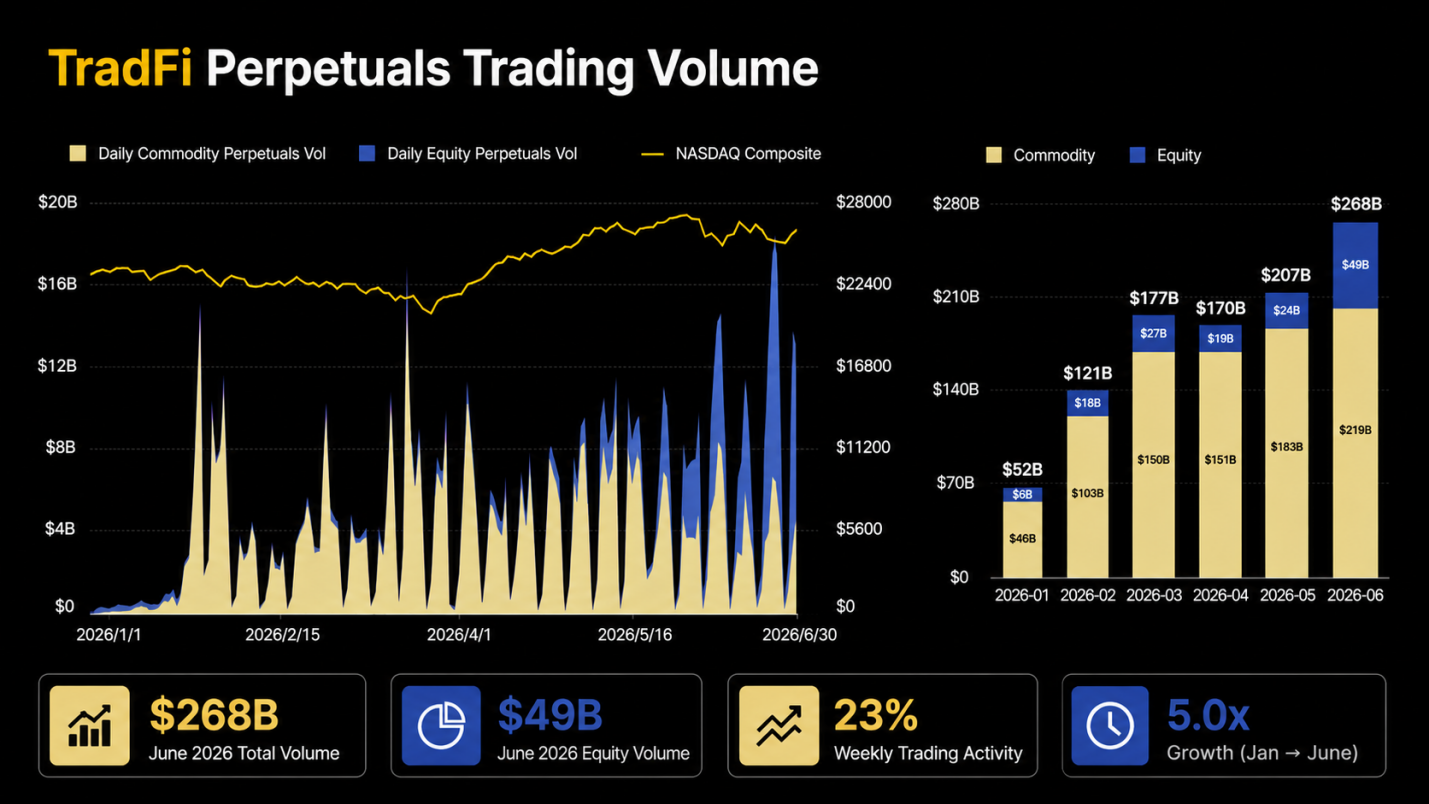
Data Source: TokenInsight
At the same time, demand is going deeper. According to Cboe data, US-listed options trading volume set records for the sixth consecutive year in 2025, exceeding 1.52 billion contracts for the year, with a daily average of 61 million contracts, a year-on-year increase of 26%. Options are long no longer the exclusive tool of institutions. When users start seriously trading US stocks on crypto platforms, they will sooner or later ask: Can we go long, short, and hedge using margin, short selling, and options just like at a real brokerage?
II. From "Accessible" to "Usable": The Upgrade in Crypto US Stock Competition
Looking at the journey of crypto platforms doing US stocks over the past year, it is clearly divided into two stages.
The first stage solves "access to US stock exposure," allowing users to obtain exposure corresponding to stock prices. Typical products include stock perpetuals, CFDs, and early tokenized stocks. Users get the price, not necessarily the stock itself. It solves the problem from zero to one, but the ceiling is obvious: a synthesized price exposure cannot support serious trading needs; you cannot build margin, short selling, and options on top of it.
The second stage solves "full access to the US stock market," moving the complete capabilities of real US stocks into crypto accounts: ability to buy spot, add positions via margin, short sell via securities lending, and hedge with options, with every link connected to the real infrastructure of the US securities market. Whatever products the US stock market has, crypto platforms must have. Options are the most iconic link in the element of "completeness"; they stand at the top of the entire capability set, are the hardest to build, and best indicate whether the foundation below is solid.
The prerequisite for entering the second stage is achieving direct broker connectivity. Tokenized stocks and stock perpetuals solve "whether there is price exposure," which is essentially the platform's own design; only with direct broker connectivity does every order placed by a user correspond to a real holding in a US licensed brokerage account, and only this allows building margin, short selling, and options on top.
Platforms that originally did not need to do this are proving the necessity of direct broker connectivity. Several leading centralized exchanges already hold tokenized stocks and stock perpetuals; they launch fast, cost low, and are sufficient from a business perspective. But over the past year, they have sequentially invested resources to build heavier, slower direct broker connectivity products. This is just the beginning; even with direct broker connectivity, the level of the full chain can vary greatly. Some platforms simply connect to an upstream broker's ready-made channel, listing US stocks counts as done, with most links of the chain held by others, often stopping at spot trading; some platforms have integrated every link of execution, clearing, and custody themselves, taking responsibility for the entire chain, only then can they talk about building margin, short selling, and options layer by layer. The former connects a channel, the latter is truly doing US stocks.
So as competition enters the second stage, it is no longer about who listed US stocks, but whose full broker chain is more complete and solid. The quality of this chain specifically falls on five dimensions:
· Product Completeness: Spot is just the starting point; margin, short selling, and options must be complete and able to collaborate within the same account; options are the hardest, whether they can be built directly indicates the depth of infrastructure.
· Compliance Completeness: Whether clearing, custody, information disclosure, and investor suitability are complete determines whether user assets have institutional protection in extreme situations.
· Regulatory Body and Investor Protection: Where the operating entity is registered, who constrains it, whether assets are segregated and custodied, usually shows no difference, but when problems arise, the difference is heaven and earth.
· Experience and Access: Stable coin deposits and withdrawals, minute-level arrival, lower account opening thresholds are the biggest advantages of crypto platforms relative to traditional brokerages.
· Trading Costs: Not just looking at commissions, but also how platform fees are calculated, whether there is a minimum per order, whether regulatory fees are transparent; charging per share or by turnover proportion makes a huge difference for large traders.
"Whether there are US stocks" is a question of the past; "whether it is done well enough and true enough" is where the victory is decided. And whether these five dimensions can be fully achieved is supported by the same full broker chain behind it.
III. BIT's Answer: Meeting Competition with Full Broker Chain Capabilities
Following this main line, BIT is a sample worth looking at carefully, because it has integrated the full broker chain itself. Earliest start, most solid foundation, most complete products, most concerned about user experience, and this launch of options happens to be a concentrated embodiment of these four points.
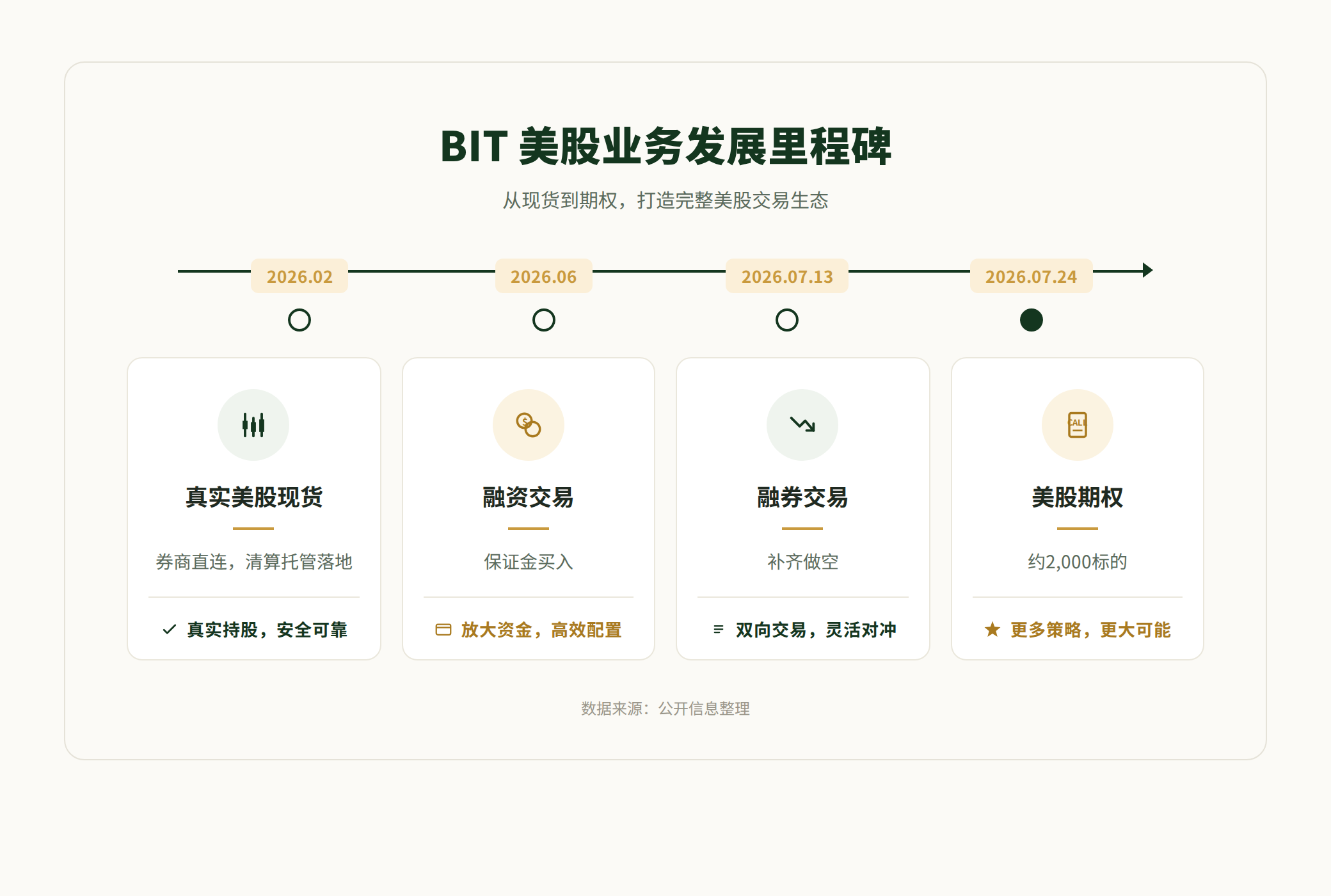
One side of the coin is product rhythm. BIT Brokerage's US stock business was not piled up at once, but built layer by layer according to a clear order. Real US stock spot was launched in February 2026, simultaneously laying the heaviest foundation of direct broker connectivity, clearing, and custody; margin was launched in June, becoming one of the earlier crypto platforms to provide real US stock margin; short selling was launched on July 13; US stock options were launched on July 24, covering approximately 2000+ mainstream stocks and ETFs in the first phase. Spot, direct broker connectivity, and clearing custody are the foundation; margin, short selling, and options are tools stacked sequentially on top of the foundation, link by link.
What needs to be highlighted here is the options launched on July 24. Options are the hardest test question for the full broker chain. They cannot be synthesized within the platform; they must truly connect to the clearing and exercise system of the US options market. When standard contracts are exercised, physical delivery of 100 shares of the underlying stock per contract is required. If any link is not solid, options cannot be built, or can only be built as an incomplete version.
And BIT's options are not just launched; they can be purchased directly using margin limits, running in the same account system as spot, margin, and short selling, which precisely shows that its full broker chain is ahead: only when execution, clearing, custody, margin and other underlying layers are connected through themselves and coordinate with each other can options be embedded into the entire account system like this. So regarding options, the angle of evaluation should not just be "added a category". It is more like a public capability acceptance: whether a platform can complete the US stock product map to the options layer directly exposes the real depth of its full broker chain. BIT has completed this layer, and completed it fully, which itself is proof of leadership.
To coordinate with the perfection of all categories and reduce user migration friction, BIT Brokerage simultaneously launched a US stock transfer event, with first-time transfer of stock assets eligible for up to $300 in double rewards (including US stock trading vouchers and stock cash cards, total prize pool $10,000, first come first served), to accelerate helping users allocate assets at low cost with real money.
The other side of the coin is the complete account experience. At BIT Brokerage, spot, margin, short selling, and options run in the same account system, connected with each other; supports deposits and withdrawals using USDT, USDC stable coins, saving the hassle of overseas banks and proof of address from traditional brokerages; US stock trading zero commission, platform fees calculated per share with various regulatory fees listed item by item, options are zero commission plus a fixed low platform fee per contract. What it wants to do is to put the low threshold, low cost, fast arrival experience of crypto platforms, and the complete functions and compliant custody of the real securities market, into the same account.
Starting early gives more time to solidify the foundation; with a solid foundation, every tool added on the upper layer is more stable; with a complete map, users do not need to move positions between several platforms for one function. These points combined constitute BIT's real barrier in the full broker chain. And options are the newest and hardest brick of this barrier currently.
IV. Conclusion
As crypto platform US stock trading enters the second stage, what will truly create the gap next is who can make the set of tools of spot, margin, short selling, and options complete, solidify the foundation of compliance and custody, while not losing the original convenience and low cost of crypto platforms, and letting users always know clearly: what they bought is not a price, but a real asset.
Risk Warning: The content of this article is for reference only, organized based on public information, does not constitute investment advice, nor does it constitute an offer to buy or sell any financial products. US stock and ETF trading involves market risks; margin and short selling involve leverage risks, which may lead to losses exceeding principal; options trading involves significant risks, which may lead to total loss of premiums paid, and using margin limits to purchase options will further amplify risks. The specific rules, quotas, and validity period of the transfer event rewards mentioned in the article are subject to BIT's official announcement; please do not trade solely to obtain rewards. Market and industry data come from third-party institutions, BIT does not guarantee their accuracy.
Join TechFlow official community to stay tuned
Telegram:https://t.me/TechFlowDaily
X (Twitter):https://x.com/TechFlowPost
X (Twitter) EN:https://x.com/BlockFlow_News