








Iran and the Federal Reserve — Three Scenarios That Will Impact Global Markets Next
TechFlow Selected TechFlow Selected
Iran and the Federal Reserve — Three Scenarios That Will Impact Global Markets Next
Negotiations have broken down, leading to a deadlock; high oil prices are driving up inflation, posing the greatest risk of interest rate hikes in 2026.
 Navigating Web3 tides with focused insights
By Dong Jing
Source: WallStreetCN
The evolving situation in Iran and the Federal Reserve’s monetary policy outlook have become the two most critical drivers shaping global markets.
Deutsche Bank’s economics team, in its latest report, systematically outlines the potential implications of three possible outcomes of Iran’s ceasefire negotiations for the Fed’s policy path—from near-term rate hike risks receding, to multiple hikes in 2026, to policy direction facing two-way uncertainty—each scenario corresponding to distinctly different market logics.
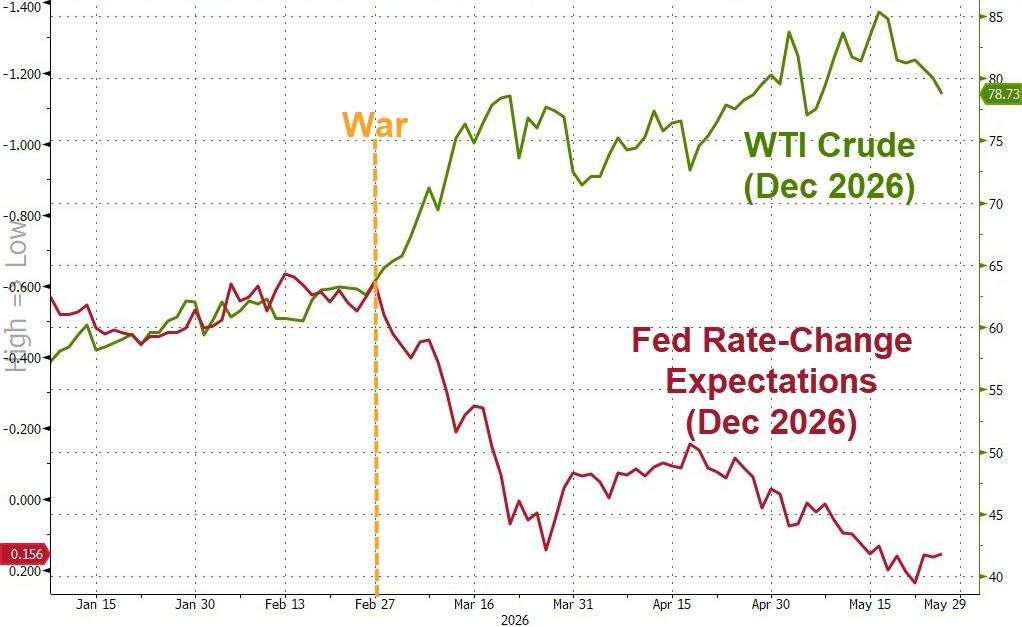
The bank’s analysis notes that oil price movements will directly affect how firmly inflation expectations are anchored, thereby determining whether the Fed needs to resume hiking. In its view, the most concerning scenario is not the most extreme escalation of conflict, but rather the “negotiation breakdown and stalemate” middle ground—in which persistently high oil prices would most likely force the Fed to undertake substantive tightening in 2026.
Latest geopolitical developments indicate some progress in negotiations aimed at extending the ceasefire agreement and reopening the Strait of Hormuz, prompting an early optimistic market reaction. Brent crude futures have fallen below $100 per barrel, hitting a one-month low; the yield on the 10-year U.S. Treasury note has also dropped significantly, erasing most of last week’s gains. However, negotiation details remain uncertain, and core disputes—including Iran’s nuclear program—remain unresolved.
Scenario One: Peace Agreement Reached—Near-Term Rate Hike Pressure Eases, But Medium-Term Risks Persist
Under Deutsche Bank’s first scenario, negotiations achieve a breakthrough: the Strait of Hormuz reopens, and oil prices continue their recent decline—though remaining above pre-war levels. U.S. Treasury yields fall further, and risk assets rally broadly as tail risks dissipate, leading financial conditions to ease.
Against this backdrop, pressure on the Fed to raise rates at its upcoming meeting will clearly diminish. With broad-based inflation data softening and short-term inflation expectations falling, Fed officials are likely to treat recent core inflation pressures as temporary disruptions stemming from energy price shocks—“looking through” them rather than responding immediately. Deutsche Bank expects newly appointed Fed Chair Warsh to reinforce this stance.
Nonetheless, the bank cautions that the baseline narrative of “transitory inflation” will take time to be disproven—and rate hike risks have not disappeared entirely. Should the labor market remain persistently tight, inflation expectations rise further, or inflation stay stubbornly elevated even after tariff and energy-related pressures subside, the risk of policy rate increases would more likely materialize in 2027.
Scenario Two: Negotiations Collapse, Stalemate Ensues—Highest Rate Hike Risk in 2026
Deutsche Bank labels the second scenario as the one with the “highest rate hike risk” among the three. Here, peace talks fail, the Strait of Hormuz remains closed for an extended period, yet the conflict does not escalate further—oil prices stay elevated rather than spiking sharply.
Persistently high oil prices would transmit more significantly into core inflation and pose a greater risk of unanchoring inflation expectations. At the same time, oil prices in this scenario are insufficient to severely damage demand and shift the Fed’s focus toward the labor market—meaning the Fed would face one-sided inflationary pressure without grounds to hold off on tightening “due to economic slowdown.”
The bank believes the Fed is unlikely to act before its September meeting—policy shifts require several steps: removing the bias toward cuts (June), some officials publicly discussing rate hikes (July–September), and finally achieving committee consensus.
Yet it notes that Fed Governor Waller recently stated that if “inflation fails to decline promptly,” hiking could be a reasonable option—suggesting the Fed may be willing to tighten policy more swiftly. Thus, multiple rate hikes in 2026 should not be ruled out.
Scenario Three: Conflict Escalates Again—Policy Outlook Faces Two-Way Risks
The third scenario envisions renewed escalation in Iran’s situation, triggering a larger and more sustained surge in oil prices. Deutsche Bank argues this scenario does not necessarily imply the Fed will unilaterally move toward hiking—but instead introduces two-way uncertainty into the policy outlook.
On one hand, conflict escalation would push overall inflation higher and more durably, raising the transmission risk to core inflation and making unanchored inflation expectations a tangible concern. The Fed would then need to signal clearly—through explicit communication—that it stands ready to tighten policy to safeguard price stability.
On the other hand, a sharp, sustained oil price increase raises the risk of nonlinear shocks to the real economy, ultimately spilling over into the labor market.
Deutsche Bank points out that consumers can currently absorb energy prices near current levels, and tax cuts have partially offset upward pressure from oil. Yet if oil and gas prices rise substantially further, this buffer will be exhausted. At that point, the labor market may slip from its current fragile equilibrium—characterized by low hiring and low layoffs—leading to further demand contraction or even a wave of layoffs.
In this scenario, the Fed’s ultimate policy stance will hinge on the sequence in which these two risks materialize: if the economy remains resilient while inflation expectations unanchor first, forceful tightening will be required; if labor-market cracks appear first, the Fed may pivot toward easing—citing softer forward-looking price pressures as justification.
Across all three scenarios, Deutsche Bank’s analytical framework reveals a clear logic chain: Iran’s situation determines oil price trends; oil price trends determine the nature and persistence of inflationary pressure; and whether inflation expectations become unanchored ultimately defines the Fed’s policy space.
Currently, the most critical signals to watch include: substantive progress in ceasefire negotiations; whether Brent crude stabilizes below $100 per barrel; and shifts in Fed officials’ language at upcoming meetings—particularly whether they begin removing the bias toward cuts or whether any officials publicly broach the possibility of rate hikes. These signals constitute key observation windows for assessing the probability distribution across the three scenarios.
Join TechFlow official community to stay tuned
Telegram:https://t.me/TechFlowDaily
X (Twitter):https://x.com/TechFlowPost
X (Twitter) EN:https://x.com/BlockFlow_News










