10x Faster Than NVIDIA! Micron Surpasses $1 Trillion Market Cap in Just 48 Days—Is the AI Memory Super Cycle Just Beginning?
TechFlow Selected TechFlow Selected
10x Faster Than NVIDIA! Micron Surpasses $1 Trillion Market Cap in Just 48 Days—Is the AI Memory Super Cycle Just Beginning?
AI-driven imbalances in supply and demand for storage chips are reshaping the entire semiconductor valuation system.
 Navigating Web3 tides with focused insights
Author: Claude, TechFlow
TechFlow Intro: Micron Technology’s market capitalization surpassed $1 trillion for the first time on May 26, making it the fastest company in U.S. stock market history to double from $500 billion to $1 trillion—achieving the milestone in just 48 trading days. By comparison, NVIDIA took 490 days to reach the same milestone. UBS raised its price target for Micron from $535 to $1,625, stating that “there is no reason Micron shouldn’t trade at NVIDIA-like valuation multiples.” AI-driven supply-demand imbalances in memory chips are reshaping the entire semiconductor valuation framework.
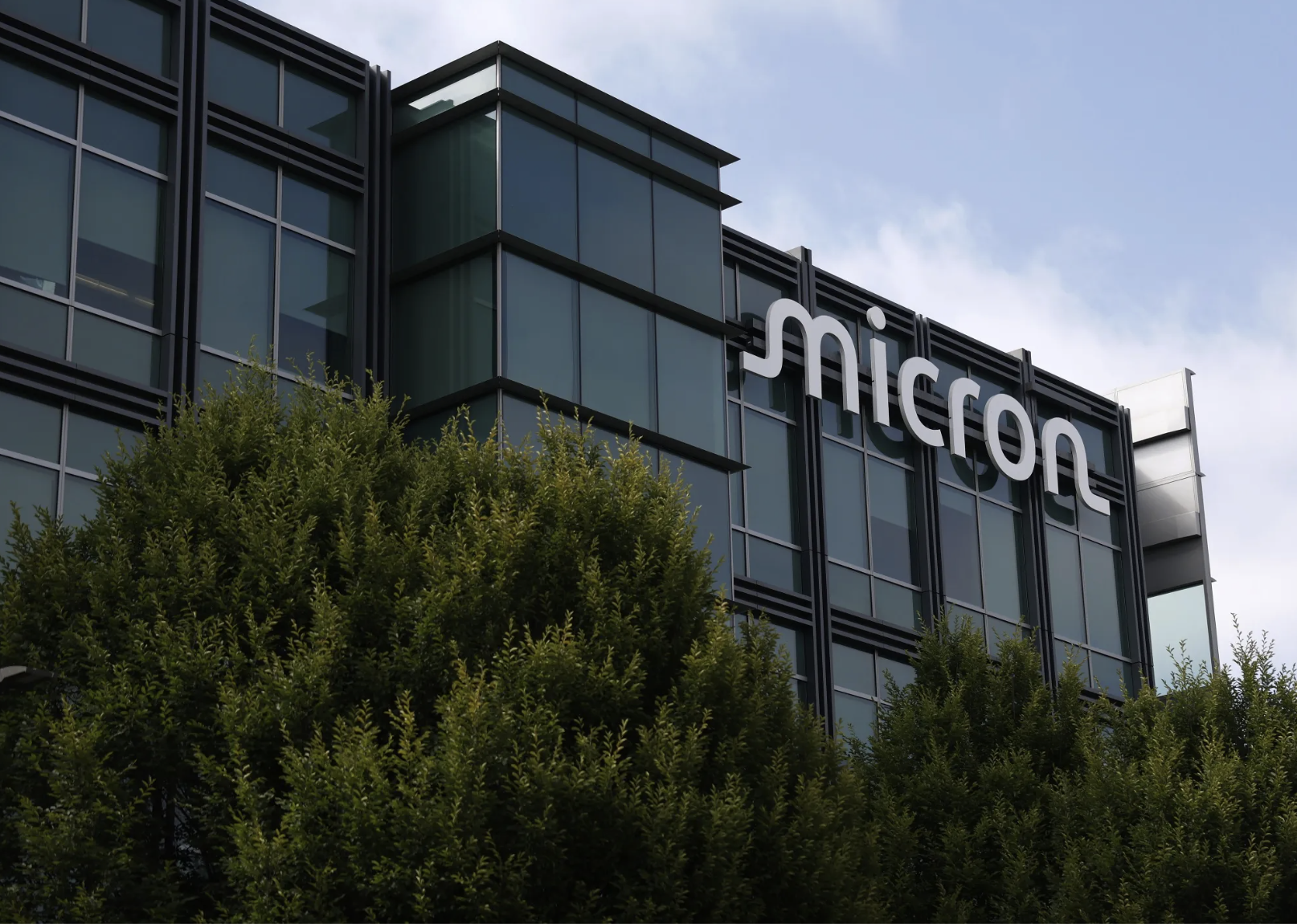
Micron Technology (NASDAQ: MU) surged 18–19% on May 26, pushing its market capitalization above $1 trillion for the first time.
The catalyst was UBS analyst Timothy Arcuri’s upward revision of Micron’s price target—from $535 to $1,625—the highest among all 46 Wall Street analysts covering Micron. Based on last Friday’s closing price of $751, this target implies more than a doubling of Micron’s share price.
48 Days vs. 490 Days: The Fastest $1 Trillion Sprint in History
Micron’s record is not merely about becoming “another $1 trillion company.”
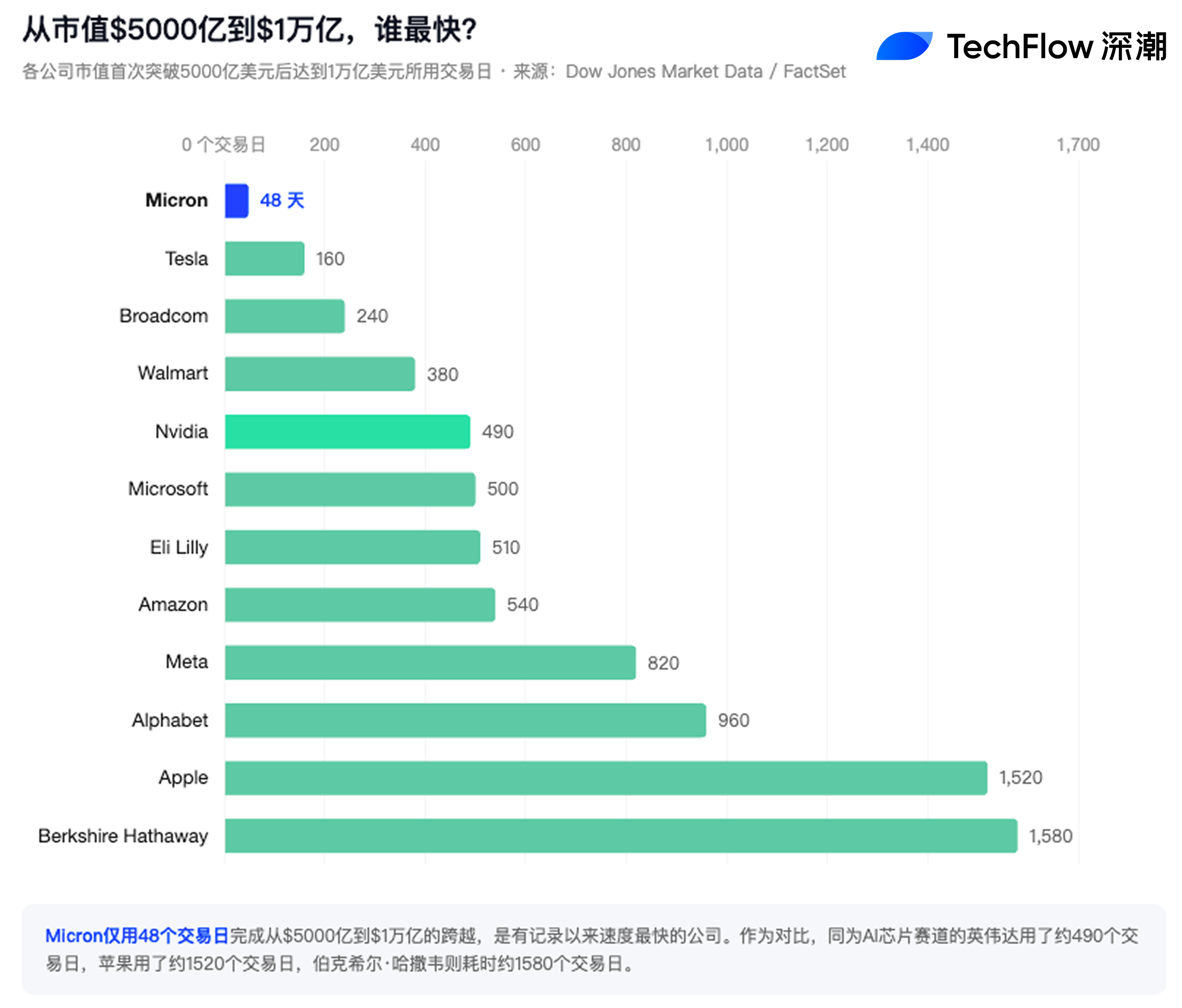
According to Dow Jones Market Data, Micron took only 48 trading days to go from first crossing the $500 billion threshold to entering the $1 trillion club. In contrast, NVIDIA—the AI chip sector’s other leading player—took approximately 490 trading days; Apple took roughly 1,520 trading days; and Berkshire Hathaway required about 1,580 trading days. Micron’s pace is ten times faster than NVIDIA’s.
This makes Micron the 12th U.S. company to reach a $1 trillion market cap—and the first headquartered in Boise, Idaho. Over the past month, the stock has surged nearly 80%; since its late-March low, it has risen 180%, contributing nearly as much to the S&P 500’s market-cap growth as Amazon over the same period.
Dan Russo, Co-Chief Investment Officer at Potomac, remarked: “By every measure, this appears unprecedented.”
UBS: Micron Has No Reason Not to Trade at NVIDIA-Like Valuation Multiples
In its report, UBS laid out a bold valuation framework: Micron is transitioning from a cyclical commodity stock to a structural growth stock underpinned by long-term agreements—warranting a fundamental shift in how it is valued.
UBS noted that AI-driven demand is fundamentally reshaping the memory chip market’s structure. Long-term supply agreements (LTAs) lock in production volumes and partially fix pricing, smoothing Micron’s historically volatile earnings trajectory. The report bluntly states that Micron “has no reason not to trade at P/E multiples similar to NVIDIA’s.”
Per UBS’s forecast, Micron’s earnings per share (EPS) will exceed $100 in fiscal years 2027 through 2029. Even using its current intraday high of approximately $891, its forward P/E ratio stands at only ~8.4x—versus ~21x for the broader S&P 500.
Michael Rosen, Chief Investment Officer at Angeles Investments, offered an even more direct assessment: “For years, Micron was viewed as a commodity investment—it produces something very basic. Today, Micron has become an industry benchmark.”
From $107 Billion One Year Ago to $1 Trillion Today: The Logic Behind the AI Memory Super-Cycle
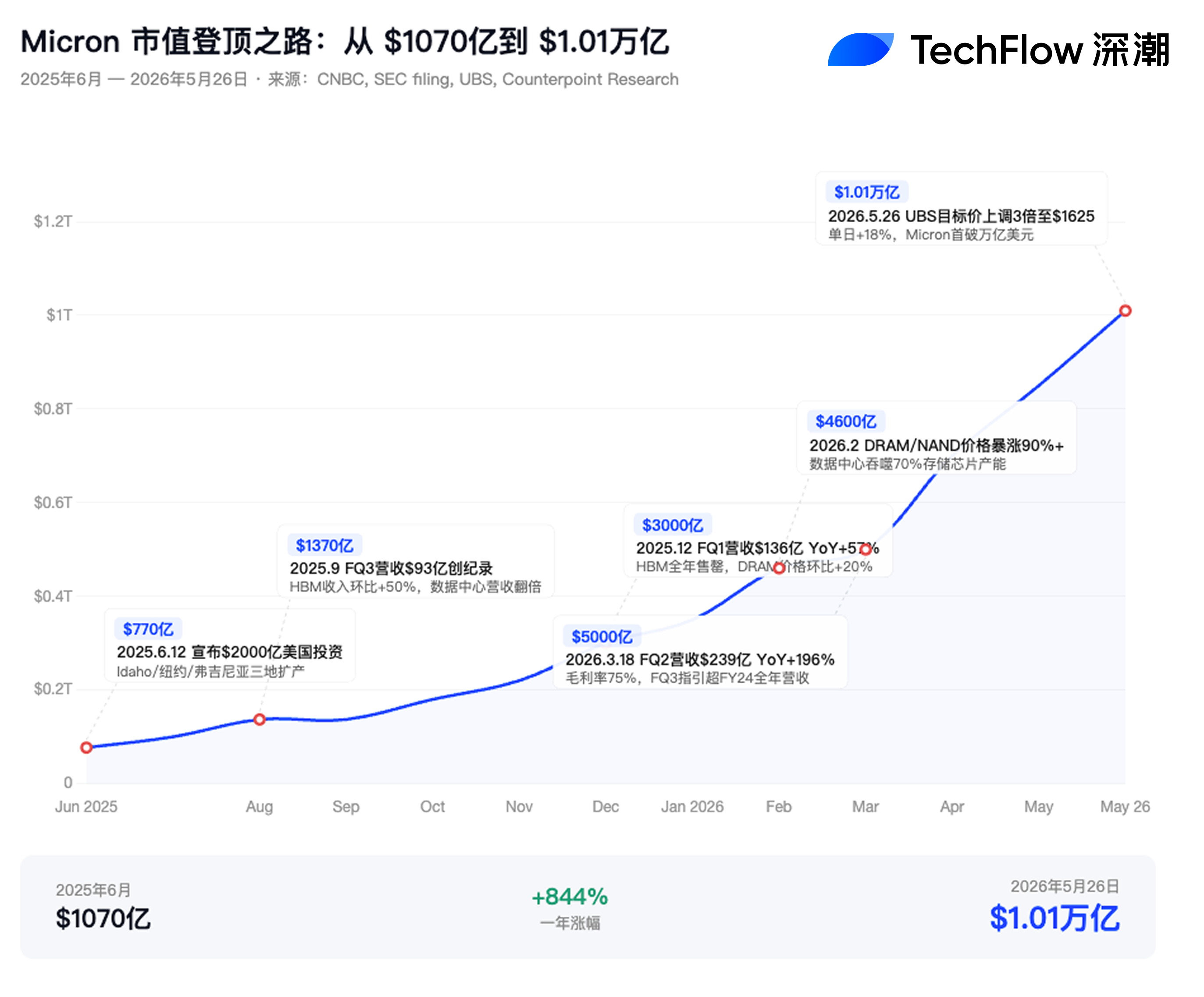
One year ago, in June 2025, Micron’s market capitalization stood at roughly $107 billion. It has now grown nearly tenfold. This explosive growth is backed by a cascade of accelerating fundamental metrics.
In June 2025, Micron jointly announced with the Trump administration a $200 billion U.S. investment plan—expanding capacity across Idaho, New York, and Virginia—with the goal of relocating 40% of its DRAM production back to the United States. Its Q1 FY2026 earnings report, released in December 2025, confirmed that annual HBM (High Bandwidth Memory)—a critical component for AI training chips—capacity was fully sold out and priced, while DRAM contract prices rose 20% quarter-on-quarter.
By March 18, 2026—when Micron reported Q2 FY2026 results—the numbers had gone completely off the charts: quarterly revenue hit $23.9 billion, up 196% year-on-year and nearly 22% above Wall Street’s consensus estimate of $19.19 billion. Gross margin soared to 75%; non-GAAP EPS reached $12.20—39% higher than the consensus expectation of $8.79. Even more astonishing was the Q3 guidance: $33.5 billion in quarterly revenue—exceeding Micron’s entire FY2024 annual revenue.
The underlying driver is the most severe supply-demand imbalance in memory chips in over 40 years. Data centers are projected to consume 70% of global memory chip output in 2026. HBM capacity is already sold out through 2027. DRAM and NAND prices surged over 90% in Q1 2026. This is not a cyclical rebound—it’s a structural reassessment of memory demand driven by AI infrastructure build-out.
Micron CEO Sanjay Mehrotra stated during the Q2 earnings call: “AI isn’t just increasing demand for memory—it’s fundamentally redefining memory as a strategic asset in the AI era.”
Memory Frenzy Overshadows NVIDIA’s Absence; Philadelphia Semiconductor Index Diverges Sharply
Micron’s single-day 18% surge propelled the Philadelphia Semiconductor Index up nearly 6%. Yet a notable feature of this rally is NVIDIA’s absence. The index and NVIDIA’s stock have exhibited a rare, sharp divergence—memory and equipment stocks have taken over the baton of the AI semiconductor rally.
Micron currently accounts for only ~2% of the Nasdaq Composite Index and ~1.5% of the S&P 500—far below the >6% weighting each of the “Magnificent Seven” holds. Yet on May 26, Micron contributed more to both indices’ gains than any individual Magnificent Seven company.
Last Friday, President Trump referenced Micron during a rally in New York: “Wow—Micron is incredible.”
On prediction market platform Kalshi, the probability of the U.S. government taking a stake in Micron in 2026 has climbed to 40%. As the sole U.S.-based memory chipmaker among the world’s top three (the others being SK Hynix and Samsung of South Korea), Micron carries additional strategic value amid today’s geopolitical landscape.
Join TechFlow official community to stay tuned
Telegram:https://t.me/TechFlowDaily
X (Twitter):https://x.com/TechFlowPost
X (Twitter) EN:https://x.com/BlockFlow_News
 深潮TechFlow