What Are Binance, OKX, and Bitget Competing On—Behind the Phrase “Valued VIP”?
TechFlow Selected TechFlow Selected
What Are Binance, OKX, and Bitget Competing On—Behind the Phrase “Valued VIP”?
Horizontal Comparison of the VIP Systems of Three Major Exchanges Reveals That the VIP Threshold Has Dropped to Just $30,000.
 Navigating Web3 tides with focused insights
Have you ever run the numbers on this?
Suppose you’re a relatively active trader, averaging over $1 million in monthly order volume. Even a 0.01% difference in fee rates could translate to thousands—or even tens of thousands—of dollars in annual trading fees.
During past bull markets, such discrepancies were easily masked by market volatility. A single upward surge or hot trend could deliver double-digit gains in a day—more than enough to offset most fee costs. But as the market gradually shifts into a “saturated” phase, more and more traders are realizing: long-term profitability is no longer determined solely by how much you earn per trade. To succeed in today’s market, you must manage your profit-and-loss ratio with far greater precision on every single trade.
This has brought an otherwise distant term back into mainstream awareness—VIP. Historically, ordinary users viewed VIP with some degree of skepticism, instinctively assuming it was a privilege reserved for “whales” holding tens of millions of dollars—far beyond their reach. Yet market developments in the first half of 2026 are actively dismantling that assumption. Leading exchanges are lowering VIP entry thresholds one after another. Where competition used to center on user acquisition, subsidies, and speed of new listings, it has now clearly entered a “service war” phase.
Since exchanges themselves are proactively lowering barriers, for ordinary users—especially “growing” users who may still have limited assets but already possess mature trading strategies—VIP is no longer just a vanity title; it’s a tangible efficiency-boosting channel.
So this article won’t discuss market trends or trading strategies. Instead, from the perspective of the average user, we’ll break down the VIP systems of major exchanges—including Binance, OKX, and Bitget—to assess, amid this wave of lowered VIP thresholds and intensified service competition, which exchange offers the most suitable VIP framework for today’s traders.
VIP System Comparison Across Three Major Exchanges
Before diving into the comparison, however, one issue needs clarification first: VIP architecture varies significantly across exchanges. Trading volume, asset holdings, borrowing, options, OTC, referrals, and account migration—each exchange supports multiple distinct VIP upgrade paths.
Ordinary users don’t need to master every rule. To help you avoid wading through dense fine print, let’s first establish a user segmentation framework based on asset size and trading habits. You can use it to identify which category you fall into—and thereby pinpoint the optimal upgrade path for yourself.
- In terms of trading style, users broadly fall into two camps: “low-frequency holders” and “high-frequency traders.” The former execute relatively few trades but maintain sizable long-term positions—making “asset holding amount” the most relevant VIP upgrade criterion. The latter trade frequently; even with modest capital, their cumulative trading volume (especially in derivatives) grows rapidly, making “trading volume”-based upgrades and actual fee discounts far more critical.
- From an asset-size perspective, users generally fall into three categories: “retail,” “growing,” and “institutional.” “Retail” and “institutional” users require little explanation—the former typically can’t meet VIP thresholds at all, while the latter effortlessly unlock top-tier VIP benefits across all major exchanges (at this level, offerings are largely comparable). What deserves special attention here is the increasingly prominent “growing” user segment.
“Growing” users refer to those whose asset size hasn’t yet reached traditional “institutional” benchmarks, but who’ve already developed consistent trading habits and actively optimize details like fees, slippage, and capital utilization. This group represents precisely the most fiercely contested demographic among today’s exchanges—because they hold exceptional potential to become core users in the future.
I. Entry Thresholds
Between March and April this year, major exchanges successively lowered their VIP entry thresholds.
Binance officially announced on March 18 a reduction in BNB holding and derivatives trading volume requirements for VIP Levels 1–3. For VIP 1, the BNB holding threshold dropped from 25 to 5 BNB, and the derivatives trading volume requirement fell from $15 million to $5 million. Additionally, Binance launched its VIP “Rising Star Program,” targeting users whose daily or 30-day average net asset balance reaches $30,000 (including at least 5 BNB). Eligible users receive dedicated VIP support, priority access to select events, and an accelerated path to full Binance VIP status.
OKX officially announced on March 24 a reduction in the 30-day derivatives trading volume requirement for VIP Levels 1–3 (VIP 1 dropped from $10 million to $5 million). On April 8, OKX further lowered the threshold for its Priority Customer Support channel to “current asset balance or 30-day average asset balance of no less than $30,000”—though not a direct VIP threshold cut, this policy grants qualified users response priority equivalent to VIPs.
Compared to Binance and OKX, Bitget, from day one of building its VIP system, focused not on “how high to set the bar,” but on “how many people to include.” Users qualify for VIP 1 simply by holding over $30,000 in assets, achieving $500,000 in spot trading volume, or $5 million in derivatives trading volume. Moreover, on April 2, Bitget launched its “VIP Fast Track” campaign, specifically designed to incentivize users currently at V0 or holding only temporary trial access—offering extra rewards to reduce friction and accelerate their progression to official VIP Levels 1–3.
The VIP upgrade requirements across the three exchanges are summarized in the chart below.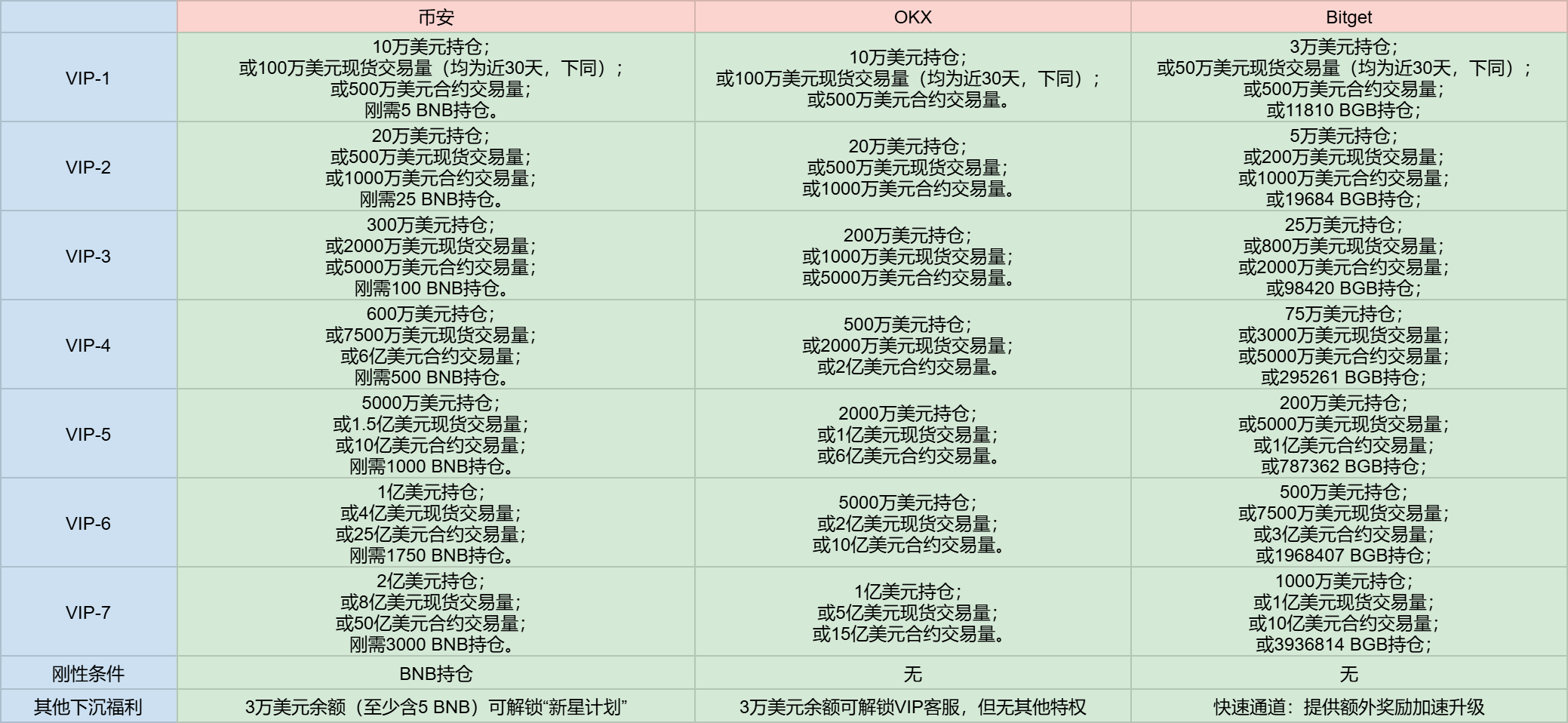
In short, $30,000 in asset holdings has emerged as a key battleground across all major exchanges—a tier that broadly covers mainstream users, especially “growing” users with strong potential to become future core users. Both Binance and OKX have extended partial VIP benefits to this cohort; Bitget has gone further, setting $30,000 as its formal VIP 1 entry threshold.
Beyond this, it’s clear that Bitget’s VIP upgrade path is significantly less demanding than those of Binance and OKX. While the other two exchanges impose thresholds measured in hundreds of millions—or even billions—of dollars for holdings and trading volume, Bitget unlocks its highest VIP Level 7 with just $10 million in holdings.
As shown in the chart above: if your total holdings amount to $50,000, you haven’t yet met Binance or OKX’s VIP thresholds—but you’re already eligible for VIP-2 on Bitget. With $1 million in holdings, you’d reach only VIP 2 on Binance and OKX—but VIP-4 on Bitget. And with $10 million in holdings, you instantly unlock Bitget’s top-tier discount, including zero-fee spot and derivatives limit orders.
Faster progression means users can efficiently unlock premium VIP privileges sooner.
II. Asset Coverage
Beyond VIP thresholds, another increasingly critical factor affecting trading experience is the platform’s breadth of asset offerings.
As narratives around Real World Assets (RWAs) and tokenized assets gain momentum, traditional financial instruments—including U.S. equities, precious metals, commodities, and pre-IPO equity—are being rapidly migrated onto-chain. Whereas competition once centered almost exclusively on cryptocurrencies, more and more trading platforms are evolving toward becoming “multi-asset, all-in-one trading gateways.”
Today’s market landscape sees centralized exchanges (CEXs) like Binance, OKX, and Bitget—as well as emerging decentralized exchanges (DEXs) like Hyperliquid and Trade.xyz—all moving decisively in this direction.
For example, Binance maintains its dominant edge in liquidity and broadest asset coverage, recently expanding access to U.S. equities via newly launched derivative products and synthetic tokens. OKX has rolled out TradFi-tracking products and continues strengthening integration between its on-chain ecosystem and Web3 trading environments; users can directly allocate across diverse assets on-chain using OKX Wallet. Bitget, meanwhile, introduced its Universal Exchange (UEX) vision last September, bridging crypto and traditional finance in one unified framework. It was the first exchange to launch U.S. equity futures and remains the primary traffic source for Ondo’s U.S. equity tokens. Recent months show accelerating expansion across U.S. equities, CFDs, and pre-IPO assets.
Personally, I often buy U.S. equity tokens via OKX Wallet, then hedge with equivalent short futures contracts on Binance to capture funding fees. Recently, however, I’ve executed several active trades on Bitget. First, last week I wanted exposure to Rocket Lab (RKLB), whose stock surged ahead of SpaceX’s anticipated IPO. After checking several major exchanges, I found RKLB’s equity token available only on Bitget. Second, ahead of the highly anticipated Cerebras Systems (CBRS) IPO, Bitget became the first among the three major exchanges to list CBRS pre-IPO futures—so I placed a small position. I’ve also participated in two Bitget pre-IPO token sales (preSPAX and preOPAI), both of which rallied strongly from launch. As of publication, preSPAX trades at $894—up 37.5% from its $650 offering price; preOPAI trades at $928—up 28% from its $725 offering price.
III. Additional Perks
Other VIP perks—such as token airdrops, physical gifts, event tickets, private briefings, and global travel opportunities—while not decisive factors in platform selection, do meaningfully enhance long-term engagement for highly active users.
Exchanges Escalate the “Service War”
Fee discounts and asset coverage reflect a platform’s “hardware” capabilities—but ordinary users need far more than that. When unexpected issues arise, the efficiency and accessibility of platform communication—the “software” layer of user experience—often determine whether users stay long-term.
With industry tailwinds plateauing, VIP frameworks across exchanges are evolving from static numerical rules into a comprehensive, behind-the-scenes “service war.” Binance—even as the undisputed market leader—has CEO He Yi personally answering user questions daily on social media. OKX has drastically lowered the threshold for VIP-dedicated customer support, extending enhanced service capabilities to a much broader user base. Bitget has consistently emphasized its “VIP from Day One” service philosophy, bringing its entire VIP account management team into the spotlight—publicly launching them on X, maintaining regular activity, and keeping Greater China Head Jason Xie visibly engaged with users. By placing real service personnel front-and-center, Bitget lowers the psychological barrier users face when seeking assistance.
These initiatives collectively illustrate the intensifying “service war.” As asset types diversify and trading products grow more complex, trading experience depends on far more than fee discounts alone—it hinges on a holistic service capability encompassing risk control responsiveness, timely product rule updates, and rapid issue resolution. For traders, “Can I quickly find someone?” “Will my issue get an immediate response?” and “Will it be resolved swiftly?” have become integral parts of platform evaluation.
Underlying this shift is a fundamental industry reality: as the market enters saturation, exchanges can no longer rely on pure user growth for rapid expansion. The exchange that best serves its active users over the long term—and grows alongside them—will hold the competitive advantage in the next phase.
How Should Ordinary Users Choose?
In this “hardware + software service war” initiated by exchanges, the biggest beneficiaries are frontline traders. Whether lower entry thresholds, clearer progression paths, or more comprehensive service ecosystems—the underlying driver is exchanges’ renewed battle for current and future core users amid saturated-market competition.
Conversely, for ordinary users aiming to optimize long-term trading management, actively seizing this rare “VIP下沉红利” (VIP democratization opportunity) is essential.
So how should ordinary users decide? Overall, Binance retains unmatched liquidity and global depth; OKX excels in on-chain ecosystem integration—the area where it holds strongest expertise; Bitget prioritizes lower barriers and proactive service delivery to capture rapidly growing traders, while its UEX strategy provides diversified asset allocation opportunities.
If deep order books and global liquidity matter most, Binance remains the safest choice. If seamless on-chain and Web3 trading experience is your priority, OKX may suit you better. And if you’re in a phase of rapid trading scale expansion—seeking early access to full VIP benefits while needing exposure to U.S. equities, pre-IPO assets, and other alternative classes—Bitget’s design aligns most closely with your practical needs.
In a sense, this may be the most noteworthy aspect of the current industry shift: VIP used to be a privilege accessible only to a select few elite users; today, more and more platforms are reimagining VIP as an early, proactive capability—designed to serve users and grow with them.
For ordinary users, this may truly be the most valuable change.
Join TechFlow official community to stay tuned
Telegram:https://t.me/TechFlowDaily
X (Twitter):https://x.com/TechFlowPost
X (Twitter) EN:https://x.com/BlockFlow_News
 Odaily