The person who helped TAO surge 90% today also personally triggered its price collapse.
TechFlow Selected TechFlow Selected
The person who helped TAO surge 90% today also personally triggered its price collapse.
As long as people remain, stories endure; once people leave, you might not even find a counterparty.
 Navigating Web3 tides with focused insights
Author: TechFlow
TAO plunged 15% today, currently trading around $277, with further downside pressure mounting.
The sudden price drop may stem from an open letter.
The letter’s author is Sam Dare, founder of Covenant AI. Bittensor is currently the highest-market-cap project in the AI + Crypto sector, and Covenant AI is the most critical subnet team within its ecosystem.
Last month, this team achieved a major milestone: training Covenant-72B—a 72-billion-parameter large language model—using consumer-grade hardware contributed by over 70 participants. They dubbed it the largest decentralized AI training effort in history.
A month ago, this achievement propelled TAO to become the brightest narrative across the entire crypto space—almost embodying the “light of AI.”
NVIDIA CEO Jensen Huang publicly praised it; prominent Silicon Valley investor Chamath Palihapitiya mentioned it on his podcast. $TAO surged nearly 90% in one month—a standout performance amid the current bear market.
But today, Sam Dare announced that his team is leaving Bittensor—effectively dismantling the foundation of that very narrative.
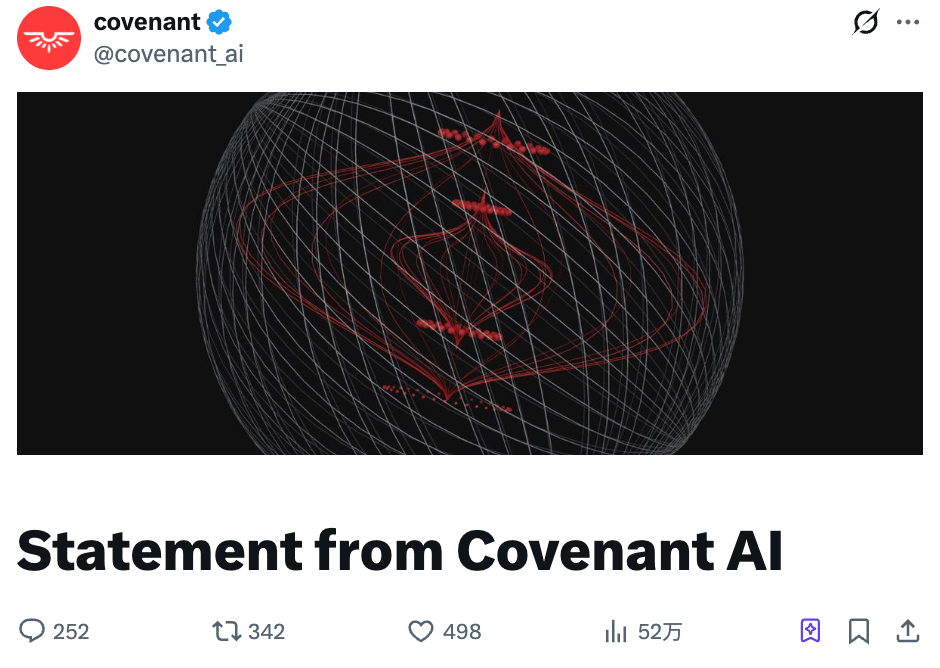
Sam Dare’s open letter is lengthy, but its core accusation is singular:
Jacob Steeves—the founder of Bittensor (widely known in the community as “Const”)—single-handedly controls the entire network; decentralization is merely window dressing.
In the letter, he lists several concrete actions. The two most severe are: first, directly halting emissions for the Covenant subnet—effectively zeroing out the team’s revenue; second, conducting large-scale token sales during the conflict to exert market pressure and force compliance.
A whistleblower website, Tao Papers, launched simultaneously today, provides even harder evidence. According to on-chain data disclosed by the site, Bittensor executed 41 network upgrades between 2023 and 2026—of which 38 were entirely orchestrated—from proposal submission to signature to deployment—by infrastructure controlled solely by Const. The other two signatories consistently co-signed within minutes each time, with no public discussion records whatsoever.
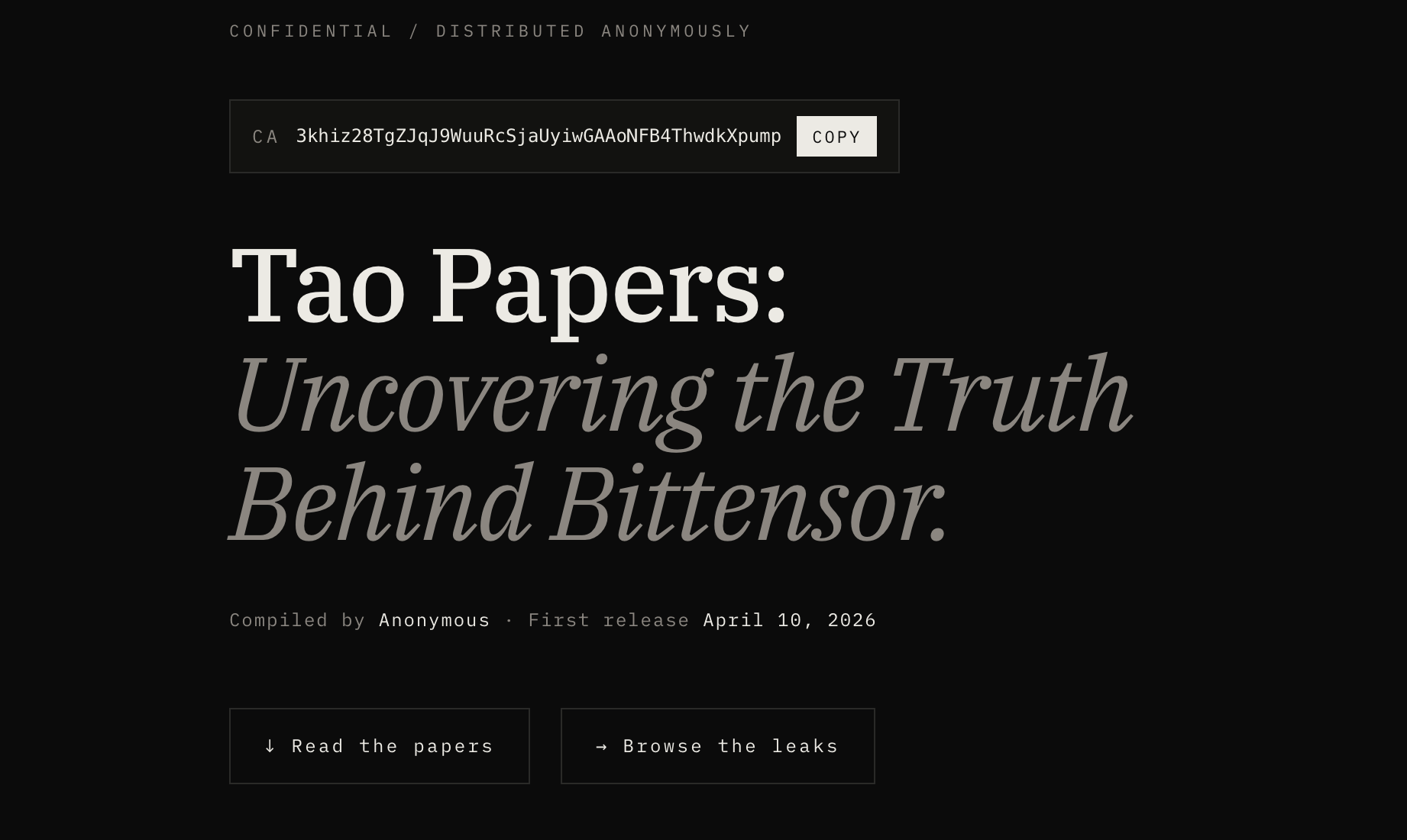
The so-called three-member “governance council” functions in practice as a one-person decision-making body, with the other two members merely rubber-stamping.
The timing of the open letter and the whistleblower site going live on the same day clearly indicates Sam’s move was not impulsive.
Correspondingly, two months ago, Bittensor’s founder Const announced his resignation as CEO of the Opentensor Foundation—the development foundation behind Bittensor—with the stated goal of advancing decentralization.
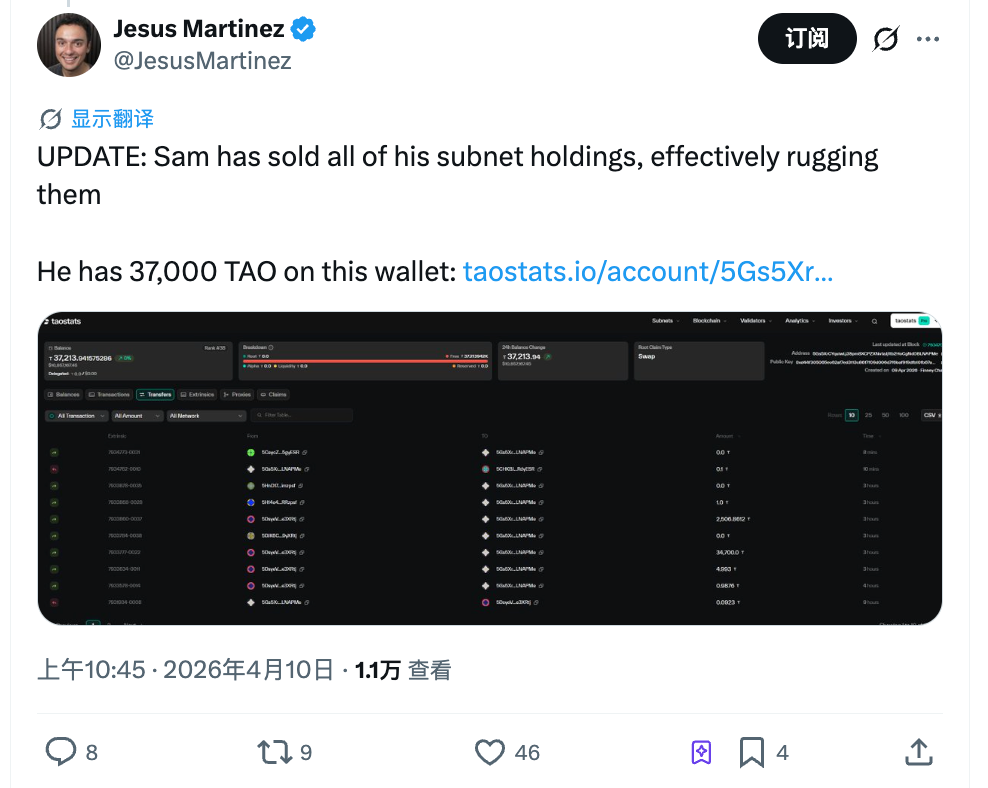
Meanwhile, after announcing his team’s departure, on-chain data shows Sam sold all 37,000 TAO tokens he held—further fueling market FUD.
To date, Const’s only public response has been a single sentence—essentially stating that Covenant’s exit is actually beneficial, as it will foster subnets that operate autonomously without reliance on any single team.
He has not addressed a single one of Sam Dare’s allegations. Yet whether it’s public infighting or contributions, the market has already priced it in.
In March, $TAO rose from roughly $170 to $337—nearly doubling. According to The Block, TAO surged over 50% in the two weeks following the release of Covenant-72B—the single largest catalyst behind its overall 90% rally.
Covenant AI is linked to the templar, basilica, and grail subnets (sn3, sn39, and sn81), whose native tokens are tied to TAO via staking mechanisms. Upon the announcement of Covenant-72B, those subnet tokens spiked as much as 400%, pulling TAO upward along with them.
So while buyers ostensibly purchase TAO as exposure to a decentralized AI network comprising over 100 subnets, the price structure tells a different story: nearly half of its gains were tethered to a single team.
“Rise with Covenant, fall with Covenant”—a phrase widely cited today, though most only grasp its surface meaning.
What deserves deeper reflection is why a network boasting 125 subnets relies on just a few to drive rallies—and likewise collapses due to drama involving just a few. In these two market cycles, the vast majority of subnets have remained virtually invisible.
Bittensor has marketed its decentralization narrative for three years—but its price structure has always looked centralized. As for who’s right or wrong in this dispute, the author believes that’s beside the point.
Every ecosystem has star teams; every star team can eventually depart.
The hard question is: what do you do about it?
Team infighting isn’t new in bear markets. When markets lack catalysts, whether a project rises depends entirely on whether there’s a compelling narrative to hype. Covenant-72B was among the strongest narratives this year—endorsed by Jensen Huang, driving TAO to double, and making the community feel decentralized AI had finally delivered something battle-tested.
Yet narrative-driven rallies carry an inherent flaw: the people who build the narrative can also destroy it. On the way up, they’re crypto’s shining light; on the way down, they’re fleeing the scene. For TAO holders, that 90% gain—and today’s 15% loss—share the exact same origin.
This may be crypto’s most authentic investment dilemma today: prices chase narratives that emerge unpredictably—and those narratives hinge on specific individuals.
As long as the person remains, the story lives; once they leave, you might not even find a counterparty.
Join TechFlow official community to stay tuned
Telegram:https://t.me/TechFlowDaily
X (Twitter):https://x.com/TechFlowPost
X (Twitter) EN:https://x.com/BlockFlow_News
 深潮TechFlow