








Profit Surge, Sentiment at Rock Bottom: The Real Face of Crypto Amid a $600M Unlock
TechFlow Selected TechFlow Selected
Profit Surge, Sentiment at Rock Bottom: The Real Face of Crypto Amid a $600M Unlock
The era of blockchain enthusiasts has come to an end; we are merely ledger maximalists, contemplating the best uses for these ledgers.
 Navigating Web3 tides with focused insights
By: Joel John, Siddharth, Saurabh Deshpande
Translated by: Saoirse, Foresight News
The Crypto Fear & Greed Index has plunged to an all-time low. Yet, at the same time, the industry’s profitability has reached unprecedented heights.
Since 2018, DeFiLlama data shows that crypto-native protocols have collectively generated $74.8 billion in fees. Nearly half—$31.4 billion—was earned in just 18 months, from January 2024 to June 2025.
So why is fear still pervasive—even as the industry enjoys some of its strongest quarters in eight years?
Over the past two months, 12 projects have shut down outright: Entropy Protocol, Milkyway Protocol, Nifty Gateway, Rodeo, Forgotten Runiverse, Slingshot, Polynomial, Zerolend, Grix Finance, Parsec Finance, Angle Protocol, and Step Finance. These were products built over many years by passionate, respected founders.
OKX, Mantra, Polygon Labs, Gemini, and Binance have all conducted layoffs. Conference attendance has dwindled. Venture capital has pivoted to AI. Developers are flocking to AI. Pessimism across the industry is real. “Move from crypto to AI—fast” has become the dominant refrain.
But should you really pivot? We’ve been wrestling with this question for weeks.
When a new technology emerges, markets initially assign it a massive premium—driven by novelty and grand vision. In the 19th century, nearly 6% of UK GDP flowed into railway stocks. By 2026, hyperscale cloud providers’ capital expenditures will account for 2% of US GDP.
But when reality sets in, valuations revert toward rationality.
What truly matters is whether the industry can prove its utility during that normalization process.
In this article, I’ll break down:
- How crypto-native revenue has evolved;
- How sticky that revenue is;
- What the industry’s real moats actually are.
Ledger Analysis: A Radical Shift in Revenue Composition
Crypto-native businesses have been profitable since day one.
Exchanges like BitMEX, Binance, and Coinbase have long been highly lucrative—but they’re centralized, held by small groups, and their revenues remain opaque.
DeFi-native protocols like Uniswap and Aave changed everything. You can verify their daily earnings in real time. Token valuations, in theory, should reflect the economic activity underpinned by these foundational components.
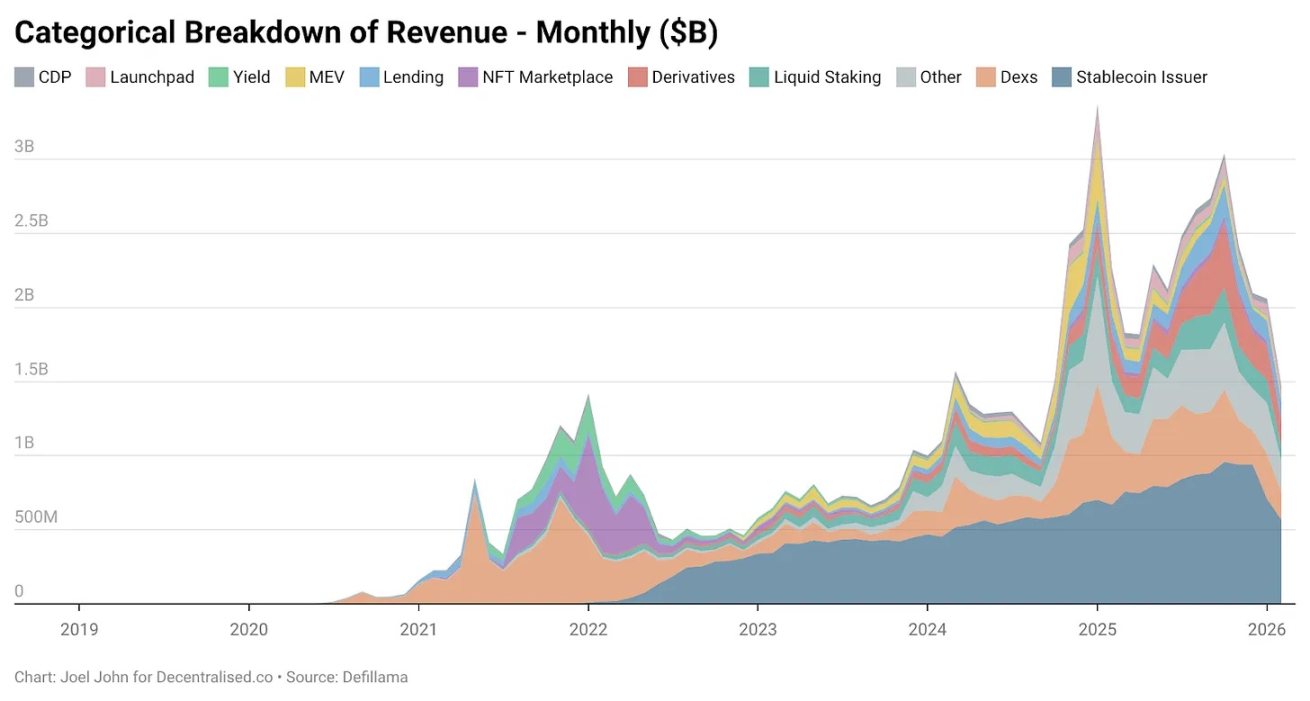
Until 2022, decentralized exchanges (DEXs) accounted for 28.4% of total industry revenue—generating $2.27 billion that year. Lending was similarly concentrated: Aave and Compound captured 82% of lending fees. Back then, consensus held that while each sector had clear leaders, long-tail protocols still had room to grow. The underlying technology was novel enough to justify high valuations.
Then came crypto’s push toward mass adoption.
NFTs once embodied a hopeful vision: cultural value priced on-chain. When celebrities swapped Twitter profile pictures, ordinary users believed mass adoption was imminent. OpenSea generated $1.55 billion in revenue that year—71.7% of the entire NFT market.
Looking back, its $13 billion valuation didn’t seem outrageous—it could have become a durable monopoly.
But fate—and markets—had other plans.
By 2025, NFT revenue accounts for less than 1%. We experienced a “Beanie Babies”-style bubble—only to be left with no physical collectibles whatsoever.
(Ed. Note: Beanie Babies were a series of plush toys launched in 1993 by Ty Inc., founded by Ty Warner. They ignited a global collecting craze and speculative bubble in the mid-to-late 1990s.)
By contrast, DEX revenue has grown—yet valuations have collapsed. Last year, DEXs generated $5.03 billion in fees; lending platforms, $1.65 billion. Together, they represent just 22.9% of total protocol fees—down sharply from 33.1% in 2022. Their economic activity now constitutes a smaller share of a much larger pie—and their valuations have cratered accordingly.
So what *is* growing?
How has the crypto-native business model evolved since 2022? The answer lies in the data:
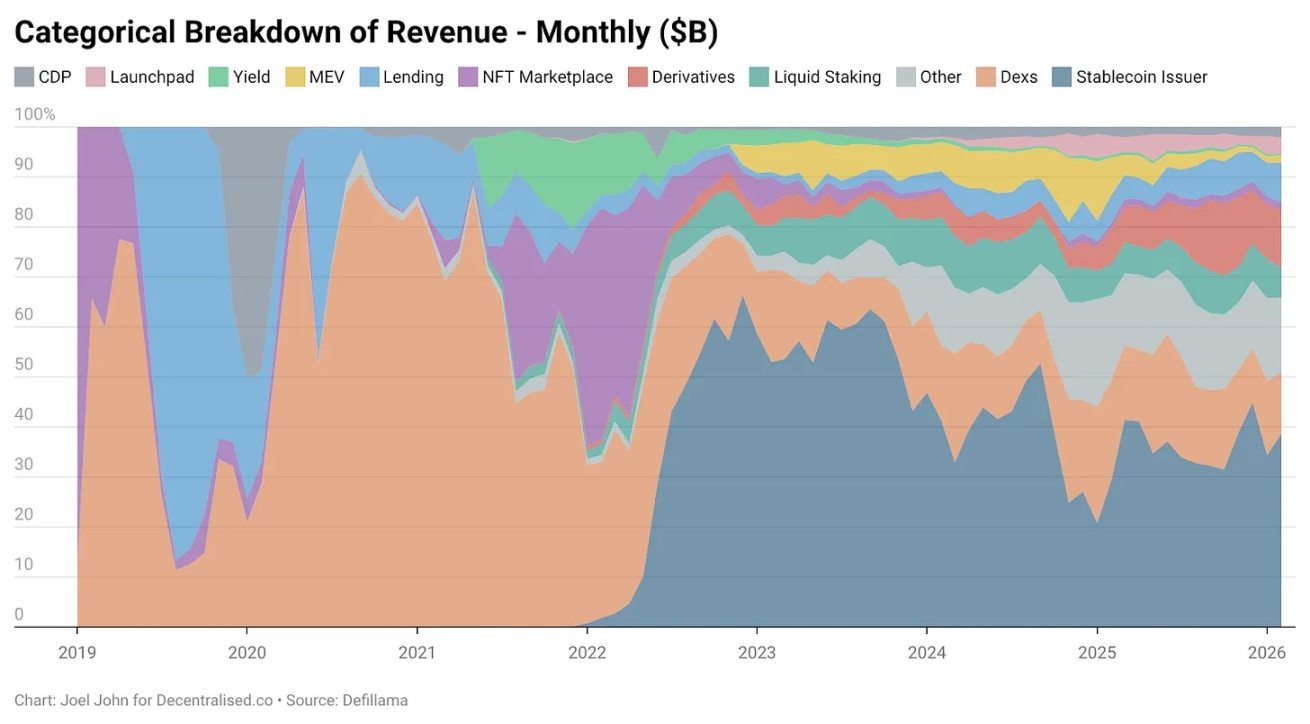
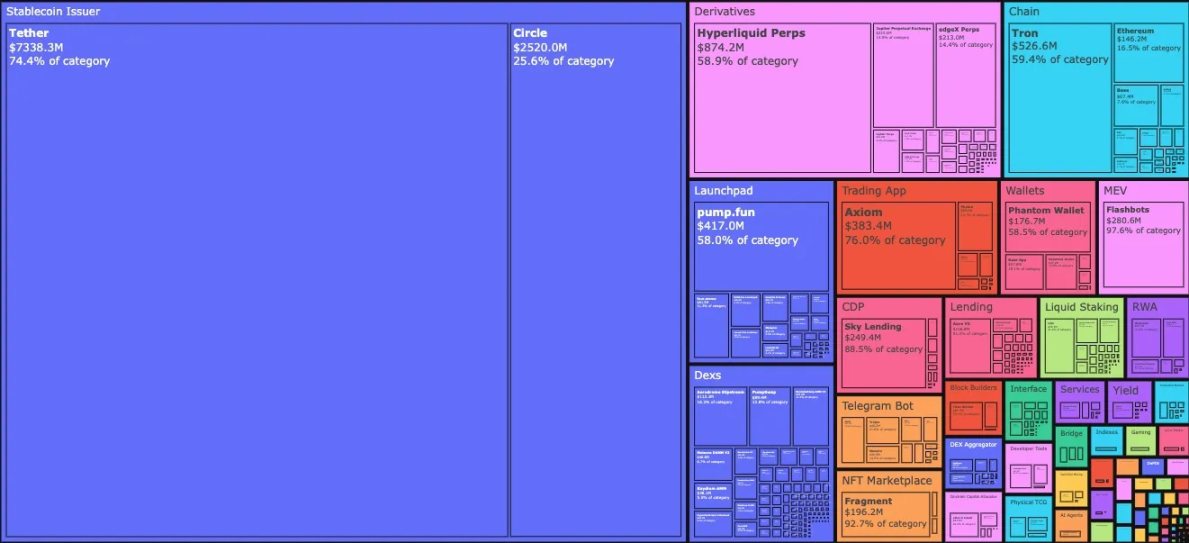
As of January 2026, stablecoin issuers Tether and Circle captured 34.3% of all industry fees. Put simply: For every $1 the industry earns, $0.34 flows to these two firms. Their revenue more than doubled—from $4.95 billion in early 2023 to $9.89 billion in 2025—almost entirely driven by U.S. Treasury yields.
This is banking-grade finance, scaling at startup velocity. Tether’s revenue is nearly three times Circle’s.
Their rise stems from two forces:
- Demand
The Global South has long needed tools to hedge local inflation and move capital freely. The U.S. dollar—even in digital form—fills that gap where local currencies cannot. Capital flight isn’t a feature—it’s a necessity.
- Cost structure
Blockchains handle the operational layer of stablecoin issuance. Unlike traditional banks or fintech firms, Tether and Circle don’t need to hire proportionally as issuance scales. Issuing another $1 billion on-chain—or transferring $100 billion across addresses—incurs near-zero marginal cost.
Demand pulls; costs compress. Together, they make stablecoin issuance one of the most capital-efficient businesses in financial history.
Stablecoins’ moat lies in liquidity, compliance, and first-mover advantage. Only a handful of issuers have survived multiple cycles.
Tether and Circle capture nearly 99% of stablecoin issuance revenue. Why? Because they launched first. Network effects from integrations across dozens of exchanges deliver legitimacy that code alone cannot replicate. Tether debuted slowly and clunkily on the Omni sidechain—but it was accessible everywhere: OTC desks, exchanges, and beyond.
That’s a distribution moat—not a technical one. It’s a barrier crypto-native founders can rarely replicate with code alone.
New Growth Engine: Trading Apps Explode
Our prior piece noted that crypto is fundamentally a trading economy. But we underestimated how fast Telegram-based trading bots and embedded trading interfaces would scale.
In January 2025 alone, those two categories generated $575 million in fees. The reason is simple: This is what users actually want.
Meme coin trading and perpetual futures exchanges let users profit quickly. To chase outsized returns, they willingly pay steep fees.
From 2022 to 2025, this category surged from just 1% of total revenue to over 15%.
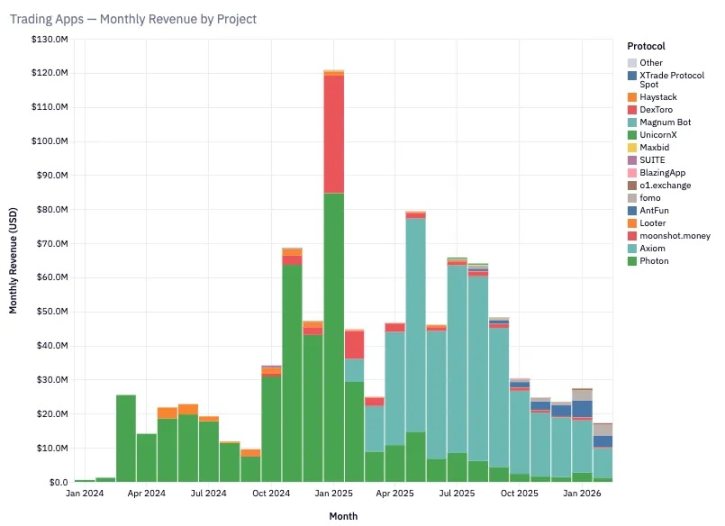
Products like TryFomo and Moonshot—focused squarely on end users—have earned millions. Technically undemanding, their edge lies in aggregating and packaging crypto-native primitives into superior user experiences. With tools like Privy matured, developers no longer need to bootstrap liquidity or manage wallets. The foundational primitives we celebrated in 2022 are now robust infrastructure—upon which apps like BullX and Photon are built.
From January 2024 to February 2026, this category generated $1.93 billion in fees. But meme assets suffer a fatal flaw: They’re lightweight applications—highly seasonal.
Does this sound familiar?
NFTs and Web3 games followed similar explosive trajectories—then collapsed. This cyclicality is both the industry’s bug and its feature.
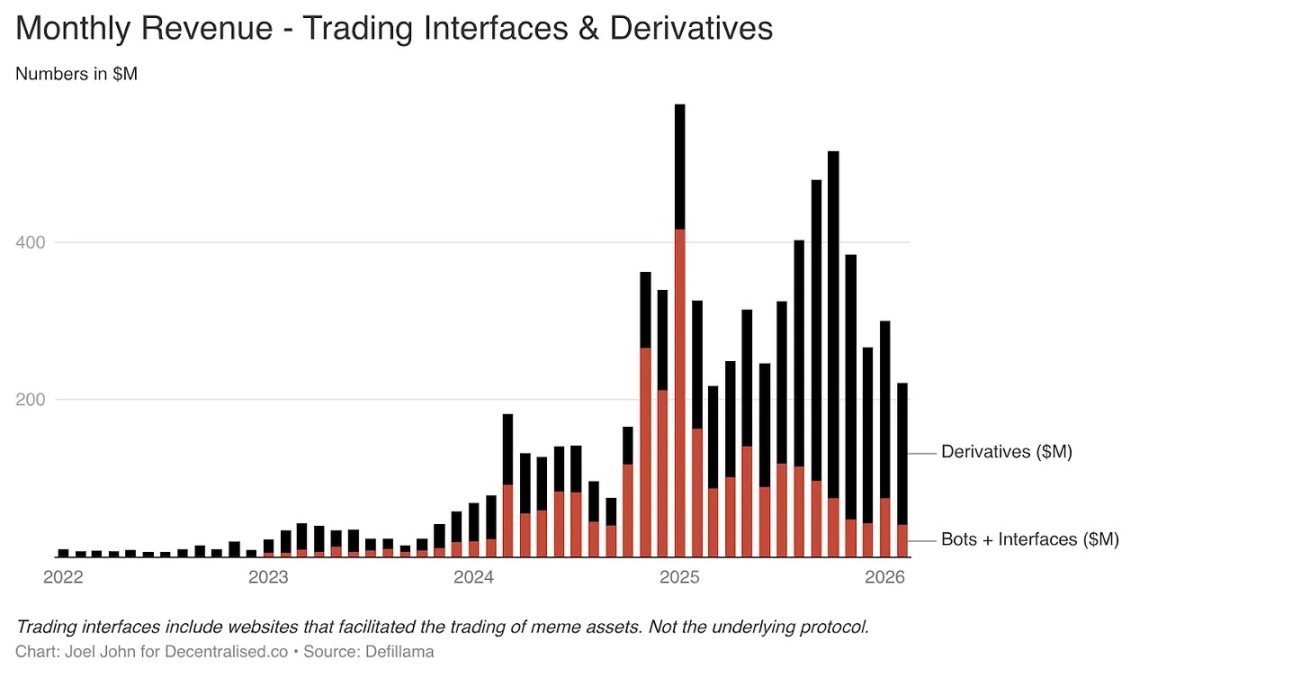
Perpetual futures exchanges—and later, prediction markets—represent a more durable new direction.
PumpFun democratized asset issuance via memes—but the game wasn’t fair. Markets eventually sobered up: Meme coins die.
The dream of getting rich overnight by buying a joke token has shattered. Users don’t want to manage random tokens—they want risk exposure.
Perpetual futures deliver precisely that.
You can trade Bitcoin, Solana, or Ethereum with high leverage. Market makers and traders seeking alternatives to centralized venues flocked in. Liquidity is the core of this category.
Hyperliquid leads because its order book depth rivals centralized exchanges. Without that parity, users have no reason to migrate. Over the past three years, Hyperliquid and Jupiter have captured most of this category’s fees.
Perpetual exchanges and trading platforms have ripped off crypto’s veil: Real profits come from extracting micro-fees from high-frequency trading. Meme trading platforms and perpetual exchanges are “dopamine machines”—packaging and selling risk. Some will mature into core financial infrastructure—enabling weekend trading of commodities, equities, and digital assets worldwide.
Blockchain-native apps are replicating what Robinhood and Binance offered years ago: risk conduits.
Hungry Fat Protocols: L1s and DeFi Valuations Plummet
So far, I haven’t mentioned base-layer blockchains—because their story is entirely different: They were victims of novelty premiums, now sliding into discount territory.
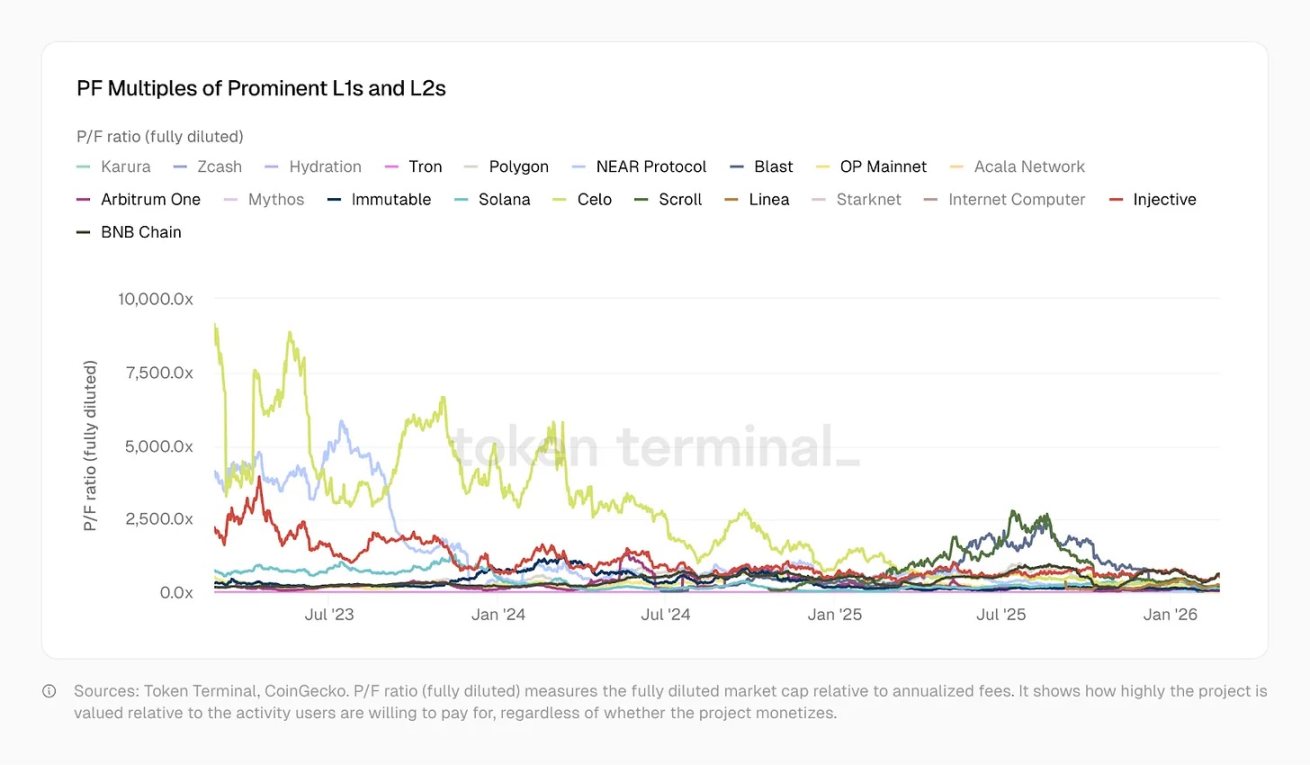
January 2023:
- Optimism Price-to-Fee (PF) ratio: 465x
- Solana: 706x
- Arbitrum and BNB Chain: ~206x
Today:
- Solana: 138x
- Arbitrum: 62x
- OP: 37x
- Polygon: just 20x—close to traditional fintech companies
- Tron—powering the stablecoin ecosystem—only 10.2x
These chains have supported increasingly sophisticated products, attracted more users, deepened liquidity, and enriched financial applications. Yet their PF ratios have collapsed—reflecting a fundamental shift in market sentiment.
Historically, Layer 1s and Layer 2s commanded massive valuation premiums over standalone infrastructure. If deployed wisely, that premium could have funded new economies and empowered developers building genuinely useful applications. But open-source + tokenization proved too easy—leading to fifty homogenous projects across thirty chains, with poor interoperability.
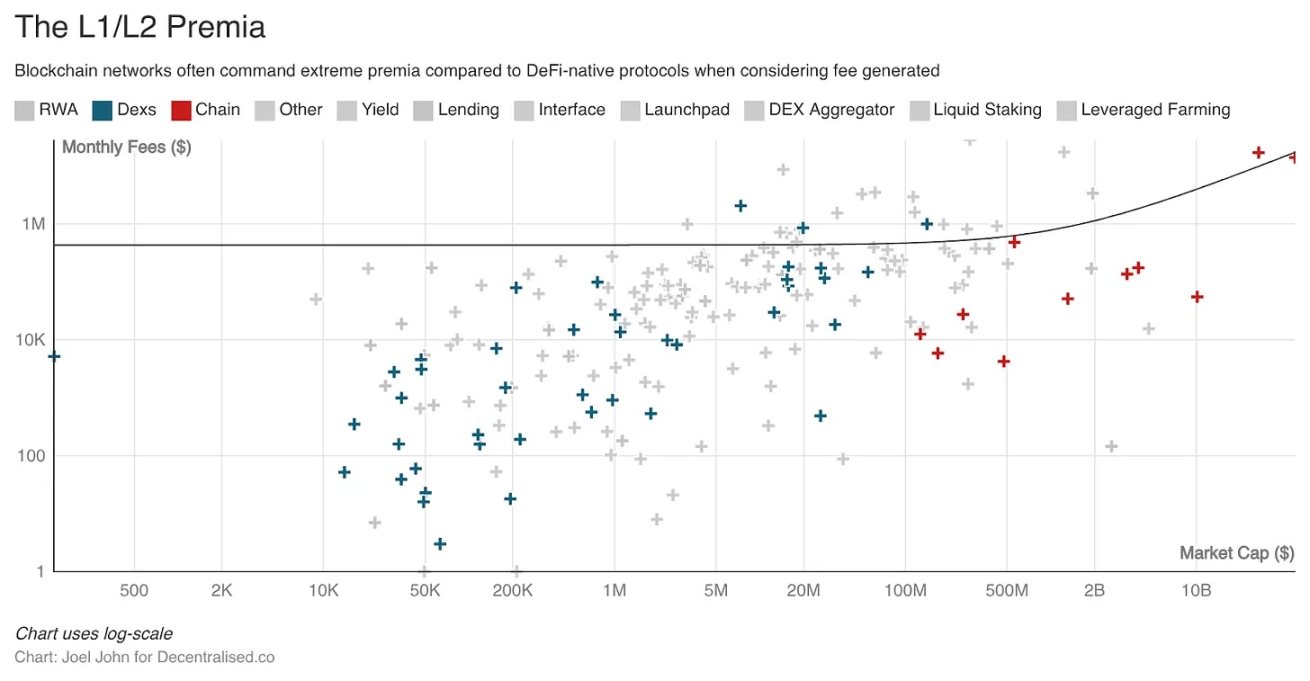
DeFi primitives fared even worse.
With too many choices and fading novelty, valuations halved—even as economic activity grew.
Kamino, Euler, Fluid, Meteora, and PumpSwap all launched with PF ratios far below 2022 levels. Some DEXs now trade at PF ratios as low as 1x.
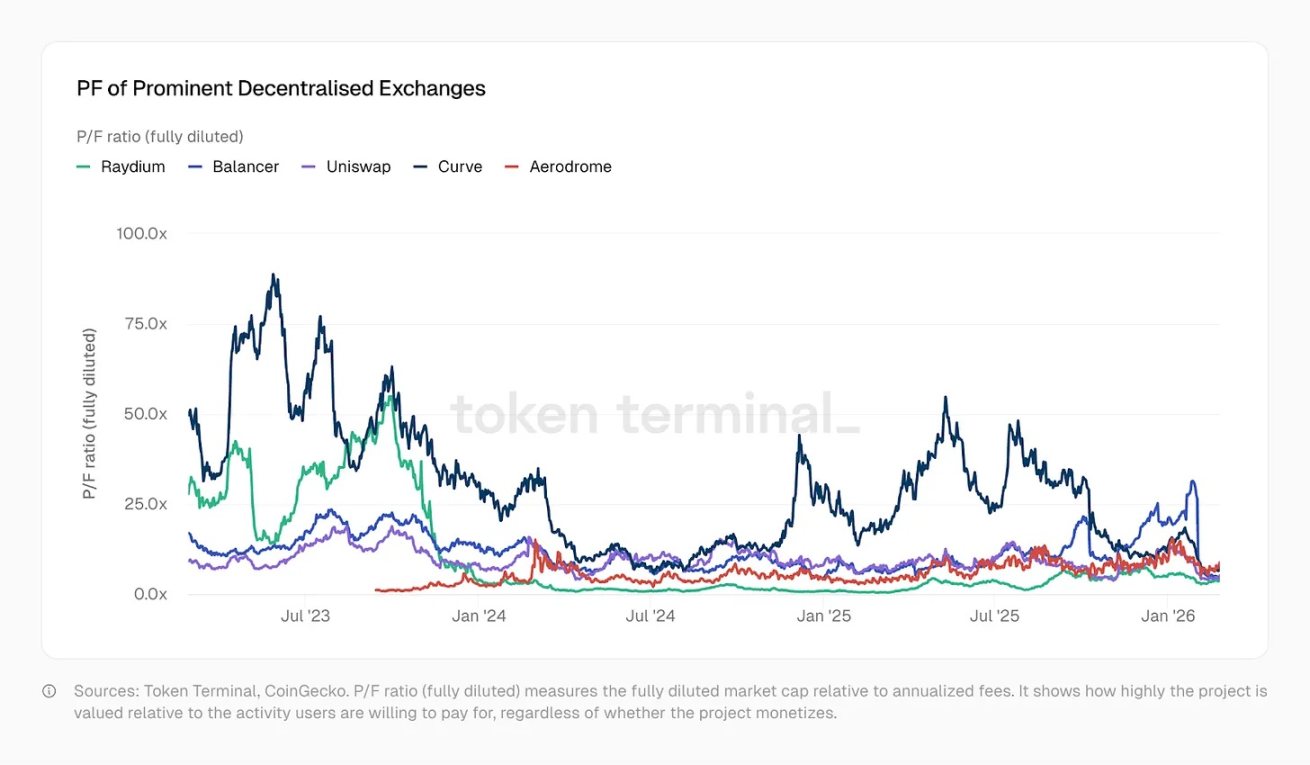
That means the market values them *below* their projected fee revenue for the next 12 months.
A paradox emerges: Underlying protocols (DeFi primitives, L1s) see collapsing valuations—while applications built atop them earn more, faster.
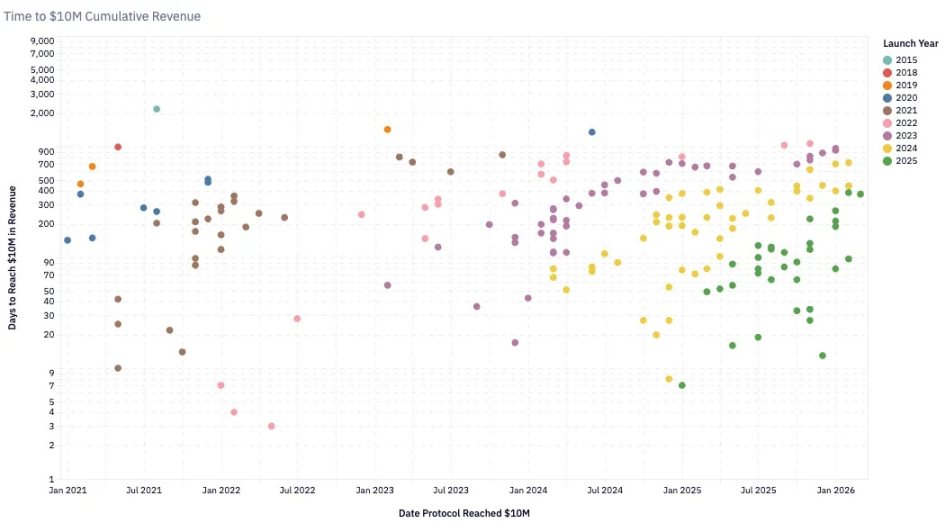
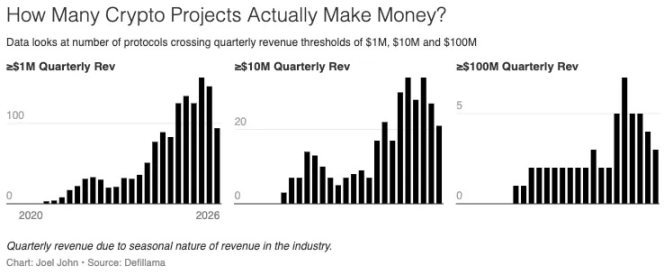
The number of teams generating >$1M in quarterly revenue has steadily risen—now exceeding 100.
In 2020, hitting $10M annual revenue took a protocol 24 months—a fast pace. By 2024, it took just ~6 months. Pump.Fun, launched early in 2024, hit $10M in revenue in only ~2 months—a record.
This acceleration reflects maturing infrastructure (faster, cheaper) and expanding on-chain capital chasing yield and entertainment.
For builders and founders, the facts are stark:
- Nearly 900 protocols are now profitable;
- Competition for median revenue slices shares thinner—but the total number of profitable teams grows;
- Median monthly revenue has fallen to $13,000.
Three Moats of the Crypto Industry
Blockchain-native businesses possess three types of moats:
- First-mover advantage
Tether and Circle’s early network effects are nearly impossible to replicate. Having survived multiple cycles, they’ve formed a duopoly. Their businesses are non-tokenized and deeply financialized. Tether is a centralized entity whose revenue derives primarily from U.S. Treasuries.
- Liquidity moat
In an industry where capital relentlessly chases yield, Aave has maintained deep liquidity across cycles. Hyperliquid is replicating this—but remains unproven. These protocols return capital to liquidity providers and optimize token governance.
- Distribution moat
Seasonal applications like meme coin trading platforms rely on capital turnover and user demand. Web3 games and NFTs fall into this category too. As AI boosts productivity, lean, focused teams can ship consumer-facing products faster. Core competency shifts to acquiring and retaining users during bull runs.
Products built on distribution moats may achieve massive value—but they’re outliers, not the norm. Traditional startups derive value from replicable experience—like Y Combinator. But crypto iterates too rapidly for such experience to crystallize.
That’s why founders struggle to replicate success in consumer-facing products.
Cyclical tailwinds that once fueled explosive growth may not return. That doesn’t mean founders shouldn’t build—but short-term, high-cashflow opportunities like prediction markets or data services for intelligent economies deserve attention.
But understand this: It’s a high-turnover, short-term game—not necessarily sustainable. The trap lies in raising blindly—or clinging to an obsolete token after the hype fades.
Questioning Governance: The Soul-Searching Question of Token Value
In 1999, many tech stocks traded at P/S multiples of 10–20x. Akamai briefly hit 7,434x—then fell to 8x by 2004. Scores of firms dropped from 30–50x to sub-10x.
The dot-com bubble burst, vaporizing trillions in speculative value. Yet many companies survived—because their businesses were real.
Amazon lost 94%—then became one of the world’s most valuable companies. Crypto is undergoing the same valuation compression—only faster.
In 2020, DeFi remained experimental—generating just $21M in annual revenue, yet commanding a market-wide P/S ratio of 40,400x.
Markets were full of fantasies about “what could be.”
In 2021, DeFi Summer turned revenue into hard numbers—slashing P/S to 338x. Today, annualized revenue stands at $18B, with P/S at ~170x. In five years, the ratio compressed from 40,400x to 170x.
But here’s the critical question:
Visa trades at ~18x P/S—with shareholders entitled to dividends, buybacks, legally enforceable income rights, and governance rights. Aave trades at ~4x P/S—but token holders historically had only governance rights, gaining direct economic rights only recently. Hyperliquid uses a rescue fund to buy back HYPE tokens—bringing holders closest to traditional equity ownership. Aave approved a $50M annual buyback program in 2025.
These are meaningful steps—but exceptions.
Across the market, most protocols lack mechanisms to return value to token holders. Valuations may look cheap—but attached rights are vastly weaker than in traditional markets. These valuations hold only because the industry’s revenue scale and efficiency dwarf traditional commerce.
Protocols compressing crypto’s P/S ratio aren’t thousands-strong organizations. They’re small teams operating global financial infrastructure—near-zero marginal cost, no physical footprint.
Breaking it down by sector clarifies further:
- Aave: P/S ~4x
- Hyperliquid: P/S ~7x
- These are no longer bubble valuations—even falling below traditional peers:
- Coinbase: ~9x
- CME: ~16x
- Visa: ~15x
Will Clemente told us on our podcast: Crypto is purest capitalism. No industry sees per-employee profitability approaching Tether’s—~125 employees, ~$12.5B annual revenue, ~$100M per employee annually.
Compare:
- NVIDIA: $5.2M per employee
- Apple: $2.4M
- Google: $2.0M
Tether’s efficiency may be unmatched in corporate history. Though the overall 170x P/S looks wild, the market isn’t irrational about truly profitable protocols—their pricing equals or undercuts traditional financial infrastructure.

Which leads to the next question: What, exactly, is a token *for*?
In many categories, tokens are powerful tools for aligning capital toward shared visions. Crypto has now entered a phase of entrenched duopolies.
Traditionally, founders needed debt or equity financing to fund financial products. Hyperliquid, Uniswap, Jupiter, and Blur proved: With token incentives, individuals willingly provide capital for new products.
If tokens confer governance rights, those contributors can participate deeply in protocol governance.
Tokens may evolve into two core functions:
- Coordinating capital and resources from the right participants
- Granting them governance authority over the protocol
Pure tokens no longer hold value. Even stocks can now be tokenized. These instruments must embed *both* economic rights to revenue *and* governance rights to steer protocol evolution. Many L1/L2 tokens fail on both counts.
Teams and VCs hold most tokens; retail holders are fragmented. Ordinary users have little reason to care about newly launched assets. The industry is fracturing. MetaDAO allows investors full refunds if teams misrepresent facts—but no major protocol has adopted it yet.
Crypto’s core reckoning is this: Traditionally, tokens granted holders too few rights. Now protocols are answering an age-old question: Why should anyone hold these things?
Crossroads: Crypto’s Next Era
Over the past two decades, capital markets have grown increasingly interwoven—largely thanks to technological progress.
We can trade commodities, foreign indices, digital assets—and soon, even compute (GPU). Blockchains enable 24/7 global trading across these markets. Nasdaq and NYSE moving toward round-the-clock trading exemplifies how technology reshapes the spirit of the age.
We live in a hyper-financialized world.
For founders, this means rethinking what to build—and how. The data is unequivocal: All blockchain products ultimately monetize via two models:
- Extracting micro-fees from high-frequency trading
- Charging premium fees for transactions requiring verifiability and trust
Core competitiveness lies either in transaction speed or verifiable transparency. Profit-seeking is the purest motive of capital market participants. Markets inevitably converge on maximum efficiency—we see proof in sectors where two players command 70% of market share.
For founders: Capital once directed toward your token will now flow to assets offering higher volatility and ROI. Long-term capital still exists—and even pays premiums—but only for demonstrable business value.
Investors in Google or Amazon don’t panic-sell because their businesses are intrinsically valuable. In an era where even software’s intrinsic value is questioned, blockchain-native applications must forge new paths to value.
We can re-engineer tokens—or even tokenize startup equity. But this isn’t just a token problem—it’s a business model problem.
The vast majority of long-tail blockchain applications—Web3 social, identity, gaming—have failed to scale or meaningfully differentiate from legacy alternatives. It’s not that these experiments lacked merit—it’s that we failed to commercialize them effectively.
The infrastructure era of crypto is over. Ahead lies deep integration with the internet.
No one says “online business” anymore—you simply exist on the internet. No one calls themselves a “mobile app developer”—you’re just a developer.
The era of the crypto enthusiast is over. We are ledger maximalists—focused on identifying the best uses for these ledgers.
Join TechFlow official community to stay tuned
Telegram:https://t.me/TechFlowDaily
X (Twitter):https://x.com/TechFlowPost
X (Twitter) EN:https://x.com/BlockFlow_News
 @Decentralisedco


