xAI's Trump Card: Why Grok-5 Could Become the Strongest Model by 2026?
TechFlow Selected TechFlow Selected
xAI's Trump Card: Why Grok-5 Could Become the Strongest Model by 2026?
Musk isn't just building a large language model; he's creating the entire ecosystem for AI to survive and operate.
 Navigating Web3 tides with focused insights
Author: Ejaaz
Translation: TechFlow
TechFlow Editorial: This article is a direct rebuttal to recent criticisms of xAI. The author systematically argues from four dimensions—computing power, data, distribution channels, and physical AI—why xAI could surpass all competitors by 2026.
The core argument is straightforward: While others are still debating model architecture, Musk is already building his own power grid, airlifting gas turbines, and feeding data via Tesla robots. This is an analysis with a clear stance—one worth reading.
The article continues below:
Lately I've seen too many criticisms of xAI. This piece aims to set the record straight.
I’ll break down one key judgment systematically: Grok 5, which xAI is about to release, won’t just catch up with rivals—it will leapfrog them entirely.
Let’s not forget—we’re talking about a company founded just two years ago. Yet they built the world’s largest supercomputer in 122 days (which normally takes four years), achieved 600 million monthly active users, and possess something no other AI lab has—a physical embodiment (yes, autonomous robots).
Enough preamble. Let’s dive in.
Musk Is Building His Own Power Grid
By 2026, xAI's advantage in computing power will be overwhelming. Their current real-time compute capacity—around 500,000 GPUs—already exceeds the combined total of Anthropic and Meta.
And it doesn’t stop there. With Colossus I and II, Musk plans to bring online 900,000 GPUs by Q2 2026. The recently announced Colossus III (yes, another new data center already under construction) is expected to reach 1 million GPUs upon completion, representing a total investment of $35 billion.
How can anyone else possibly keep up?
It’s not just about how much money was spent or hardware stacked—it’s *how* they pulled this off. Check out this post:
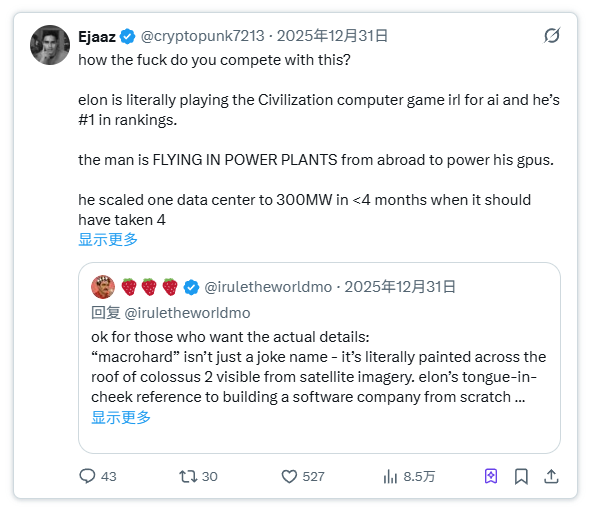
Elon is literally airlifting gas turbines to power data centers because the grids in Tennessee and Memphis simply can't handle the load. These turbines alone can support an additional 600,000 GPUs.
He’s choosing to completely bypass state-level power infrastructure (which would take years to upgrade) just to accelerate model training. On top of that, he’s deployed approximately 250MW of Tesla Megapack battery storage to manage peak demand when the grid falls short.
This combination of forward-thinking strategy and blistering execution speed is giving xAI a massive lead in compute over its competitors.
You have to understand—the regulatory approvals, talent recruitment, logistics operations involved at this scale have never been successfully managed before. xAI not only pulled it off, but made it look effortless.
If the assumption “more compute = stronger models” holds true (and so far, it clearly does), then the rumored 7-trillion-parameter Grok 5 will be a monster. For comparison: Grok 4 had 3 trillion parameters—this more than doubles it.
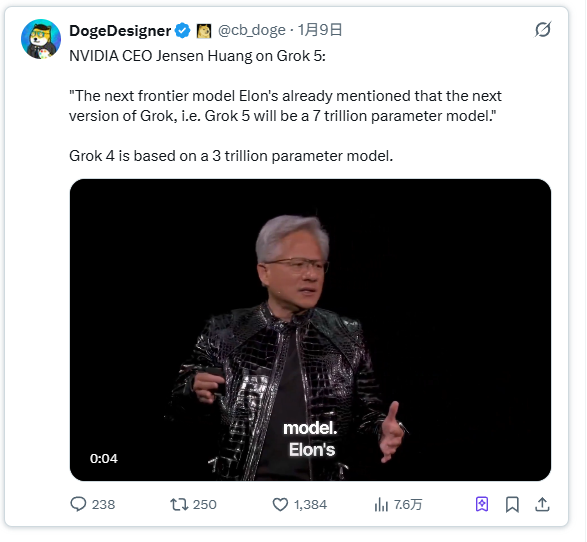
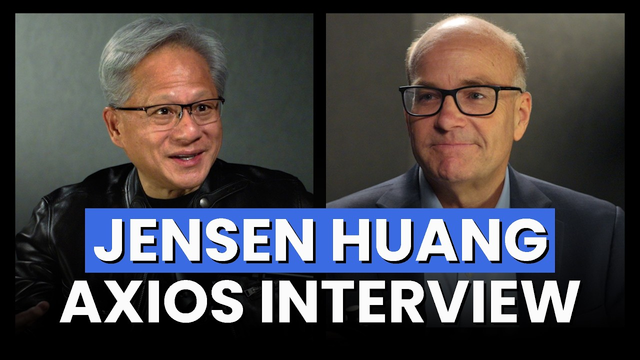
NVIDIA CEO Jensen Huang on Grok 5:
“Elon has mentioned the next frontier model—the next version of Grok, Grok 5—will be a 7 trillion parameter model.”
The infrastructure race is already over.
There isn’t even a competition anymore—xAI has already won. Their strategy is “build first, ask questions later.” Unless other labs catch up, xAI’s models will remain ahead indefinitely.
X’s ‘X Factor’: Unlocking Personal AI
xAI leads in compute, but top-tier models also need vast amounts of data.
Not just any data. AI labs are increasingly realizing that real-time data is the key to unlocking personalized AI—an AI that deeply understands your desires and goals, acting before you even think.
Google’s latest product launch, “Personal Intelligence,” is the clearest signal yet that models are ultimately heading in this direction. But here, xAI holds a unique advantage Google lacks:
A social media platform feeding them over 100 million posts per day.
This means more than 100 million pieces of text, images, and videos available to train Grok, enabling it to:
- Capture real-time trends and breaking news
- Understand viral dynamics, trends, and human behavior at scale
- Perceive the global cultural pulse in real time
Other models can tell you what happened. Grok can tell you what happened—and how people feel about it—faster than anyone else.
This capability has real value.
If we assume users derive 10x more value from a customized AI compared to a general-purpose large model, X’s moat becomes nearly unassailable.
It’s not just about data—X’s distribution power is insane too:
- 70 million daily active users
- 600 million monthly active users
- An “Ask Grok” button next to every post
It’s easy to imagine xAI integrating real-time prediction markets, shopping, banking, dating, and more into a single app—all powered by Grok.
Most AI labs today are valued based on GPU counts, benchmark scores, and reputation. xAI has all of that—but also has the potential to dominate multiple internet monopolies. Don’t forget: their goal is to become the “everything app.”
Today, X’s recommendation algorithm runs on Grok, analyzing every post for suggestions. Tomorrow, it will deliver personal intelligence services to every user.
Grok is clearly not just another standard LLM—its valuation should reflect that.
Physical AI Advantage: xAI Is the Most Forward-Thinking Lab
That robots will profoundly impact the world in the next five years is no longer a secret. The technology has finally matured.
From factory labor to last-mile delivery, from fast food chains to elite surgeons—robots will either assist or fully replace humans across these domains.
The viral Boston Dynamics videos from over a decade ago have snowballed into autonomous fleets and (surprisingly) impressive humanoid robots. To be honest, when you think of these two things now, only one company comes to mind: Tesla.
A car that drives better than a human is no longer fantasy. The latest v14.2.2.3 update technically makes Tesla vehicles superior drivers. Once regulations allow, self-driving Teslas will be everywhere, transporting people autonomously.
Likewise, a humanoid robot capable of carrying your grocery bags and gently wiping your mom’s delicate china is becoming reality. Optimus will begin mass shipments by year-end, entering homes and factories.
What does this have to do with xAI?
Two things:
- Machines need brains—Tesla uses Grok as theirs.
- Grok needs diverse data sources to understand the world—and those come from Tesla’s robots.
This symbiotic relationship gives xAI an almost unfair edge over competitors. Arguably, only Google can compete at this level—but even they’re behind.
Today, Grok already powers Tesla vehicles—the latest update lets you ask Grok to drive you somewhere, play music, and narrate Roman history—all at once.
Conversely, Grok is now receiving video data from Tesla cameras, distance data from sensors, and more—helping it understand real-world physics, visual perception, and navigation.
All this data strengthens Grok’s broader capabilities, such as generating more physically accurate video content.
We must acknowledge: Musk is playing five-dimensional chess. He’s not just building a large language model—he’s constructing the entire ecosystem in which AI lives and operates.
At this point, I admit—it all sounds incredible, even overly ambitious… which brings us to the final section:
Yes, There Are Risks
Everything carries risk. Maybe managing five companies is Elon’s limit—six might be too much… but I doubt it. If there’s one person who has repeatedly proven skeptics wrong, it’s him.
Call me crazy—I don’t care. The fact that he’s achieved what he has is itself nearly impossible.
I see three main risks:
The King of Controversy — Elon and headlines go hand-in-hand. He’s currently embroiled in a $130 billion lawsuit with OpenAI and under investigation by EU and Indian regulators. Who knows—maybe he’ll do something outrageous and derail the whole vision.
Execution Risk — xAI burns through around $1 billion per month. That’s a huge burn rate. And Elon runs five companies (not counting Starlink).
Scaling Laws — xAI is betting everything on “more compute = stronger models.” But if a fundamentally better training architecture emerges, this assumption collapses. Andrej Karpathy has repeatedly said he believes large language models aren’t the final form.
That’s it! I feel people have unfairly criticized xAI’s efforts to push the frontier of intelligence lately—and seem to have forgotten they remain a formidable force.
Hope this article changed your mind. Thanks for reading.
Join TechFlow official community to stay tuned
Telegram:https://t.me/TechFlowDaily
X (Twitter):https://x.com/TechFlowPost
X (Twitter) EN:https://x.com/BlockFlow_News
 @cryptopunk7213